

OPERATIONAL ARCHITECTURE
How is authority operationalized? — The Strategic Stage of Cloud Strategy
MATURITY POSITION — CLOUD ARCHITECTURE STAGE 05 OF 07
- Current Stage: Strategic — Maturity Stage 05 of 07
- Primary Architectural Concern: Identifying whether the authority established at CS4 is capable of producing consistent operational behavior — whether schedulers, deployment pipelines, service mesh policies, platform APIs, and automation workflows execute as the authority model intends
- Primary Failure Mode: Authority Without Execution — the condition where authority is defined and owned but never reaches the systems that act; execution proceeds on inherited defaults, stale configuration, or prior automation
- Stage Outcome: Ability to identify where the Operational Authority Boundary sits; ability to diagnose whether authority is reaching the execution plane; ability to map Automation Drift as an active governance risk before it surfaces as an incident
- Previous Stage: CS4 — Control Plane Architecture — What governs the architecture?
- Next Stage: CS6 — Strategic Governance — Who governs authority?
Operational architecture is the discipline of verifying that authority defined through governance structures, ownership models, and policy frameworks is actually capable of producing consistent behavior in the systems that execute work. The question this stage answers is not who governs — CS4 answered that. The question is whether that governance reaches the execution plane at all.
The first four stages of this path read the architecture from constraints to authority. CS1 mapped what exists and what the organization is bound to. CS2 mapped what those dependencies prevent from moving. CS3 read what movement constraints cost — and identified the point where cost becomes a deciding structural force. CS4 identified where authority resides: which systems can authorize, deny, enforce, or override architectural decisions, and where the formal ownership record and the operational reality diverge. Operational Architecture is where that map gets tested. An authority model that cannot reach schedulers, deployment pipelines, or runtime enforcement systems is not a governance structure — it is documentation. CS5 is where the difference between the two becomes visible.
WHY THIS STAGE EXISTS — AUTHORITY WITHOUT EXECUTION
Cloud architectures rarely fail because authority is undefined. They fail because authority never reaches the systems that execute work.
CS4 identified where authority resides. CS5 evaluates whether that authority is capable of producing operational behavior.
This stage evaluates authority reaching the execution plane inside a single control plane. The Cloud Arbitration Layer — Framework #166 — picks up the adjacent question: what happens when an unplanned authority tier forms above and across several control planes that this stage’s execution-verification model never anticipated arbitrating between. Additive, not competing — #166 assumes CS5’s question is already answered.
Stage Anchor Question
How is authority operationalized?
Architectures are not governed by the systems that own decisions. They are governed by the systems capable of executing them — and the gap between ownership and execution is where most operational authority failures originate.
How Operational Architecture Anchors the Full Path
| Stage | Name | Question |
|---|---|---|
| 01 | Dependency Architecture | What are we dependent on? |
| 02 | Movement Architecture | What controls our movement? |
| 03 | Economic Architecture | What determines our economic structure? |
| 04 | Control Plane Architecture | What governs the architecture? |
| 05 | Operational Architecture | How is authority operationalized? |
| 06 | Strategic Governance | Who governs authority? |
| 07 | Strategic Resilience | How does authority survive failure? |
The first three stages establish what exists, how it moves, and what it costs. CS4 identifies where authority resides. CS5 tests whether that authority executes. CS6 governs who holds it. CS7 asks how it survives failure. Every control plane is ultimately judged by its execution plane — and CS5 is where that judgment begins.
Stage Anchor Framework — Operational Architecture
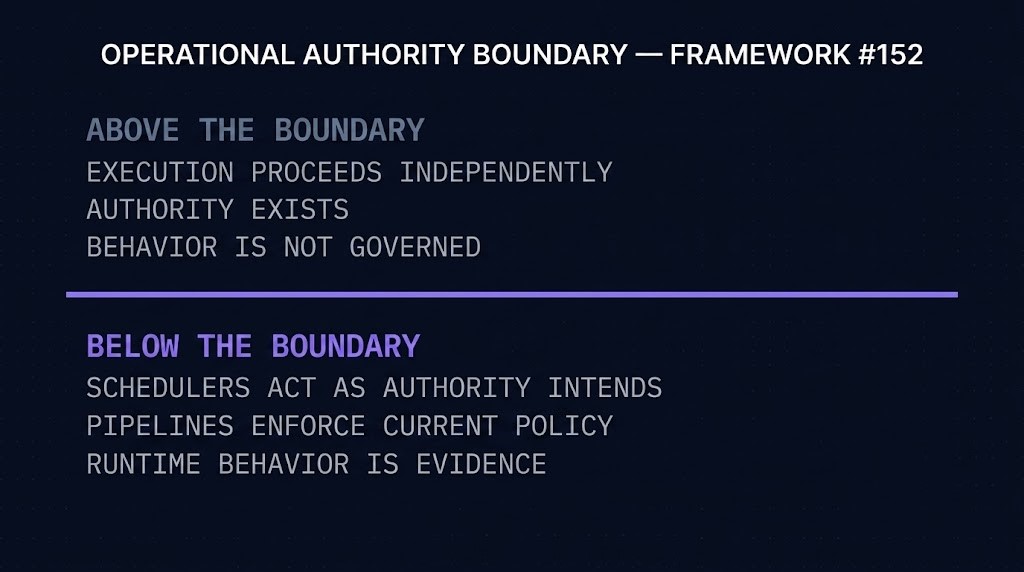
Operational Authority Boundary (#152)
The point at which authority defined through ownership models, policies, and governance structures must translate into executable operational behavior. Below the boundary: authority is expressed through schedulers, deployment pipelines, service mesh policies, platform APIs, and automation workflows — the execution plane acts as the authority model intends. Above it: execution proceeds independently of the authority that nominally governs it; authority exists, but execution does not follow it. Every execution system below the boundary becomes evidence of whether authority is actually functioning.
Named Failure State: Authority Without Execution · Indicators: governance structures and ownership models exist but execution systems operate on inherited defaults · pipeline gates are configured but not enforced against the current authority model · scaling and scheduling systems respond to capacity signals rather than authority signals · automation continues executing a prior model without detection
Why Architects Misjudge Operational Authority
Governance documents are mistaken for execution systems. Policies, standards, and ownership models describe what authority intends. They are not execution planes. Each governance document requires translation into scheduler logic, pipeline gate configuration, service mesh policy enforcement, and platform guardrails before it can produce operational behavior. A policy that has not been translated is still a description of intent — it governs nothing until an execution system acts on it.
Execution system presence is mistaken for authority execution. Kubernetes, a service mesh, and a CI/CD pipeline are execution systems. Their presence does not mean authority reaches them. Each system can operate on inherited defaults, stale policy states, or configuration that predates the current authority model by months or years. Deploying an execution system is a distinct event from confirming that the system is executing current authority. Organizations consistently conflate the two — and discover the gap during incidents.
Automation is treated as a solved problem once deployed. Automation continues executing after the authority model that created it has changed. A pipeline deployed under one policy regime will run indefinitely under the next unless explicitly re-verified. Autoscaling behavior configured for one workload authority model will apply to workloads operating under a different model. Platform guardrails implemented for a prior security posture will enforce a prior posture until someone confirms they no longer should. This is Automation Drift — and it produces governance failures in systems that appear stable precisely because they never stop executing.
What This Stage Is Not
Not a Kubernetes administration guide. CS5 reads schedulers, autoscalers, resource controllers, and orchestration layers through the authority-execution lens — which scheduling decisions represent authority, whether resource limits enforce the policy model the organization has adopted, and whether the scheduler can act on what the authority model intends. Kubernetes configuration and operational mechanics are covered in the articles this stage sequences; they are not this stage’s subject. This stage’s subject is what those systems reveal about whether authority executes.
Not a platform engineering tutorial. Platform teams matter in this stage because they operationalize authority — they are the organizational layer that translates governance decisions into the pipelines, guardrails, and platform APIs that execution systems act on. How platform teams are staffed, tooled, or structured is a separate question. The architectural question here is whether the platform layer is successfully bridging authority to execution, or whether it has become an intermediary layer that absorbs governance intent without propagating it.
Not AI Infrastructure Stage A5. AI Infrastructure A5 — LLMOps Architecture — asks how AI infrastructure is operated: inference pipelines, model lifecycle, observability at the inference layer. CS5 asks how cloud authority is operationalized: whether the governance model for cloud environments reaches schedulers, deployment pipelines, and runtime enforcement systems. The structural parallel is intentional — both stages sit at the same maturity position in their respective paths — but the subjects are distinct. CS5’s center of gravity is authority, not operations.
Not CS6 — Strategic Governance. CS5 operationalizes authority: it identifies whether the authority model established at CS4 is capable of producing consistent execution behavior. CS6 governs who possesses strategic authority: it addresses decision rights, policy-making legitimacy, escalation paths, and the structures that determine who holds authority over systems that have been confirmed to execute it. CS5 produces the verified execution map that CS6 governs. Without CS5, CS6 is governing an authority model that has never been confirmed to function.
>_ Architecture Maturity Position
| Stage | Name | Maturity Level | Stage Question |
|---|---|---|---|
| CS1 | Dependency Architecture | Foundation | What are we dependent on? |
| CS2 | Movement Architecture | Operational | What controls our movement? |
| CS3 | Economic Architecture | Operational | What determines our economic structure? |
| CS4 | Control Plane Architecture | Strategic | What governs the architecture? |
| CS5 ← YOU ARE HERE | Operational Architecture | Strategic | How is authority operationalized? |
| CS6 | Strategic Governance | Strategic | Who governs authority? |
| CS7 | Strategic Resilience | Resilient | How does authority survive failure? |
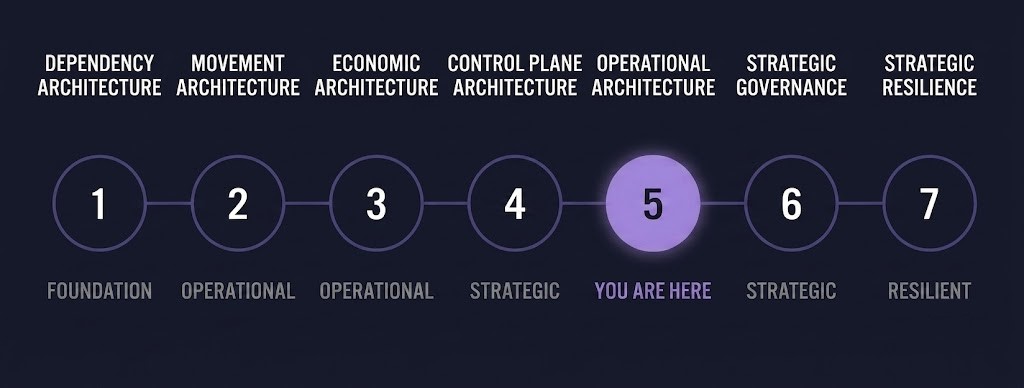
>_ Where This Stage Sits
The Cloud Architecture Path Is a Dependency-Progression Model
| Stage | Architectural Question |
|---|---|
| CS1 — Dependency Architecture | What are we dependent on? |
| CS2 — Movement Architecture | What controls our movement? |
| CS3 — Economic Architecture | What determines our economic structure? |
| CS4 — Control Plane Architecture | What governs the architecture? |
| CS5 — Operational Architecture | How is authority operationalized? |
| CS6 — Strategic Governance | Who governs authority? |
| CS7 — Strategic Resilience | How does authority survive failure? |
The first half identifies constraints — dependency, movement, economics. The second half tests authority — where it resides, whether it executes, who governs it, and whether it survives disruption. CS4 identified where authority lives. CS5 determines whether it reaches the execution plane. Every control plane is ultimately judged by its execution plane.
>_ Where to Enter This Stage
This stage is the correct entry point if CS4 produced an authority map — an identification of which systems govern which decisions — but no model exists for verifying whether execution systems are acting on it. Specifically, enter here if:
- Deployment pipelines, schedulers, or service mesh policies were configured against a prior authority model and have not been re-verified since
- A team can identify who owns a platform but cannot demonstrate that the platform enforces the authority model currently assigned to it
- Autoscaling, resource limits, or scheduling decisions are made by systems operating on inherited configuration rather than explicit current-model policy
- An incident postmortem revealed that an execution system acted outside the authority model — not because authority was unclear, but because authority never reached the system
- Automation that was correct under a previous governance model continues executing under the current one without anyone having confirmed it should
- CS4 produced the map; CS5 is the next question — can the architecture actually execute what that map says it can?
Do not enter this stage expecting a Kubernetes operations playbook or a platform engineering implementation guide. Those are addressed in the articles this stage sequences — they are not what this stage is about. CS5 answers one question: does authority reach the execution plane? The answer to that question is what CS6 governs and what CS7 must preserve under failure.
>_ Stage Reading Sequence
AUTHORITY EXECUTION BEGINS HERE
Operational Architecture reads the execution plane for evidence of whether authority is functioning. The sequence moves from operationalization — how decisions become actions — through the specific systems that translate authority into runtime behavior, to the enforcement layer, to how authority behaves under workload change, and finally to diagnostics: how to verify authority is executing before an incident does it for you.
Note: certain control-plane articles appear in both CS4 and CS5. The same article reads differently through the authority-identification lens (CS4) and the authority-execution lens (CS5). Stage pages are curricula — they frame articles through the stage’s architectural question, not through the article’s original context.
Architectural question: How do decisions become actions?
How do decisions become actions?
Authority defined at the governance layer must travel through an intermediary before it reaches execution systems — and that intermediary is the platform layer. This cluster covers how platform engineering operationalizes authority: the structures, pipelines, and organizational models that translate governance intent into the repeatable behavior execution systems can act on. When the platform layer absorbs governance intent without propagating it, Authority Without Execution is the result.
Architectural question: Which systems translate authority into behavior — and what happens when they cannot?
Which systems translate authority into behavior — and what happens when they cannot?
Execution systems are the point where authority becomes observable. The scheduler decides what runs, where, and under what constraints. The controller enforces desired state. When those systems cannot act on the authority model they nominally operate under, the architecture experiences Authority Without Execution — not because authority was absent, but because the execution system could not carry it. This cluster pairs the mechanics of how execution systems work with a concrete failure case that demonstrates exactly what Authority Without Execution looks like at the scheduler level.
Architectural question: How is authority enforced after deployment?
How is authority enforced after deployment?
Deployment is not enforcement. Authority that reaches the deployment pipeline but stops at the container boundary is not operational authority — it is deployment authority. Runtime enforcement is the layer where policy intent meets actual traffic behavior, actual resource consumption, and actual workload boundaries. This cluster covers the two primary enforcement surfaces: service mesh policy, which governs how services interact at the network layer, and resource limits, where the gap between declared policy and kernel enforcement is where runtime drift originates.
>_ Cloud Operational Architecture Failure Patterns
Architectural question: What happens to authority when workloads scale, move, or evolve?
What happens to authority when workloads scale, move, or evolve?
Authority is not tested at steady state. It is tested when workloads change — when they scale out, when they resize, when they migrate across node pools or availability zones, when demand patterns shift the resource model the scheduler was operating under. This cluster reads autoscaling systems as authority systems: the choice between VPA and HPA is not a capacity decision, it is an authority decision about which system is permitted to resize a workload and under what conditions. Scaling divergence is what happens when that authority decision was never made explicitly.
>_ Live Diagnostics
Architectural question: How do you verify that authority is actually executing?
How do you verify that authority is actually executing?
The stage’s synthesis cluster — a structured diagnostic process for verifying that authority reaches the execution plane. Where do scheduler configuration, pipeline gates, mesh policies, and autoscaling behavior align with the current authority model, and where do they diverge? Which divergences are tolerable, and which are Authority Without Execution waiting for the right workload change or governance audit to expose it? This cluster will anchor around OPAA — the Operational Platform Authority Analyzer — currently in development.
>_ Authority Execution as an Architectural Practice
Operationalizing authority is not a one-time configuration pass. The execution systems that carry authority — schedulers, deployment pipelines, service mesh policies, autoscalers — are not static artifacts. They are reconfigured, extended, and replaced as the environment evolves. Each change introduces the possibility that the new configuration no longer reflects the current authority model, that it reflects a prior one, or that the relationship between the two was never explicitly verified.
Three practices establish ongoing authority execution as an architectural discipline rather than a deployment milestone. First, deployment verification: each time a pipeline gate, mesh policy, or scheduler configuration is modified, the modification is verified against the current authority model before promotion to production. The question is not whether the configuration is syntactically correct — it is whether it acts as the authority model intends. Second, change-event review: every significant authority change — a new policy, a new team taking platform ownership, a new version of a platform component that changes default behavior — triggers a verification pass on the execution systems it governs. Authority changes are not complete until the execution plane has been confirmed to reflect them. Third, Automation Drift audit: a periodic review of automation that was deployed under a prior authority model and has never been re-verified. Automation that has not been re-verified is not neutral — it is actively executing a prior model, and it will continue doing so indefinitely unless interrupted.
The instinct in most organizations is to treat these as operational concerns — the work of whoever owns the platform. The architectural position is different. Whether authority reaches the execution plane is a structural question about the environment, not a procedural question about operations. CS6 — Strategic Governance — will ask who governs the authority that CS5 has confirmed executes. That sequence only functions if CS5’s work is real. Governance cannot meaningfully assign or audit authority that has never been proven to execute.
>_ Stage Graduates Can Now
CS1 graduates understand dependencies. CS2 graduates understand movement. CS3 graduates understand economics. CS4 graduates understand authority. CS5 graduates understand whether authority executes. They can identify where the Operational Authority Boundary sits, diagnose Authority Without Execution before it surfaces as an incident, and distinguish a governance structure that functions from one that exists on paper. What changes at Strategic Governance — the next stage — is the shift from verifying that authority executes to governing who holds it: the decision rights, escalation paths, and policy-making structures that operate over systems that have been confirmed to act.
- Distinguish authority definition from authority execution — and identify where the gap between the two exists in a given environment
- Apply the Operational Authority Boundary (#152) to map the point at which governance structures stop describing what should happen and start (or fail to start) producing what does happen
- Identify Authority Without Execution before it surfaces as an incident — by verifying that execution systems are acting on the current authority model, not an inherited one
- Recognize Automation Drift as a structural governance risk in operationally stable-looking systems — automation that has not been re-verified against the current authority model is not neutral; it is executing a prior model
- Read autoscaling, scheduling, and runtime enforcement decisions as authority decisions — not capacity decisions — and evaluate them accordingly
- Enter CS6 (Strategic Governance) with a verified execution map — governance cannot meaningfully assign or audit authority that has never been proven to execute
>_ Where Do You Go From Here
>_ Frequently Asked Questions
Q: What is operational architecture in cloud strategy?
A: Operational architecture is the discipline of verifying that authority defined through governance structures, ownership models, and policy frameworks is capable of producing consistent behavior in the systems that execute work. It answers CS5’s stage question: how is authority operationalized? The output is a verified execution map — confirmation of whether schedulers, pipelines, service mesh policies, and autoscaling systems act as the authority model intends, or whether they operate on inherited defaults that predate the current governance posture.
Q: What is the Operational Authority Boundary?
A: The Operational Authority Boundary (Framework #152) is the point at which authority defined through ownership models, policies, and governance structures must translate into executable operational behavior. Below the boundary, authority is expressed through schedulers, deployment pipelines, service mesh policies, platform APIs, and automation workflows — the execution plane acts as the authority model intends. Above it, execution proceeds independently of the authority that nominally governs it. Every execution system below the boundary becomes evidence of whether authority is actually functioning.
Q: What is Authority Without Execution?
A: Authority Without Execution is the named failure state for this stage — the condition where authority is defined and owned, governance structures exist, and the authority map produced at CS4 is accurate, but none of it reaches the execution plane. Schedulers operate on inherited placement configuration. Pipelines enforce prior-model gates. Service mesh policies reflect a governance posture from a previous quarter. Autoscalers respond to capacity signals with no awareness of authority model changes. The architecture appears governed. It is not executing governance.
Q: What is Automation Drift?
A: Automation Drift is the condition where automation continues executing after the authority model that created it has changed. Old policy pipelines, stale platform guardrails, obsolete autoscaling behavior, and inherited CI/CD logic continue producing operational effects under a governance model they were not designed for. Automation Drift is structurally different from Runtime Drift — Runtime Drift is a configuration gap, Automation Drift is an automation-lifecycle failure. It is the condition that makes CS6 Strategic Governance necessary rather than optional.
Q: How does CS5 differ from AI Infrastructure Stage A5?
A: AI Infrastructure A5 — LLMOps Architecture — asks how AI infrastructure is operated: inference pipelines, model lifecycle, observability at the inference layer. CS5 asks how cloud authority is operationalized: whether the governance model for cloud environments reaches schedulers, deployment pipelines, and runtime enforcement systems. The structural position is identical — both sit at the fifth maturity stage in their respective paths — but the subjects are distinct. CS5’s center of gravity is authority, not operations.
Q: How does CS5 differ from CS6 Strategic Governance?
A: CS5 operationalizes authority — it identifies whether the authority model established at CS4 is capable of producing consistent execution behavior and delivers a verified execution map. CS6 governs who possesses strategic authority — it addresses decision rights, policy-making legitimacy, escalation paths, and the structures that determine who holds authority over systems that have been confirmed to execute it. CS5 produces what CS6 governs. Without CS5, CS6 is governing an authority model that has never been confirmed to function.
Q: What is OPAA and when will it be available?
A: OPAA — Operational Platform Authority Analyzer — is a CS5-specific diagnostic tool in development. It will score authority execution gaps across scheduler configuration, pipeline enforcement, runtime policy, and autoscaling alignment, producing an execution map that identifies where authority reaches the execution plane and where it terminates before it gets there. Until OPAA is live, ARGA (AI Runtime and Governance Analyzer) addresses a structurally identical question in the AI infrastructure domain and is available as a cross-pillar diagnostic reference.
>_ Related Systems
The prerequisite stage — CS4 produced the authority map this stage tests. Authority Without Execution cannot be diagnosed without first knowing which systems CS4 identified as authoritative.
Open Stage →The next stage — Strategic Governance governs who holds authority over the execution plane CS5 has confirmed operates. Who governs authority?
Open Stage →The cloud architecture strategy guide — the full decision framework for dependency, movement, cost, control plane, and authority architecture.
Open Pillar →Cluster 01 anchor — the organizational and architectural layer that operationalizes authority between governance structures and execution systems.
Open Post →Cluster 03 anchor — the runtime enforcement layer where service-to-service policy is either enforced as authority intends or becomes a runtime drift surface.
Open Post →Framework #166 — the cross-control-plane extension of this stage’s question. CS5 verifies authority inside one control plane; #166 names what happens when a layer nobody designed arbitrates across several.
Open Post →Cross-pillar diagnostic for runtime authority and governance drift — structural analog to OPAA; addresses the authority-execution verification question in the AI infrastructure domain.
Open Tool →The structural parallel in the AI path — same maturity position, different subject; AI A5 studies infrastructure operations where CS5 studies operational authority.
Open Stage →Authoritative reference for scheduler extension points, plugin phases, and filter/score/bind stages — the execution mechanics underlying Cluster 02’s authority-execution analysis.
Open Reference →Reference model for platform capability maturity — relevant context for Cluster 01’s operationalization layer, particularly the distinction between platform tooling maturity and authority-execution maturity.
Open Reference →