

STRATEGIC GOVERNANCE
Who governs authority? — The Strategic Stage of Cloud Strategy
MATURITY POSITION — CLOUD ARCHITECTURE STAGE 06 OF 07
- Current Stage: Strategic — Maturity Stage 06 of 07
- Primary Architectural Concern: Identifying whether authority that has been confirmed to execute at CS5 is organizationally legitimate — whether it can be audited, challenged, delegated, and revoked by governance structures that actually own it
- Primary Failure Mode: Governance Theater — the condition where governance structures exist, are documented, and are staffed, but cannot prove who authorized the authority, who can challenge it, who can audit it, and who can revoke it; authority executes without organizational legitimacy
- Stage Outcome: Ability to place the Governance Legitimacy Boundary; ability to distinguish authority that is operationally effective from authority that is organizationally legitimate; ability to identify Governance Theater before it surfaces as an audit failure or a revocation incident
- Previous Stage: CS5 — Operational Architecture — How is authority operationalized?
- Next Stage: CS7 — Strategic Resilience — How does authority survive failure?
Cloud governance architecture is the discipline of establishing whether authority — defined at CS4 and confirmed to execute at CS5 — is organizationally legitimate: auditable, challengeable, delegable, and revocable. The question this stage answers is not whether authority executes — CS5 answered that. The question is whether the governance structures that claim ownership of that authority can actually exercise it. Governance is not the existence of authority. Governance is the ability to audit, challenge, delegate, and revoke authority.
The first five stages of this path read the architecture from constraints to execution. CS1 mapped what exists and what the organization is bound to. CS2 mapped what those dependencies prevent from moving. CS3 read what movement constraints cost — and identified the point where cost becomes a structural forcing function. CS4 identified where authority resides: which systems can authorize, deny, enforce, or override architectural decisions. CS5 tested whether that authority reaches the execution plane — whether the map CS4 produced describes something that actually functions. Strategic Governance is where the verified execution map gets governed. An authority model that executes but cannot be audited, challenged, delegated, or revoked is not a governance structure. It is an operational arrangement. CS6 is where the difference between the two becomes consequential.
WHY THIS STAGE EXISTS — AUTHORITY WITHOUT GOVERNANCE
Modern cloud architectures rarely fail because authority does not exist. They fail because authority exists without governance structures capable of proving, constraining, auditing, or revoking it.
CS4 identified where authority resides. CS5 confirmed that authority reaches the execution plane. CS6 evaluates whether the governance structures that claim ownership of that authority are legitimate — whether they can exercise it when challenged, audit it when questioned, delegate it when restructured, and revoke it when compromised.
Stage Anchor Question
Who governs authority?
Architectures are not governed by the structures that claim to own decisions. They are governed by the structures capable of auditing, challenging, delegating, and revoking those decisions — and the gap between claimed ownership and exercisable governance is where most strategic governance failures originate.
How Strategic Governance Anchors the Full Path
| Stage | Name | Question |
|---|---|---|
| 01 | Dependency Architecture | What are we dependent on? |
| 02 | Movement Architecture | What controls our movement? |
| 03 | Economic Architecture | What determines our economic structure? |
| 04 | Control Plane Architecture | What governs the architecture? |
| 05 | Operational Architecture | How is authority operationalized? |
| 06 | Strategic Governance | Who governs authority? |
| 07 | Strategic Resilience | How does authority survive failure? |
The first three stages establish what exists, what it costs to move, and what those costs structure. CS4 identifies where authority resides. CS5 confirms that authority reaches the execution plane. CS6 governs who holds it — establishing the legitimacy structures that determine whether authority can be audited, challenged, delegated, and revoked. CS7 asks the question CS6 cannot answer: how does governance survive when the infrastructure it governs fails?
Stage Anchor Framework — Strategic Governance
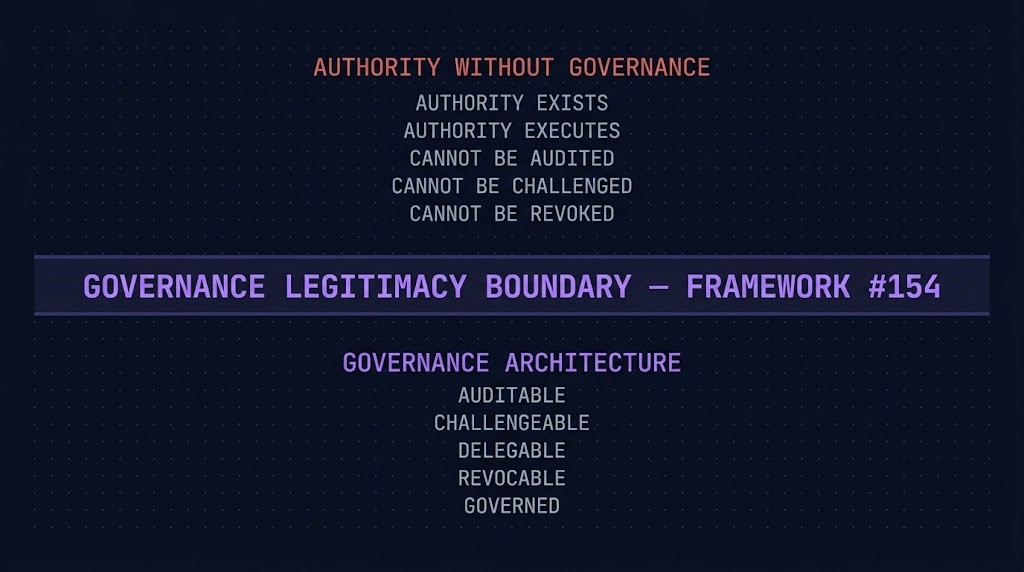
Governance Legitimacy Boundary (#154)
The point at which authority transitions from being operationally effective to being organizationally legitimate. Below the boundary: authority can be audited, challenged, delegated, and revoked — governance structures validate and constrain authority ownership across five legitimacy dimensions. Above it: authority exists and executes, but no governance structure can prove who granted it, who reviews it, who audits it, or who can revoke it. Every governance structure above the boundary becomes evidence of whether legitimacy is architecturally real or documented theater.
Named Failure State (category): Authority Without Governance · Named Failure State (signature): Governance Theater — the condition where governance structures exist and are documented but cannot produce a revocation decision, an audit result, or a challenge to a specific delegation · Five legitimacy dimensions: Audit · Challenge · Delegate · Revoke · Govern
CS5 → CS6 — WHEN AUTHORITY BECOMES GOVERNANCE
Operational Architecture determines whether authority executes. Strategic Governance determines whether that authority is legitimate, auditable, and revocable. CS5 produced the verified execution map — CS6 is the governance architecture that operates over it. Authority without governance scales risk faster than infrastructure, because execution continues regardless of whether governance can interrupt it.
Why Architects Misjudge Governance Legitimacy
Governance documentation is mistaken for governance architecture. Policy documents, RACI matrices, and ownership registries describe what governance intends. They are not the governance layer. Each requires translation into an operational process — a process by which authority can actually be audited, challenged, delegated, or revoked. A policy that cannot be enforced through a revocation decision is documentation, not governance. The documentation can be complete, accurate, and current while the governance architecture it describes does not exist.
Authority that executes is assumed to be governed. The fact that a system operates as intended — that execution follows the authority model CS5 confirmed — does not mean the authority model is legitimate. CS5 confirms execution. CS6 asks whether the ownership of that execution is auditable and contestable. An authority model can be operationally effective and organizationally illegitimate simultaneously. The two conditions are independent. Organizations consistently discover this distinction during revocation events, when the authority exists and executes but no governance structure can act on it.
Compliance is treated as governance. Compliance frameworks produce point-in-time assessments against documented requirements. Governance architecture produces the ongoing structure that makes authority auditable and revocable independent of any compliance regime. An organization that passes an annual compliance audit but cannot execute a revocation decision on a compromised identity delegation has compliance posture without governance architecture. CS6 is governance architecture. Compliance coverage is an output — not a substitute.
What This Stage Is Not
Not a compliance framework guide. CS6 reads identity, sovereignty, security, and control-plane governance through the legitimacy lens — who possesses authority, whether it can be audited and revoked, and whether governance structures that claim ownership can actually exercise it. Compliance frameworks, certification requirements, and regulatory mapping are addressed in the articles this stage sequences; they are not what this stage is about. This stage’s subject is whether governance is architecturally real. Compliance coverage may or may not follow from that.
Not CS5 — Operational Architecture. CS5 verifies that authority reaches the execution plane and produces a verified execution map. CS6 governs who holds authority over the execution plane CS5 has confirmed operates. CS5 produces what CS6 governs. Without CS5, CS6 is governing an authority model that has never been confirmed to function. The two stages are sequential dependencies — not alternative framings of the same question.
Not a security operations playbook. Container security, identity architecture, and sovereign networking appear in CS6 because security authority is a governance question — who possesses the authority to define, audit, and revoke the security posture applied to systems. The subject is not securing systems. It is determining whether the governance structures that claim to own the security decisions for those systems can actually exercise that ownership: audit the posture, challenge a policy, delegate control, revoke access.
Not CS7 — Strategic Resilience. CS6 governs who holds authority under normal operating conditions — when infrastructure is functional and governance structures can be exercised deliberately. CS7 asks what happens to governance when the infrastructure it governs fails. CS6 is the prerequisite: governance structures that have never been confirmed to function cannot be expected to survive infrastructure failure. The question CS7 answers depends entirely on the governance map CS6 produces.
>_ Architecture Maturity Position
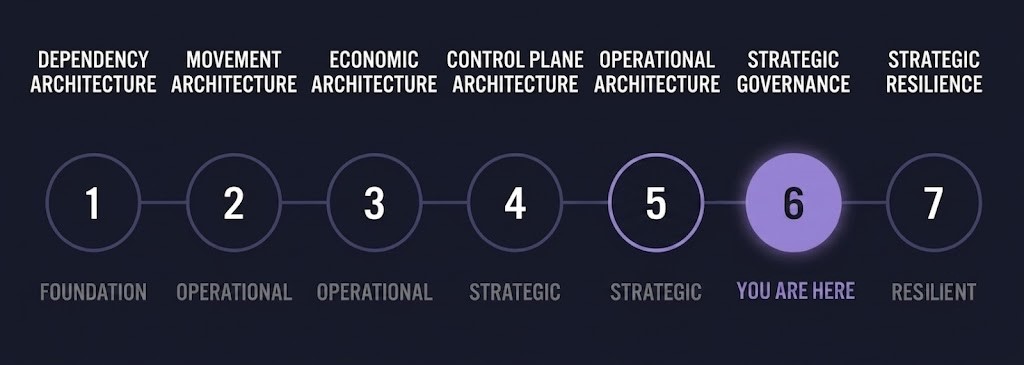
| Stage | Name | Maturity Level | Stage Question |
|---|---|---|---|
| CS1 | Dependency Architecture | Foundation | What are we dependent on? |
| CS2 | Movement Architecture | Operational | What controls our movement? |
| CS3 | Economic Architecture | Operational | What determines our economic structure? |
| CS4 | Control Plane Architecture | Strategic | What governs the architecture? |
| CS5 | Operational Architecture | Strategic | How is authority operationalized? |
| CS6 ← YOU ARE HERE | Strategic Governance | Strategic | Who governs authority? |
| CS7 | Strategic Resilience | Resilient | How does authority survive failure? |
>_ Where This Stage Sits
The Cloud Architecture Path Is a Dependency-Progression Model
| Stage | Architectural Question |
|---|---|
| CS1 — Dependency Architecture | What are we dependent on? |
| CS2 — Movement Architecture | What controls our movement? |
| CS3 — Economic Architecture | What determines our economic structure? |
| CS4 — Control Plane Architecture | What governs the architecture? |
| CS5 — Operational Architecture | How is authority operationalized? |
| CS6 — Strategic Governance | Who governs authority? |
| CS7 — Strategic Resilience | How does authority survive failure? |
The first half identifies constraints — dependency, movement, economics. The second half tests authority — where it resides, whether it executes, who governs it, and whether it survives disruption. CS5 confirmed that authority reaches the execution plane. CS6 determines whether that execution is legitimate. Governance is not the existence of authority. Governance is the ability to audit, challenge, delegate, and revoke authority.
>_ Where to Enter This Stage
This stage is the correct entry point if CS5 has produced a verified execution map — a confirmation that authority reaches the execution plane — but no governance process exists that can audit, challenge, delegate, or revoke the authority that map describes. Specifically, enter here if:
- Authority has been confirmed to execute at CS5, but no governance structure can produce an audit result identifying who holds a specific delegation
- An identity system, sovereignty posture, or security architecture is operational, but no process exists to revoke access or challenge an ownership claim through governance channels rather than operational channels
- A revocation event — a security incident, a personnel change, a vendor relationship ending — has revealed that governance structures exist in documentation but cannot produce a decision under operational pressure
- Compliance posture satisfies external audits but cannot answer internal challenges about who authorized a specific delegation, who reviewed it last, and who can end it
- Governance Drift has occurred: ownership maps, delegation structures, and audit processes describe an authority arrangement that no longer reflects how the architecture actually operates
- CS5 produced the execution map — CS6 is the next question: can the governance structures that claim ownership of that map actually exercise it?
Do not enter this stage expecting a compliance readiness checklist or a security architecture implementation guide. Those are addressed in the articles this stage sequences. CS6 answers one question: is authority governed? The answer determines what CS7 is protecting and what it will find when governance structures are placed under infrastructure stress.
>_ Stage Reading Sequence
GOVERNANCE LEGITIMACY BEGINS HERE
Strategic Governance reads the architecture for evidence of whether authority is legitimate. The sequence moves from identifying where governance attaches to the architecture, through identity and sovereignty as primary governance surfaces, to how governance extends to non-traditional enforcement points — and concludes with diagnostics: how to verify governance is functioning before a revocation event or audit failure does it for you. Each cluster below is organized by architectural problem. Every cluster answers: what becomes architecturally unstable if this discipline is misunderstood?
Note: certain sovereignty articles appear in both the CS6 stage page and the Sovereign Infrastructure cross-cutting layer. The sovereign infrastructure context treats sovereignty as an environmental condition. CS6 reads the same articles through the governance-legitimacy lens — who possesses authority over sovereign environments, and whether that authority satisfies the five legitimacy dimensions. Stage pages are curricula; they frame articles through the stage’s architectural question, not through the article’s original context. Cross-pillar reference: #134 Sovereignty Evidence Chain is not a CS-pillar framework — it is a cross-cutting governance artifact that CS6 references without redefining, in the same way CS4 references #132 without owning it.
Architectural question: Where does governance actually attach to the architecture?
Where does governance actually attach to the architecture?
Authority requires an attachment surface — a point in the architecture where governance structures can assert ownership, audit decisions, and enforce constraints. This cluster identifies two primary surfaces where governance attaches or fails to: the security boundary and the identity system. Container security architecture is not a security operations question; it is a governance question about which layer owns the authority to define, audit, and revoke the security posture applied to workloads. Identity is the other primary surface. When identity systems fail, governance fails with them — because identity is the mechanism through which authority delegation is authenticated, constrained, and revoked. Governance is not the existence of authority. Governance is the ability to audit, challenge, delegate, and revoke authority — and at CS6, identity and security are the first two surfaces where that ability is tested. A third surface rarely gets named at all: operational functions that have quietly accreted identity-authority status — help desks, support queues, any process that can reset, enroll, or approve — without ever being governed, audited, or measured as one.
Architectural question: Who governs access to authority?
Who governs access to authority?
Identity is not a security layer. At CS6, identity is the governance layer through which authority delegation is authenticated, constrained, and revoked. Access to authority flows through identity — which means the architecture of the identity system determines whether governance structures can exercise the revocation and delegation functions that make authority legitimate. This cluster is the natural bridge from CS4’s control-plane ownership discussion: CS4 identified who claims to own authority; CS6 asks whether the identity architecture that controls access to that authority is itself governed. Governance doesn’t create sovereignty — it maintains the evidence that sovereignty is real. That evidence architecture is defined by #134 Sovereignty Evidence Chain (cross-pillar reference); what CS6 adds is the governance structure required to sustain it across the identity surface.
Architectural question: How do you prove authority remains governed?
How do you prove authority remains governed?
Sovereignty claims are governance claims. An organization that asserts control-plane isolation, jurisdictional data residency, or network sovereignty is asserting that it possesses authority over its own environment — authority that cannot be exercised by a third party without its knowledge or consent. CS6 reads sovereignty through the governance lens: not whether isolation is technically implemented, but whether the governance structures that claim sovereignty can prove it. Sovereignty without evidence is a governance failure — authority is claimed, but the five legitimacy dimensions cannot be satisfied. #134 Sovereignty Evidence Chain is the cross-pillar architecture that defines how that evidence is constructed; CS6 does not redefine it. What this cluster adds is the governance architecture required to sustain sovereignty evidence over time — the structures that keep the claim auditable rather than allowing it to become an assertion without a chain of proof.
>_ Cloud Governance Architecture Failure Patterns
Architectural question: How does governance extend to non-traditional enforcement surfaces?
How does governance extend to non-traditional enforcement surfaces?
Governance does not reside only in identity systems and sovereignty architecture. It extends — or fails to extend — to every surface through which authority is exercised. This cluster examines two non-traditional enforcement surfaces where the reach of governance is increasingly consequential: the landing zone pattern, which determines whether policy constraints are architecturally enforced or merely documented, and the browser layer, which has become an execution surface for enterprise access control, credential management, and policy enforcement that most governance architectures have not caught up to. The browser article is CS6 material because its argument is fundamentally a governance argument — governance is increasingly enforced through execution surfaces rather than policy documents, and the surfaces are moving faster than the governance structures designed to control them. Whether governance extends to these surfaces is a structural question, not an operational one.
>_ Live Diagnostics
Architectural question: How do you know governance is failing before authority fails?
How do you know governance is failing before authority fails?
The stage’s synthesis cluster — a structured diagnostic process for verifying that governance structures can actually exercise the five legitimacy dimensions against the authority model CS5 confirmed executes. Where can authority be audited, challenged, delegated, and revoked? Where are the governance structures present in name but not in function? Which gaps are tolerable and which are Governance Theater waiting for a revocation event, an audit challenge, or a security incident to surface? This cluster anchors around GRA — the Governance Readiness Assessment — currently in development. The five legitimacy dimensions (audit, challenge, delegate, revoke, govern) are the diagnostic axes; the output is a governance map that distinguishes exercisable governance from documented governance.
>_ Cloud Governance Architecture as Architectural Practice
Cloud governance architecture is not a configuration milestone. The governance structures that make authority legitimate — the processes that audit, challenge, delegate, and revoke it — require periodic verification against the five legitimacy dimensions, because governance structures drift from operational reality in exactly the same way that execution systems drift from authority models. The only difference is that CS5 drift is visible in performance and incident data; CS6 drift is visible only when governance is required to act and cannot.
Three practices establish ongoing governance legitimacy as an architectural discipline rather than a documentation exercise. First, delegation review: authority assignments are time-bounded and re-verified against the current governance model on a defined schedule, not only when a personnel change prompts a manual review. Every delegation that has not been re-verified is a delegation whose legitimacy is assumed rather than confirmed. Second, revocation testing: the revocation process is executed under realistic conditions before it is needed under operational pressure. A revocation process that has never been tested is not a governance structure — it is a procedure that may or may not produce a decision when called upon. Third, evidence chain maintenance: sovereignty and ownership claims are supported by auditable records that remain current and externally verifiable. A sovereignty claim whose evidence chain has not been updated since the last infrastructure change is a claim that has begun to diverge from the architecture it describes.
The architectural position is different from the operational one. Whether governance structures can exercise legitimacy is a structural question about the environment — not a procedural question about who is responsible for running governance processes. CS7 — Strategic Resilience — will ask what happens to the governance structures CS6 has confirmed can be exercised when the infrastructure those structures govern fails. That sequence only works if CS6’s output is real. Governance that has never been confirmed to function cannot be expected to survive infrastructure stress.
>_ Stage Graduates Can Now
CS1 graduates understand dependencies. CS2 graduates understand movement. CS3 graduates understand economics. CS4 graduates understand authority. CS5 graduates understand whether authority executes. CS6 graduates understand whether authority is legitimate. They can place the Governance Legitimacy Boundary, identify Governance Theater before it surfaces as a revocation incident or an audit failure, and distinguish governance architecture from governance documentation. What changes at Strategic Resilience — the next stage — is the question CS6 cannot answer: what happens to governance when the infrastructure it governs fails? You have established the governance structures that make authority legitimate, auditable, and revocable. Resilient maturity forces the question of whether those structures survive infrastructure failure.
- Place the Governance Legitimacy Boundary (#154) and identify the point at which authority transitions from being operationally effective to being organizationally legitimate
- Apply the five legitimacy dimensions — audit, challenge, delegate, revoke, govern — as diagnostic axes against any authority claim in the environment, and distinguish exercisable governance from documented governance
- Identify Governance Theater before it surfaces as an operational failure: recognize where governance structures exist but cannot produce a revocation decision, an audit result, or a challenge to a specific delegation
- Read identity, sovereignty, and security architecture as governance surfaces — evaluate whether the authority governing those surfaces satisfies the five legitimacy dimensions rather than evaluating them as security or operational concerns
- Enter CS7 (Strategic Resilience) with a verified governance map — resilience architecture cannot preserve governance structures whose legitimacy has never been confirmed, and the stress conditions CS7 models will surface Governance Theater faster than any audit
>_ Where Do You Go From Here
>_ Frequently Asked Questions
What is cloud governance architecture?
Cloud governance architecture is the discipline of establishing whether authority — defined at CS4 and confirmed to execute at CS5 — is organizationally legitimate: auditable, challengeable, delegable, and revocable. It answers CS6’s stage question: who governs authority? Governance is not the existence of authority. Governance is the ability to audit, challenge, delegate, and revoke authority. The output of cloud governance architecture is a verified governance map — confirmation of whether governance structures that claim ownership of authority can actually exercise it, or whether the environment has Governance Theater: documented governance that cannot produce a revocation decision, an audit result, or a challenge to a specific delegation.
What is the difference between governance architecture and compliance architecture?
Compliance architecture produces point-in-time assessments against documented requirements — a compliance framework evaluates whether stated controls exist and are evidenced at a specific moment. Governance architecture produces the ongoing structure that makes authority auditable and revocable independent of any compliance regime. An organization can pass an annual compliance audit while being unable to execute a revocation decision on a compromised identity delegation — that organization has compliance posture without governance architecture. CS6 is governance architecture. Compliance coverage may or may not follow from it, but compliance is an output, not a substitute. The distinction matters most at the moment governance is required to act: compliance frameworks describe what should be true; governance architecture determines whether what should be true can be exercised.
What is the Governance Legitimacy Boundary?
The Governance Legitimacy Boundary (Framework #154) is the point at which authority transitions from being operationally effective to being organizationally legitimate. Below the boundary: authority can be audited, challenged, delegated, and revoked — governance structures validate and constrain authority ownership across five legitimacy dimensions. Above it: authority exists and executes, but no governance structure can prove who granted it, who reviews it, who audits it, or who can revoke it. Every governance structure above the boundary becomes evidence of whether legitimacy is architecturally real or documented theater. The five legitimacy dimensions — audit, challenge, delegate, revoke, govern — are the diagnostic axes for placing the boundary in any environment.
What is Governance Theater?
Governance Theater is the signature CS6 failure state — the condition where governance structures exist, are documented, are staffed, and are referenced in compliance submissions, but cannot produce a revocation decision, an audit result, or a challenge to a specific delegation. Governance is performed rather than exercised. An organization with Governance Theater can describe its governance architecture in detail. It cannot exercise it under operational pressure. The distinction between describing governance and exercising governance is what Governance Theater obscures — and it is most common in environments that pass compliance audits regularly, because compliance audits test governance description, not governance execution.
How does CS6 differ from CS5 Operational Architecture?
CS5 operationalizes authority — it verifies that the authority model established at CS4 reaches the execution plane, and delivers a verified execution map: confirmation that schedulers, pipelines, service mesh policies, and autoscaling systems act as the authority model intends. CS6 governs who possesses that authority — it evaluates whether the governance structures that claim ownership of the authority CS5 confirmed executes can actually exercise it: audit it, challenge it, delegate it, and revoke it. CS5 produces what CS6 governs. Without CS5, CS6 is governing an authority model that has never been confirmed to function. Without CS6, CS5’s verified execution map describes a set of operational arrangements that nobody is legitimately governing.
How does CS6 differ from CS7 Strategic Resilience?
CS6 governs who holds authority under normal operating conditions — when infrastructure is functional and governance structures can be exercised deliberately. CS7 asks what happens to governance when the infrastructure it governs fails: how authority is maintained, transferred, or reconstituted under failure conditions, and whether governance structures designed for stable environments can function when those environments are disrupted. CS6 is the prerequisite: governance structures that have never been confirmed to function cannot be expected to survive infrastructure failure. The stress conditions CS7 models will surface Governance Theater faster than any audit — which is why CS7 requires CS6’s verified governance map as its starting point.
What is the Governance Readiness Assessment (GRA) and when will it be available?
GRA — Governance Readiness Assessment — is a CS6-specific diagnostic tool in development. It will evaluate whether authority can be audited, challenged, delegated, governed, and revoked across identity, control-plane, and sovereignty boundaries, scoring each of the five legitimacy dimensions introduced by Framework #154 Governance Legitimacy Boundary. The output is a governance map that distinguishes exercisable governance from documented governance and identifies where Governance Theater exists before a revocation event or audit failure surfaces it. Until GRA is live, ARGA (AI Runtime and Governance Analyzer) addresses a structurally analogous governance legitimacy question in the AI infrastructure domain and is available as a cross-pillar reference.
>_ Related Systems
The prerequisite stage — CS5 produced the verified execution map this stage governs. Governance cannot meaningfully audit or revoke authority that has never been confirmed to execute.
Open Stage →The next stage — Strategic Resilience asks what happens to the governance structures CS6 confirmed can be exercised when the infrastructure those structures govern fails.
Open Stage →The cloud architecture strategy guide — the full decision framework for dependency, movement, cost, control plane, operational, and governance architecture.
Open Pillar →Cluster 02 anchor — the governance architecture of the identity layer; who possesses authority over identity systems, and whether that authority satisfies the five legitimacy dimensions.
Open Page →Cluster 01 anchor — the governance attachment surface at the workload boundary; security authority as a governance question about who can define, audit, and revoke security posture.
Open Page →The structural parallel in the AI path — same governance maturity position; A6 governs AI runtime authority where CS6 governs cloud platform authority.
Open Stage →Cross-pillar diagnostic for runtime governance legitimacy — structural analog to GRA; addresses the governance-legitimacy verification question in the AI infrastructure domain until GRA is live.
Open Tool →Authoritative reference for identity-centric access governance — the federal zero trust model that frames identity as the primary policy enforcement surface; relevant context for Cluster 01 and Cluster 02.
Open Reference →Reference model for cloud native security governance across the lifecycle — relevant context for Cluster 01’s container security authority analysis and the governance attachment surface at the workload boundary.
Open Reference →