

STATE & DEPENDENCY ARCHITECTURE
Where shared infrastructure quietly becomes a platform other teams depend on.
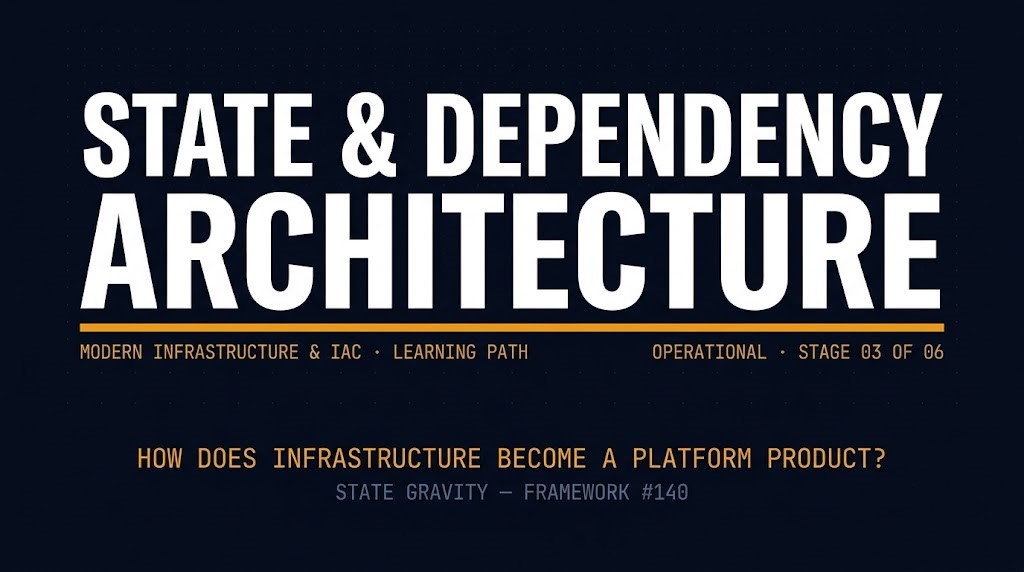
MATURITY POSITION — STAGE 3 OF 6
- Current Stage: State & Dependency Architecture
- Primary Architectural Concern: When shared infrastructure crosses into being a platform other teams’ roadmaps depend on, and what that dependency costs architecturally
- Primary Failure Mode: Platform Stagnation — the point where redesign cost exceeds governance cost, and change becomes something the organization manages around rather than performs
- Stage Outcome: Reader can name where platform state actually lives, who depends on it, and how close the system sits to the point where redesign becomes prohibitively expensive
- Next Stage: MI4 — Governance & Drift — How is infrastructure governed?
State dependency architecture is the discipline of understanding what happens after infrastructure becomes reliable enough that other teams start depending on it. MI1 taught you when infrastructure deserves to become code. MI2 taught you who has the right to change it. MI3 exists because settling both of those questions doesn’t stop the next one from forming quietly underneath them: at what point does a well-run, GitOps-governed, policy-enforced system stop being infrastructure at all, and start being a platform other teams’ roadmaps are built on top of.
That transition isn’t a milestone architects celebrate. It’s rarely announced, rarely documented, and almost never designed on purpose. It happens the moment a second team starts building against your Terraform module, your shared Kubernetes namespace, or your etcd-backed state store — and it changes the cost structure of every future change you make to that system, whether anyone planned for it or not.
The Modern Infrastructure & IaC Path Is an Intent-Governance Progression
| Stage | Architectural Question |
|---|---|
| MI1 — Declarative Infrastructure | When does infrastructure deserve to become code? |
| MI2 — Control Plane Boundaries | Who has the right to change infrastructure? |
| MI3 — State & Dependency Architecture | How does infrastructure become a platform product? |
| MI4 — Governance & Drift | How is infrastructure governed? |
| MI5 — Economics of Automation | How does infrastructure survive change? |
| MI6 — Infrastructure Survivability | How is infrastructure continuously proven? |
MI3 assumes MI2’s control-plane ownership model has already been assigned. It does not assume every consumer dependency on shared state has been mapped — that mapping is this stage’s entire job, and MI4 through MI6 all inherit whichever platform-formation state MI3 leaves them with.
WHY THIS STAGE EXISTS — PLATFORM STAGNATION
Most organizations believe a platform stays healthy as long as it stays reliable. In practice, uptime and adoption metrics can keep climbing while accumulated state dependencies quietly make the next architectural change prohibitively expensive.
Stage Anchor Question
How does infrastructure become a platform product?
Not: how do you build a platform deliberately? Not: which tool turns infrastructure into a platform? MI3 answers a quieter question — the point at which infrastructure stops being something a team builds and starts being something other teams architecturally depend on, independent of whether anyone set out to build a platform at all.
Platform Stagnation is the named failure state for this stage: the point where redesign cost exceeds governance cost, and change becomes something the organization manages around rather than performs. Every module still works. Every consuming team is still shipping. Each system is functioning exactly as designed — the failure isn’t in any one component, it’s in the fact that the platform’s state has accumulated to the point where nobody can afford to change the design underneath it anymore.
This maps directly onto Framework #140’s core finding: State Gravity is not the accumulation of state itself, it’s the increase in architectural change cost that accumulation causes. Module boundaries, dependency chains, refactoring scope, and rebuild sequencing all bend toward existing state rather than ideal design — and unlike technical debt, this happens even when no shortcuts were ever taken.
Stage Anchor Framework — Infrastructure State Gravity
State Gravity (#140)
The increase in architectural change cost caused by accumulated state. Distinct from technical debt: technical debt is the cost of past shortcuts, while State Gravity exists even when no shortcuts were taken at all. The Module Lifecycle Curve (Reusable → Shared → Forked → Fragmented → Unmaintainable) is a named sub-model describing how module architecture degrades under State Gravity over time.
Named Failure State: Platform Stagnation — change becomes something the organization manages around rather than performs · Related: Framework #159 Emergency Reconciliation Gap (MI4, moderate relationship — both describe governance gaps opening at the moment engineering effort alone stops being sufficient) · Framework #133 Policy Intent Drift (MI2 anchor, weak relationship — same governance lineage, different mechanism)
Why Architects Misjudge Platforms
Shared infrastructure is mistaken for a platform. A shared Kubernetes cluster, a common Terraform module, or a central state backend is not automatically a platform. A platform emerges specifically at the point other teams become dependent on the state it owns — not at the point it becomes shared, reused, or well-documented.
Reuse is mistaken for standardization. A module used by ten teams looks like standardization from the outside. Internally, it can still fragment into ten incompatible variants — each with its own overrides and undocumented exceptions — long before anyone notices the module stopped being one thing.
Operational success hides platform debt. Platforms often appear healthy right up until they aren’t. Uptime, reliability, and adoption metrics keep climbing while accumulated state dependencies quietly make the next architectural change prohibitively expensive — invisible until someone actually tries to change the design.
What This Stage Is Not
Not a tool comparison. This stage isn’t about choosing between Terraform, OpenTofu, or any state backend. Tooling-transition questions live in MI2 (control-plane authority) and MI5 (automation economics), not here.
Not a migration guide. This stage doesn’t walk through how to migrate state backends or refactor modules. It explains why that refactor gets more expensive every quarter you wait.
Not a repeat of MI2’s control-plane question. MI2 asks who has the right to change infrastructure. MI3 assumes that’s already answered and asks a harder question: why does exercising that right get more expensive the longer the platform survives?
Not technical debt. Technical debt is the cost of past shortcuts. State Gravity exists even when no shortcuts were ever taken — it’s a structural property of accumulated state, not a record of past mistakes.
>_ Estimated Reading Depth
| Format | Count | Estimated Time | Notes |
|---|---|---|---|
| Architecture articles — Cluster 01 | 1 | ~15 min | Platform Formation — Framework #140 anchor, the condition itself |
| Architecture articles — Cluster 02 | 3 | ~35 min | Dependency & Ownership — who owns the platform once others depend on it |
| Architecture articles — Cluster 03 | 2 | ~25 min | State Mechanics — where platform state actually lives |
| Architecture articles — Cluster 04 | 2 | ~25 min | Lifecycle & Operational Debt — why successful platforms become harder to evolve |
| Platform Stagnation Failure Patterns Grid | 1 | ~8 min | Five failure patterns — read last, closing the reading sequence as the culminating framework failure |
| Total stage depth | 8 | ~108 min | Operational stage — assumes MI2’s control-plane ownership model is already assigned |
Reading Depth: ~108 min estimated across 8 articles. Final duration recalculated after article publication based on actual word count.
>_ Where To Enter This Stage
Enter here if you’ve already settled MI2’s control-plane ownership question and have a Terraform module, Kubernetes namespace, or state backend that a second team has started building against — whether or not anyone decided that was going to happen. If you’re arriving from a Kubernetes-operations background without the MI1/MI2 context, Cluster 03 (State Mechanics) reads fine standalone, but the “platform” framing in Clusters 01–02 assumes you understand why ownership questions arise in the first place.
Skip-ahead criteria: Architects who can already name where their platform’s state physically lives, who consumes it, and whether redesign cost has started to exceed governance cost for that system, may consider entering at MI4 — Governance & Drift. If any of those is untested, complete this stage first.
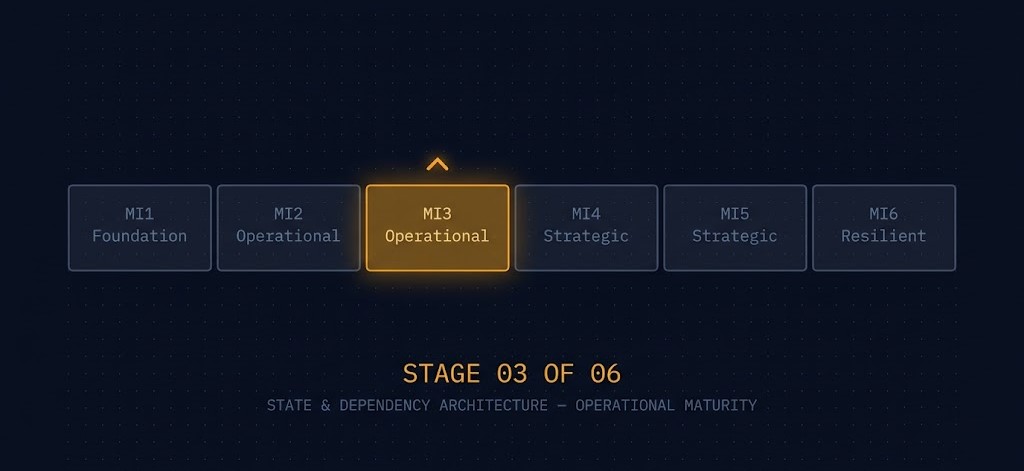
>_ Architecture Maturity Position
| Stage | Name | Maturity Level | Stage Question |
|---|---|---|---|
| MI1 | Declarative Infrastructure | Foundation | When does infrastructure deserve to become code? |
| MI2 | Control Plane Boundaries | Operational | Who has the right to change infrastructure? |
| MI3 ← YOU ARE HERE | State & Dependency Architecture | Operational | How does infrastructure become a platform product? |
| MI4 | Governance & Drift | Strategic | How is infrastructure governed? |
| MI5 | Economics of Automation | Strategic | How does infrastructure survive change? |
| MI6 | Infrastructure Survivability | Resilient | How is infrastructure continuously proven? |
>_ Stage Reading Sequence
STATE & DEPENDENCY ARCHITECTURE BEGINS HERE
The sequence below moves through four architectural questions in order. Cluster 01 is the anchor — Framework #140 in full, establishing State Gravity and the Module Lifecycle Curve before anything else. Cluster 02 asks who owns the platform once other teams depend on it. Cluster 03 grounds the abstraction in the actual systems holding platform state. Cluster 04 makes the Module Lifecycle Curve concrete through accumulated operational debt. The failure patterns grid sits at the very end, not between clusters — Platform Stagnation is the culminating framework failure this whole stage builds toward, not a midpoint to resolve before continuing.
Reading out of sequence is possible. Cluster 03 (State Mechanics) reads fine standalone for readers arriving from a Kubernetes-operations background.
Architectural question: When does infrastructure stop being infrastructure and start becoming a platform?
When does infrastructure stop being infrastructure and start becoming a platform?
Framework #140 in full: why accumulated state — not past shortcuts — is what makes platforms expensive to change, and the Module Lifecycle Curve that describes how that happens over time.
Architectural question: Who owns the platform once others depend on it?
Who owns the platform once others depend on it?
Ownership doesn’t stay with whoever built the system first. It moves — or gets contested, deferred, or abandoned — as soon as other teams start relying on it.
Architectural question: Where does platform state actually live?
Where does platform state actually live?
State Gravity is abstract until you can point to the actual systems holding your platform’s state — and understand what breaks when that storage layer is treated as an implementation detail.
Architectural question: Why do successful platforms become harder to evolve?
Why do successful platforms become harder to evolve?
The Module Lifecycle Curve made concrete: what accumulated operational debt looks like in practice, and one rare case where a platform constraint actually loosened.
>_ Common State & Dependency Failure Patterns
>_ Stage Graduates Can Now
You can now operate at scale with clear control-plane ownership — MI2 gave you that. What Operational maturity adds at this stage is the ability to see platform formation before it’s finished happening, and to name the exact mechanism — State Gravity — making your next architectural change more expensive than it should be. What Strategic maturity adds next is turning that diagnosis into enforceable governance.
- Identify when a piece of shared infrastructure has crossed into being a platform other teams depend on
- Locate where your platform’s state actually lives, and name what breaks if that layer is treated as an implementation detail
- Recognize Module Fragmentation and Ownership Dilution before they harden into Platform Stagnation
- Distinguish State Gravity from technical debt — and stop treating symptoms of the former with fixes meant for the latter
- Place Framework #140 — State Gravity — alongside its related MI4 counterpart, Framework #159 Emergency Reconciliation Gap
>_ Where Do You Go From Here
ARCHITECTURE REVIEW
Infrastructure Architecture Review
A structured review of state dependency, module ownership, and where your platform sits on the lifecycle curve — before Platform Stagnation sets the cost of change for you.
[+] Request Assessment →WEEKLY DISPATCH
Weekly Dispatch
Architecture signals, framework updates, and new content from across the five pillars — delivered weekly for senior infrastructure architects.
[+] Subscribe →>_ Frequently Asked Questions
What is state dependency architecture in the context of enterprise infrastructure?
State dependency architecture is the study of what happens once other teams start depending on infrastructure a platform team owns. It’s not about the tooling used to build the platform — it’s about the point at which shared infrastructure crosses into being something other teams’ roadmaps are built on top of, and what that dependency costs architecturally.
How is Infrastructure State Gravity different from technical debt?
Technical debt is the cost of past shortcuts — it exists because something was built quickly or imperfectly. State Gravity exists even when no shortcuts were ever taken at all. It’s the increase in architectural change cost caused purely by accumulated state — module boundaries, dependency chains, and rebuild sequencing all bending toward existing state rather than ideal design, regardless of how carefully the system was originally built.
How does this stage differ from MI2’s control-plane ownership question?
MI2 asks who has the right to change infrastructure — a question about authority. MI3 assumes that authority question is already answered and asks a different one: why does exercising that right get more expensive the longer the platform survives? MI2 is about ownership of the decision. MI3 is about the cost of the decision once other teams depend on its outcome.
What is the Module Lifecycle Curve and why does it matter?
A named sub-model within Framework #140 describing how module architecture degrades under State Gravity over time: Reusable → Shared → Forked → Fragmented → Unmaintainable. It matters because it turns an abstract framework into a diagnostic — you can place your own modules on the curve and see how close they sit to becoming unmaintainable.
What is Platform Stagnation and how do you recognize it before it happens?
Platform Stagnation is Framework #140’s named failure state — the point where redesign cost exceeds governance cost, and change becomes something the organization manages around rather than performs. It’s recognizable earlier through its precursors: Module Fragmentation, Ownership Dilution, and State Dependency Entrenchment — all of which are visible well before the platform actually stops being changeable.
Who should read this stage vs. jump straight to MI4 Governance & Drift?
Read this stage first if you can’t yet name where your platform’s state actually lives, who consumes it, or whether redesign cost has started to exceed governance cost for that system. MI4’s governance and drift enforcement assume you already understand why alignment with intent gets harder as state accumulates — that understanding is this stage’s entire job.
>_ Related Systems
MI2 — Control Plane Boundaries. The prerequisite stage — who has the right to change infrastructure, before this stage asks why exercising that right gets more expensive.
Open Stage →MI4 — Governance & Drift. The next stage — Framework #159 Emergency Reconciliation Gap, related to #140 at moderate strength.
Open Stage →Why Configuration Standards Fail During Emergency Changes. Framework #159 anchor post — the MI4 counterpart most closely related to #140.
Open Post →Recovery Platform Architecture (D2). Cross-pillar: the same state-dependency question applied to backup/recovery platforms other systems depend on.
Open Stage →The System Recovered. Your Recovery Boundary Didn’t. — dependency scoping from the opposite direction: not what depends on your platform’s state, but what your service depends on outside its own boundary.
Open Post →Terraform — State documentation. Official reference for backend configuration and remote state locking — the mechanical layer underneath this stage’s architectural questions.
Open Reference →Kubernetes — etcd operations guide. Upstream operational guidance for etcd as the Kubernetes state store — background for Cluster 03.
Open Reference →