

Infrastructure State Gravity: Why You Can No Longer Redesign the Platform You Built
Infrastructure state gravity is the reason a Terraform module that shipped clean fourteen months ago can no longer be touched without someone getting nervous. Nobody voted to freeze it. Forty teams now call it, and that’s enough.

This isn’t a Terraform article, and it isn’t really a module article either. It’s an article about why infrastructure accidentally becomes a product — and why nobody ever decides that on purpose.
Infrastructure Becomes a Product Before Anyone Calls It One
Here’s the version every platform team recognizes. A module ships in month one: one owner, one consumer, a clean interface. Nobody reviews changes to it because nobody else depends on them yet. It’s an implementation detail, not a commitment.
By month six it has a second consumer, then a fifth. The interface hasn’t changed, but every change to it now has to be checked against five call sites instead of one. By month fourteen it has forty. The module hasn’t gotten more important in any way its original author would recognize — it does the same thing it always did. What’s changed is the cost of touching it.
That’s the actual transition, and it has a precise threshold: the transition happens when changing the platform becomes more expensive than governing it. Once that’s true, the rational move for every team involved — including the team that owns the module — is to stop trying to redesign it and start managing change to it instead: versioning, deprecation windows, consumer sign-off. That’s not a maturity milestone anyone chose. It’s a product operating model, adopted by default, because the alternative — freely redesigning something forty teams depend on — stopped being available.
Nobody decided to run infrastructure as a product. The infrastructure decided, the moment redesigning it got more expensive than governing it.
Infrastructure State Gravity
Infrastructure state gravity is not the accumulation of state itself. It is the increase in architectural change cost caused by accumulated state.
That distinction matters more than it looks. State, once created, exerts gravitational pull on every subsequent architectural decision — module boundaries, dependency chains, refactoring scope, and rebuild sequencing all bend toward existing state rather than ideal design. The module in the opening example isn’t badly designed. It’s exactly as well-designed as it was on day one. What changed is the mass of things now depending on it not changing.
Technical debt is the cost of past shortcuts. State Gravity exists even when no shortcuts were taken at all. A module built with zero compromises, following every best practice available at the time, still accumulates State Gravity the moment a second team starts consuming it — because the cost it’s measuring isn’t the quality of the original decision, it’s the number of things now anchored to that decision. You cannot refactor your way out of State Gravity the way you can pay down technical debt, because the thing generating the cost isn’t a flaw in the module. It’s the module’s success.
FRAMEWORK #140 — INFRASTRUCTURE STATE GRAVITY
The increase in architectural change cost caused by accumulated state, independent of implementation quality.
Once change cost exceeds redesign appetite, every subsequent architectural decision bends toward the state that already exists — not toward the design that would be chosen from scratch.
Architectural Relationships
Why It Connects
Both frameworks describe governance gaps that open at the moment engineering effort alone stops being sufficient — #159 at incident time, #140 as consumer count grows. #140 is a formation mechanism, not a drift or authority framework; #159 is not affected by change cost.
Explore Framework →Why It Connects
Both sit in the Modern Infrastructure & IaC governance lineage, but #133 describes divergence between declared and enforced policy, not change-cost accumulation.
Explore Framework →The Module Lifecycle Curve
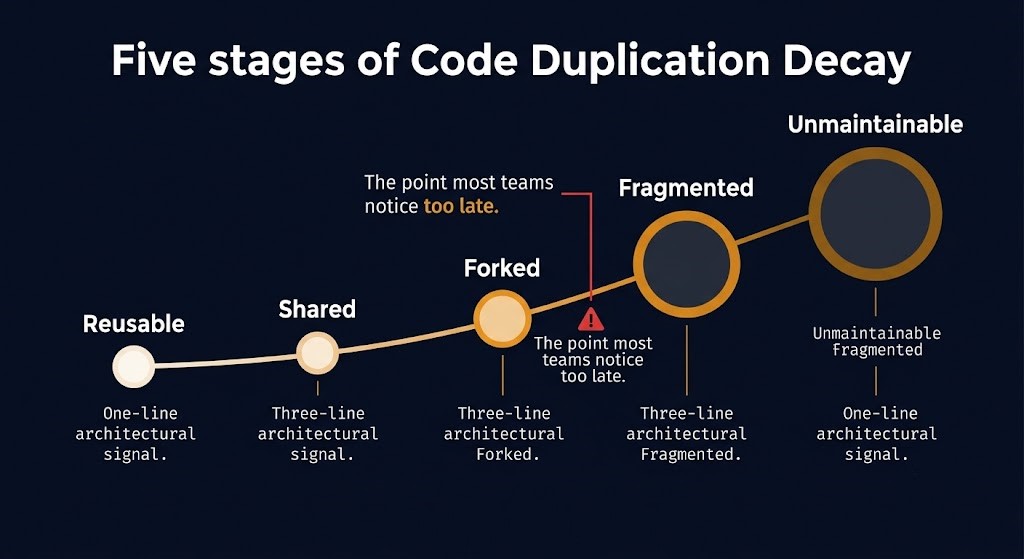
Infrastructure state gravity doesn’t hit all at once. It moves a module through five stages, and each stage has a specific, checkable signal — not a vague sense that “things feel harder now.”
| Stage | What Changed | Architectural Signal | Typical Response |
|---|---|---|---|
| Reusable | Single consumer, clean interface | Changes ship without coordination | Ship freely |
| Shared | Multiple consumers | Breaking changes require coordination | Add a review step |
| Forked | Local modifications emerge | Consumers stop trusting upstream changes | Create local variants |
| Fragmented | Multiple variants exist | No authoritative implementation | Establish governance |
| Unmaintainable | Change cost exceeds replacement cost | Platform stagnation | Replatform or replace |
Most teams notice the Fragmented stage — that’s when someone finally asks “wait, which version of this module is the real one?” By then the Forked stage, where the actual damage started, is already months behind them. The Module Lifecycle Curve exists so a team can locate itself before Fragmented, at the point where the fix is still a review policy rather than a replatforming project.
Why State Gravity Creates Platform Products
The clearest bridge into this is a framework that’s already lived on the site for a while: The Infrastructure Team Is the Real Single Point of Failure. State gravity increases dependency concentration — the more consumers a module has, the more that module’s continued correctness depends on a small number of people who actually understand it. Dependency concentration increases bus-factor risk. The two frameworks describe the same accumulating mass from two angles: one measures the cost of changing the thing, the other measures the cost of losing the people who understand it.
That bridge is what actually answers this stage’s question. Infrastructure becomes a platform product the moment the cost of changing it becomes a governance problem rather than an engineering problem. Below that threshold, a change is a pull request. Above it, a change is a negotiation — a deprecation window, a consumer notification, a versioning decision, a person whose job is now partly to own that negotiation. None of that is a step a team takes on purpose. It’s what State Gravity produces once enough consumers exist that redesign stops being cheaper than coordination.
Infrastructure State Gravity Concentrates in Three Places
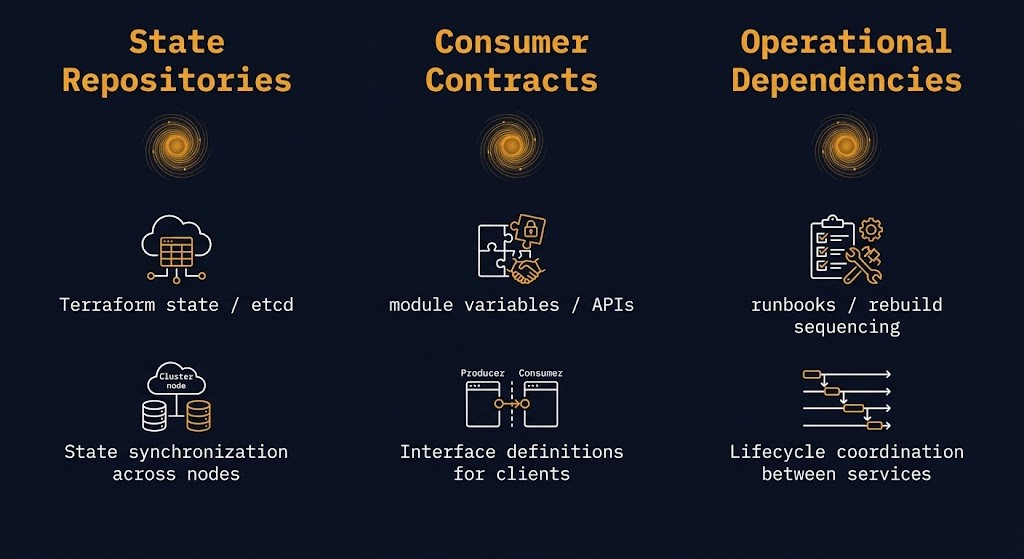
State gravity isn’t a Terraform-specific phenomenon, even though Terraform state files are its most literal example. It concentrates wherever three kinds of mass accumulate.
State Repositories — the literal record of what exists. Terraform state files, etcd, and application databases all hold state that every downstream operation has to reconcile against. A Terraform state file with forty resources can be redesigned in an afternoon. The same file with four thousand resources across twelve teams’ workspaces cannot — not because the redesign got harder technically, but because the state file itself is now something other teams’ pipelines depend on existing in its current shape.
Consumer Contracts — the interfaces other systems have built against. Module variables and outputs, internal APIs, platform abstractions. A Terraform module’s variable contract is a promise the moment a second consumer writes code against it — the same dynamic playing out in Kubernetes storage abstractions, where the choice between a PersistentVolume and a StorageClass locks in assumptions that every pod scheduled against that storage class then inherits.
Operational Dependencies — the processes built around the state, not the state itself. Runbooks, ownership assignments, rebuild sequencing, redeployment order. Kubernetes 1.35’s in-place pod resize is a direct example of state gravity at the operational layer: for years, resizing a workload meant destroying and recreating the pod, because the platform’s rebuild sequencing had accumulated around “resize requires recreation” as a load-bearing assumption. Removing that assumption wasn’t a small feature — it was unwinding operational state gravity that had built up since the scheduler was first designed.
None of these three categories are unique to any one tool. Terraform and Kubernetes just make the pattern easiest to see, because their state, contracts, and operational dependencies are all explicit and inspectable rather than buried in institutional memory.
Designing Against Infrastructure State Gravity
You do not close infrastructure state gravity. You design for the moment it arrives — the design layer this framework anchors within the Modern Infrastructure & IaC Learning Path, where State & Dependency Architecture builds directly on this post.
The teams that handle this well share three practices, all aimed at the same target: keeping the cost of change predictable even as consumer count rises, rather than letting it rise silently until someone discovers it the hard way.
Versioned module contracts. Treat a module’s interface like a published API the moment it has a second consumer — semantic versioning, changelogs, and a deprecation window before a breaking change ships, not after someone’s pipeline breaks.
Ownership boundaries drawn before the module is Shared, not after it’s Fragmented. This is the same ownership discipline covered in IDPs Don’t Solve the Ownership Problem and Configuration Drift Is the Symptom — a named owner for a module is cheap to assign at the Reusable stage and expensive to reconstruct at the Fragmented stage, once nobody’s sure which team’s variant is authoritative.
Diagnostic visibility into where state actually lives. This is what the State File Risk Analyzer and Module Sprawl Analyzer — both reserved as this framework’s tool residency — are built to surface: which state repositories, consumer contracts, and operational dependencies have quietly moved from Reusable toward Fragmented, before the move becomes Unmaintainable. Neither tool is built yet; this framework is what activates their build.
Architect’s Verdict
Infrastructure starts as an implementation. State turns it into a dependency. Dependency turns it into a product. State Gravity explains why.
Most platform teams experience this as a mystery — the module was fine, the design didn’t get worse, and yet somehow every change now takes three times as long and needs two sign-offs. It isn’t a mystery. It’s a measurable, predictable increase in change cost, driven entirely by how many things now depend on the state that already exists. Technical debt is what you get from cutting corners. State gravity is what you get from succeeding — from building something enough teams found useful enough to depend on.
Platform-product status was never a milestone you reach. It’s the label for what’s already true the moment redesign becomes more expensive than governance.
Additional Resources
View 3 more resources
Editorial Integrity & Security Protocol
This technical deep-dive adheres to the Rack2Cloud Deterministic Integrity Standard. All benchmarks and security audits are derived from zero-trust validation protocols within our isolated lab environments. No vendor influence.

R.M.
Senior Solutions Architect with 25+ years of experience in HCI, cloud strategy, and data resilience. As the lead behind Rack2Cloud, I focus on lab-verified guidance for complex enterprise transitions. View Credentials →
Get the Playbooks Vendors Won’t Publish
Choose the architecture problems you care about. Get field-tested playbooks and frameworks delivered to your inbox.
- > AI Infrastructure & Inference Economics
- > Cloud Strategy & Hidden Cost Models
- > Virtualization & Deterministic Migration
- > Kubernetes, IaC & Modern Infrastructure
- > Data Protection & Recovery Engineering
Zero spam. Includes The Dispatch weekly drop.
Need Architectural Guidance?
Independent review before major infrastructure decisions.
- > Validate assumptions
- > Identify hidden dependencies
- > Quantify migration risk
- > Challenge vendor narratives
Triage · Advisory · Fractional · Direct Hire