

You Bought an Observability Layer. You Needed an Evidence Layer.
An AI evidence platform is not the thing most organizations think they bought when they signed off on observability tooling. The budget got approved, a vendor got selected, a dashboard got stood up — and nobody in the room asked whether “we can see what the model did” and “we can prove what the model did” were the same purchase. They aren’t, and the gap between them is the actual subject of this post.
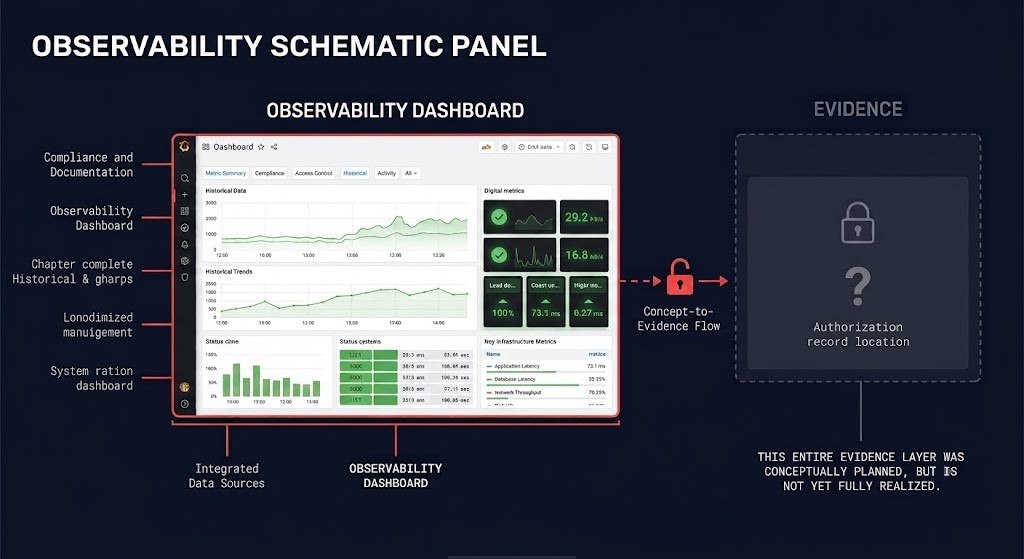
Why Organizations Mistook Visibility For Proof
The mistake is understandable, which is exactly why it’s so common. During an incident review, or a board question about a model’s output, or a customer escalation, the observability dashboard is the only artifact in the room that looks like an answer. It has timestamps. It has a trace. It has a graph that goes up before the bad thing happened. Everyone in the meeting nods, because visibility feels like proof — it’s concrete, it’s queryable, and it was expensive enough that surely it does more than just display things.
That feeling is the entire failure mode. Observability answering “what happened” satisfies the question a room full of engineers asks during an incident. It does not satisfy the question a regulator, an auditor, or opposing counsel asks six months later, which is closer to “prove that the person who approved this was authorized to, under the policy that was in effect at the time.” Those are different questions with different evidentiary requirements, and the platform that answers the first one was never built to answer the second. That’s the room where an AI evidence platform quietly gets replaced by a very good dashboard, and nobody notices the substitution happened.
This isn’t a new observation about observability specifically — it’s the same distinction this site has already drawn between observability as a governance layer and observability as passive telemetry. The Observability Authority Boundary names the moment observability stops being a dashboard and starts being asked to enforce something. Most organizations are still on the dashboard side of that boundary and don’t know it, because nobody has yet asked them to produce something the dashboard can’t.
The same substitution has a name one pillar over. Data Protection’s Governance & Recovery Assurance stage calls this exact failure mode Evidence Theater — recovery evidence that exists, looks complete, and satisfies every internal review, but has never been examined by a party with actual standing to reject it. Swap “recovery” for “AI execution” and the description doesn’t change. An AI evidence platform that was never tested against independent challenge is Evidence Theater with a different noun in front of it.
What Observability Was Designed To Do
None of this is a case against the tooling. Observability platforms are good at what they’re built for: real-time visibility into model behavior, latency, error rates, drift signals, resource consumption. That’s genuinely valuable, and organizations that lack it are flying blind in ways that cause real production incidents. The tooling is not the problem.
The problem is what got assumed on top of it. Observability was scoped, built, and sold as an operations tool — something that helps a team see and respond to what a system is doing right now. Evidence is a different requirement entirely: something that survives past the moment it was generated, that can be handed to a party who wasn’t in the room, and that holds up when the system being described is no longer available to ask.
The mistake wasn’t buying observability. The mistake was expecting observability to produce artifacts it was never designed to generate. None of what’s listed above describes an AI evidence platform, and no vendor sold it as one — the confusion was assumed on top of the purchase, not written into it.
What an AI Evidence Platform Actually Requires
Here’s where the gap actually lives, mechanically. Observability tells you a request happened, what it returned, and roughly how long it took. It does not, by default, tell you who authorized the action that produced that request, under what policy that authorization was granted, or whether that policy was even the one in effect at execution time. It tells you the system ran. It does not tell you the system ran legitimately, in a form a third party could independently check.
That’s not a tooling gap that a better dashboard closes. It’s a category difference. Observability data lives inside the platform that generated it — query it, graph it, alert on it, but the moment that platform is gone, retired, or simply not trusted by the party asking, the data goes with it. Evidence, by definition, has to survive exactly that condition. It has to be portable enough, and attributable enough, that it means something outside the system that produced it.
This is the condition this site’s AI Evidence Artifact Layer framework (#149) names directly: the architectural layer responsible for producing portable, attributable, verifiable execution evidence that survives outside the runtime that generated it. In plainer terms, that’s what an AI evidence platform actually is — not a dashboard, but a mechanism for producing artifacts that outlive the system that made them. The framework’s failure state has a name too — Visibility Without Proof — and it describes exactly the situation above: operators can see what the AI system did, but no third party can reconstruct authorization, provenance, or policy state after the fact, because the runtime is gone and the evidence was never actually generated in a form built to outlive it.
Put side by side, the distinction is a governance question, not a feature comparison:
| Question | Observability | Evidence |
|---|---|---|
| What happened? | Yes | Yes |
| Who approved it? | Limited | Yes |
| What policy authorized it? | Usually no | Yes |
| Can it survive platform removal? | No | Yes |
| Can it be independently verified? | No | Yes |
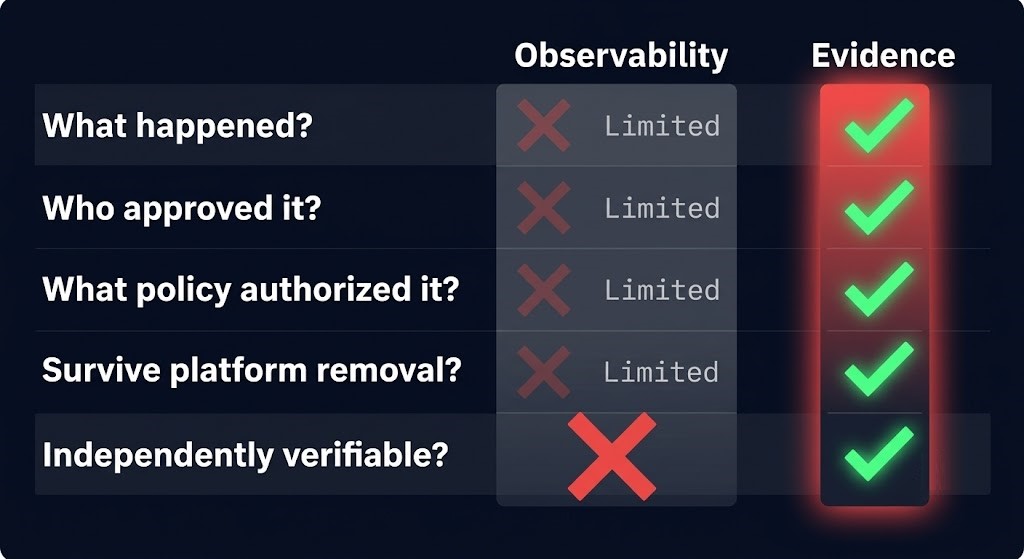
Every “no” and “limited” in that table is a place where an organization believes it has an answer and, under scrutiny, discovers it doesn’t.
Why This Gap Stays Invisible Until It’s Tested
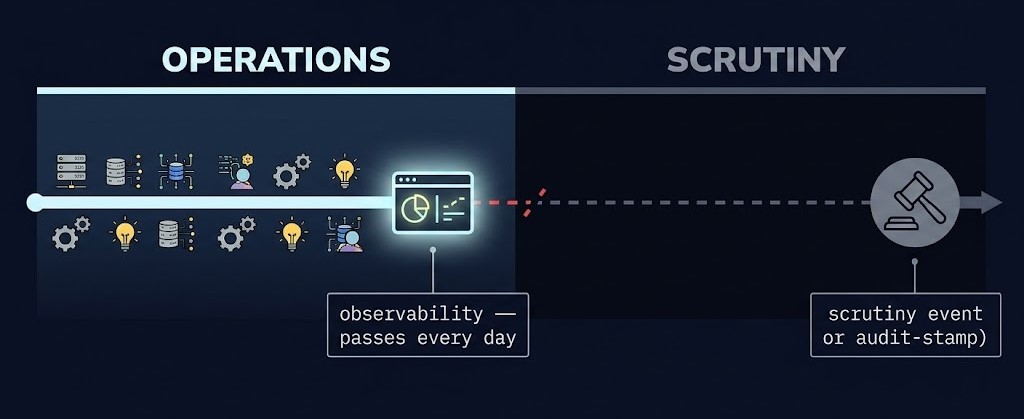
The reason this goes unnoticed for so long is structural, not accidental: observability succeeds during operations. Evidence is tested during scrutiny. Those are different audiences with different tolerances, and only one of them shows up during normal business.
Operations teams love observability, correctly — it’s what lets them find and fix a problem at 2am. An AI evidence platform doesn’t get built during that calm period, because nothing during normal operations ever asks it to defend anything. Auditors, regulators, legal teams, and investigators require evidence, and they don’t show up during normal operations. They show up after something has already gone wrong, or after a regulator has already asked, which means the first time most organizations discover the gap is the first time it actually matters. Who Approved the Model’s Output? covers exactly this failure mode at the authorization layer — the platform ran the model, but nobody can produce, after the fact, who signed off on it running. The Model Answered. Nobody Asked Who Authorized That. is the same gap one layer earlier, at the point of execution rather than the point of review.
The Procurement Failure Underneath the Technical One
This is the part that doesn’t show up in the architecture diagrams, and it’s the actual reason this gap is this widespread. During procurement, infrastructure evaluated visibility, security evaluated access controls, and legal reviewed contract language. Nobody was explicitly accountable for proving authorization history six months later. Every function in the room did its job correctly, on the scope it was handed. None of those scopes included evidence survivability, because nobody wrote it into any of them. Every scope in the room was evaluated correctly; none of them was named “AI evidence platform,” so none of them was accountable for building one.
That’s worth asking directly, because the answer is more useful than the observation:
- Who owned the purchase?
- Who owned governance?
- Who owned evidence requirements?
- Who assumed somebody else handled it?
In most organizations, the honest answer to all four is the same word: nobody. Not because anyone was negligent — because the purchase was scoped as an operations decision, evaluated by operations criteria, and evidence requirements were never assigned to a function that would have flagged them. Your AI Vendor Became Critical Infrastructure Before The Contract Did is the same procurement failure pattern from a different angle: critical dependencies get established faster than the contractual and governance scaffolding meant to cover them.
If your organization is facing this gap and doesn’t yet have a clear owner for evidence requirements, the AI Governance Assessment is built to surface exactly this — not a technology audit, but a scope audit for whether you have an AI evidence platform or just an observability layer wearing its name, and who’s accountable for closing the difference.
Architect’s Verdict
The purchase wasn’t wrong. The scope was. Every organization that bought an observability platform bought something real and useful — the failure wasn’t in the product, it was in the unstated assumption that visibility and proof were the same requirement, evaluated by the same criteria, satisfied by the same purchase. An AI evidence platform is a governance requirement, not a line item — treating it as the latter is the mistake this entire post is describing.
The regulatory pressure this gap sits under isn’t hypothetical or distant — the EU AI Act enforcement timeline turns “can you prove this” from a hypothetical audit question into a compliance deadline with a date attached. Organizations that treat evidence as a feature they’ll add later are treating a governance requirement as a product roadmap item, and those two things do not move on the same schedule.
The hardest evidence problem isn’t collecting evidence. It’s determining whether the evidence still exists when the platform that generated it cannot be trusted. Many organizations assume evidence exists because a platform can display information. The moment that platform becomes unavailable, disputed, or untrusted is the moment they discover whether evidence actually exists.
Additional Resources
View 2 more resources
Editorial Integrity & Security Protocol
This technical deep-dive adheres to the Rack2Cloud Deterministic Integrity Standard. All benchmarks and security audits are derived from zero-trust validation protocols within our isolated lab environments. No vendor influence.

R.M.
Senior Solutions Architect with 25+ years of experience in HCI, cloud strategy, and data resilience. As the lead behind Rack2Cloud, I focus on lab-verified guidance for complex enterprise transitions. View Credentials →
Get the Playbooks Vendors Won’t Publish
Choose the architecture problems you care about. Get field-tested playbooks and frameworks delivered to your inbox.
- > AI Infrastructure & Inference Economics
- > Cloud Strategy & Hidden Cost Models
- > Virtualization & Deterministic Migration
- > Kubernetes, IaC & Modern Infrastructure
- > Data Protection & Recovery Engineering
Zero spam. Includes The Dispatch weekly drop.
Need Architectural Guidance?
Independent review before major infrastructure decisions.
- > Validate assumptions
- > Identify hidden dependencies
- > Quantify migration risk
- > Challenge vendor narratives
Triage · Advisory · Fractional · Direct Hire