

Infrastructure Pipeline Survivability Analyzer
Can Your Infrastructure Survive Losing Its Control Plane?
Stop Assuming Recoverable. Start Measuring Control Plane Survivability.
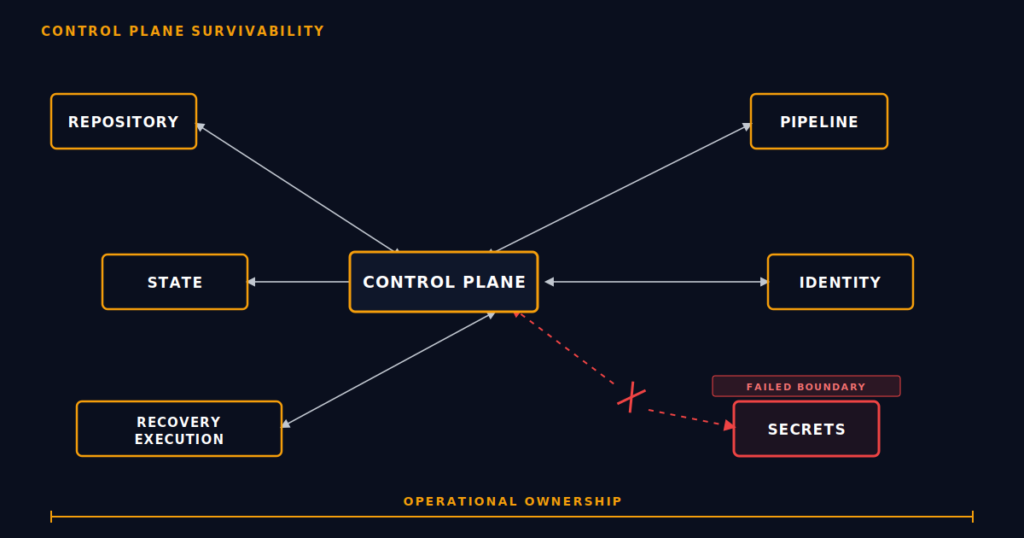
Most infrastructure teams have tested backups, VM restores, and application-level failover. Very few have tested what happens when the systems that operate infrastructure — Terraform, the CI/CD pipeline, the secrets manager, Git, the state backend — are themselves the thing that’s down. As Infrastructure Survivability Starts In The Pipeline lays out, availability and survivability measure different properties. A control plane can be highly available and still be architecturally unrecoverable.
The Infrastructure Pipeline Survivability Analyzer scores six control-plane domains — Repository, Pipeline, Infrastructure State, Identity, Secrets, and Operational Ownership — against a weighted 0–100 scale, then surfaces the single weakest boundary and what actually fails when it’s exercised. Failover that looks plausible on a diagram is not the same as failover that executes under real disruption — the gap Multi-Cloud Failover Is Mostly Theater covers from the execution side.
Built for architects running the Modern Infrastructure & IaC Learning Path — this analyzer is the diagnostic layer that sits between “our recovery plan exists” and “our recovery plan actually executes when the tools we’d use to fix it are the tools that are down,” the exact governance boundary the path’s Governance & Drift stage addresses from the control side.
Key Features
Boundary Diagnosed.
Now Architect The Recovery.
The analyzer surfaces where the control plane fails. The harder question is what an actually-survivable recovery architecture looks like across your state backend, pipeline, identity, and secrets systems — before you have to prove it during an outage instead of before one.
Control Plane Survivability Review
Vendor-agnostic assessment of what actually happens when your automation control plane goes down — and what it would take to close the gap between availability and survivability.
- > State & pipeline recovery independence
- > Identity and secrets break-glass design
- > Recovery runbook ownership transfer
- > Availability vs. survivability gap closure
Architecture Playbooks. Every Week.
Field-tested patterns on control plane survivability, recovery architecture, and the difference between staying online and staying recoverable — from real enterprise environments. No vendor marketing. Just architecture depth.
- > Infrastructure Pipeline Survivability
- > GitOps & CI/CD Architecture Patterns
- > Recovery vs. Continuity Case Studies
- > Real Failure-Mode Case Studies
Zero spam. Unsubscribe anytime.
Frequently Asked Questions
Q: What does the Infrastructure Pipeline Survivability Analyzer actually measure?
A: Whether your infrastructure control plane — the systems you’d use to rebuild, modify, or recover infrastructure, not the infrastructure itself — can survive disruption. It scores six domains: Repository, Pipeline, Infrastructure State, Identity, Secrets, and Operational Ownership, and surfaces the single weakest boundary rather than an averaged score.
Q: How is this different from a disaster recovery or backup calculator?
A: DR and backup tools assess whether workloads and data can be restored. This tool assesses whether the systems required to execute that restoration — Terraform, CI/CD, Git, identity, secrets — are themselves independent of the outage. A recovery plan that depends on the thing that’s down isn’t a recovery plan.
Q: What environments does this cover?
A: Any infrastructure-as-code environment with a CI/CD-driven change process — Terraform, OpenTofu, or similar, across cloud, hybrid, or on-prem. The assessment is self-reported and provider-agnostic; it does not scan your actual environment.
Q: Does the availability comparison affect my survivability score?
A: No. The availability target you optionally enter is a comparison point only — it never feeds back into the six-domain scoring model. The survivability score reflects your control-plane answers alone.
Q: Is any data sent to a server or stored?
A: No. All twelve answers, the scoring, and the chain visualization are computed entirely in your browser’s client-side memory. Nothing is transmitted to Rack2Cloud servers or any third-party API.
Q: Why is Operational Ownership treated differently from the other five domains?
A: The first five domains are technical dependencies — a chain that can break at any link. Operational Ownership is an organizational condition: it determines whether the other five boundaries can actually be exercised during an incident, regardless of how they score individually. That’s why it renders as a spanning band, not a sixth link.
🔒 Privacy Architecture: No cookies. No tracking pixels. No server-side database.
This logic runs entirely in your local browser session.