

The Gateway Consolidated Your Controls. NetScaler Compromise Response Has to Unconsolidate Them.
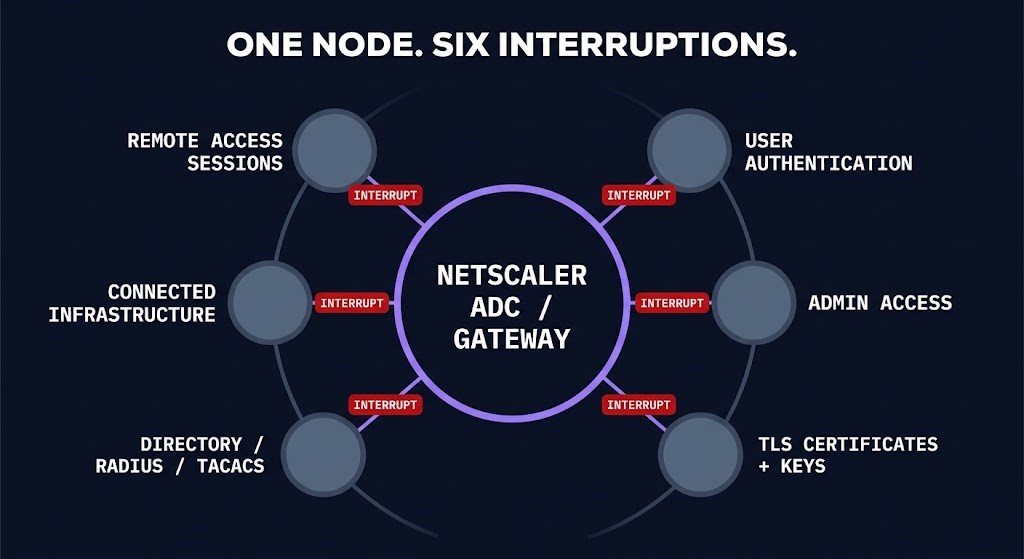
NetScaler compromise response is difficult for the same reason the appliance is valuable: it concentrates authentication, remote access, certificates and administrative trust in one node, so every step of response has to unwind that concentration.
Citrix disclosed eight NetScaler ADC and Gateway vulnerabilities on September 27, 2026, two of them already exploited. The guidance that followed from Citrix, CISA and Google’s Mandiant and Threat Intelligence Group reads less like a patch procedure than a list of interruptions, and the order depends on what you find on the appliance.
What Was Disclosed, and What Wasn’t
Citrix published bulletin CTX697096 on September 27, 2026, covering CVE-2026-88771 through CVE-2026-88778. The bulletin says exploitation of CVE-2026-88771 and CVE-2026-88772 has been observed on unmitigated deployments. The first is an unauthenticated command-execution flaw that affects every deployment in its default configuration. The second is a memory-overflow flaw that requires DTLS, which is on by default for VPN virtual servers. The bulletin covers customer-managed deployments; Citrix upgrades its own cloud-managed services.
CISA added both to its Known Exploited Vulnerabilities catalog the same day, with a September 30 federal remediation date and a requirement for forensic triage under BOD 26-04. Its alert also carries a caution that matters later in this note: preserve forensic evidence before applying updates, because updates can cost forensic visibility.
The bulletin says nothing about how long exploitation had been running, how widely, or by whom. The public source for that is Google’s Mandiant and Threat Intelligence Group, whose September 29 report describes a campaign against CVE-2026-88772 that was “ongoing since at least early September,” with likely impact on government, financial services, technology, education, and legal and professional services organizations in North America and Europe. For CVE-2026-88771 the report relies on the vendor’s disclosure rather than its own analysis. It does not attribute the activity, and neither does this note. How long an exposure runs before an operator can see it is a cost in its own right, covered in patch visibility debt, and it is why the missing start date matters for NetScaler compromise response.
Concentration Is the Point of the Appliance
A NetScaler in the path exists so that authentication brokering, TLS termination, remote access and policy enforcement happen in one controlled place instead of inside every application behind it. Deciding where to concentrate enforcement is a cloud architecture strategy decision, and it is also a decision about where failure will concentrate. Google’s report notes that these devices face the internet, sit outside endpoint detection, and often store or process credentials that reach deeper into the network. Because TLS terminates on the appliance, upstream network devices generally cannot see the request paths or headers inside it.
None of that is an argument against gateways. The concentration is the design working. The argument is about what happens afterward, because NetScaler compromise response inherits the concentration. Whatever the appliance holds, response has to invalidate. Whatever it fronts, response has to be ready to interrupt. The question for an architect is not whether the appliance is important, which was settled when it was placed in the path, but whether anyone has written down what it costs to take it out of service, and who may decide to.
NetScaler Compromise Response Is a Sequence of Interruptions
Three documents describe what to do, and they start from different states. CISA writes for the gap between disclosure and update. Google’s guidance writes for an estate that may or may not be compromised. Citrix’s standing article on suspected compromise writes for an appliance you no longer trust. Each step in NetScaler compromise response has a service cost, and several steps cost the same service.
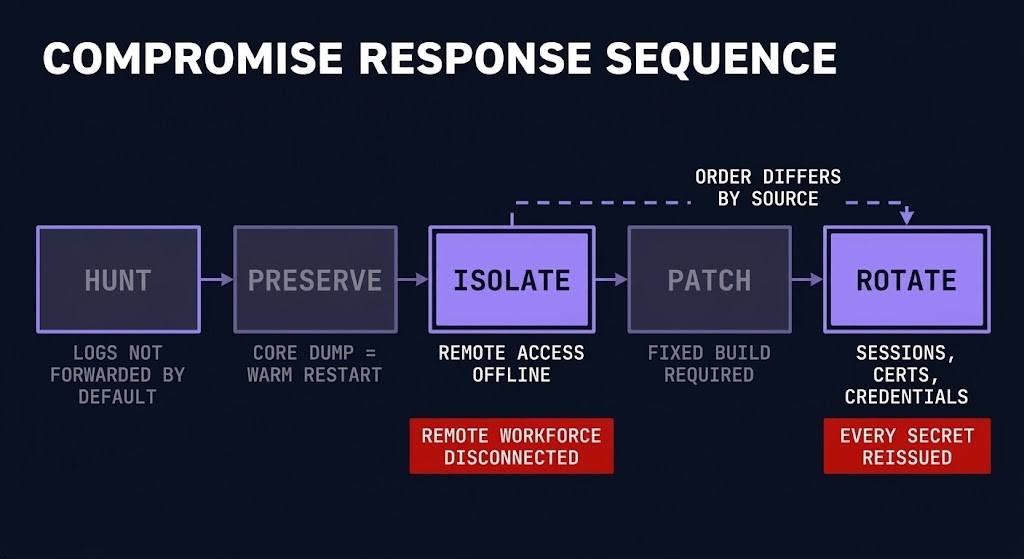
Evidence comes first, if you can afford it. Citrix’s article starts with preservation: snapshot a virtual appliance, record system time and NTP settings before isolation, keep remote syslog and management-console logs, and collect a support bundle, while noting that the vendor does not support forensic investigation. Its next step is a core file of the packet engine, and the article states that the system performs a warm restart during that process and drops SSH sessions. Google asks for a memory-inclusive snapshot of a virtual appliance before any reboot where operationally possible, and several of its detections depend on logs the appliance does not forward by default. That matters because the actor Google describes scrubbed its traces from appliance files and, per Google’s hunting guidance, from web access logs, which is the boundary in your logs are not evidence if the infrastructure that produces them can rewrite the record.
Then isolation, which for a gateway means removing remote access. Google says isolating a compromised or suspected appliance can cause significant business disruption where the appliance provides remote access, and that broad internet isolation or strict allow-listing disrupts remote workforces. It recommends a targeted, phased approach that prioritizes the fixed build, with isolation weighed against risk tolerance and operational requirements. When the appliance fronts services owned by several teams, who may make that call is an ownership question before it is a technical one, the pattern in an ownership problem, not a technology problem.
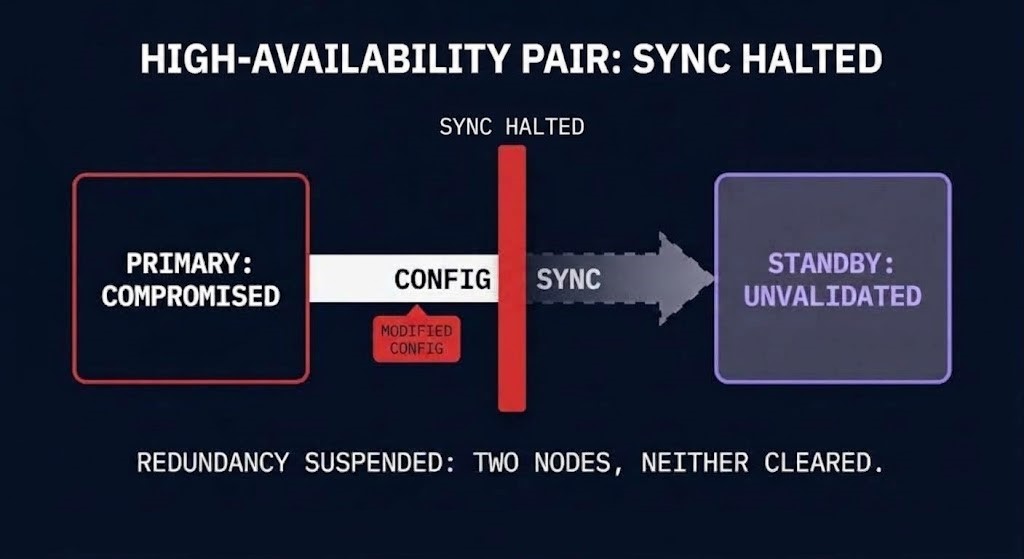
In a high-availability pair, Google adds a step that turns the redundancy mechanism into the thing being contained: halt configuration synchronization and assess each node independently, so a compromised node cannot replicate attacker-modified configuration to its standby. Google presents this as a preventive step, not a reported occurrence. The architectural reading is mine. The feature that keeps the pair available is also a propagation path, so containment means running the pair as two unvalidated nodes until each is cleared. Delay is exposure. Action is lost redundancy.
Then the fix, which is not one action either. Citrix’s article has virtual appliances replaced rather than repaired, firmware upgraded before any configuration is restored, and the restored backup verified to predate the compromise. That last condition needs a date. Google’s early-September floor covers one of the two exploited flaws, and the vendor bulletin gives no date for either. Citrix’s article also says that where law enforcement involvement is possible, counsel should weigh in before rebuild, because evidence preservation can outrank restoring service. And a fixed build closes the flaw without evicting an actor who persisted through it. Google describes web-server configuration changes, an elevated-privilege setting on the shell and an appliance reboot used to make access survive, which is the argument in the server was fixed and persistent access wasn’t.
What Concentration Makes You Rotate
The rotation guidance in NetScaler compromise response is where the concentration becomes visible. Google and Citrix both list what has to change, and the lists overlap almost entirely. They differ on timing: Citrix revokes before the rebuild and rotates restored secrets afterward, while Google places rotation after patching.
| What the appliance concentrates | What the guidance has you change | Who feels it |
|---|---|---|
| Remote-access sessions, including administrative, Gateway, VPN and ICA/HDX | Revoke and terminate the sessions | Every user connected through the node |
| User accounts authenticated through Gateway or AAA virtual servers | Change credentials on their respective systems (Citrix) | Every user population the node authenticated |
| Appliance administrator, local and SSH credentials, plus key encryption keys (Citrix) | Rotate | Administrators and the automation that uses them |
| Certificates and private keys | Revoke and replace | Every service that presents the node’s certificate |
| LDAP, RADIUS, TACACS, SNMP and API integration credentials | Change on the systems they authenticate to | Identity, network and monitoring teams at once |
| Connected infrastructure such as StoreFront, delivery controllers and session hosts | Review for lateral movement | Teams that never owned the appliance |
The first two columns come from the two documents. The third is my analysis.
Read down the first column and you have the appliance’s real dependency map: the directory, the authentication path, the certificate chain, the management plane and the user population, all in one node. Nobody drew it that way when the appliance was deployed, and it was there the whole time.
Questions to Run Against Your Estate
Run these against your estate before NetScaler compromise response is something you are doing rather than planning:
PRE-INCIDENT QUESTIONS
- What terminates on each NetScaler, and which teams own the services behind it?
- Who may authorize isolating a Gateway, and is that authority written down?
- Is the list of secrets, certificates and integration credentials on each appliance maintained, or would you be assembling it during response?
- Does the runbook say when to halt synchronization in a high-availability pair, and what redundancy you give up while it is halted?
- Which configuration backup would you trust, and how would you show when it was taken relative to the compromise?
Architect’s Verdict
A gateway consolidates controls on purpose, and compromise response has to unconsolidate them on demand. NetScaler compromise response is not a patch. It is an ordered series of interruptions to everything the appliance was trusted to hold together.
Every incident response interrupts service, so that alone is not the argument. The difference is scope. Each decision in this sequence reaches every service that shared the node, and the public guidance enumerates them: sessions, administrative access, certificates, directory and authentication integrations, management integrations, and the infrastructure connected behind it.
The rotation inventory is the architecture diagram. It shows what the appliance concentrated, in the order a responder has to undo it, and it is more accurate than any design document written when the appliance was deployed.
Gateways earn their place in the path. The cost of that placement arrives as a list, on the day you trust the node least.
Additional Resources
View 1 more resource
Editorial Integrity & Security Protocol
This technical deep-dive adheres to the Rack2Cloud Deterministic Integrity Standard. All benchmarks and security audits are derived from zero-trust validation protocols within our isolated lab environments. No vendor influence.

R.M.
Senior Solutions Architect with 25+ years of experience in HCI, cloud strategy, and data resilience. As the lead behind Rack2Cloud, I focus on lab-verified guidance for complex enterprise transitions. View Credentials →
Get the Playbooks Vendors Won’t Publish
Choose the architecture problems you care about. Get field-tested playbooks and frameworks delivered to your inbox.
- > AI Infrastructure & Inference Economics
- > Cloud Strategy & Hidden Cost Models
- > Virtualization & Deterministic Migration
- > Kubernetes, IaC & Modern Infrastructure
- > Data Protection & Recovery Engineering
Zero spam. Includes The Dispatch weekly drop.
Need Architectural Guidance?
Independent review before major infrastructure decisions.
- > Validate assumptions
- > Identify hidden dependencies
- > Quantify migration risk
- > Challenge vendor narratives
Triage · Advisory · Fractional · Direct Hire