

The Host Networking Stack Is Part of the Guest Isolation Boundary
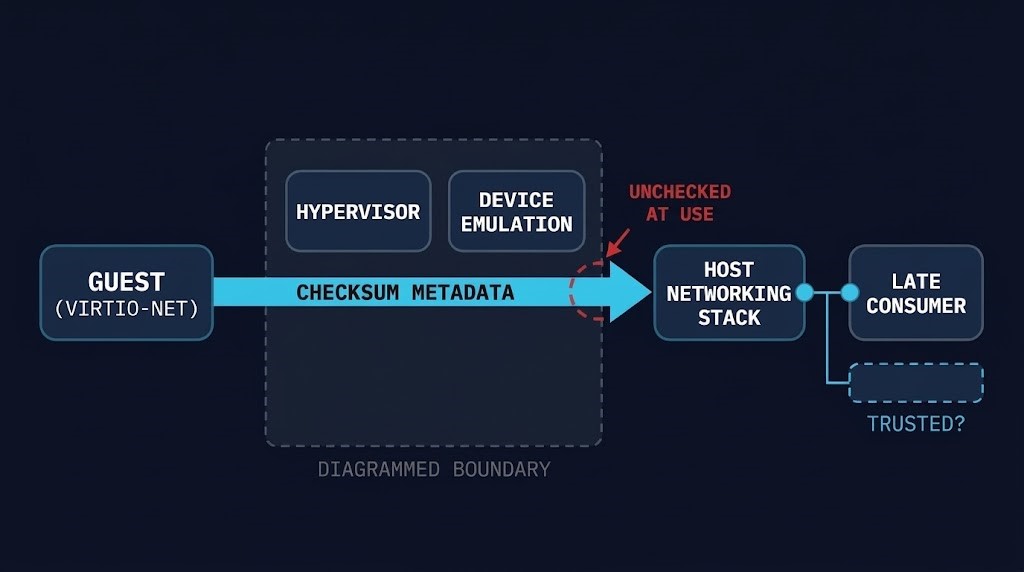
On a KVM host that attaches guests through virtio-net, the host networking stack is part of the guest isolation boundary, whether or not the isolation design drew it that way. CVE-2026-99999, published on October 15 and fixed upstream in commit 6785011f8b16, is the clearest recent demonstration. A checksum hint supplied by the guest reaches IPv4 code on the host, and that code acts on it after the packet has already been parsed and trusted.
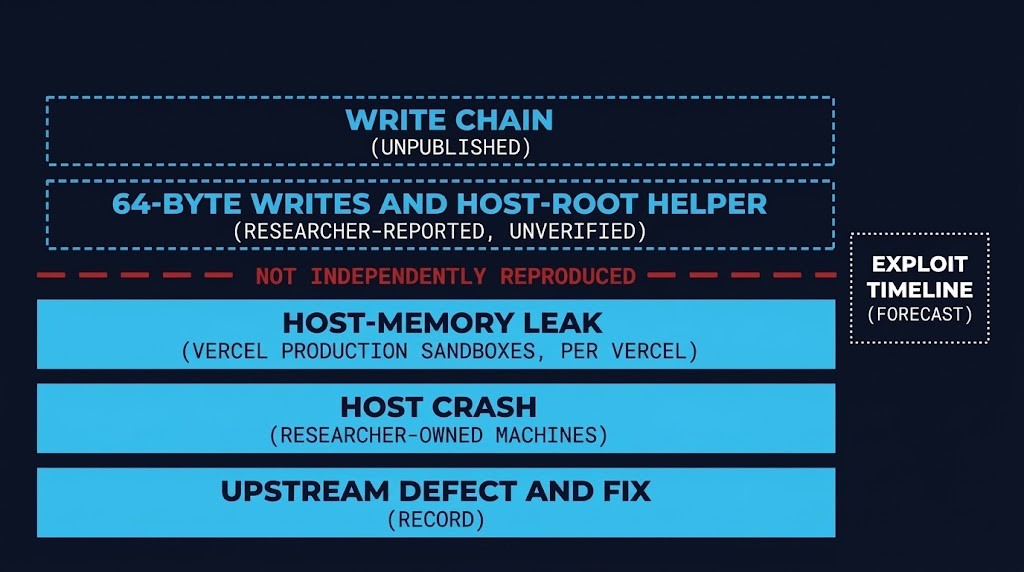
The researchers at pwn.ai, who named the flaw PwnEscape, demonstrated host-memory disclosure against Vercel production sandboxes. They also demonstrated host crashes, and they report a host-command-execution chain, on their own KVM and Firecracker machines. The detailed write chain remains unpublished. Those results have different evidentiary boundaries, and the architectural argument does not require treating them as equivalent.
What Was Reported, and at What Evidence Level
Whether a vulnerability changes a virtualization architecture depends on what was demonstrated, where, and by whom. The sources here do not all say the same thing about the host networking stack, so the table labels each claim by its basis.
| Claim | Basis | Evidence label |
|---|---|---|
| Guest-controlled checksum metadata can corrupt the IPv4 header on the host and leak host memory | pwn.ai write-up; Vercel’s findings report | Demonstrated by the researcher; Vercel states the leak was demonstrated against its production sandboxes |
| The same flaw crashes the host | pwn.ai (researcher-owned Linux 6.12 and 7.x hosts); Vercel (two packets, researcher’s own KVM and Firecracker machines) | Demonstrated on researcher-owned machines |
| Selected 64-byte host-kernel writes, then a host-root helper executed in a lab | pwn.ai; Vercel restates host command execution with administrator privileges on the researcher’s own machines | Researcher-reported. The write chain is unpublished, deferred to a Part 2 |
| The upstream fix is defense in depth and broader input validation is still to come | Commit message, via the kernel CVE record | Upstream fact |
| Exploits for weaker configurations within weeks, for default configurations within a month | pwn.ai | Forecast |
| Customer data accessed in Vercel Sandbox | Vercel said no reports showed anyone accessing customer data in Vercel Sandbox | Not reported |
The byte-level account that follows is pwn.ai’s description of a controlled test geometry. The kernel record describes the defect class: a packet with bad checksum metadata lets the checksum helper corrupt the network header. Vercel’s report states the same three outcomes, a leak, a crash and code execution. Neither the kernel record nor Vercel’s report reproduces the byte-level sequence, so it is attributed to the researcher and not asserted.
The Host Networking Stack Is Part of the Isolation Boundary
Isolation reviews of KVM hosts usually enumerate vectors in the hypervisor and its device emulation. This site’s hypervisor kernel hardening post lists three guest-to-hypervisor vectors: shared memory, kernel modules and MMIO. The host networking path is not on that list, and that omission is the point. A virtio-net guest does not only touch emulated hardware. It hands the host packets and, with them, metadata describing work the host should perform later.
On the transmit side, Linux can carry a packet whose checksum is still pending. The packet records where checksum accumulation starts and where the result is written. Those values are not descriptive. They authorize a write into packet memory, and the host will perform it after other code has already looked at the same bytes. Where those packets travel next, through TAP or vhost-net, a bridge, connection tracking and fragmentation, is the host’s virtual networking architecture, and an isolation review that stops at the hypervisor does not cover it.
pwn.ai describes a controlled geometry in which the host parsed an IPv4 header of one length. In its account, a deferred checksum write then changed the header’s length field, and output fragmentation later read the changed value as authoritative and copied more header bytes than the packet’s logical data held. pwn.ai reports that those extra bytes were host memory, and that the first bounded disclosure was 32 bytes per active case. None of this sequence is independently reproduced here, and these figures describe the researcher’s test setup. They are the evidence for a disclosure primitive, not a measure of what any given production host leaks. The defect sits in the host networking stack, and the researcher is explicit that “escape” names the boundary crossed, not the location of the bug.
Trust Inversion: Validated Early, Acted On Late
pwn.ai calls the pattern deferred-metadata trust inversion. It is their descriptive name, not an established term, and it is useful because it names the order of events. Untrusted metadata enters and is validated against an early representation. The packet is then normalized, parsed and authorized. A metadata-driven operation runs later, security-relevant bytes change, and a later consumer trusts the changed interpretation.
The researcher separates three trust transitions inside that sequence. Origin trust: a less-trusted guest describes an operation the host will carry out. Interpretation trust: the packet changes representation as link-layer headers are processed, so a value checked against one view is used against another. Temporal trust: a deferred operation alters state that other code has already parsed.
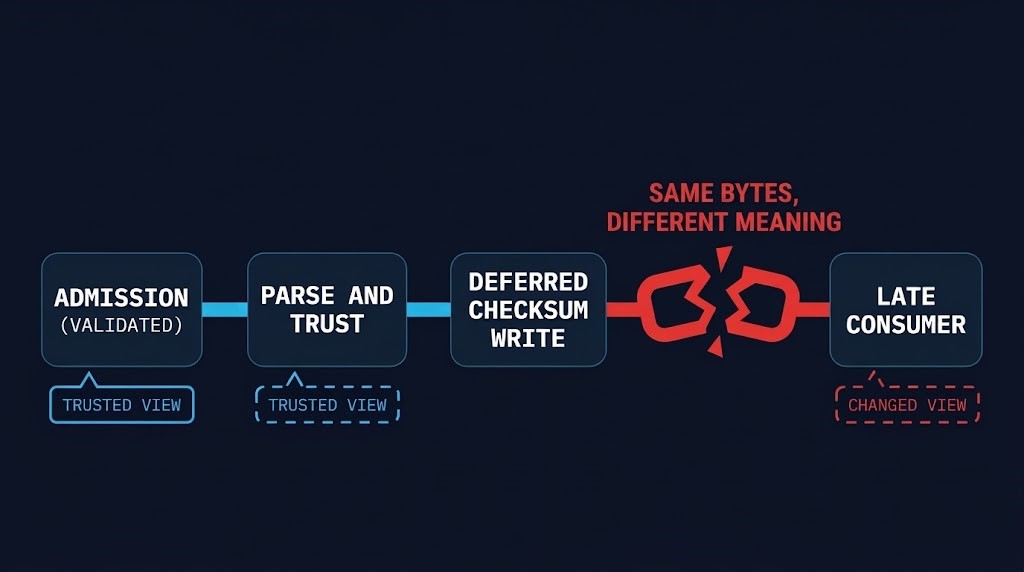
The audit question follows from the sequence. It is not whether the checksum offsets were validated at admission. It is whether, after every transformation, a deferred writer can still target bytes whose meaning has already been trusted. A packet can pass admission legitimately and still reach that state, because the failure sits in the order of operations and not at the door. Reviews that treat the host networking stack as plumbing, and not as a parser of guest-controlled data, never ask the question.
This is also why hardening controls are the wrong lens. The KASLR, SMEP and SMAP measurement post names the information leak as the condition under which KASLR stops mattering. A repeatable host-memory disclosure is a leak of that kind. The researcher says host-memory observations informed the later write work. The researcher does not publish whether or how KASLR was defeated, and this post makes no claim either way.
What the Fix Closes and What It Does Not
The accepted upstream change checks, before a checksum is completed, that the checksum start lies beyond the IPv4 header. It adds that check in five consumers. The files the patch touches cover output fragmentation, bridge connection tracking, NFQUEUE, the CHECKSUM target and xfrm output, with a shared helper in the IPv4 header file. Per pwn.ai, mainline took it on October 14, and the stable branches carry it in 5.10.272, 5.15.223, 6.1.190, 6.6.159, 6.12.113, 6.18.57 and 7.2.11. The CVE record dates the introducing commit to 2.6.27.
The commit message calls the change defense in depth and says a more complete validation at input is forthcoming but needs more work. The guard checks that checksum completion cannot start inside the IPv4 header. It is not a declaration that every downstream transport-field mutation or every related validation path is safe. The researcher also notes that reviewers raised concerns about later mutation of transport fields after policy checks, and states that those are related consistency risks and not addressed by the IPv4 fix. Five consumers in the host networking stack now carry the guard, and the metadata that reaches them is still guest-controlled. A patched host closes this instance. The class is not declared closed.
Severity is not settled either. The kernel CNA scores the issue 9.3 critical with no privileges required. Red Hat scores it 8.8, Important, with low privileges required. Ubuntu lists its priority as Medium. AWS describes the actor as having privileged access inside a guest. Each assessment rests on its own assumption about attacker position and guest privilege. Practical exposure on a given host depends on who can submit guest-controlled packets to it and which of those assumptions applies.
Vendor status checked October 21, 2026
Fixed, affected, vulnerable and no advisory found are different statements. Each row links its source. Downstream vendors backport patches without taking the upstream version number, so comparing a vendor kernel against the upstream list above can mislead. Amazon Linux 2023 ships its fix in kernel-6.1.188-233.385.amzn2023, a number below upstream 6.1.190. Read the vendor advisory for the exact build.
| Distribution | Status | Source |
|---|---|---|
| Debian 12 (bookworm) | Fixed in 6.1.190-1 | DLA-4841-1, Debian tracker |
| Debian 13 (trixie) | Fixed in 6.12.113-1 | DSA-6568-1, Debian tracker |
| RHEL 9 | Fixed, RHSA-2026:86033 | Red Hat CVE page |
| AlmaLinux 9 | Fixed, ALSA-2026:86033 | AlmaLinux errata |
| RHEL 10 (current stream) and RHEL 8 | Affected, no erratum listed | Red Hat CVE page |
| Ubuntu 22.04, 24.04, 26.04 | Vulnerable | Ubuntu tracker |
| Rocky Linux 9 | No advisory found | Rocky errata search |
| Amazon Linux 2 and 2023 | Fixed builds listed | AWS bulletin 2026-137-AWS |
What to Verify on Your Own Hosts
DIAGNOSTIC QUESTION
“Which of your hosts run guests you do not administer, and has anyone tested the host networking stack as part of their isolation boundary?”
The sources do not say which host configurations reach the patched consumers, so the work here is inventory and not lookup. AWS names self-managed KVM with virtio-net, Firecracker included, on unpatched kernels. Red Hat describes a local attacker or untrusted guest. Beyond that, the reachable paths depend on how the host forwards, bridges and filters guest traffic.
HOST INVENTORY
- Hosts that run guests you do not administer, attached through virtio-net with TAP or vhost-net.
- Whether each host kernel is upstream or vendor-built, and what the vendor advisory says for that exact build, including whether a reboot is pending.
- Which of the changed paths exist on the host data path: forwarding with fragmentation, bridge connection tracking, NFQUEUE, the CHECKSUM target, IPsec.
- Who owns the claim that the host networking stack sits inside the isolation review, and when it was last tested through the channel the guest is allowed to use.
The last item is an ownership question before it is a technical one. An isolation claim that nobody verifies through the channels the environment is built to leave open ages silently, and a virtio-net device is that channel for a guest.
What Remains Unpublished
⚠ WHAT THIS DOES NOT ESTABLISH
It does not establish that every KVM configuration is exploitable, that any production host was compromised, or that the unpublished write chain works as described. Vercel said no reports showed anyone accessing customer data in Vercel Sandbox. The exploit timeline is the researcher’s forecast.
The researcher defers the allocator-sensitive write chain, the object-lifetime controls and the hypervisor-specific adaptation to a second article. Until it appears, host code execution rests on the researcher’s report and Vercel’s restatement of it, both describing machines the researcher owns. The researcher also claims a new class of attacks in Linux networking and exposure across many other hypervisor environments. Those are the researcher’s claims, and this post evaluates neither.
Architect’s Verdict
The isolation boundary on a KVM host includes every piece of host kernel code that acts on data a guest supplies. The host networking stack is such code, and it was never drawn inside the boundary because the diagram stopped at the hypervisor.
The real problem is not that one checksum path lacked a check. Admission-time validation is necessary and does not cover a deferred writer that changes bytes after they were trusted. Reviews that ask whether input was validated will keep passing hosts that fail on the order of operations.
Patching matters, and the fix is a defense-in-depth guard with broader validation still to come. It closes this instance. Closing the class takes someone who owns the question of what the guest can steer on the host, and who tests it. The host networking stack deserves the scrutiny a hypervisor’s device emulation already gets.
A boundary drawn at the hypervisor leaves out code the guest can steer. The guest does not honor the diagram.
Additional Resources
Editorial Integrity & Security Protocol
This technical deep-dive adheres to the Rack2Cloud Deterministic Integrity Standard. All benchmarks and security audits are derived from zero-trust validation protocols within our isolated lab environments. No vendor influence.

R.M.
Senior Solutions Architect with 25+ years of experience in HCI, cloud strategy, and data resilience. As the lead behind Rack2Cloud, I focus on lab-verified guidance for complex enterprise transitions. View Credentials →
Get the Playbooks Vendors Won’t Publish
Choose the architecture problems you care about. Get field-tested playbooks and frameworks delivered to your inbox.
- > AI Infrastructure & Inference Economics
- > Cloud Strategy & Hidden Cost Models
- > Virtualization & Deterministic Migration
- > Kubernetes, IaC & Modern Infrastructure
- > Data Protection & Recovery Engineering
Zero spam. Includes The Dispatch weekly drop.
Need Architectural Guidance?
Independent review before major infrastructure decisions.
- > Validate assumptions
- > Identify hidden dependencies
- > Quantify migration risk
- > Challenge vendor narratives
Triage · Advisory · Fractional · Direct Hire