

Certificate Issuance Authority Follows the Signing Identity, Not the Issuer Resource
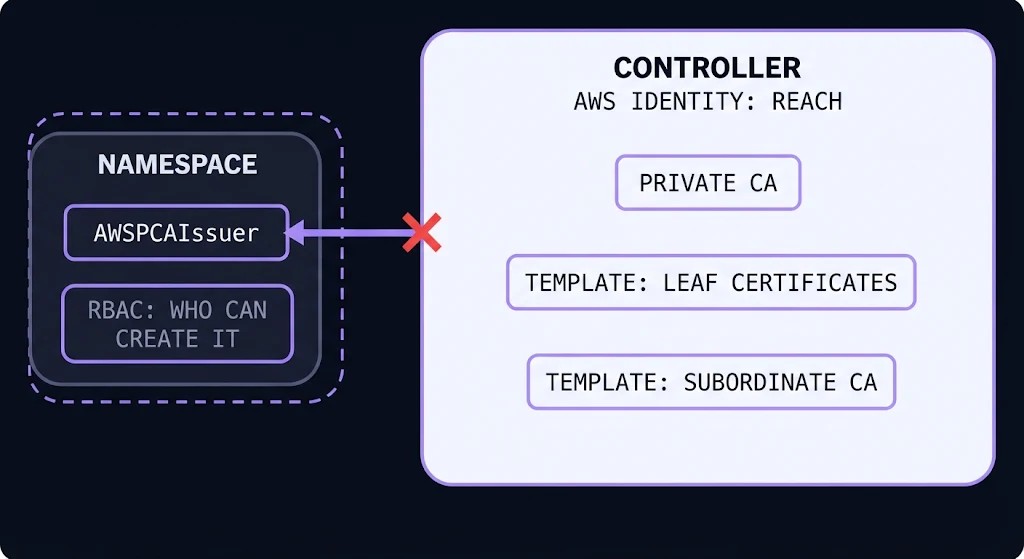
Certificate issuance authority in AWS Private CA Connector for Kubernetes (aws-privateca-issuer) sits with the AWS identity that signs, and two AWS bulletins published 19 days apart describe three paths in which that identity was not the one the Kubernetes permissions implied. In each, a user whose permissions authorized only a namespace-scoped issuer could obtain certificates, including subordinate CA certificates, that those permissions did not authorize. The decision is where that authority is isolated: at the Kubernetes issuer resource, or at the AWS identity the controller signs with.
What the Two AWS Bulletins State, and What They Do Not
Both bulletins concern aws-privateca-issuer, the open-source cert-manager external issuer AWS maintains and distributes as an Amazon EKS add-on. Whether a tenant can obtain certificates it was never meant to hold is a cloud strategy architecture question as much as a patching one, because it depends on where certificate issuance authority was delegated. Everything in the table is AWS’s own bulletin text, read on the bulletin pages on November 20: 2026-156-AWS and 2026-187-AWS. NOT STATED marks something the bulletin does not say; it is not a finding that the answer is no.
| Path and bulletin | Precondition stated | What could be obtained | Fixed in | What stops working on upgrade |
|---|---|---|---|---|
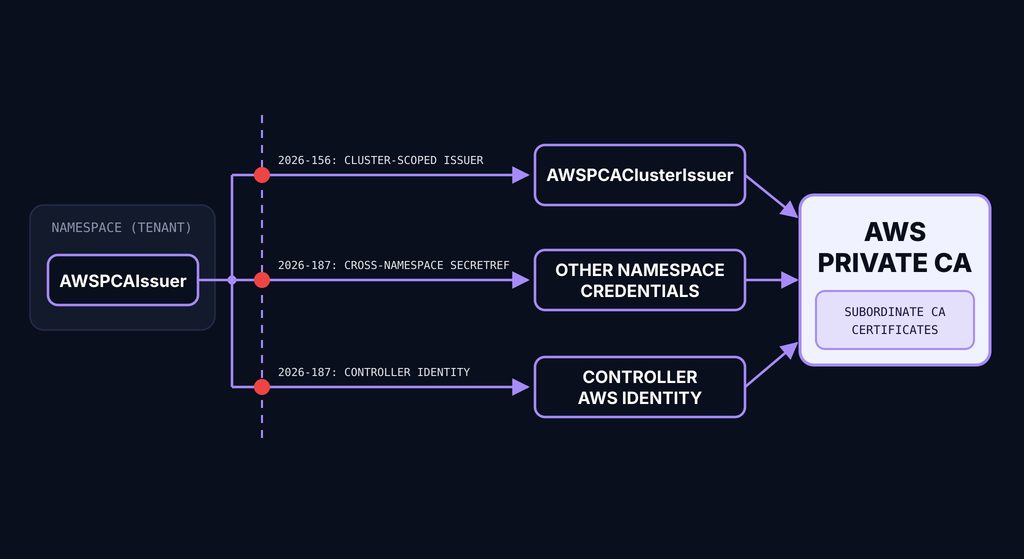
| 1. 2026-156-AWS, 10/29/2026, CVE-2026-119115 | Authenticated user whose approval policy authorizes only a namespace-scoped issuer; “under certain conditions” | Certificates, including subordinate CA certificates, signed by a cluster-scoped issuer the user is not authorized to use | v1.10.1 (EKS add-on v1.10.1-eksbuild.1) | Wrong or missing issuerRef.kind goes Failed; kind: AWSPCAIssuer on a cluster-scoped issuer stays Pending; renewals stop |
| 2. 2026-187-AWS, 11/17/2026, CVE-2026-130622 | User who can create namespace-scoped issuers; issuer references a credentials Secret in another namespace (only where a namespace stores AWS access keys in a Secret) | Certificates, including subordinate CA certificates, signed with that namespace’s AWS credentials | v1.12.0 (EKS add-on v1.12.0-eksbuild.1) | Cross-namespace secretRef rejected; issuers relying on it stop issuing |
| 3. 2026-187-AWS, 11/17/2026, CVE-2026-130623 | User who can create namespace-scoped issuers; issuer has no credentials or only a role; controller uses its own AWS identity (IRSA, EKS Pod Identity, EC2 Instance Role, IAM Roles Anywhere) | Certificates, including subordinate CA certificates, from every Private CA and template the controller identity, or any role it can assume, reaches | v1.12.0 (EKS add-on v1.12.0-eksbuild.1) | Default fallback to the controller identity removed; issuers relying on it stop issuing |
| NOT STATED | Both bulletins | Exploitation status; how many clusters were affected; whether any subordinate CA certificate was in fact issued | NOT STATED | NOT STATED |
The October 29 bulletin does not describe its “certain conditions,” so this post does not either. The mechanisms also differ: 2026-156 concerns which issuer a request resolves to, 2026-187 concerns which AWS credentials an issuer loads.
Certificate Issuance Authority Lives in the Signing Identity
Rack2Cloud’s run-as service account note reduced a Google permission check to one rule: a principal cannot hand an integration an identity it is not itself entitled to act as. The Principal and Delegate fields in delegation governance name that relationship. An issuer is the same relationship in Kubernetes form. The actor authorized to create the issuer is the delegating party; the AWS identity that signs is the delegate. The question is whether the delegation grants authority the delegating party is entitled to exercise.
In all three paths, the check that should have enforced the rule sat on the wrong object. Certificate issuance authority spans four layers that are not one boundary. Kubernetes permissions govern who can create or update the issuer. The credentials the issuer uses decide who actually signs. The Private CAs and templates those credentials reach decide what can be signed. And the certificates actually issued are best established from the CA’s records, because AWS notes that CertificateRequest resources may have been deleted.
What this adds to the run-as argument is the output. A failed identity check prevents the unauthorized action; a wrong signing identity can produce a certificate. The bulletins describe remediation of the issuance paths, not recall of certificates already issued. AWS’s 2026-187 remediation ends in finding unexpected certificates and revoking them.
The split between the formal owner of a system and the system that decides is what the Control Plane Architecture stage of the Cloud Strategy learning path covers in general. The issuer resource is the owned object. The signing identity is where the decision was made.
Three Paths Between Resource Scope and Signing Reach
Each path is a gap between apparent authority, what the Kubernetes objects imply, and effective authority, what the signing identity can do.
| Path | Apparent authority (Kubernetes) | Effective authority (signing identity) | The decision it exposes |
|---|---|---|---|
| 1. Issuer kind resolution | Approval policy authorizes a namespace-scoped issuer | A cluster-scoped issuer signs | Whether approval policy and RBAC bind issuer kind as well as name |
| 2. Cross-namespace Secret | A namespace-scoped issuer in the tenant’s namespace | Another namespace’s stored AWS credentials sign | Who may point an issuer at a credential they do not own |
| 3. Ambient fallback | An issuer with no credentials, or only a role | The controller’s own AWS identity signs | What the controller identity reaches, against what every issuer creator may use |
Three paths in 19 days is a timeline: October 29 and November 17. Calling them one class is analysis. The common shape is that the person creating or approving the issuer was bound by a Kubernetes boundary that was not the boundary on certificate issuance authority. AWS does not describe the paths as one class, and nothing here depends on AWS agreeing.
The October 29 path is the configured-versus-enforced shape: an approval policy written for one issuer kind did not show which issuer a request resolved to. MCP Policy Enforcement Failed Twice in the AWS API MCP Server tests the same gap on a different AWS server by asking it to do what the policy forbids. A proposed method, not AWS guidance: in a test cluster, request a certificate from a cluster-scoped issuer as a user approved only for a namespace-scoped one. After v1.10.1 AWS says that request stays Pending. Before it, the bulletin says such a request could have been signed, under conditions it does not describe.
The Issuer Delegation Register
The register asks one question per issuer: what can its signing identity do, and who was entitled to hand it that identity? It records where certificate issuance authority actually sits. It is a reconciliation instrument. It exposes the gap between what the cluster says an issuer can do and what its signing identity reaches. It does not guarantee a complete history, and it cannot say what was issued.
| Issuer (kind, namespace) | Who can create or update it | Credential source | CAs and templates the identity reaches | Ambient setting | Expected issuance (cluster records) | CA-side evidence checked |
|---|---|---|---|---|---|---|
AWSPCAClusterIssuer, cluster-scoped | Platform team only | serviceAccountRef / IRSA | Named issuing CA, leaf templates only | Not applicable | Platform workload certificates | Audit report compared, dated |
AWSPCAIssuer, payments | Payments namespace admins | No credentials, ambient fallback | Every CA and template the controller identity, or any role it can assume, reaches, including any subordinate CA template | enableIssuerAmbientCredentials true | Payments service certificates | Not yet checked |
The rows are illustrative values, not findings. The second is the shape CVE-2026-130623 describes.
Credential source takes one of four values: a same-namespace Secret; serviceAccountRef / IRSA; a role reference without issuer credentials, which falls back to the ambient identity; or no credentials, which does the same. After v1.12.0 the last two work only where enableIssuerAmbientCredentials is true, which AWS says restores the fallback and leaves the cluster exposed to CVE-2026-130623. AWS says to use it only where everyone who can create a namespace-scoped issuer is trusted. EKS Pod Identity cannot be assigned per issuer, so AWS says issuers on it should move to IRSA.
Fill the reach column from IAM, not the issuer spec: the policies on the identity and on every role it can assume, down to the certificate templates. A template that can issue subordinate CA certificates is a different row from one that cannot.
The remediation depends on what the register shows. Isolate issuance authority at the identity boundary. Where issuer-level identity assignment is unavailable, restrict who can create issuers, disable ambient credentials, and ensure the controller identity cannot exercise authority tenants should not possess. AWS’s own workaround is narrower. Restricting create and update of AWSPCAIssuer to cluster administrators mitigates both CVEs in 2026-187-AWS until you upgrade. Scoping the controller’s identity reduces only the CVE-2026-130623 risk, and if tenants keep that permission there is no partial mitigation for CVE-2026-130622. AWS states that upgrading is the only complete remediation.
DIAGNOSTIC QUESTION
“If a tenant created an AWSPCAIssuer with no credentials last month, which record would tell you what it signed?”
The Fix Stops Issuance Before It Closes the Gap
Both fixes are breaking changes, and AWS flags each under “Action required before upgrading.”
v1.10.1 requires issuerRef.kind to be exactly AWSPCAIssuer or AWSPCAClusterIssuer and to match the issuer it references. Requests that relied on lenient resolution stop renewing, and AWS says dependent services are affected when those certificates expire. A missing or wrong kind goes Failed, including kind: Issuer, which cert-manager sets for Ingress annotations that do not specify one. A kind: AWSPCAIssuer request pointing at a cluster-scoped issuer stays Pending indefinitely. The effect is delayed: services feel it when the affected certificates expire.
v1.12.0 rejects a cross-namespace secretRef and removes the default fallback to the controller’s identity, so issuers relying on either stop issuing. AWS’s order is to record the affected issuers, apply the v1.12.0 CRDs, then migrate: copy the Secret into the issuer’s namespace and update secretRef.namespace for CVE-2026-130622, and give each issuer that relied on the controller’s identity, including one that sets only a role, its own credentials through a serviceAccountRef with IRSA or a same-namespace secretRef for CVE-2026-130623. A serviceAccountRef needs IRSA set up for the issuer’s ServiceAccount, and the controller needs permission to create tokens for it.
AWS also says to keep both the controller’s identity and the ServiceAccount in each issuer role’s trust policy until the upgrade is complete, then remove the controller’s entry. That overlap is a window by design. Until the entry is removed the role still trusts the identity the upgrade was meant to retire, so each register row carries the date it came out.
Prove Issuance From the CA Side
The cluster is the wrong place to prove what certificate issuance authority actually produced, and AWS says CertificateRequest resources may have been deleted. The procedure in 2026-187-AWS starts at the cluster, with the recorded issuers, the AWSPCAIssuer and CertificateRequest resources, and Kubernetes API audit logs if enabled. It then moves to the CA: generate an AWS Private CA audit report with CreateCertificateAuthorityAuditReport or review CloudTrail IssueCertificate events, retrieve each certificate by ARN with GetCertificate, compare it against the certificates expected in each cluster, and revoke any unexpected one with RevokeCertificate. 2026-156-AWS gives no equivalent recovery steps, so for the first path this is the same method applied by analogy.
The register supplies the expected side of that comparison, and it is only as good as the date it was written. A register built after the fact says what the clusters hold today, not what they expected last month. The bulletins do not state how far back the audit report or CloudTrail records reach in your account. Answer that retention question before the comparison, not after.
Upgrading the controller restores the control. It does not show what was signed before. A ccTLD hijack has the same invariant at another layer: restoring DNS is not restoring issuance control, and a certificate an attacker obtained stays valid until it expires or is revoked.
What revocation removes depends on what was obtained. A leaf is one certificate. A subordinate CA certificate changes the revocation scope: certificates issued beneath it may also need to be considered. The revocation unit is the set one revoke action removes, and it has to enclose the certificates you need gone. That is analysis. The bulletins give the revocation call and do not discuss its scope.
What This Does Not Argue
No claim that any of the three paths was exploited, because neither bulletin states exploitation status. No claim about how many clusters were affected. No claim that any subordinate CA certificate was in fact issued; the bulletins say a user could obtain one. No claim about other cert-manager issuers or the cert-manager approval layer: this post covers where certificate issuance authority sits in one controller. The GitHub security advisories linked from the two bulletins and the controller’s source were not read, so nothing here is validated beyond AWS’s bulletin text. Reading the paths as one class is analysis. And the register is a reconciliation instrument, not a forensic record: the CA-side records are the authoritative check.
Architect’s Verdict
Certificate issuance authority belongs to whatever AWS identity signs, and an issuer resource is only a pointer to it. Across three paths in 19 days, the Kubernetes permission that governed who could create or approve an issuer and the AWS credentials that decided what it signed were not the same boundary.
The real problem is not three defects. The cluster’s records describe the pointer, not the signer. RBAC can be correct, an approval policy can be written, and the controller can still sign with an identity the requester never held. The output is a certificate, and the bulletins point to revocation, not the upgrade, as what removes it.
So isolate authority at the identity boundary, record what each issuer’s signing identity can reach, and settle what was actually issued from the CA’s records, the only place that holds it.
The issuer resource is where the permission is written. The signing identity is where the authority is spent.
Additional Resources
View 1 more resource
Editorial Integrity & Security Protocol
This technical deep-dive adheres to the Rack2Cloud Deterministic Integrity Standard. All benchmarks and security audits are derived from zero-trust validation protocols within our isolated lab environments. No vendor influence.

RM
I’m a Senior Solutions Architect with 25+ years of experience in HCI, cloud strategy, and data resilience. I lead Rack2Cloud, delivering lab-verified guidance for complex enterprise transitions. View Credentials →
Get the Playbooks Vendors Won’t Publish
Choose the architecture problems you care about. Get field-tested playbooks and frameworks delivered to your inbox.
- > AI Infrastructure & Inference Economics
- > Cloud Strategy & Hidden Cost Models
- > Virtualization & Deterministic Migration
- > Kubernetes, IaC & Modern Infrastructure
- > Data Protection & Recovery Engineering
Zero spam. Includes The Dispatch weekly drop.
Need Architectural Guidance?
Independent review before major infrastructure decisions.
- > Validate assumptions
- > Identify hidden dependencies
- > Quantify migration risk
- > Challenge vendor narratives
Triage · Advisory · Fractional · Direct Hire