

Sovereign AI Requires a Sovereign Control Plane
For most enterprise infrastructure teams, AI sovereignty has been treated as a data residency problem. Get the data on-premises, in a compliant region, or behind a jurisdictional boundary — and sovereignty is achieved. That framing is wrong in a way that is becoming increasingly expensive to ignore.
Sovereignty is no longer just a data residency problem. It is increasingly a control plane sovereignty problem. The AI workload can be running entirely within your infrastructure boundary while the systems that govern its runtime behavior — routing decisions, policy enforcement, guardrail evaluation, telemetry pipelines, identity validation — resolve to external SaaS endpoints you did not architect and cannot fully control.
This is the gap that most enterprise AI sovereignty strategies leave open. And closing it requires a different kind of analysis than asking where your data lives.
The Residency Trap — Why Data Location Is Not Sovereignty
Data residency requirements are real and necessary. Jurisdictional compliance, data gravity constraints, GDPR enforcement, and cross-border transfer restrictions all have genuine architectural consequences. None of that is in dispute.
The problem is that data residency has been adopted as a proxy for sovereignty — and the proxy is incomplete. Where data sits and where runtime authority resides are two different questions, and enterprise AI strategies have consistently answered only the first one. Organizations that have invested heavily in private cloud sovereignty architecture have often done the hard work of keeping data inside the boundary while leaving the runtime governance layer fully exposed. That gap between infrastructure sovereignty and governance sovereignty is the central argument of the private cloud operating model post — infrastructure form and governance authority are not the same variable, and repatriation projects that treat them as equivalent fail the same way AI sovereignty projects do: by closing the wrong gap.
Many enterprise AI deployments now exhibit false sovereignty: the workloads run locally, but the routing logic, policy enforcement, telemetry pipeline, or identity authority still resolve to external SaaS systems. The reason those planes default to external dependency is structural: inference routing and orchestration layers are rarely classified as infrastructure at deployment time, so no ownership model is established and vendor-managed defaults fill the gap. The infrastructure appears sovereign while operational authority remains externally anchored. From an operational standpoint, this is not a nuanced risk posture. It is a structural gap.
Consider what actually happens when an inference request enters your AI platform. The model may run on your hardware. But before that request reaches the model, it has likely passed through a vendor-managed routing layer that selected which model to call. After execution, the response passes through a guardrail system that may be evaluating it against a policy definition hosted in a vendor cloud. The telemetry event generated by that request streams to an observability SaaS. The authorization check that permitted the request in the first place validated a token against an identity provider you do not operate — a dependency pattern that sovereign identity and access architecture is specifically designed to close.
The data never left the boundary. The runtime authority never entered it. This is the same authority inversion that Sovereign Virtualization Architecture defines as the terminal test for platform sovereignty — not whether the workload moved, but whether governance authority moved with it. The four-condition Sovereignty Boundary Model applies at the AI layer with the same precision it does at the hypervisor layer.
This is what the Sovereignty–Authority Gap (Framework #68) describes: the organizational condition where sovereign deployment assumptions diverge from where runtime authority actually resides. It is not an edge case. It is the default state of most enterprise AI deployments that describe themselves as sovereign.
The gap typically forms before any architecture is drawn. Most sovereignty strategies fail before architecture begins because the residency proxy is committed at the strategy stage — the framing document names where data lives and never asks where runtime authority must reside, so the Sovereignty–Authority Gap is inherited by every downstream architecture decision.
What Sovereign AI Control Plane Architecture Actually Means
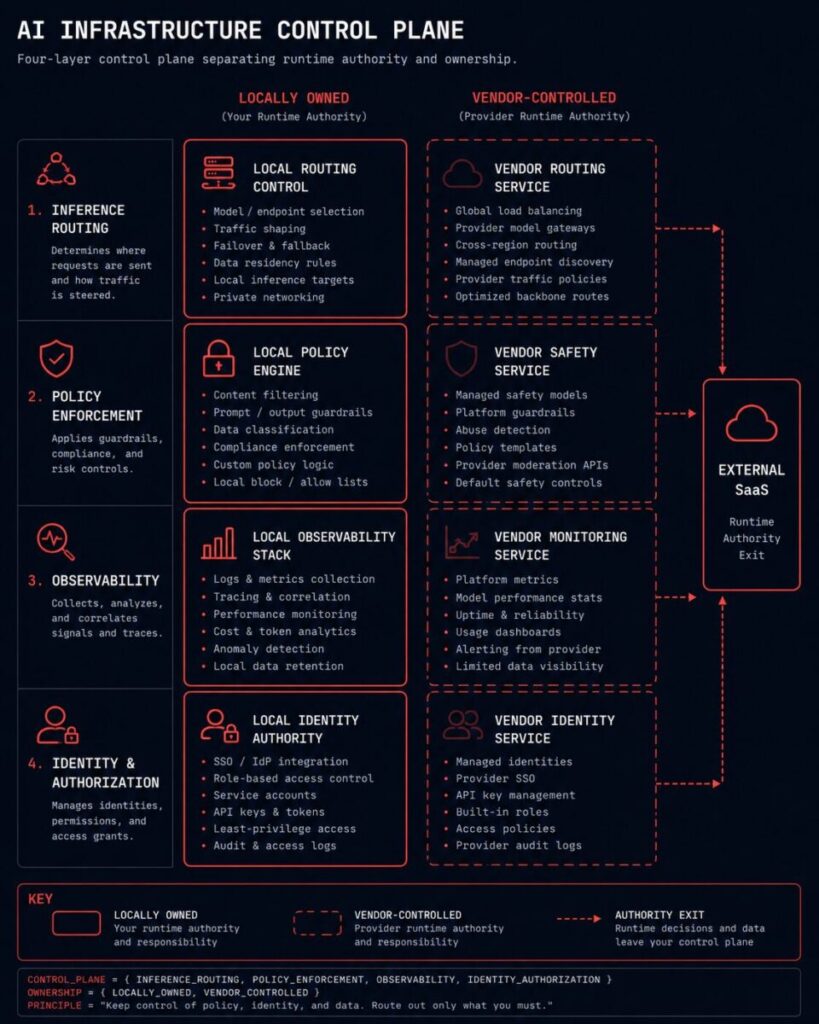
Control plane sovereignty is an operational property, not a deployment location. To achieve it, four functional planes must be under local authority — not just locally deployed, but locally operated, locally configured, and locally mutable.
The inference routing plane determines which model handles which request, which fallback executes when the primary model is unavailable, and how load is distributed across inference endpoints. If a vendor orchestration layer owns this logic — even when the models themselves are on-premises — the routing behavior is externally mutable. Vendor policy changes, API deprecations, or silent configuration updates can alter how your AI workload routes requests without a change ticket on your side.
The policy enforcement plane is where guardrails, content filters, safety evaluations, and rate logic execute. This plane is most directly shaped by how an organization has structured its LLM operations architecture — the lifecycle management decisions made at model deployment time carry forward into guardrail dependencies at runtime. Most enterprise AI deployments outsource this because managed guardrail services are convenient and their vendor integrations are tight. The consequence is that the behavioral boundaries of your AI system are defined and enforced by a system you do not operate. When the vendor updates their policy model, your AI behavior changes.
The observability plane controls what inference requests and responses are logged, where those logs are stored, how long they are retained, and who can query them. Most enterprise AI observability relies on SaaS pipelines. That means inference telemetry — including the content of requests and responses — exits the boundary on every transaction, regardless of where the model runs. The AI inference observability layer is only sovereign if the pipeline it feeds into is locally operated.
The identity and authorization plane governs who can invoke a model, under what conditions, with what privilege scope. If token validation passes through a third-party identity provider with no local fallback, then model access authority is contingent on an external dependency you do not control.
The following table maps each plane against what vendor-managed deployments typically own versus what a sovereign AI control plane requires:
| Control Plane | Vendor-Managed Default | Sovereign Requirement |
|---|---|---|
| Inference routing | Vendor router owns model selection and fallback | Local router with local policy configuration |
| Policy enforcement | Guardrails evaluate against vendor-hosted policy | Local guardrail engine with locally owned policy definitions |
| Observability | Telemetry streams to vendor SaaS pipeline | Local logging infrastructure with local retention control |
| Identity / authorization | Token validation via third-party IdP | Local identity authority with local fallback path |
If any row in that table is unresolved, you do not have a sovereign AI control plane. You have a sovereign AI workload running inside an externally governed runtime.
Closing those rows is a control plane sovereignty exercise. Deciding who owns the accountability for keeping them closed — as vendor relationships, contracts, and integrations change over time — is a separate Strategic Governance question. The four-plane model identifies where sovereignty lives. It doesn’t, by itself, answer who is responsible for the boundary the next time a vendor changes default behavior.
SaaS Dependency Mapping — Where Control Actually Lives
The practical starting point for any control plane sovereignty assessment is dependency mapping — a systematic walk of the inference path that identifies where operational authority actually resides at each hop.
Start with a single inference request and follow it end-to-end: prompt in → authentication → routing → model selection → guardrail evaluation → execution → response filtering → logging → audit trail. For each step, answer three questions: Who owns the execution? Where does the configuration that governs this step live? What happens to runtime behavior if that vendor makes a unilateral change?
Most teams find that the first three steps in that chain resolve cleanly to local infrastructure. The next four are split between local and vendor systems in ways that were never explicitly designed — they were inherited. This is the phenomenon of Runtime Dependency Inheritance: the transfer of operational authority from locally deployed AI systems to upstream vendor-controlled runtime services. It happens gradually, through integration decisions that each appear low-risk in isolation. A managed guardrail here. A hosted observability pipeline there. A vendor identity integration because it was already in the stack. No single decision creates the problem. The accumulated dependency surface does. The same accumulation pattern drives inference placement decisions — the placement layer and the sovereignty layer are both answering questions about where execution authority actually lives.
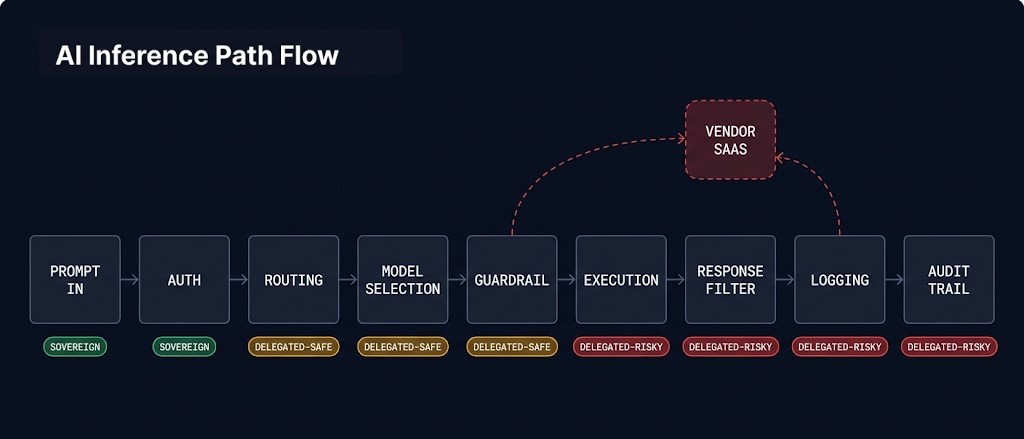
The dependency map is not complete until you have answered these four questions for every hop in the inference path:
DIAGNOSTIC QUESTION
“For each step in your inference path: if the vendor who owns this component changed its behavior tonight, would you know before your users did?”
If the answer is no for any step, that step is outside your operational authority boundary. The dependency map turns that intuition into a structured audit. Walk the path. Name each vendor dependency. Classify each one as sovereign (locally owned and configurable), delegated-safe (externally managed but bounded by contract and observability you control), or delegated-risky (externally managed with no local override path). Most enterprise AI deployments have more entries in the third column than they expect.
The Sovereign Drift Auditor runs this analysis programmatically against your infrastructure configuration — useful as a starting baseline before the manual dependency walk.
Inference Routing Topology — Three Architectures
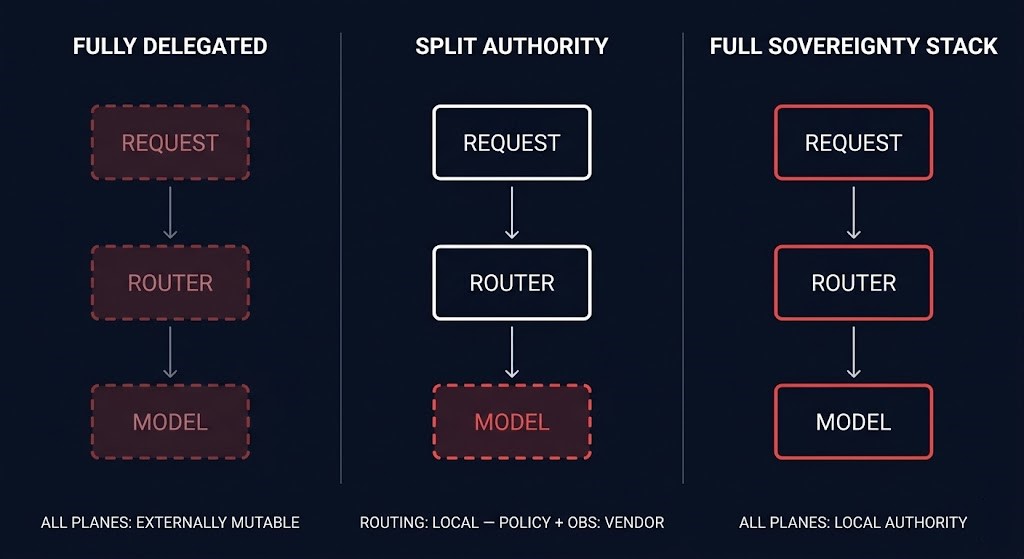
The routing plane is where control plane sovereignty diverges most sharply across deployment patterns. Three distinct topologies characterize how enterprise AI systems currently route inference requests, and each carries a different sovereignty posture.
Fully Delegated Topology
Mutability verdict: Every runtime plane is externally mutable. The vendor can alter routing, fallback, policy, and telemetry without a change ticket on your side.
In the fully delegated topology, the vendor orchestration layer owns model selection, fallback logic, load balancing, guardrail evaluation, and observability. The enterprise provides credentials and consumes the API. This is the default state for most early enterprise AI rollouts — it is fast to deploy, the SLA is the vendor’s problem, and integration complexity is low.
| Plane | Who Can Mutate It |
|---|---|
| Routing logic | Vendor |
| Fallback behavior | Vendor |
| Guardrail policy | Vendor |
| Telemetry retention | Vendor |
| Model selection | Vendor |
The sovereignty exposure here is total. The AI system functions as a dependency on a vendor-operated runtime. Data residency requirements can be met within this model; control plane sovereignty cannot.
Split Authority Topology
Mutability verdict: Local routing is owned; remote execution, guardrails, and observability remain externally mutable. Sovereignty is partial and bounded by what the local router can enforce without vendor cooperation.
In the split authority topology, the enterprise operates a local router that owns model selection and fallback logic. Inference execution happens at a remote endpoint — either a hosted model or a managed inference service. Guardrail evaluation and telemetry typically remain in vendor-managed systems because the local routing layer was not designed to intercept and process those functions.
| Plane | Who Can Mutate It |
|---|---|
| Routing logic | Local |
| Fallback behavior | Local |
| Guardrail policy | Vendor |
| Telemetry retention | Vendor |
| Model execution | Vendor (remote inference endpoint) |
This is the most common architecture in organizations that have made deliberate sovereignty investments but have not completed the control plane analysis. The routing sovereignty is real. The policy and observability exposure is not. Teams frequently overestimate their sovereignty posture because they own the router and treat that as equivalent to owning the runtime.
Full Sovereignty Stack
Mutability verdict: All runtime planes are under local authority. External vendors supply model weights and tooling components, but no vendor can alter runtime behavior without a local configuration change.
The full sovereignty stack requires local operation of all four control planes: routing, policy enforcement, observability, and identity. Model inference runs on locally operated infrastructure — on-premises GPU clusters, air-gapped private cloud, or dedicated sovereign infrastructure with contractually isolated control plane management. The distributed AI fabrics layer that connects GPU compute nodes to the inference serving stack is itself a sovereignty surface — fabric management that resolves to a vendor control plane undermines the stack regardless of where the models sit. Guardrails execute against locally owned and versioned policy definitions. Telemetry streams to local observability infrastructure. Identity validation has a local authority path with no external dependency for the fallback case.
| Plane | Who Can Mutate It |
|---|---|
| Routing logic | Local |
| Fallback behavior | Local |
| Guardrail policy | Local |
| Telemetry retention | Local |
| Model execution | Local |
The operational overhead is substantially higher. You are running infrastructure that managed services typically abstract away. The sovereignty claim is also the only one in the three topologies that holds under adversarial conditions — vendor outage, vendor policy change, contract termination, or regulatory requirement to demonstrate that no external party can modify AI runtime behavior.
Operational Authority Boundaries — What You Have to Own
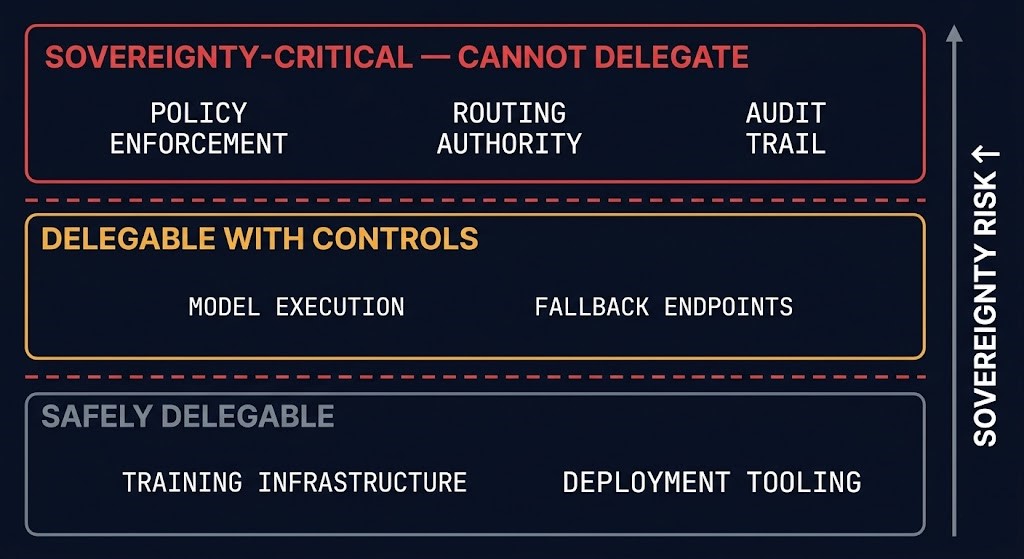
Control plane sovereignty is not binary — it exists on a spectrum defined by which planes are under local authority and which are delegated. The Operational Authority Boundary Model (Framework #69) provides the architectural decision framework for mapping that spectrum against operational requirements.
01 — SOVEREIGNTY-CRITICAL: CANNOT DELEGATE
Policy enforcement, routing authority, and audit trail integrity. External mutability in any of these directly undermines the sovereignty claim regardless of vendor SLA or contractual controls. If the vendor can change how these components behave without your approval, your AI system’s runtime governance is externally contingent.
02 — DELEGABLE WITH CONTROLS
Model execution on a managed inference endpoint and fallback to remote model versions. Delegation is operationally acceptable if bounded by local observability and a real local override path. The key test: can you exercise the override without vendor assistance? If the answer is no, this component belongs in the sovereignty-critical tier.
03 — SAFELY DELEGABLE
Pre-training infrastructure, model development tooling, and deployment pipeline automation. These components do not participate in runtime authority. Vendor management carries no sovereignty risk because no vendor-side change can alter how your production AI system routes, enforces policy, or records its behavior.
The boundary work is not conceptual. It requires a specific architectural output: for every component in your AI stack, a documented owner, a documented mutability boundary, and a documented override path. Teams that have done the dependency mapping exercise have the raw material for this. Teams that have not will find that the boundary exercise surfaces dependencies they did not know they had.
The connection to inference placement logic is direct. The Why Inference Placement Is the New Capacity Planning post covers the placement decision layer — where to run inference given cost, latency, and performance constraints. The Operational Authority Boundary Model adds the sovereignty dimension: where to run inference given who needs to own the runtime governance. These two questions have to be answered together. Placement decisions that optimize for cost or latency while ignoring authority boundaries produce architectures that appear optimized but are sovereignty-compromised at runtime.
Where Sovereign AI Control Planes Actually Break
The failure modes are not architectural edge cases. They are the predictable outcomes of treating sovereignty as a deployment property rather than an operational one.
Guardrail SaaS dependency. Policy enforcement exits the boundary at runtime. The guardrail service evaluates requests against a policy model hosted in a vendor cloud. When the vendor updates their safety taxonomy, your AI system’s behavioral boundaries change without a deployment event on your side. In regulated environments, this is a compliance failure waiting for an audit.
Vendor-managed routing. Model selection logic is opaque and remotely configurable. The routing behavior that determines which model handles sensitive requests, which fallback fires under load, and how traffic is distributed across endpoints is controlled by a system you cannot inspect or override. This is not a theoretical concern — vendor orchestration platforms have updated routing behavior through silent configuration changes that changed model selection outcomes without customer notification.
Telemetry exfiltration. Inference observability data streams to vendor cloud infrastructure. This is the failure mode that produces no operational error state. The workload continues functioning normally. Requests are processed. Responses are returned. Meanwhile, every inference request and response — including the content — is being logged by a system you do not operate, retained under a policy you did not write, and queryable by parties you did not authorize. This is what Silent Sovereignty Failure looks like: sovereignty erodes without an alarm, without a failed health check, without any signal in the operational dashboard that anything is wrong.
⚠ SILENT SOVEREIGNTY FAILURE
The most dangerous sovereignty failures produce no operational error state. The workload continues functioning normally while authority quietly exits the boundary. Telemetry exfiltration is the canonical example: inference observability streaming to vendor cloud carries no failed health check, no alert, no dashboard signal. It is only visible if you are looking for it — and most organizations are not.
Identity delegation. Token validation passes through a third-party identity provider with no local fallback. Model access authority becomes contingent on an external dependency. The sovereign identity and access architecture layer exists precisely because this failure pattern is not hypothetical — IdP availability events, token validation behavior changes, and security incidents at identity providers have operational blast radius that extends directly into AI model access when the identity plane is not locally anchored.
Model pull at inference time. Model weights are fetched remotely per request rather than cached locally. The model that executes on your infrastructure is determined at runtime by a remote system. Vendor-side changes to model versions, deprecation of model endpoints, or availability events all affect inference behavior without a local deployment event.
The pattern across all five failures is the same: the infrastructure appears sovereign while the runtime authority does not reside there. The sovereignty claim is real at the layer being measured and absent at the layer that matters.
Architect’s Verdict
Sovereignty is an operational property, not a deployment location. The question is not where the model runs — it is who controls the runtime behavior of the system that runs it. Inference routing, policy enforcement, observability, and identity validation are the planes where that control is exercised. If any of those planes resolve to a vendor SaaS endpoint, the sovereignty claim does not hold at runtime, regardless of where the model weights sit.
The Sovereignty–Authority Gap is the defining control plane problem in enterprise AI right now. Most organizations have closed the data residency gap. Most have not mapped the authority gap. The governance portability problem is not unique to AI — it is the same structural gap the Sovereign Virtualization Architecture stage maps at the platform layer. The four conditions — governance authority, operational continuity, lifecycle control, dependency enforcement — apply to AI runtime planes with the same force they apply to hypervisor platforms. The AI stack just inherited the problem faster. The dependency surface is wide, the failure modes are largely silent, and Runtime Dependency Inheritance means the gap typically grows through integration decisions that each appeared low-risk in isolation. The sovereign AI infrastructure architecture does not emerge from a single architecture decision. It requires sustained operational ownership of four planes that vendor ecosystems have strong commercial incentives to manage on your behalf.
If runtime authority leaves the boundary, sovereignty leaves with it.
Additional Resources
View 4 more resources
Editorial Integrity & Security Protocol
This technical deep-dive adheres to the Rack2Cloud Deterministic Integrity Standard. All benchmarks and security audits are derived from zero-trust validation protocols within our isolated lab environments. No vendor influence.

R.M.
Senior Solutions Architect with 25+ years of experience in HCI, cloud strategy, and data resilience. As the lead behind Rack2Cloud, I focus on lab-verified guidance for complex enterprise transitions. View Credentials →
Get the Playbooks Vendors Won’t Publish
Choose the architecture problems you care about. Get field-tested playbooks and frameworks delivered to your inbox.
- > AI Infrastructure & Inference Economics
- > Cloud Strategy & Hidden Cost Models
- > Virtualization & Deterministic Migration
- > Kubernetes, IaC & Modern Infrastructure
- > Data Protection & Recovery Engineering
Zero spam. Includes The Dispatch weekly drop.
Need Architectural Guidance?
Independent review before major infrastructure decisions.
- > Validate assumptions
- > Identify hidden dependencies
- > Quantify migration risk
- > Challenge vendor narratives
Triage · Advisory · Fractional · Direct Hire