

FinOps Moved the Goalposts. Now It’s Influencing What Gets Built.
Cloud architects have already accepted that cost belongs inside architecture decisions. The next evolution of architecting for value is not simply measuring financial impact — it is understanding when financial models begin influencing which architectural options survive long enough to be considered.
It’s tempting to read that as FinOps replacing architectural judgment. It isn’t, and that’s not the argument here. Architects still generate the options. Architects still make the final call. What’s changed is where in that sequence a financial model gets to act — and once a system participates early enough in forming the choices you get to pick from, it has already exercised authority, whether or not anyone signed off on giving it that role.
This is the layer underneath the FinOps shift, not a repeat of it. If cost becoming a design constraint is the first chapter — see Cloud Cost Is Now an Architectural Constraint — this is the second: what happens once that constraint arrives early enough to shape the options themselves, not just judge them after the fact.
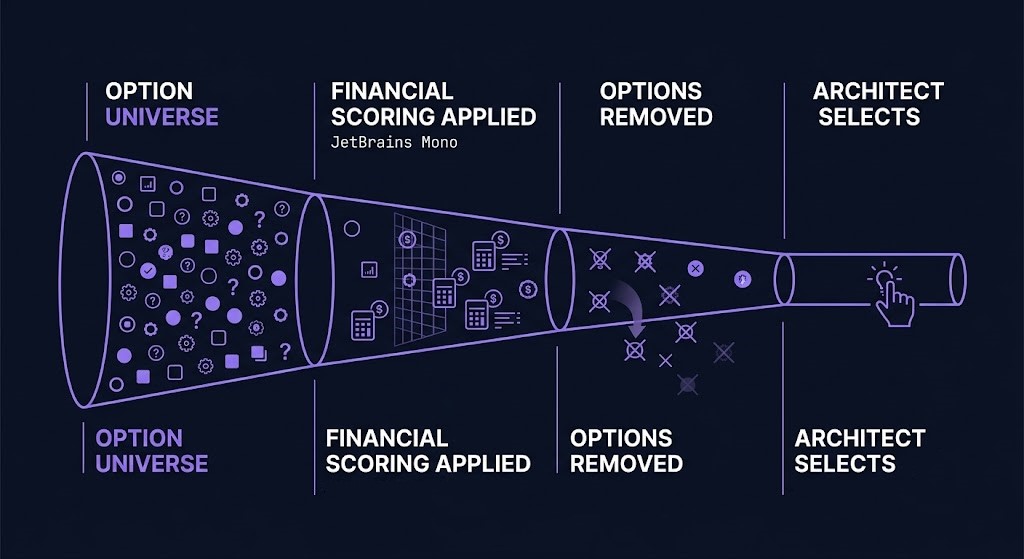
FinOps Used to Review Decisions. Now It Helps Form Them.
For most of FinOps’ history inside cloud strategy architecture, the discipline sat downstream of the architecture decision, not inside it. That’s changed in three distinct generations, and the distance between generation one and generation three is the entire subject of this post.
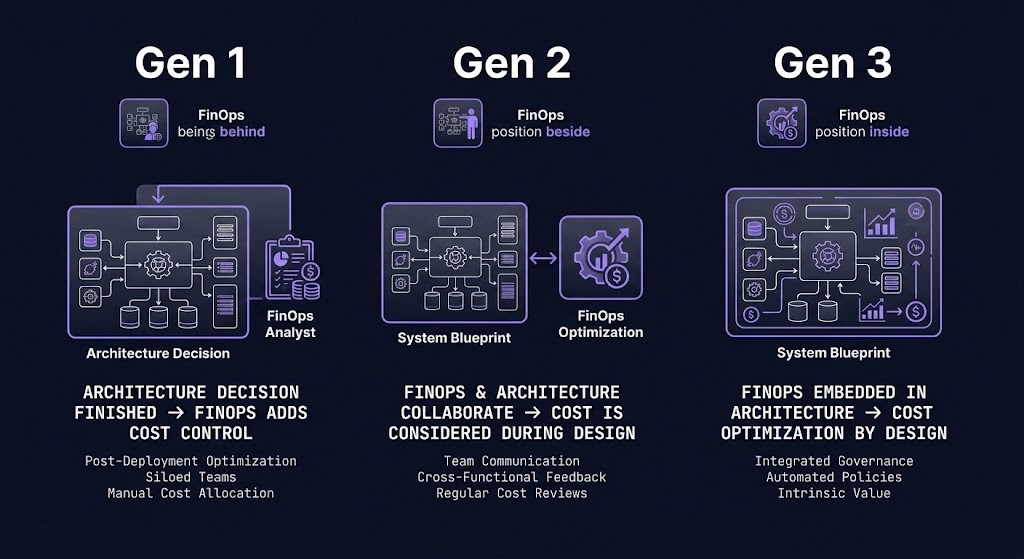
GEN 1 — COST VALIDATION
Architecture is built first. FinOps validates what it costs after the fact — a rearview mirror on decisions already made.
GEN 2 — COST COMPARISON
Architecture proposes a shortlist of options. FinOps scores each one on cost before a decision is finalized — still reactive, but now inside the approval step instead of after it.
GEN 3 — VALUE-DRIVEN OPTION FORMATION
FinOps tooling shapes which options get generated in the first place. The shortlist an architect sees has already been filtered by a financial model before architectural judgment is applied to it.
Generation one and two are still fundamentally architecture-first. Generation three is not — and generation three is where the discipline is heading in 2026.
Architecting for Value Changes the Decision Sequence
The FinOps Foundation now names this shift directly: its Architecting & Workload Placement capability formalizes connecting architectural and workload placement decisions to business outcomes through unit metrics and value comparisons, applied before a workload is provisioned rather than after. That’s architecting for value in its own words — a capability, not a slogan, sitting inside the FinOps Framework itself.
The prior post on this site covered why that capability exists: cost had to become a design-time constraint because cleanup-after-deployment stopped scaling. That’s a different claim than seeing what something costs — visibility and design-time constraint are separate maturity steps, and this post is about a third step past both of them. This post isn’t re-making the design-constraint case. The relevant detail for what follows is narrower and less discussed: the State of FinOps 2026 survey found that executive sponsorship reaching VP/SVP/EVP-level and above correlates with dramatically more influence over technology selection decisions than sponsorship capped at the director level. Influence over technology selection is not a cost-reporting outcome. It’s a decision-authority outcome — and it’s the trigger for everything in the rest of this piece.
Authority Doesn’t Move When Someone Signs. It Moves When Someone Controls the Options.
Here’s the part that gets missed when this trend gets covered as a FinOps story instead of an architecture story: nobody has to grant a system decision-making authority for that system to start exercising it. Authority isn’t the signature at the bottom of the approval. Authority is control over which choices reach the person doing the signing.
An architect who selects from four pre-scored options has made a decision. But the space of what was even eligible to be selected was already shaped by whatever scored those four options into existence — and that shaping happened before architectural review ever saw the shortlist. The architect’s judgment is real. It’s just judgment over a narrower set than the one that existed before the scoring ran.
This isn’t a new pattern, and it isn’t unique to FinOps. Architecting for value is simply the name this particular migration has taken inside the cost discipline — every function that starts as advisory and later gets tooling inside the actual provisioning path goes through the same shift:
| Function | Started As | Became |
|---|---|---|
| Security | Review Function | Policy Enforcement |
| Compliance | Audit Function | Approval Gate |
| Platform Engineering | Enablement Layer | Service Ownership |
| FinOps | Optimization Function | Decision Influence |
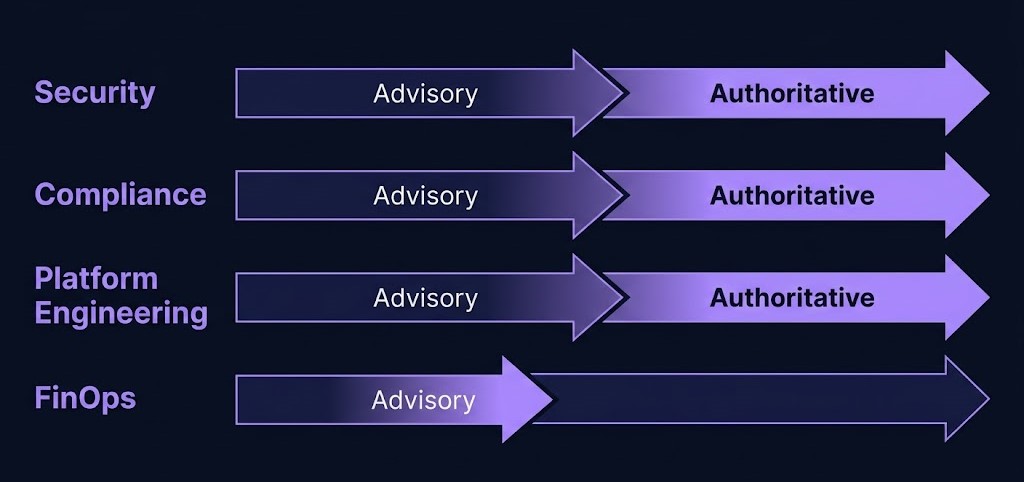
None of these functions were handed authority in a memo. Security didn’t get a charter that said “you may now block deployments” — it got a scanner wired into the CI/CD pipeline, and the blocking followed from where the tool sat, not from an org chart. Compliance didn’t get a charter that said “you may now halt releases” — it got an audit gate that had to pass before release, and the halting followed from that gate’s placement. Platform engineering ran the same migration from enablement layer to the team that effectively decides which services get built on — nobody voted on that authority either. FinOps is running the identical migration, one step behind: the earlier a scoring mechanism enters a process, the more authority it acquires.
The significant FinOps shift, then, is not that finance is replacing architecture. It’s that financial models are entering the decision lifecycle earlier, and every system that shapes options eventually gains authority — not because anyone decided it should, but because shaping the options is what authority actually is.
The Decision Origination Boundary
That migration is specific enough to name — and it’s the mechanism sitting underneath architecting for value once you look past the capability description to what it actually does at runtime. Below the boundary, a financial evaluation acts on a set of options an architect has already generated — validating or comparing, but not filtering. Above it, the financial model acts before the option set is finalized, and the options an architect ends up choosing from have already been narrowed by an evaluation the architect didn’t run and, in many cases, didn’t see.
FRAMEWORK #161 — DECISION ORIGINATION BOUNDARY
The point where a decision-support mechanism stops evaluating options and starts determining which options exist to be evaluated.
Failure state: Unreviewed Financial Default — the condition where the filtered shortlist is treated as the complete option set, because no architectural authority reviewed what got removed at node 03 before node 04.
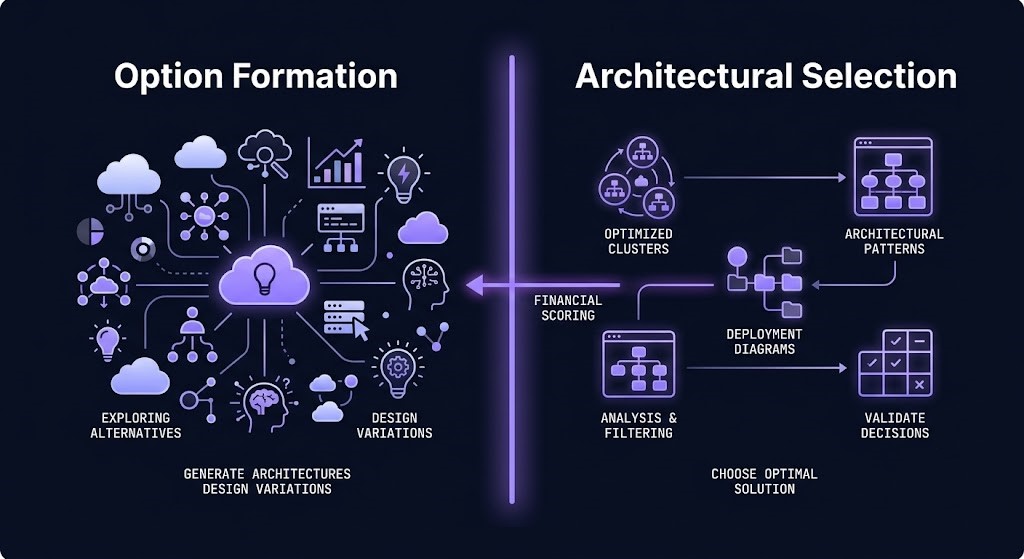
The Decision Origination Boundary is distinct from Framework #131, Economic Gravity Boundary, which describes economic forces constraining architectural outcomes after those outcomes are already on the table. The Decision Origination Boundary describes something earlier: the point where an economic evaluation mechanism begins shaping which decisions are available before architectural selection occurs at all. #131 asks whether economics limits what you can build. #161 asks whether economics already decided what you’d be offered to build from.
This is a single-mechanism version of a shape that generalizes further once more than one automated evaluator enters the picture. The Cloud Arbitration Layer — Framework #166 — describes what happens when the Decision Origination Boundary stops being one financial lens narrowing options and becomes several independent engines (cost, compliance, latency, sustainability, sovereignty) actively competing to decide. #161 is one mechanism filtering before review. #166 is arbitration among competing authorities — the difference between a narrower shortlist and a decision nobody actually made.
There’s a third related boundary worth distinguishing, closer to containment than filtering: Your Identity Provider Was Never Your Spend Boundary asks what happens after an identity already has spend authority — not which options get filtered before review, but whether anything independent of that identity can cap what it authorizes once it’s compromised. #161 is upstream of the decision. That post is downstream of the authority.
A fourth related boundary sits earlier still, upstream of both option-generation and option-filtering: Phantom Capacity — Framework #171 — asks whether the demand signal feeding either process was ever validated in the first place. #161 assumes the option universe accurately reflects real constraints when scoring narrows it. Phantom Capacity is the condition where that underlying assumption is already false — a capacity or demand signal accepted into planning with no evidence it represents real intent, before any scoring or filtering ever touches it.
Where Architects Will Actually Feel This
Architecting for value isn’t abstract once you stop looking at it as a capability description and start looking at where it actually lands. It shows up in specific, everyday architectural decisions — and in most organizations, it’s already showing up without anyone naming it.
| Decision | Historically | Increasingly Influenced By |
|---|---|---|
| Cloud Region | Architect | Cost Models |
| Service Selection | Architect | Cost Comparison Tools |
| Retention Strategy | Architect | Financial Efficiency Metrics |
| Workload Placement | Architect | Value Optimization Models |
| Platform Choice | Architecture Board | Economic Scoring |
None of these rows describe an architect losing authority in any formal sense. They describe an architect exercising authority over a smaller set of live options than existed before a scoring model ran — the same distinction the Decision Origination Boundary names above. The organizations that will handle this well aren’t the ones who keep financial models out of the pipeline. They’re the ones who put architectural review at node 03, not node 04 — reviewing what got filtered out, not just what’s left.
Why C-Suite Leaders Struggle With AI Consumption Pricing makes the inverse case: architecture — specifically the runtime behaviors a system is allowed to exhibit — is what generates the economics in the first place, one step downstream of the filtering described here.
Architect’s Verdict
FinOps didn’t take architecture’s decision-making authority. Nobody has, and this piece isn’t arguing they will. What’s actually happened is narrower and more consequential: architecting for value moved a financial model earlier in the decision lifecycle than it used to sit, and the earlier a scoring mechanism enters a process, the more authority it acquires — regardless of what any org chart says about who’s formally in charge.
The question worth asking inside your own organization isn’t whether FinOps tooling influences architecture. By 2026, for any team with a mature cost practice, it already does. The question is whether someone with architectural authority is in the room when that tooling is chosen and configured — reviewing what it filters out, not just approving what survives — or whether the tool made that decision by default, unreviewed, the moment it was turned on.
Every function that has ever moved from advisory to authoritative did it the same way: not through a grant of power, but through a tool that got to shape the options before anyone with formal authority saw them. FinOps is not the first function to cross this line. It won’t be the last.
Additional Resources
View 3 more resources
Editorial Integrity & Security Protocol
This technical deep-dive adheres to the Rack2Cloud Deterministic Integrity Standard. All benchmarks and security audits are derived from zero-trust validation protocols within our isolated lab environments. No vendor influence.

R.M.
Senior Solutions Architect with 25+ years of experience in HCI, cloud strategy, and data resilience. As the lead behind Rack2Cloud, I focus on lab-verified guidance for complex enterprise transitions. View Credentials →
Get the Playbooks Vendors Won’t Publish
Choose the architecture problems you care about. Get field-tested playbooks and frameworks delivered to your inbox.
- > AI Infrastructure & Inference Economics
- > Cloud Strategy & Hidden Cost Models
- > Virtualization & Deterministic Migration
- > Kubernetes, IaC & Modern Infrastructure
- > Data Protection & Recovery Engineering
Zero spam. Includes The Dispatch weekly drop.
Need Architectural Guidance?
Independent review before major infrastructure decisions.
- > Validate assumptions
- > Identify hidden dependencies
- > Quantify migration risk
- > Challenge vendor narratives
Triage · Advisory · Fractional · Direct Hire