

OVHcloud’s CLI Release Tags Didn’t Change. The Files Under Them Did.
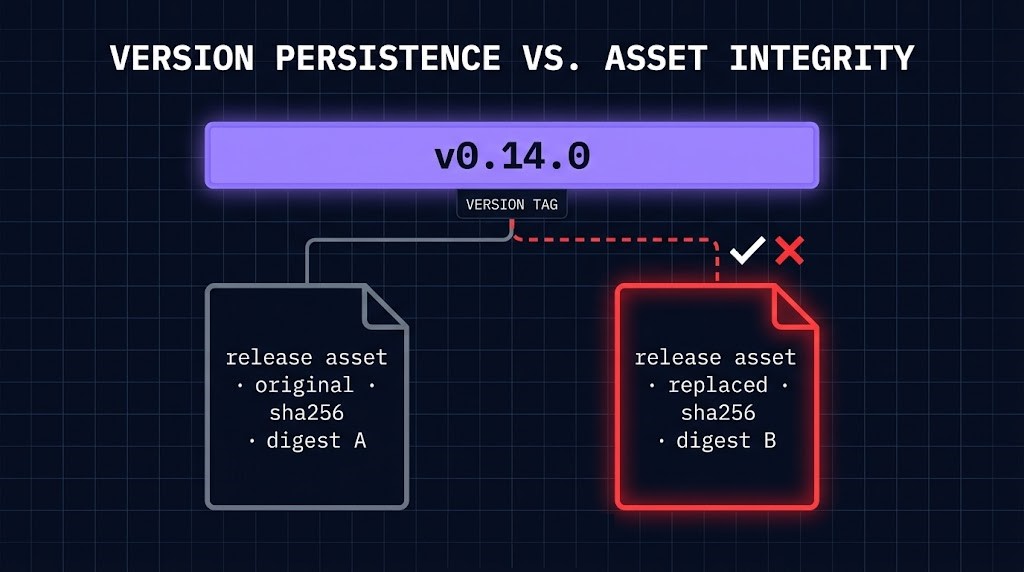
Release tags do not, by themselves, prove the integrity of the bytes distributed alongside them, and the OVHcloud CLI incident of 19 October 2026 shows how large that gap can be. According to OVHcloud’s security advisory (GHSA-862f-55f5-vmvw), published 20 October, the binaries attached to releases v0.11.0 through v0.15.0 were replaced with malicious ones after those releases had been built and published. The release tags stayed where they were. The files under them did not.
The decision this post is meant to support is narrow: if a pipeline, a laptop or a golden image pulled a tool from a release page, can anyone say afterward which bytes it ran, and against what independently held evidence? Every claim below is attributed to its source. Where the source is the vendor’s own account, I say so, and I do not treat it as an independent forensic finding.
What OVHcloud Says Happened
The advisory scopes the exposure by version and by time. It names v0.11.0 through v0.15.0 as affected, and only for builds downloaded or installed in a window on 19 October 2026, 14:47 to 16:21 UTC+2. It describes v0.10.0 and earlier, v0.16.0 and later, and anything fetched before the window as unaffected. Its key figures put the period of malware availability at 1h33. Those are the vendor’s numbers. The advisory’s publication date is 20 October; the material I reviewed does not state a time of publication.
OVHcloud attributes the incident to a compromised developer GitHub account. Its advisory traces the compromise to a malicious browser extension installed on the developer’s personal MacBook in October 2025, and says stolen keys were later used to replace the release binaries. OVHcloud says the substitutions were not performed from that personal MacBook. It also says the repository “was not appropriately configured to ensure release immutability.” This is the vendor’s account, not an independent forensic finding.
This is a cloud strategy architecture problem before it is a tooling problem. A CLI is a dependency your estate acquires at a point in time from a location that can change underneath you. The download step often encodes a version choice without recording an independently verified expected digest. The shape is familiar from vendor-side compromises that never touch your own perimeter: the vendor’s boundary failed, and the authority it held, here the authority to publish bytes you chose to run, did exactly what it was configured to do.
Release Tags Held. A Retained Digest Is What Noticed.
Issue #300 on the project’s repository is the detection record, and it comes from a reporter, not the vendor. The reporter’s CI job had kept a SHA-256 for the Linux arm64 binary from an earlier download. A later download of the same release no longer matched it. The reporter also describes build metadata in the new binary that differed from the original, including a +dirty marker. The reporter describes the replacements as occurring over roughly 25 minutes; that observation has not been reconciled with the vendor’s incident window.
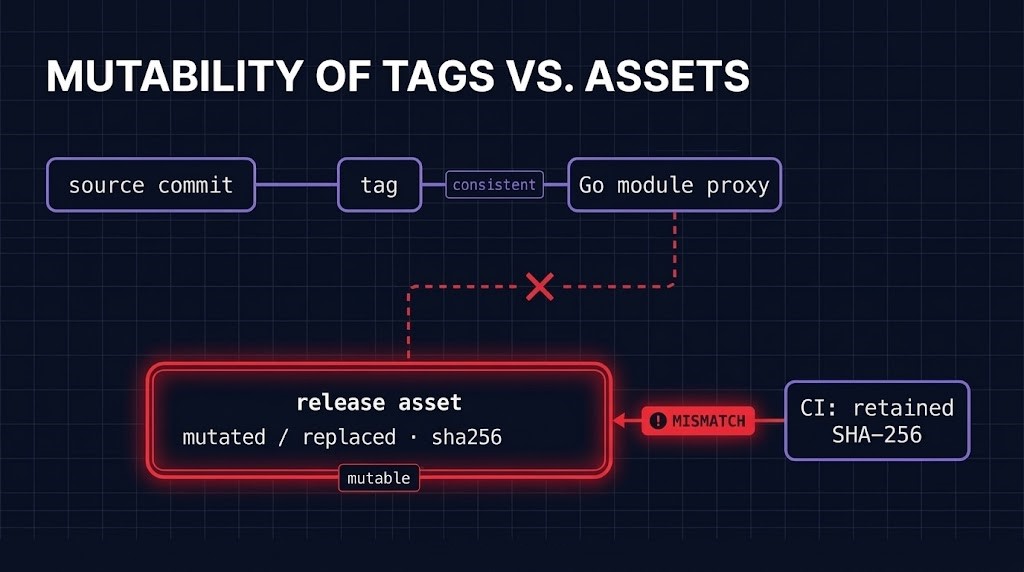
What that establishes is specific. One downstream job, holding a digest it had recorded itself, saw a mismatch. The reporter’s evidence showed that the downloaded binary’s digest had changed and its build metadata identified a later, dirty commit. Meanwhile, the v0.15.0 tag and the Go module proxy still pointed to the original commit. The reporter concluded that the replacement binary had not come from the release pipeline. A Git tag identifies a source revision; a release may also publish downloadable assets whose integrity must be established separately. In this repository, by the vendor’s own account, those assets could be replaced after publication.
What it does not establish is equally specific. It does not show that every check in OVHcloud’s build chain passed, and it says nothing about the complete integrity of that chain. Whether the replacement files were built from the same source, or at all from the same pipeline, is not something issue #300 or the advisory lets me assert. The evidence supports one conclusion: the release tags and the content beneath them diverged. In this case, a downstream job noticed because it had kept its own record.
The Checksum Sat on the Same Path as the Binary
The reporter’s check worked because the expected digest had been retained separately from the later download. The issue does not document the exact storage or access controls protecting that record. Reporting on the incident indicates that checksums.txt was replaced through the same release authority as the binaries. If so, a job that downloaded the binary and the checksum file together and compared them would have passed. The comparison would have been honest arithmetic over two attacker-influenced inputs.
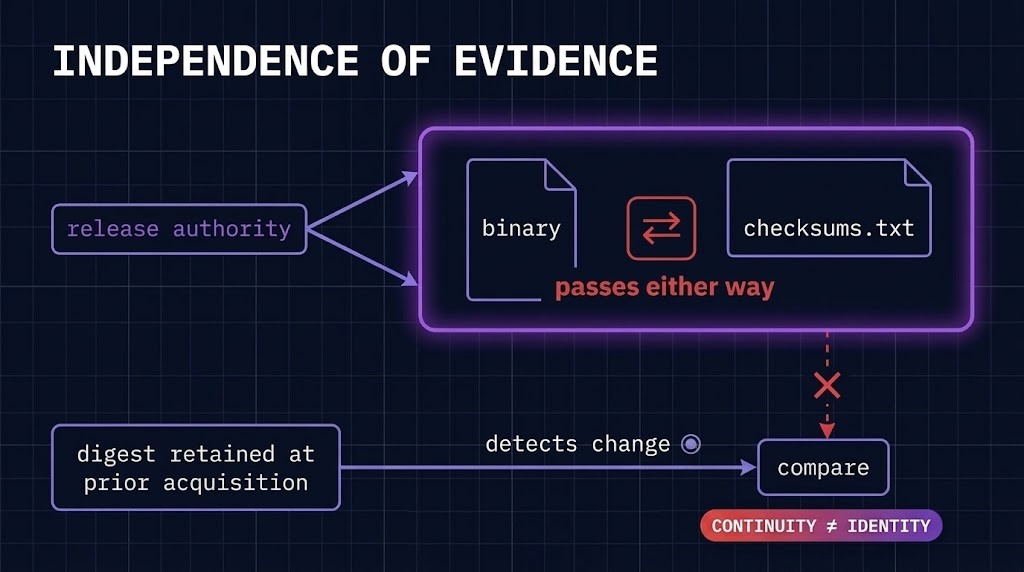
This is not a new mechanism. It is an instance of the principle already laid out in Your Logs Are Not Evidence If The Infrastructure That Produces Them Can Rewrite The Record: evidence stops being evidence when it depends on the system whose behavior it is meant to vouch for. A checksum served beside the binary shares a publisher, a credential and an upload path with the thing it vouches for. Whoever can rewrite one can rewrite both.
The useful question is how the expected digest became trusted. A digest retained outside the release path can detect later changes, as the reporter’s CI job demonstrated. It does not establish that the first acquisition was authentic unless that acquisition was independently validated. An internal mirror helps preserve the bytes and their history, but it becomes an integrity control only when the artifact is checked against trusted evidence at ingestion and subsequent use is checked against that record. A checksum fetched from the same release page as the release tags and assets is not that evidence. This also changes how you think about the build job itself. As argued in Your CI-CD Pipeline Is Your Real Infrastructure Control Plane, the job that fetches a tool holds credentials and reach, and the tool it fetches inherits all of it for the duration of the run.
Pinning to Release Tags Pins a Label
Most install steps in the wild name a version and trust it. A curl against a release download URL, a pinned version in a setup action, a line in a bootstrap script: each one resolves a tag to a file at the moment it runs. Pinning to release tags feels like immutability because the string never changes. It is a pin on the label, and the label is resolved to bytes every time the step executes.
Which object you trusted depends on the acquisition path. A fetch of the prebuilt release asset trusts the uploaded file. A build from source at a tag trusts the commit the tag points to. A module-proxy install trusts the proxy’s record of that commit. The reporter’s account is that the tag and the Go module proxy continued to point to the original commit while the assets changed, which is consistent with the source-level objects being intact. It does not tell you that any particular install path in your estate was safe, and I am not calling any path or platform unaffected on the strength of the sources I have: the reports on individual assets and platforms conflict, and I have not been able to reconcile them.
The useful move is to be explicit about what each pin refers to. Pinning release tags is fine as a convenience. It is not a control. The control is a digest that was validated when the file was first acquired, compared on every later fetch, and held where the publisher cannot rewrite it. Retention alone gives continuity; validation at ingestion gives identity, and neither supplies the other. Teams that mirror release assets into an internal artifact store have a place to do this, but a mirror that never checked what it ingested preserves a malicious artifact as faithfully as a good one. Teams that fetch straight from the release page at run time have a version number and a hope.
A Hash List of Bad Files Is Not Proof of Good Ones
The advisory’s appendix lists MD5 hashes for the five malicious binaries, one each for Darwin arm64, Darwin x86_64, Linux arm64, Linux x86_64 and Windows x86_64. It lists no known-good hashes. The advisory says v0.16.0 was released with a signed tag. A tag signature and an artifact signature answer different questions: verifying the tag does not, by itself, establish that a separately downloaded binary matches the intended release artifact. I have not independently verified the v0.16.0 assets.
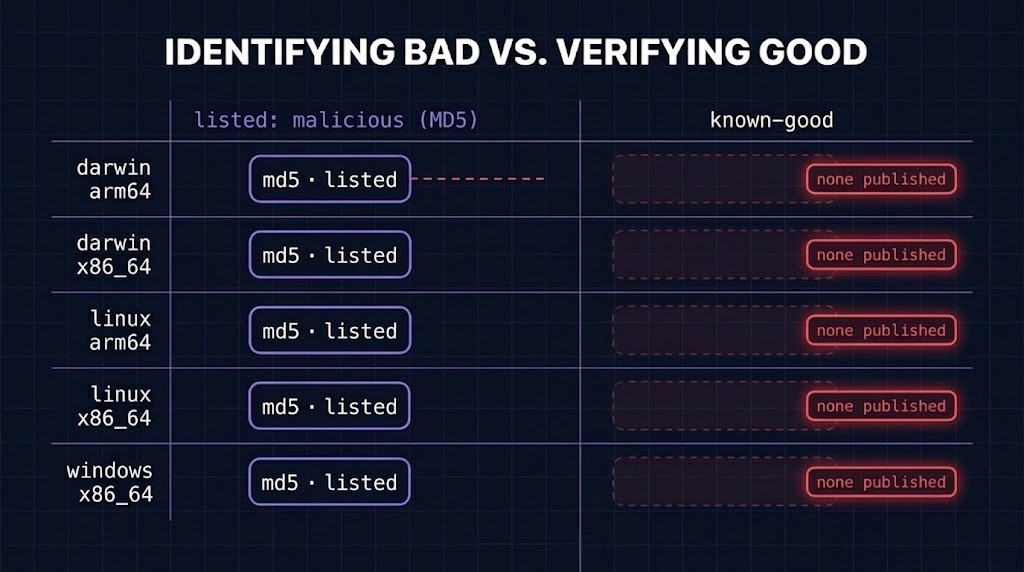
The distinction matters operationally. Published indicators let you ask whether a file you hold matches one of the listed malicious files. A match is useful. A non-match tells you nothing about authenticity: a different substituted file would also be a non-match. MD5 is not an appropriate modern basis for adversarial integrity assurance, and the advisory does not provide known-good artifact digests or describe an artifact-signing or provenance mechanism for consumers to validate the binaries independently. Known-bad identification and known-good verification are different capabilities, and an incident notice normally only gives you the first.
The vendor’s remediation list deserves the same careful reading. OVHcloud reports it deleted the malicious assets, suspended the developer account, reviewed write access and logs, enabled immutable releases and published v0.16.0. It plans to review build and publication pipelines, require signed commits and merges, make release immutability systematic, review organization-linked GitHub accounts and tie release publishing to its central IAM system. Those are controls on who can publish and whether published files can be changed. They narrow the repeat window. None of them, in the advisory I read, gives a consumer a way to verify that a particular binary is the one the publisher intended; it does not commit to signing release artifacts or publishing provenance. Until that exists, the verification evidence you hold has to come from your side.
What the Payload Was Reportedly After
I have not analyzed the malware and this section is documentary. OVHcloud’s advisory names the categories of local data the malware gathered: cloud credentials (AWS including S3, Google Cloud, Azure), container and infrastructure tooling (Docker, Kubernetes, Terraform), package and platform tokens (NPM, DigitalOcean’s doctl), .netrc, the global Git configuration, SSH keys, and the local databases and session histories of editors and AI coding assistants.
The advisory’s exposure guidance is conditional on execution: it says that if you downloaded or updated the CLI in the window and ran it, the secrets on that computer should be considered compromised. A download alone does not establish exposure. (Its affected-builds section speaks of downloads only, and the advisory does not reconcile the two wordings.) It also describes the malware creating a folder named envchecker- followed by 9 to 10 digits in the temporary directory, which it says is never deleted and can show whether a machine was exposed. That is an attributed indicator to look for, not a reason to run a suspect binary.
The list above is the exposure test in practical terms. The relevant question for any machine or runner that executed an affected binary in the window is not whether it was “a CLI host” but what the executing process could read. A build runner with a cloud role, a Terraform state backend and a deploy key is a very different answer from a developer laptop with a stale profile, even if both ran the same file.
An Acquisition Worksheet for Tools Your Pipelines Fetch
Release tags were never going to catch this, so the remediation belongs to acquisition, not to the tool. For every CLI or binary your estate fetches from a release page, record the following at acquisition. Keep the record in a separate trust domain, with access controls that prevent the release-publishing identity from rewriting it. Validate the artifact against trusted evidence before treating its digest as the expected value for later fetches.
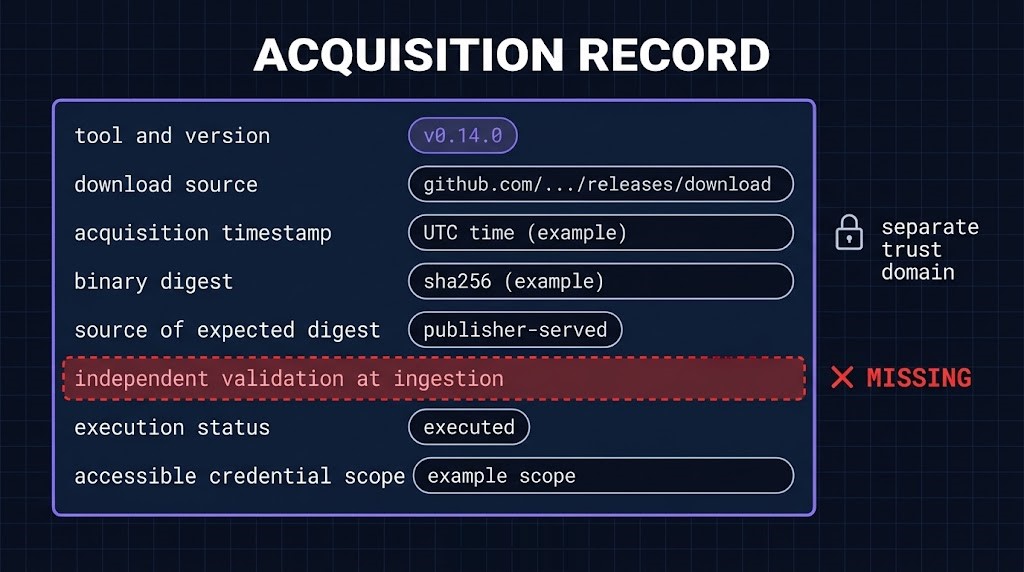
| Field | What to record | Why it matters on 20 October |
|---|---|---|
| Tool and version | Exact version string, not “latest” | Scopes you against the advisory’s v0.11.0 to v0.15.0 range |
| Download source | URL or mirror actually used | Separates release-page fetches from internal mirrors and package managers |
| Acquisition timestamp | UTC time of the fetch | The vendor’s exposure test is time-bounded, so a timestamp decides in or out |
| Binary digest | SHA-256 of the file as acquired | The record a later fetch is compared against |
| Source of the expected digest | Where the expected value came from: your own validated ingestion, or whatever the publisher served | Distinguishes a digest you recorded from one the publisher served |
| Independent validation at ingestion | What trusted evidence the file was checked against when first acquired, or “none” | Retention gives continuity; only validation gives identity, so “none” must be a visible answer |
| Execution status | Where and when it ran, with what identity | Turns “we downloaded it” into “it executed here” |
| Accessible credential scope | What the runner or user could read, including the secret types the advisory names | Defines what a rotation decision actually covers |
This is a dependency inventory with a time axis. The Dependency Architecture stage of the Cloud Architecture learning path is where the underlying discipline lives, and its Dependency Awareness Boundary (#126) is the line below which a tool fetched in a job step typically sits until someone writes it down. If your answer to the worksheet is “the pipeline downloads latest at run time,” you cannot answer the advisory’s question from records. You can only answer it from memory and log retention.
Architect’s Verdict
Release tags are labels. In this incident the label held while the content beneath it changed, and by the vendor’s own account the repository was configured in a way that allowed it. Treating release tags as a statement about bytes was the assumption that failed, and it fails the same way for any publisher that has not locked releases down.
The real problem is where verification evidence comes from. The party that noticed in this case was a downstream job that had recorded its own digest at an earlier acquisition. A checksum fetched from the release, an incident hash list of bad files and a signed tag do not substitute for that, and even a retained digest proves identity only if the first acquisition was validated. Evidence you cannot show was held independently of the publisher is a claim, and claims about what ran in your estate are exactly what an incident review will ask you to prove.
Know what you fetched, when, from where, and against what you checked it. If the answer lives only in release tags on the publisher’s page, you do not have an answer.
Additional Resources
Editorial Integrity & Security Protocol
This technical deep-dive adheres to the Rack2Cloud Deterministic Integrity Standard. All benchmarks and security audits are derived from zero-trust validation protocols within our isolated lab environments. No vendor influence.

R.M.
Senior Solutions Architect with 25+ years of experience in HCI, cloud strategy, and data resilience. As the lead behind Rack2Cloud, I focus on lab-verified guidance for complex enterprise transitions. View Credentials →
Get the Playbooks Vendors Won’t Publish
Choose the architecture problems you care about. Get field-tested playbooks and frameworks delivered to your inbox.
- > AI Infrastructure & Inference Economics
- > Cloud Strategy & Hidden Cost Models
- > Virtualization & Deterministic Migration
- > Kubernetes, IaC & Modern Infrastructure
- > Data Protection & Recovery Engineering
Zero spam. Includes The Dispatch weekly drop.
Need Architectural Guidance?
Independent review before major infrastructure decisions.
- > Validate assumptions
- > Identify hidden dependencies
- > Quantify migration risk
- > Challenge vendor narratives
Triage · Advisory · Fractional · Direct Hire