

GPU Node Requalification: The Readiness Gap After In-Place Changes
GPU node requalification is the process of running qualification tests again after a node change that may affect the validity of its earlier results, so an operator can establish whether the existing evidence still applies. This post scopes it to NVIDIA DSX OS as documented between November 5 and November 8, 2026: NVIDIA’s technical blog, the NVSentinel validation documentation and chart defaults, and the aicr CLI reference.
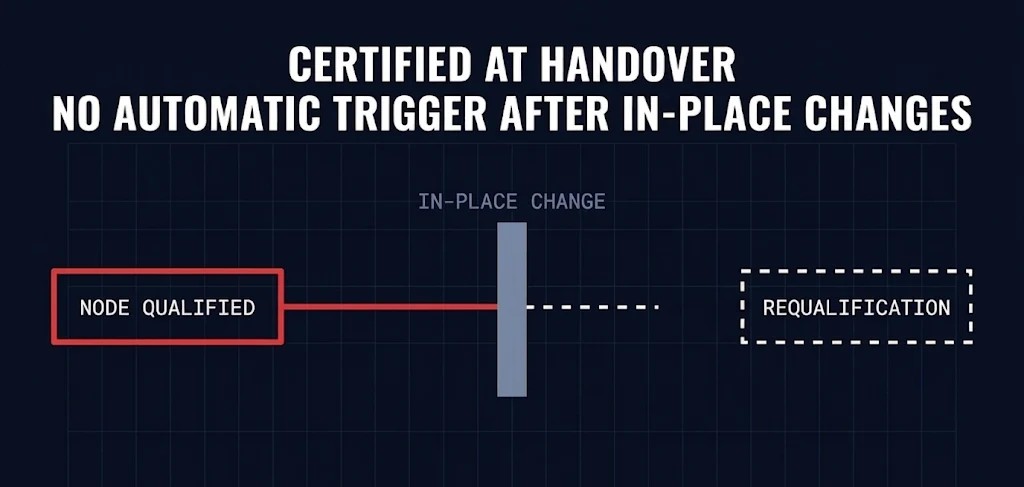
The premise is NVIDIA’s own. Its blog says a cluster certified at handover changes as nodes are replaced and drivers are patched, and that without repeated validation the original certification no longer reflects the cluster. The same post documents what starts that validation automatically when configured: a node joining the cluster, and a node returning after remediation. It documents that in-place driver upgrades, operator upgrades and fabric changes are not on that list, and that triggering validation after them is the operator’s job. The defaults examined for this post then show nothing that starts GPU node requalification on its own after an in-place change.
That is not a missing mechanism. NVIDIA documents the validation request, the cordon and the drift check. It is an ownership question: after an in-place change, which named role starts GPU node requalification, and what holds the node out of service until it finishes?
What a Node Certification Establishes
For AI infrastructure, a node certification is a test result bound to a moment. It establishes that a defined set of tests passed on that node when they ran. It says nothing about the node after a driver, operator or fabric change, which is why NVIDIA’s blog describes manual certification as point-in-time and why GPU node requalification is a separate step from certification.
Five things get conflated, and this post keeps them apart. A certification records test outcomes. A cordon marks the node unschedulable. A taint influences scheduling through taint and toleration rules. A ValidationRequest requests and tracks validation work. Schedulability is what the scheduler will actually do with the node. The qualification evidence was produced before an in-place change. Until the affected node is reassessed or requalified, the operator has not established that the earlier result remains applicable to its current configuration.
What the Sources Establish, and What They Do Not
Every claim here belongs to one of three categories. Documented behavior is attributed to NVIDIA or to NVSentinel’s own documentation. Examined defaults and code are values and behavior read from named repository files at a named commit. Architectural analysis is this post’s own reading, labeled wherever it appears, and is not NVIDIA’s statement.
⚠ SCOPE OF THE EVIDENCE
One vendor, one announcement. The absence of an automatic trigger in the examined defaults is not proof that no other integration can trigger GPU node requalification. This post describes an observed implementation boundary, not a universal product claim, and uses no production-failure data, thresholds or intervals.
| Topic | Established | Category | Not established |
|---|---|---|---|
| Premise | A handover certification stops describing the cluster as nodes are replaced and drivers patched | Documented (NVIDIA blog) | That any cluster has failed this way |
| Automatic triggers | Two events start validation when configured: node join, and node return after remediation | Documented (NVIDIA blog, NVSentinel) | Whether other integrations exist |
| In-place changes | In-place driver upgrades, operator upgrades and fabric changes “do not automatically trigger revalidation”; operators trigger validation after them | Documented (NVIDIA blog) | Whether a later release adds a trigger |
| Chart defaults | The lifecycle-manager, fault-quarantine and certification-monitor components are off, and fault-quarantine.validation.enabled is false | Examined defaults (NVSentinel) | How any deployment is configured |
| New-node criteria | Every criterion must hold, and a node already carrying the NewNodeValidationRequested condition is excluded | Documented, matching the chart defaults | Nothing further |
| Drift check | aicr diff compares two snapshots; with --fail-on-drift it exits with code 2 on drift, a code the reference says also covers invalid input | Documented (aicr) | Which driver, operator or fabric changes a snapshot field covers |
| Release of scheduling controls | The controller clears the cordon if cordon.remove is true (the chart default) and lifts only taints listed with remove: true (none are listed); it does not apply them | Documented, matching examined code and defaults (NVSentinel) | Which process cordons a new node |
| Certification record | NVCRE writes Certification resources and never taints, cordons or marks a node | Documented (NVSentinel) | Whether a certification records driver, operator or fabric configuration |
The repository evidence was read from main, not from release tags. NVSentinel was read at commit 8dbe1a1 (distros/kubernetes/nvsentinel/values.yaml, the lifecycle-manager chart values.yaml, docs/validation.md, docs/configuration/validation.md, docs/nvcre-certification-monitor.md and the controller file lifecycle-manager/internal/controller/validationrequest_nodes.go) and aicr at commit d2db931 (docs/user/cli-reference.md). NVSentinel published three releases between October 26 and November 7, so re-read the files before relying on any default stated here.
GPU Node Requalification: Two Documented Validation Paths and One Operator-Initiated Path
Both documented paths run through one mechanism. A ValidationRequest names nodes and tests, and NVSentinel’s validation documentation describes a controller that checks the node stays healthy, creates the test resources, retries a failed group, and releases the node’s scheduling controls only when the last request tracked for the node has succeeded.
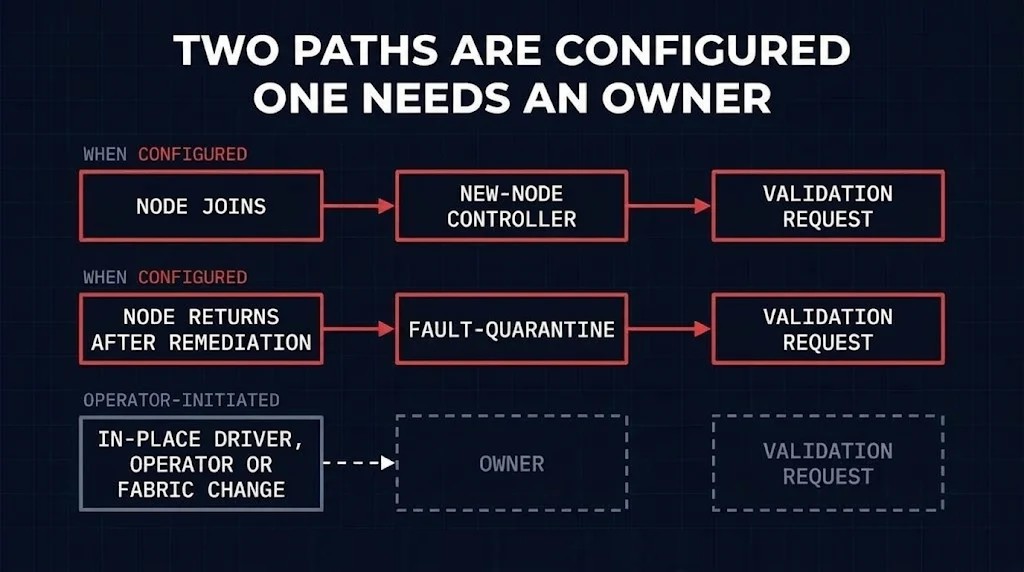
Node join. The node-validation controller batches nodes that match its criteria over a configured window, then creates one request for the batch. In the chart defaults the test is dcgm-diag-test, and a node qualifies only if it joined recently by creation timestamp, carries the label nvidia.com/gpu.present=true, and is already cordoned. The controller lives in the lifecycle-manager component, and the chart’s flag for it, global.lifecycleManager.enabled, is false in values.yaml at the pinned commit. The documentation shows turning it on as the way to activate new-node validation.
Post-remediation return. Fault-quarantine can create a request when a node is unquarantined. The default rule set covers nodes that had a fatal GPU event requiring a VM or bare-metal restart, and runs dcgm-diag-test. It requires fault-quarantine.validation.enabled, which is false by default, on a component the chart also leaves off.
Operator-initiated. The documentation says an operator can create a request manually or write a client of their own. NVIDIA’s blog puts in-place driver, operator and fabric changes on this path: operators cordon the nodes, then create the request. Requests from every origin are reconciled by the validation controller in the lifecycle-manager component, so that component has to be running on this path too.
What the controller releases. NVSentinel’s term, the scheduling gate, covers two different things. The cordon, the node’s unschedulable setting, is cleared when cordon.remove is true, which is the chart default. A taint is lifted only when it matches a listed entry on key, value and effect with remove set to true; the controller never applies these taints, expects them in place before the request exists, and the chart lists none. Both releases wait for the last request tracked for the node to succeed, and a failed request stays tracked, so the node stays cordoned. Under the chart defaults the control released is the cordon alone.
Architectural analysis, not NVIDIA’s statement. Because every new-node criterion must hold, a node already in service fails the creation-time test whatever changed on it. A driver upgraded in place leaves the node object’s creation timestamp unchanged, and a node that joined through this path already carries the condition that excludes it. On the documented criteria, the new-node path does not fire for the changes the blog assigns to the operator. That is consistent with the blog and adds nothing to it.
Schedulable and Unflagged After the Change
If no separate control gates the node, it may remain schedulable and unflagged after an in-place change, even though its earlier qualification evidence has not been reassessed. Nothing in the documents read makes an in-place change cordon, taint or mark the node by itself. An upgrade procedure or another deployment control may do any of those, but that is the operator’s wiring. The qualification evidence was produced before the change. Until the affected node is reassessed or requalified, the operator has not established that the earlier result remains applicable to its current configuration. That is architectural analysis.
The certification path shows how separate the layers are. NVSentinel’s documentation says NVCRE records results in Certification resources and itself never taints, cordons or marks a node, so on the NVCRE path alone a node that fails certification stays schedulable. A separate certification monitor can turn failed results into health events on a periodic sweep. Platform Connectors then set a node condition, and fault-quarantine’s bundled rule set applies a NoSchedule taint without a cordon. The examined chart leaves the monitor off by default, and fault-quarantine with it. Evidence, flag and schedulability each need their own owner and their own configuration.
This post does not rely on any positive readiness marker; none of the sources read establishes one, and the argument concerns the absence of a trigger, not the presence of a label. Nor do the sources say whether a Certification records driver, operator or fabric configuration, so nothing here claims a certification can detect that it has gone stale.
The failure also differs from security drift, which describes infrastructure that gets less secure while staying exactly as deployed. GPU node requalification covers the opposite case: someone deliberately makes a change, and nothing in the defaults makes qualification follow it.
The Trigger Map
The map below is a proposed method for GPU node requalification, not an NVIDIA procedure, and it is architectural analysis throughout. For each change event it separates three things the documents run together: initiating a request, completing qualification successfully, and what happens to the node’s scheduling controls while that is pending and after it ends. Completion is four checks, not one: the request was created; the requested validation completed; the outcome was successful; and the scheduling control that gated the node was released by the mechanism authorized to release it. A request that reports success is not, by itself, proof that the node is schedulable.
| Change event | Qualification evidence potentially invalidated | Required response | Trigger mechanism (initiation) | Accountable owner | Completion check (completion and disposition) |
|---|---|---|---|---|---|
| In-place driver upgrade | Results recorded before the upgrade on that node | Requalify, or reassess and record the reason, owner and disposition | Operator cordons the node, then creates the request; not automatic per NVIDIA | Assigned node-class or infrastructure lifecycle owner | Requalify: all four checks; the controller clears the operator’s cordon if cordon.remove is true. Reassess: no request; the reason, owner and disposition are on record |
| Operator upgrade | Results recorded before the upgrade on nodes the operator manages | Requalify, or reassess and record the reason, owner and disposition | Same as above | Same as above | Same as above |
| Fabric change | Results that exercised the changed paths, scoped to affected nodes; fabric design is covered in deterministic networking for AI infrastructure | Requalify affected nodes, or reassess and record the reason, owner and disposition | Same as above | Same as above | Same as above |
| Post-remediation return | Results recorded before the fault | Requalify (documented path, opt-in) | Fault-quarantine creates the request at unquarantine when validation.enabled is true | Named owner of the quarantine and recovery process | All four checks; the cordon and each fault-quarantine taint listed with remove: true are released, and an unlisted taint never is |
| New-node join | None on file | First qualification (documented path, opt-in) | Node-validation controller, when criteria match and lifecycle-manager is enabled | Named owner of the node-validation lifecycle | All four checks; the cordon the node had to carry is cleared if cordon.remove is true |
The GPU node requalification map carries no thresholds, intervals or test selections. NVIDIA’s blog leaves tests and thresholds to the operator, and the sources read give no basis for a number. The blog’s term is operator upgrades, and this post does not narrow which operators that means. The owner column names a role, and the names are organization-specific. Configuration ownership and operational accountability are different things, and the map assigns the second. This post makes no claim about which fabric changes require which tests.
Requalify or Reassess: A Policy Decision per Node Class
Not every change justifies a full GPU node requalification run, and the sources do not say which do. No source read says every driver, operator or fabric change invalidates a node’s results, and this post does not claim it. What the map requires is a decision made in advance, per node class, between two responses. Requalify: run the node’s tests again before it returns to service. Reassess: record the reason the earlier evidence is judged to still apply, the named owner who judged it and the node’s disposition, and leave that evidence in place. Reassessment creates no validation request.
Either response is defensible. The failure is the third outcome, where no one decides and the node returns to service by default. The policy is a small table of node class, change event, decision and owner. The worksheet below is a blank version of it, and it is this post’s method, not something NVIDIA mandates.
Where aicr and the Pipeline Fit
What the diff reports
aicr’s CLI reference describes aicr diff as a field-by-field comparison of two snapshots that reports added, removed and modified readings across the Kubernetes, GPU, OS, systemd, node-topology and network-topology measurement types. With --fail-on-drift, aicr diff exits with code 2 when it detects drift, allowing a pipeline to treat the comparison as a failed check. NVIDIA’s blog describes it failing a pipeline stage when a live cluster drifts from its recipe, as a trigger for a certification run in the same pipeline that made the change.
The diff reports. It does not requalify, and the reference describes no step that creates a ValidationRequest. It compares two snapshots that someone has to take, supply and act on.
What the sources do not establish
The sources read do not say which driver, operator or fabric changes a snapshot’s fields capture, how fresh a snapshot has to be, or what a drift result should map to in a validation request. A diff that exits with code 2 says something differs, or that the invocation was invalid; the reference says both map to exit code 2 and points to summary.total in the JSON output to tell them apart. It does not say which nodes to requalify or whether the difference matters. aicr diff is one possible trigger input for GPU node requalification, not a universal solution, and wiring its exit status to a node-level request is the operator’s design work.
Who Owns the Wiring
DIAGNOSTIC QUESTION
“When a driver changes under a node that already passed, which named role creates the validation request, and what holds the node out of service until it succeeds?”
The documents assign the trigger for GPU node requalification to operators and stop there. Four decisions follow, and none of them is made by software in the defaults read. Who detects the change: the pipeline, the node team or no one. Who creates the request, and under which credentials. Who owns the cordon and any taints, meaning who applies them before the request exists and which mechanism releases them. And who accepts the node’s disposition when a request fails.
Authority over the cordon and taints is where the documentation is most explicit, and it is split. The controller does not apply the taints it lifts, and it clears the cordon only when no pending, in-progress or failed request still holds the node. NVSentinel’s configuration reference also warns that lifecycle-manager matches taints on key, value and effect, so a taint it is configured to lift is lifted even if it was on the node before the quarantine. Something else applies the cordon and the taints, and the controller releases what it is configured to release. That split is a runtime cluster orchestration question: which control loops may change what the scheduler will do with a node, and which may not.
The split shows up organizationally too. If the group that upgrades drivers and the group that runs validation differ, the change and the request sit in different queues. The blog’s word is operators, which names a role and not a team, and nothing in the defaults supplies the name.
Architect’s Verdict
GPU node requalification after an in-place change is a documented operator responsibility, and in the defaults examined it is not automated. NVIDIA’s blog says so directly. NVSentinel’s chart leaves the lifecycle-manager, fault-quarantine and certification-monitor components switched off until someone enables them. That is an observed implementation boundary, not a claim about every deployment or every release.
The risk is not that a driver upgrade breaks a node. The risk is that the upgrade completes, the node may remain schedulable and unflagged, and the qualification evidence was produced before the change, with no one assigned to establish that the earlier result still applies to the node’s current configuration. Whether to requalify or reassess is a decision a team can make in advance for each node class. Software that was never told the change happened cannot make it afterward.
Nothing here establishes how often in-place changes invalidate results, which changes matter, or what a threshold should be, and the post gives none. The method is deliberately small: a map from change event to trigger, owner and completion check, and a policy decision per node class.
The validation request, the diff, the cordon and the certification record are components. The wiring between a change and a GPU node requalification is a design decision, and it has an owner or it does not exist. Name that owner before the next in-place change.
Additional Resources
Editorial Integrity & Security Protocol
This technical deep-dive adheres to the Rack2Cloud Deterministic Integrity Standard. All benchmarks and security audits are derived from zero-trust validation protocols within our isolated lab environments. No vendor influence.

R.M.
Senior Solutions Architect with 25+ years of experience in HCI, cloud strategy, and data resilience. As the lead behind Rack2Cloud, I focus on lab-verified guidance for complex enterprise transitions. View Credentials →
Get the Playbooks Vendors Won’t Publish
Choose the architecture problems you care about. Get field-tested playbooks and frameworks delivered to your inbox.
- > AI Infrastructure & Inference Economics
- > Cloud Strategy & Hidden Cost Models
- > Virtualization & Deterministic Migration
- > Kubernetes, IaC & Modern Infrastructure
- > Data Protection & Recovery Engineering
Zero spam. Includes The Dispatch weekly drop.
Need Architectural Guidance?
Independent review before major infrastructure decisions.
- > Validate assumptions
- > Identify hidden dependencies
- > Quantify migration risk
- > Challenge vendor narratives
Triage · Advisory · Fractional · Direct Hire