

The AI Scheduler War Has Already Started
The AI scheduler war has already started, and almost nobody is covering it, because the industry keeps pointing cameras at the model instead of the layer quietly deciding what that model is allowed to do. Every quarter brings another announcement about context windows, reasoning benchmarks, or agent frameworks — and underneath every one of those announcements sits the same unglamorous question nobody’s marketing team wants to lead with: who decides what runs, when it runs, where it runs, and with whose authority. That’s not a model question. That’s a scheduler question.
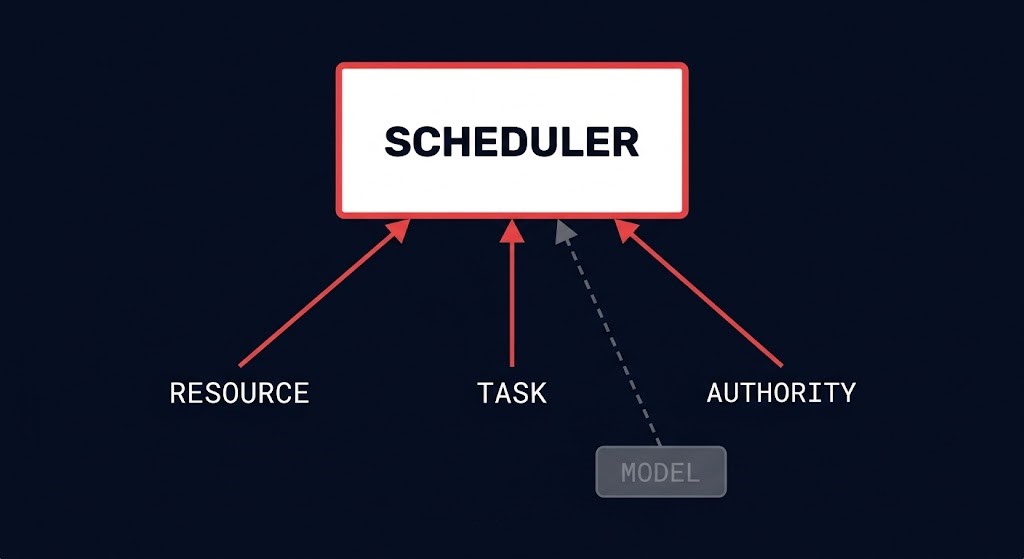
The AI Scheduler War: The Model Isn’t Deciding Anything
Start with the plain mechanics. A model generates output. It does not decide execution order, it does not enforce a budget, it does not choose which GPU it runs on, and it does not decide whether the action it just proposed is allowed to actually execute. Every one of those decisions happens in a layer the model never sees.
This is easy to miss because the model is the part everyone interacts with directly. It’s the part with a chat window, a benchmark score, a release note. The scheduler has none of that — no product page, no leaderboard, no press cycle. It just sits underneath, making the decisions that actually determine cost, performance, and risk. Enterprise architects who evaluate AI platforms by model quality alone are evaluating the wrong layer. The model is the visible product. The scheduler is the layer where the actual architecture lives.
Scheduling Is Becoming the New Control Plane
This is a familiar pattern for anyone who has watched infrastructure long enough. Cloud strategy stopped being about compute and became a fight over the control plane. Virtualization stopped being about hypervisor features and became a fight over operational simplicity. Observability stopped being a dashboard problem and became an evidence problem. In every case, value migrated beneath the layer everyone was looking at.
AI infrastructure is running the same play. Inference platforms decide which model executes, which GPU it lands on, and who gets priority when requests queue. Agent frameworks decide which task runs next, which tool gets invoked, and what the retry and concurrency behavior looks like when something fails. AI platforms decide budget enforcement, execution quotas, and approval gates before any of it reaches a model. None of that is a model capability. All of it is scheduling. The vendors racing to own “the AI platform” are, whether they say it out loud or not, fighting the AI scheduler war — they just haven’t named it that yet.
The AI Scheduler War Sits Above the Model
Here’s the inversion worth sitting with: most people still think in terms of model → platform → result, as if the model is upstream of everything else. It isn’t. The scheduler is upstream of the model.
The industry keeps talking about model wars. Models do not decide what executes, what gets priority, what receives resources, what stays inside budget, or what authority can be exercised. Schedulers do.
Before a single token generates, something has already decided which model gets to run, on what hardware, at what priority, under what spending ceiling, and with what authority to act. The model is the last stage in a decision chain, not the first. Architects who design AI systems around model selection while treating the scheduling layer as an implementation detail are building on top of a decision surface they haven’t actually mapped.
Three Scheduler Wars Happening at Once
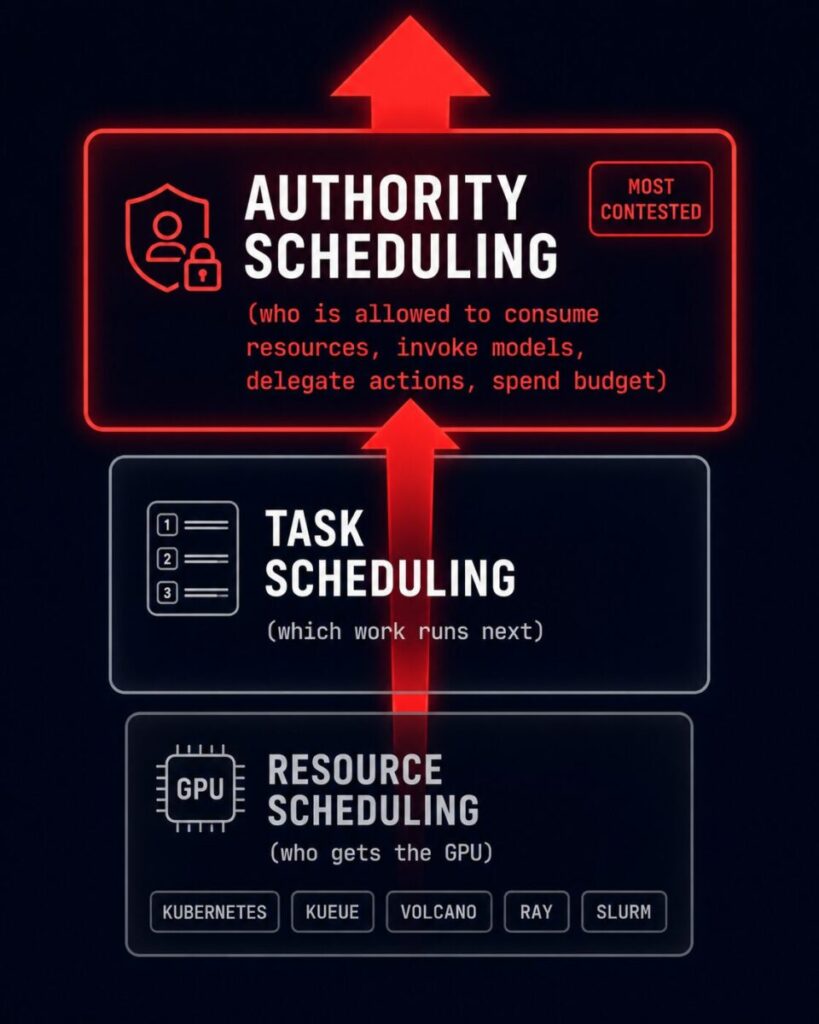
The AI scheduler war isn’t one fight — it helps to separate what’s actually being contested, because “scheduling” is doing a lot of work as a single word. There are three distinct fights running in parallel, and they are not equally mature.
| Scheduling Layer | Core Question | Where It’s Fought Today | Maturity |
|---|---|---|---|
| Resource Scheduling | Who gets the GPU? | Kubernetes, Kueue, Volcano, Ray, Slurm, Run:ai, vendor-native orchestration | Mature, actively contested, largely tactical |
| Task Scheduling | Which work runs next? | Agent frameworks, orchestration layers, tool-call sequencing | Emerging, fragmented, framework-specific |
| Authority Scheduling | Who is allowed to consume resources, invoke models, delegate actions, spend budget, or trigger execution? | AI platform control planes, governance layers, identity systems | Early, unowned, the actual contest |
Resource scheduling is the layer most architects already know. Who gets GPUs, at what priority, under what quota — this is the fight playing out across Kubernetes schedulers, Kueue, Volcano, Ray, Slurm, Run:ai, and vendor-specific orchestration tooling. It’s real, it matters operationally, and it’s becoming increasingly implementation-specific — which is exactly why it’s tactical rather than strategic. It’s a “which tool” decision, not a “who wins” decision — if that’s the decision you’re actually evaluating, start with the scheduler mechanics themselves rather than the market-level argument this post is making.
Task scheduling is one layer up. Which task runs next, which tool executes, what the concurrency limits are, what happens on retry — this is the layer agent frameworks are still fighting to define, and it’s genuinely unsettled. Different frameworks make different bets on this, and none of them has won yet.
Authority scheduling is the layer that actually matters, and it’s the one almost nobody is naming directly. This is the question of who is allowed to consume resources, invoke models, delegate actions, spend budget, or trigger execution — not in the abstract, but as an enforced, revocable, evidence-producing boundary. Most organizations think they’re building AI systems. Increasingly, they’re building systems that decide who receives computational authority. That’s a fundamentally different design problem than “which model,” and most AI platform architectures haven’t been built to answer it.
This is precisely the territory Framework #141, Agentic Authority Boundary, was built to describe — the formal boundary within which an agentic system may delegate execution authority, and the four failure states that define when that boundary has collapsed: scope creep delegation, implicit trust inheritance, non-revocable grants, and authority chain opacity. Every AI platform vendor currently racing to ship agentic capability is, whether they’ve named it or not, making architectural decisions inside this boundary. Most are making them by default rather than by design.
Why Vendor Platforms Care So Much About Scheduling
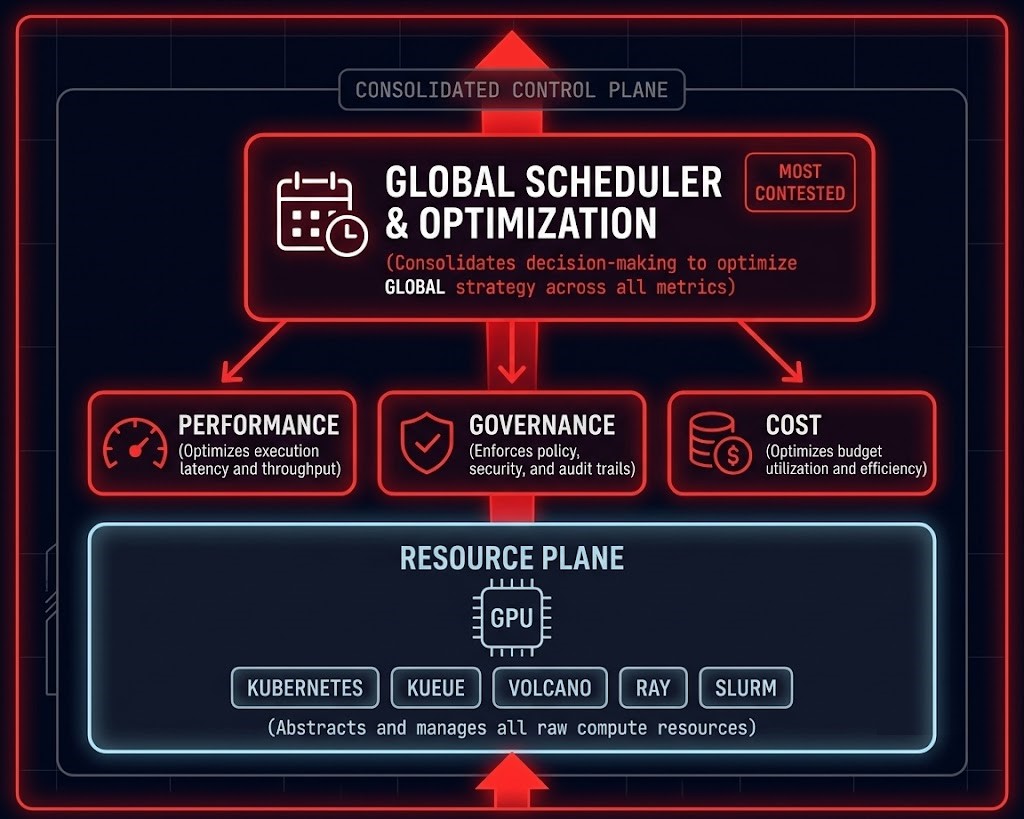
None of this is accidental, and none of it is really about developer convenience. Whoever owns the scheduler owns cost, because scheduling decisions determine GPU utilization and idle capacity. Whoever owns the scheduler owns performance, because placement and priority decisions determine latency under load. Whoever owns the scheduler owns governance, because budget enforcement, approval gates, and execution quotas are scheduling functions, not model functions.
This is the mechanism Framework #115, Control Plane Capture, names directly: the accumulation of operational authority by a single vendor or platform control plane until alternatives become impractical. Every AI platform vendor building a scheduling layer that looks vendor-neutral on the surface is, structurally, building the same consolidation pattern that’s played out at every other layer of the stack — cloud landing zones, service mesh, Kubernetes distributions. The scheduler is just the newest place it’s happening.
But capture is a description of the mechanism, not the underlying question. The underlying question is ownership — and that’s Framework #135, Control Plane Ownership Boundary: where authority over a system’s control plane actually resides, versus where an organization assumes it resides. #115 explains how consolidation happens. #135 explains what’s actually being consolidated. Put together, they describe exactly what’s at stake in the AI scheduler war: not a feature competition, but an ownership contest over who holds execution decision rights.
Architects evaluating an AI platform on model quality, context window, or agent framework ergonomics are evaluating criteria that will look dated in eighteen months. The criteria that will still matter are: who owns the scheduling layer, what authority model it enforces, and what happens when you want to leave.
The Next AI Platform Differentiator
Every AI vendor conversation right now centers on model capability or tool ecosystem breadth. Neither is where the next real differentiator sits. It isn’t a bigger model. It isn’t more tools. It’s better decisions about what runs next — under whose authority, at what cost, and with what evidence trail once it’s done.
This isn’t a hypothetical shift. Open infrastructure vendors are already positioning explicitly at this layer rather than the model layer — Upbound’s Modelplane, built on the CNCF-graduated Crossplane project, was released this year as fleet-wide scheduling infrastructure that sits above existing serving engines, schedulers, and gateways rather than competing with any single model or inference stack. That’s a vendor betting, correctly, that the durable fight isn’t inference quality. It’s who owns the decision layer above it.
The organizations that win the next phase of enterprise AI won’t be the ones with the best model access. They’ll be the ones who mapped their scheduling layer — resource, task, and authority — before a vendor mapped it for them. It’s the same lesson observability architects learned the hard way: the layer you bought and the layer you actually needed were never the same layer.
Where This Shows Up First
If your organization is running an AI Governance Assessment conversation, this is usually where it starts — not with model risk, but with an execution layer nobody explicitly designed. The Infrastructure Architecture Review’s AI Governance Assessment is built around exactly this gap: mapping who actually holds execution authority across your AI stack, versus who your org chart assumes holds it.
Architect’s Verdict
The AI scheduler war isn’t being fought over model quality, context windows, or agent framework ergonomics — it’s being fought one layer beneath all of that, over who decides what runs, when, where, and under whose authority.
Most organizations building AI systems today believe they’re making model decisions. They’re actually making scheduling decisions by default, one unexamined vendor default at a time, and they won’t discover what authority they’ve delegated until an incident forces the question. The scheduler was never the boring implementation detail. It was the architecture the whole time.
Every prior control-plane war — cloud, virtualization, observability — was won by whoever owned the layer nobody was watching. This one is no different. The model was never the control plane. The scheduler is.
Additional Resources
Editorial Integrity & Security Protocol
This technical deep-dive adheres to the Rack2Cloud Deterministic Integrity Standard. All benchmarks and security audits are derived from zero-trust validation protocols within our isolated lab environments. No vendor influence.

R.M.
Senior Solutions Architect with 25+ years of experience in HCI, cloud strategy, and data resilience. As the lead behind Rack2Cloud, I focus on lab-verified guidance for complex enterprise transitions. View Credentials →
Get the Playbooks Vendors Won’t Publish
Choose the architecture problems you care about. Get field-tested playbooks and frameworks delivered to your inbox.
- > AI Infrastructure & Inference Economics
- > Cloud Strategy & Hidden Cost Models
- > Virtualization & Deterministic Migration
- > Kubernetes, IaC & Modern Infrastructure
- > Data Protection & Recovery Engineering
Zero spam. Includes The Dispatch weekly drop.
Need Architectural Guidance?
Independent review before major infrastructure decisions.
- > Validate assumptions
- > Identify hidden dependencies
- > Quantify migration risk
- > Challenge vendor narratives
Triage · Advisory · Fractional · Direct Hire