

The Checkbox Was Labeled Security. It Also Said Availability.
The AWS CloudFront outage on July 16 exposed a security reliability tradeoffs problem that most cloud architecture teams have never priced: the feature you enable for its security benefit can quietly carry a reliability decision nobody put on the review agenda.
Three And A Half Hours In Frankfurt
At 3:45 a.m. ET on July 16, 2026, AWS CloudFront began returning 5xx errors to every customer using its VPC Origins feature. The failure lasted three hours and thirty-three minutes. AWS traced it to a capacity limit in a single availability zone in Frankfurt — euc1-az2 — inside the VPC Origins control plane. When that limit was hit, the system responsible for distributing routing configuration to CloudFront’s global edge network stopped updating. The edge processors kept running. They just no longer had valid instructions for where to send VPC Origins traffic.
The blast radius wasn’t proportional to the cause. This wasn’t a full CloudFront outage — it was one feature, in one region, hitting one capacity ceiling. The casualty list looked nothing like that scope: Hugging Face, unavailable across most regions. The UK National Lottery, unreachable by players nationwide. Canvas and Blackboard — the two dominant learning management systems in higher education — simultaneously down at hundreds of institutions, the second time in nine months the pair has gone offline together from an AWS CDN failure. Tailscale’s admin console and package repository. Ubiquiti’s cloud services. Coda, Doxy, Frontegg, TigerData.
None of these organizations made a bad infrastructure decision in the way that phrase usually gets used. Nobody skipped a failover test or ignored an SLA warning. Somewhere in each of their stacks sat a feature that was doing exactly what it was designed to do — right up until the moment “designed to do” and “the only thing it could do” turned out to be the same sentence.
It’s worth being precise about what kind of failure this wasn’t. It wasn’t a repeat-incident process gap, where the same containment lesson goes unlearned across several unrelated outages — this was one event, one cause, fully explained. And it wasn’t a knowingly-accepted concentration risk either, where an organization chose a single region or provider and simply never priced what that choice cost them. Every VPC Origins customer that got hit on July 16 would have said, if asked in June, that they hadn’t concentrated risk in CloudFront at all — they’d made a security decision, full stop. That’s the more interesting failure mode, and it’s the one this post is actually about.
What VPC Origins Actually Buys You
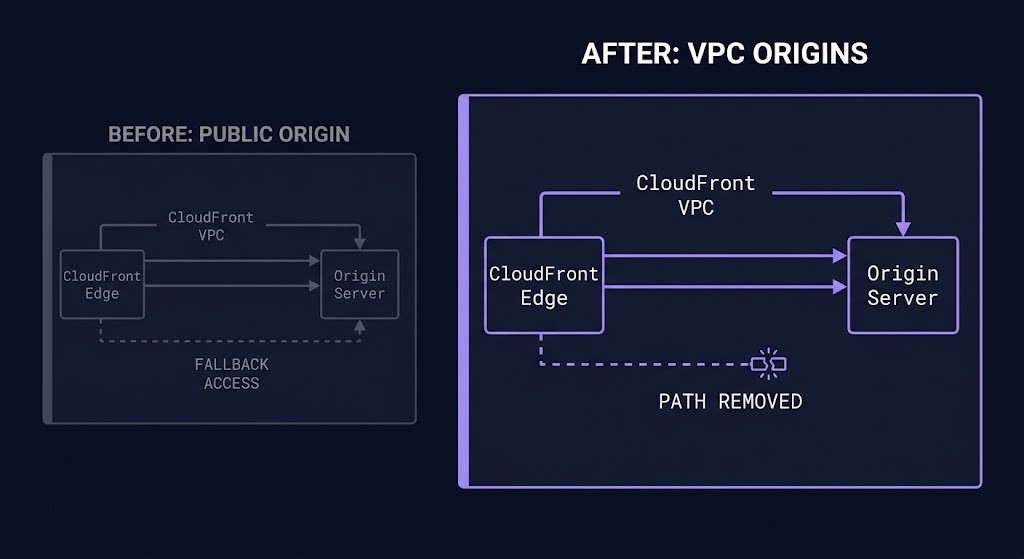
VPC Origins is a real security feature with a real, defensible pitch. Before it existed, an origin server behind CloudFront needed a public IP address and a public-facing security posture — reachable directly, in principle, by anyone who found it, CDN or no CDN. VPC Origins lets a customer keep that origin fully private: no public IP, no direct-access attack surface, traffic reaching the backend only through CloudFront’s own private connection into the customer’s VPC.
For a security team evaluating this feature, the calculus is straightforward and correct. Fewer exposed endpoints is fewer things to patch, fewer things to misconfigure, fewer things an attacker can find with a port scan. Financial institutions, healthcare platforms, and SaaS providers — the customer base AWS itself points to for VPC Origins — adopted it for exactly this reason. It is a good security decision, evaluated as a security decision.
That’s the part worth sitting with before moving to what went wrong: nothing about the July 16 outage means VPC Origins was a mistake to adopt. The mistake, where one exists, happened one level up — in how the decision to adopt it got evaluated in the first place.
The same one-level-up mistake shows up in identity architecture, for the identical reason. Centralizing authentication behind a single SaaS identity provider is a correct, defensible security decision — fewer credential stores, cleaner audit trails, one place to revoke access. It’s also, unreviewed, a resilience decision: the moment that provider can’t issue tokens, every system that trusted it becomes unreachable, not degraded. Same evaluation gap, different feature.
The Security Reliability Tradeoffs Nobody Evaluated
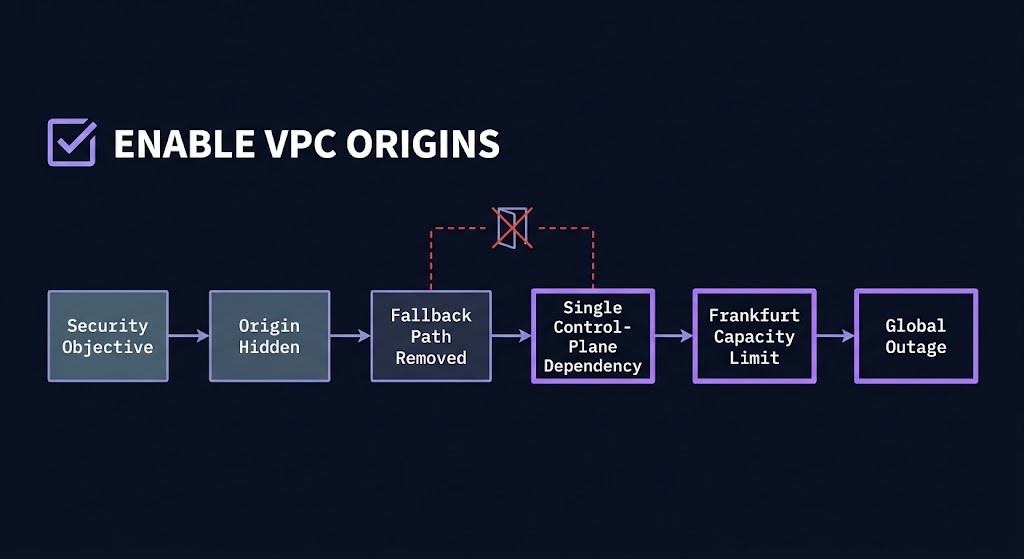
Here’s the chain, in order. An organization sets a security objective: stop exposing the origin server to the public internet. It enables VPC Origins. The origin is now hidden — unreachable except through CloudFront’s private path. That private path is singular by design; it is, definitionally, the only door. Which means the fallback path a public-origin configuration would have retained — a public IP an operator could reroute to in an emergency, a secondary access route independent of CloudFront’s own control plane — is gone, not degraded, gone. The organization now depends on CloudFront’s VPC Origins control plane as the only intended production path: if that control plane can’t route, there is no other sanctioned way in. On July 16, a capacity limit in one Frankfurt AZ hit that exact dependency, and the failure propagated globally to every VPC Origins customer at once, regardless of their own region.
Nobody in that chain made a reliability decision on purpose. They made a security decision, and a reliability decision rode along inside it, unexamined, until an outage examined it for them.
This is worth naming directly, because it’s a pattern, not an incident: call it a bundled architectural decision — a single configuration choice that resolves two independent architectural questions at once, where only one of the two ever reaches a review meeting. VPC Origins bundles a security posture decision with a failure-mode decision. The security team signs off on the first. Nobody signs off on the second, because nobody framed it as a decision that existed.
The same shape shows up one layer down, in execution config rather than adoption config: autoscaling gets reviewed as a capacity decision and silently makes an authority decision — how much the execution plane may do without asking a human — that nobody signed off on either. Different axis pair, same review that only asked one question.
This is a decision-time instance of the same gap the Automation Validation Tax (Framework #172) names at runtime: a review process — human, in this case, not automated — was asked to verify one axis and got treated as though it had verified both. The security review didn’t fail. It just was never scoped to check the axis nobody put in front of it, which is functionally identical to a verification step that never scaled to cover the growing surface it was supposed to cover.
The decision-chain shape above — objective, mechanism, hidden path, removed fallback, single dependency, trigger event, propagation — is the reusable part. Swap out “VPC Origins” and “Frankfurt capacity limit” and the same six-step chain describes a different feature and a different failure, somewhere else, later. That’s the actual lesson CloudFront is teaching. The outage is the specific instance. The bundled decision is the mechanism underneath it.
This is also a live instance of a pattern the site’s Dependency Awareness Boundary framework already names: the line between dependencies an organization has explicitly mapped and those it discovers only at failure time. That framework is usually framed around a strategic decision forcing the discovery — a migration, an exit, a sovereignty review. This outage shows the other trigger: no decision at all, just an unplanned failure surfacing a dependency nobody had mapped, because nobody had framed VPC Origins as a dependency-creating choice in the first place.
AI inference infrastructure hits the same dependency-discovery-at-failure-time pattern for a different reason: physics and cost concentrate GPU clusters into one facility the way a security decision concentrated CloudFront traffic into one control plane. The forcing function differs. The moment of discovery — an outage, not a review — doesn’t.
Where Else This Pattern Hides
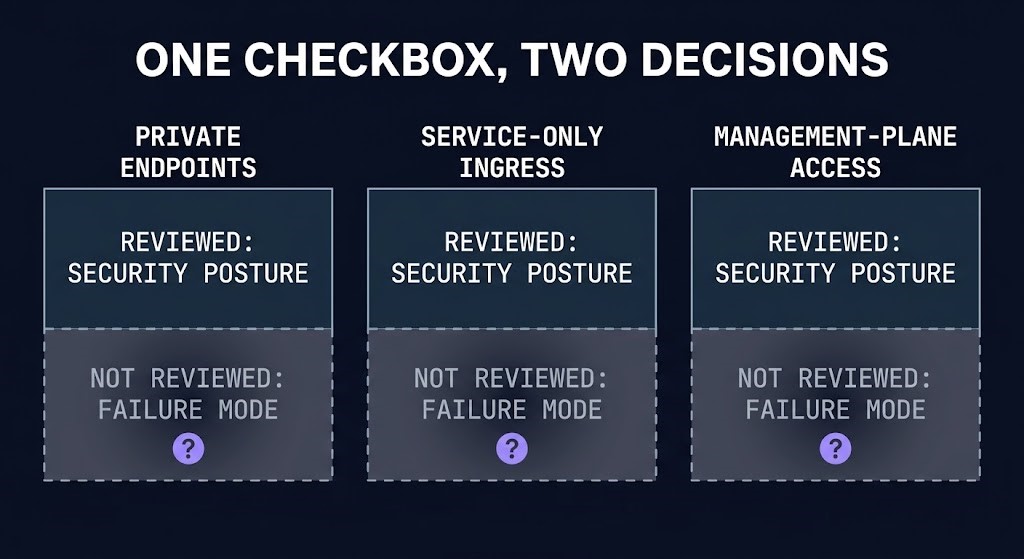
VPC Origins isn’t a special case. It’s a specific instance of a category of cloud features that bundle a stated benefit with an unstated architectural consequence, and the category is bigger than CDN configuration — it shows up anywhere cloud architecture decisions get made one feature at a time instead of as a full-domain review:
Private endpoint features — the same private-connectivity pitch VPC Origins makes, offered across nearly every hyperscaler service tier, carries the same question: what happens to your access path if the private connection’s own control plane has a bad day? It’s the same shared-substrate question the site’s own Multi-Cloud Cascading Failure piece raised about failover paths that look independent but aren’t — same shape, different layer.
Service-only ingress restrictions — locking a resource so it only accepts traffic from a specific managed service (rather than a broader network range) reduces attack surface and simultaneously makes that managed service’s own availability a precondition for yours.
Management-plane-only administrative access — removing direct SSH/RDP exposure in favor of a cloud provider’s own session-broker service is good security hygiene, and it also means the session broker’s uptime is now load-bearing for your ability to reach your own infrastructure during an incident.
API and platform model decisions — settling the architecture question (which API model, which platform) leaves the operational-risk question underneath it unreviewed by default, because feature comparison matrices stop at the layer that was actually decided.
Data placement and service coupling decisions — choosing where data lives and which managed services a workload depends on gets evaluated on cost and velocity today, and silently decides what it costs to leave later. The exit cost isn’t on the invoice until the exit is forced.
The common shape is the same class of security reliability tradeoffs, recurring: a feature marketed and evaluated on one axis (security) silently forecloses an alternative on a second axis (reliability) that was never part of the sales conversation, the security review, or the architecture sign-off. It’s the same one-axis-evaluated blind spot vendor lock-in exposed at the data layer — the industry spent a decade securing compute portability against the wrong kind of lock-in while the real one formed one layer down, unreviewed because nobody was looking at that axis. The fix isn’t “don’t adopt these features.” Most of them are still the right call. The fix is treating feature adoption as a review with two questions, not one: what does this buy me, and what does it quietly take away.
Architect’s Verdict
VPC Origins didn’t fail. It did exactly what a single-path system does when its one path stops working — it went down completely, for everyone using it, all at once. That’s not a flaw in the feature. That’s what “no alternate path” means, and it was true the day the feature launched, not the day Frankfurt hit a capacity ceiling. The security reliability tradeoffs it carried were real from day one; the outage just made them visible.
The actual failure happened earlier, in a review that only asked one question. Security teams evaluated VPC Origins as a security decision, correctly, and approved it. Nobody in that same review asked what the feature did to the organization’s failure modes, because nobody framed it as a second decision riding inside the first one. That’s the pattern worth carrying forward, and it isn’t unique to CDN configuration — it shows up anywhere a vendor sells a feature on one axis while quietly deciding a second axis on your behalf.
That second axis has a name the site uses elsewhere: optionality. Every adoption review that only asks what a feature buys is pricing optimization and getting optionality for free — right up until the free option turns out to have been load-bearing.
Every architecture review asks what a feature adds. Almost none ask what alternatives disappear the moment it’s enabled. That second question is the one worth adding to the checklist — not after the next outage, before the next checkbox.
Additional Resources
View 7 more resources
Editorial Integrity & Security Protocol
This technical deep-dive adheres to the Rack2Cloud Deterministic Integrity Standard. All benchmarks and security audits are derived from zero-trust validation protocols within our isolated lab environments. No vendor influence.

R.M.
Senior Solutions Architect with 25+ years of experience in HCI, cloud strategy, and data resilience. As the lead behind Rack2Cloud, I focus on lab-verified guidance for complex enterprise transitions. View Credentials →
Get the Playbooks Vendors Won’t Publish
Choose the architecture problems you care about. Get field-tested playbooks and frameworks delivered to your inbox.
- > AI Infrastructure & Inference Economics
- > Cloud Strategy & Hidden Cost Models
- > Virtualization & Deterministic Migration
- > Kubernetes, IaC & Modern Infrastructure
- > Data Protection & Recovery Engineering
Zero spam. Includes The Dispatch weekly drop.
Need Architectural Guidance?
Independent review before major infrastructure decisions.
- > Validate assumptions
- > Identify hidden dependencies
- > Quantify migration risk
- > Challenge vendor narratives
Triage · Advisory · Fractional · Direct Hire