

Private Cloud Is Back — Because Governance Never Left
The private cloud narrative was declared dead by cloud-first doctrine for the better part of a decade. Cost comparisons, operational overhead, capital expenditure cycles — all of it pointed toward public cloud as the inevitable destination. The private cloud operating model was framed as legacy thinking, a failure to move forward, the choice of organizations that hadn’t finished their transformation yet.
Most organizations are not repatriating because public cloud failed. They’re repatriating because they finally identified which governance responsibilities were never actually outsourced — and they now have a governance problem they can point to with enough specificity to justify an architecture decision.
THE AUTHORITY LAYER
The Repatriation Story Is Being Told Wrong
Cost is the headline every time. Egress bills, reserved instance sprawl, compute overprovisioning — all real, all measurable, all entirely capable of generating a business case. The repatriation calculus has been run at enough organizations now that the pattern is established: workloads move back when the unit economics cross a threshold, and the cloud-first doctrine that made that threshold invisible is no longer unquestionable.
But framing repatriation as a cost story misses what is actually driving architecture decisions at the enterprise layer. Teams are not moving workloads back because the numbers work. They are moving them back because governance broke down in ways they cannot fix from inside a hyperscaler console — and the cost story gives them the boardroom cover to do it.
The organizations with the clearest repatriation rationale are not the ones with the largest bills. They are the ones who can name a specific governance requirement their current architecture cannot satisfy — a regulatory audit that exposed an infrastructure-level control gap, a compliance posture that requires physical authority the shared model doesn’t expose, a workload locality requirement where data gravity and governance authority need to co-locate in a layer the provider doesn’t hand over. The cost calculus follows the governance failure. It does not precede it.
What “Cloud Operating Model” Actually Meant
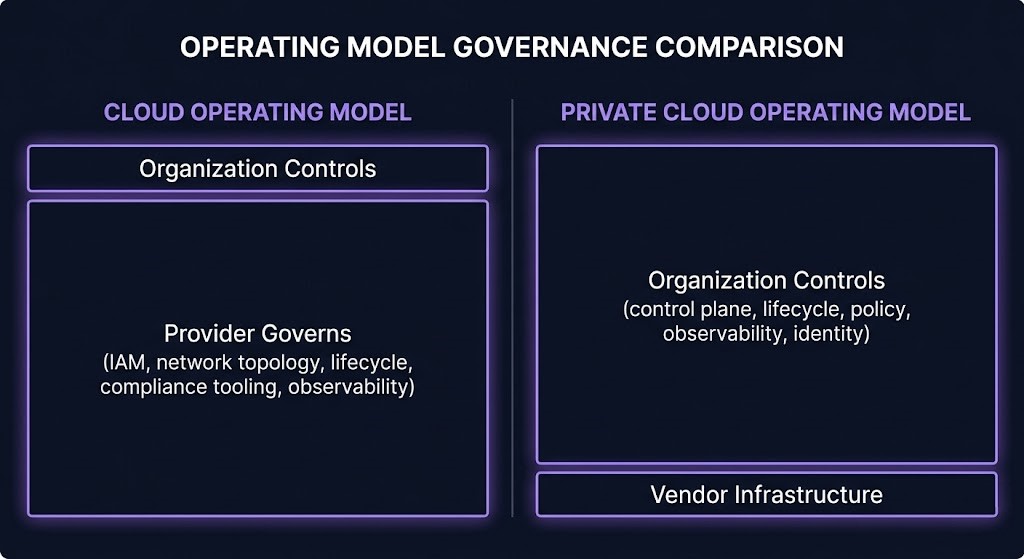
An operating model is the combination of governance authority, operational ownership, lifecycle control, and dependency boundaries that determine who can make infrastructure decisions during normal operations and failure conditions. That definition matters because the cloud operating model, applied at scale, was not neutral with respect to those four dimensions.
The cloud operating model reduced the governance surface area organizations were expected to own directly. Governance Surface Area is the total set of operational, policy, lifecycle, and authority decisions an organization must control directly in order to satisfy its governance requirements — and the cloud operating model contracted it systematically. IAM delegated to a shared-responsibility boundary. Network topology defined by provider SDN. Compliance posture maintained through provider tooling. Lifecycle decisions tied to service roadmaps the organization does not control. Observability data retained on infrastructure the organization cannot audit independently.
This was not a failure of cloud architecture. It was a design outcome. The shadow control plane problem is the same pattern at the interface level: every governance interaction that routes through a provider console rather than an organization-controlled enforcement layer reduces governance surface area by default. The market dynamic is accelerating this further: as covered in The Infrastructure Control Plane Is Consolidating, vendors are now deliberately expanding into policy, identity, and automation authority — absorbing the governance surface area that repatriation is meant to recover. Organizations rebuilding a private cloud operating model need to map which governance layers are being contested externally, not just which ones the provider retained under the shared responsibility model.
That contest is the same one cloud governance failure domains names structurally: once a governance mechanism — a policy engine, an identity layer, a lifecycle tool — sits inside the execution path rather than advising it, whoever controls that mechanism controls the blast radius of every decision routed through it. Governance surface area isn’t just what an organization has delegated. It’s what an organization has handed a failure domain to.
The cloud operating model reduced governance ownership in exchange for operational convenience. That trade was rational for most workloads for most of the last decade. What has changed is not the trade itself — it is which workloads it still applies to.
The Governance Problems Shared Responsibility Cannot Solve
The shared responsibility model is architecturally coherent for most of what enterprise organizations run. The provider secures the physical layer, the networking fabric, the hypervisor surface. The organization secures its workloads, its data, its access controls within the boundaries the provider defines. For the majority of workloads, that division is sufficient.
The governance failures that drive repatriation are the ones that sit at the boundary — the requirements that assume a level of infrastructure-level control the shared model doesn’t expose, regardless of which tier or service the organization is running.
Data residency requirements that exceed what region-scoped configuration can satisfy are the most common version. A region designation is a contractual commitment to a geographic scope. It is not an auditable physical control — and regulated workloads increasingly require the latter. Regulatory audit paths that require infrastructure-level logging, configuration attestation, or change reconstruction at a granularity the provider’s shared model doesn’t surface are the second category. The organization can prove what it configured. It often cannot prove what the provider’s control plane did.
The failure pattern looks like this: a regulated organization runs a workload on provider-managed infrastructure with provider-managed logging. An audit requires reconstruction of an operational decision chain — who authorized what, when, through which control path, with what policy enforcement in effect at the time. The logs exist. The control path through the provider’s management plane does not expose the granularity the audit requires. The architecture was compliant. The governance requirement was not met. The difference between those two statements is the governance surface area the provider retained.
The sovereign infrastructure strategy covers the broader version of this pattern — the point at which hybrid cloud governance becomes dependency with latency rather than architectural flexibility.
This same governance surface area gets contested a different way once workloads sit inside a hyperscaler rather than moving off one. The Cloud Arbitration Layer — Framework #166 — names what happens when cost, compliance, latency, sustainability, and sovereignty engines each arbitrate placement automatically inside the very shared-responsibility boundary this post is describing — a governance surface the organization technically owns on paper but doesn’t actually control in practice, because five automated systems are making the calls a human never reviews. Repatriation recovers governance surface area by moving infrastructure. The Cloud Arbitration Layer shows why some of that surface area was never really available to recover in the first place — it was already being arbitrated by tooling, not policy.
GOVERNANCE SURFACE AREA — FRAMEWORK #84
The total set of operational, policy, lifecycle, and authority decisions an organization must control directly in order to satisfy its governance requirements. The cloud operating model reduced the governance surface area organizations were expected to own directly. Repatriation is what happens when the residual requirements exceed what shared responsibility can deliver.
What “Private Cloud” Usually Means (And Why It’s Wrong)
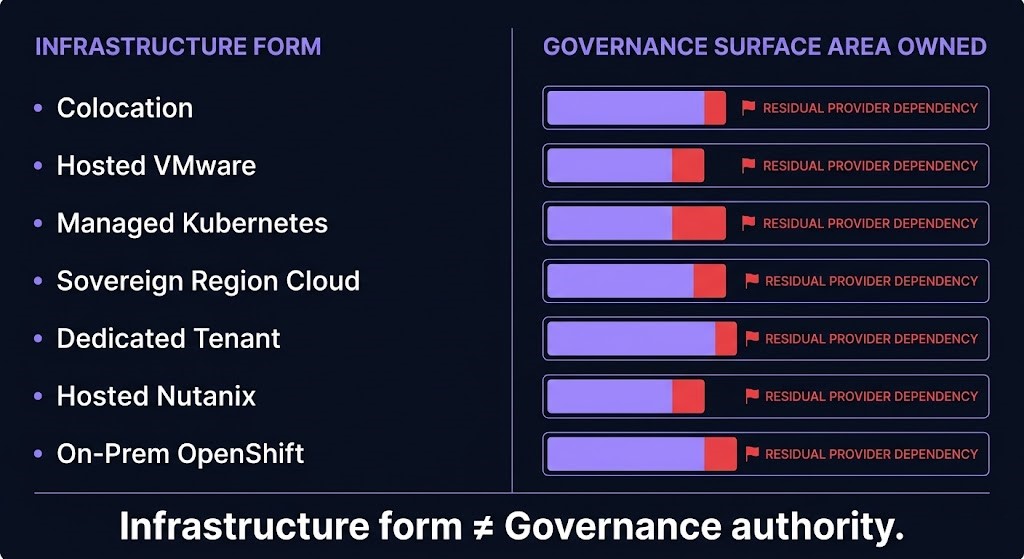
The repatriation conversation is complicated by a persistent conflation: infrastructure form with governance authority. Organizations that move to colocation, hosted VMware, managed Kubernetes, sovereign region cloud, dedicated tenant arrangements, hosted Nutanix, or on-premises OpenShift routinely describe the result as “private cloud.” The infrastructure may be physically separate. The governance surface area may be nearly identical to what they left.
Infrastructure ownership and governance ownership are not the same thing. The question is not what form the infrastructure takes. The question is what fraction of the governance surface area the organization actually controls — and whether that fraction satisfies the requirements that drove the repatriation decision in the first place.
Most “private cloud” implementations retain SaaS governance dependencies that the infrastructure transition does not address:
COMMON GOVERNANCE DEPENDENCIES THAT SURVIVE REPATRIATION
- SaaS identity provider — authorization chain routes through external infrastructure
- Cloud-hosted observability — operational telemetry retained outside the organization’s control boundary
- Vendor-managed lifecycle tooling — platform updates and deprecations controlled by the vendor roadmap
- External ticketing and change automation — operational decisions require external system availability
- Remote licensing authority — workload execution depends on license validation through vendor infrastructure
- Hosted control planes — management plane availability tied to provider uptime, not organizational authority
- Outbound support dependency — recovery procedures require vendor access to systems the organization nominally owns
- Vendor telemetry requirements — operational continuity conditioned on telemetry egress the organization cannot interrupt
The Shadow Sovereignty Auditor maps these dependencies against the governance requirements the repatriation was intended to satisfy — identifying which governance surface area gaps survive the infrastructure move.
DIAGNOSTIC
“If your infrastructure cannot continue governance operations during vendor API loss, identity provider outage, or SaaS observability interruption — you do not own the control surface.”
A private cloud that cannot operate during external control-plane loss is not sovereign infrastructure. It is a relocated dependency model.
The distinction matters because an organization that completes a repatriation project without auditing its governance dependencies has not recovered governance authority. It has moved hardware while leaving the governance surface area intact at the provider layer.
Private Cloud Is an Operating Model Decision, Not a Procurement Decision
Public cloud did not eliminate operational complexity. It centralized and standardized it behind a provider-owned governance model. The operational burden organizations shed when adopting cloud-first did not disappear — it was absorbed by the provider’s platform team, expressed through SLAs and service tiers, and governed by a control surface the organization never directly owned.
Public cloud optimized for operational convenience by externalizing governance complexity. Private cloud re-internalizes that complexity in exchange for authority. That is the real trade: convenience versus authority, delegation versus control, abstraction versus operational ownership. Neither side of that trade is obviously correct. The right answer is workload-specific and governance-requirement-specific.
The organizations getting private cloud decisions wrong treat repatriation as a migration project. Move the workloads, reduce the bills, declare the project complete. The organizations getting it right treat it as an operating model rebuild. That distinction — infrastructure move versus operating-model rebuild — is exactly the fault line virtualization’s own consolidation era ran into a decade ago, and the reason AI infrastructure is approaching the identical inflection point now: hardware maturity was never the hard part. The operating model always was. They are asking different questions: What governance authority do we need to satisfy our requirements directly? What lifecycle control do we require over the platforms we depend on? What does operational continuity look like when the platform is ours and its failure modes are our problem? What is the exit cost architecture of re-internalizing governance complexity, and does the governance premium justify it?
The procurement decision — which hardware, which hypervisor, which vendor — is the last decision in that sequence, not the first. Organizations that start with the hardware question and work backward to governance are solving for infrastructure form rather than governance authority. The operating model question precedes everything else.
What the Private Cloud Operating Model Actually Requires
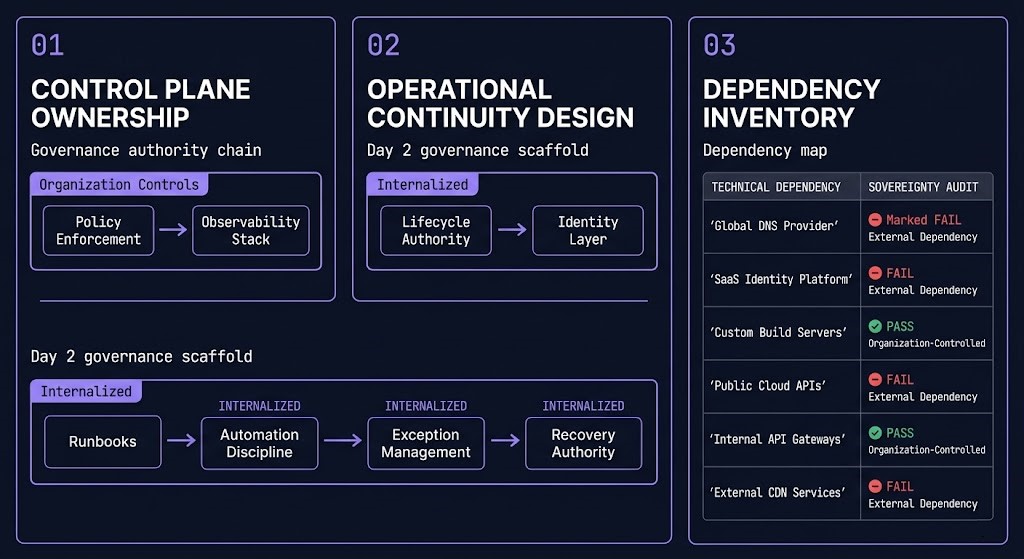
Applying the Governance Surface Area framework to the private cloud decision produces three requirements that determine whether the operating model delivers what the governance case promised.
Control plane ownership is not the same as running a hypervisor on your own hardware. It means owning the lifecycle of the management layer — the policy enforcement system, the observability stack, the identity authority, the change management path — such that no governance decision requires a vendor API call to execute or a vendor support escalation to authorize. Organizations that repatriate workloads to on-premises infrastructure while retaining a hosted management plane have not achieved control plane ownership. They have moved compute while leaving the authority layer in place.
Operational continuity design is what separates private cloud from co-located public cloud. The cloud operating model papered over Day 2 governance scaffolding — the runbook investment, the automation discipline, the exception management process — because the provider’s platform absorbed most of the operational complexity. Private cloud re-internalizes that complexity without the provider’s platform absorbing it. Organizations that underestimate this consistently discover that the operational overhead they shed in the cloud-first transition was real, and recovering it requires deliberate investment in governance infrastructure they never built. The platform team cost governance problem — engineering capacity consumed by operational overhead rather than architectural development — is what happens when this investment doesn’t happen.
Dependency inventory is the audit that most organizations skip. Map every system that is required for governance operations: identity, monitoring, alerting, ticket routing, change authorization, license validation, vendor telemetry. For each one, determine whether the organization can operate that governance function independently — not with degraded capability, but with full authority — if the external dependency becomes unavailable. The items that fail that test are the residual governance surface area the operating model does not cover.
01 — CONTROL PLANE OWNERSHIP
Own the lifecycle of the management layer, policy enforcement, and observability stack. No governance decision should require a vendor API call to execute or a vendor escalation to authorize.
02 — OPERATIONAL CONTINUITY DESIGN
Invest deliberately in Day 2 governance scaffolding — runbooks, automation discipline, exception management — that the cloud operating model absorbed through the provider’s platform. This investment does not happen by default.
03 — DEPENDENCY INVENTORY
Map every system required for governance operations. Determine which can be operated independently during external dependency loss. Items that fail that test are residual governance surface area the operating model does not cover.
The infrastructure-to-AI governance bridge runs through the same framework. The sovereign AI control plane problem is control plane ownership applied to the AI runtime layer — the same governance authority question that drives private cloud repatriation, one layer up the stack. Organizations that have not resolved the infrastructure governance question will find the AI governance question harder, not easier, because AI workloads introduce additional data locality, inference authority, and audit chain requirements on top of the infrastructure governance baseline.
Authority Layer: Who Actually Owns the Control Surface
The Authority Layer series has been mapping a consistent pattern across every post: the infrastructure control surface — the layer where governance decisions are actually made — sits above the hardware, above the software configuration, and frequently above the formal governance model the organization believes is in charge.
Parts 1 and 2 mapped the failure modes at the tooling layer: the CI/CD pipeline bypassed by console access, the console mutations that accumulate as untracked state. Part 3 named the human layer above both: the senior engineer whose operational authority artifacts are not in any system. Part 4 mapped the organizational layer: the platform team whose engineering capacity was consumed by cost governance until infrastructure authority became a finance function.
Part 5 is the infrastructure architecture layer: organizations that moved to cloud-first transferred governance authority to a provider-owned control surface, and the repatriation wave is what happens when that transfer turns out to be incomplete for the workloads that matter most.
The organizations with the clearest private cloud operating models have done the same thing at each layer: traced the governance requirement to the control surface that must satisfy it, determined whether they own that surface, and made the architectural decision accordingly. Infrastructure form follows from that analysis. It does not substitute for it.
SERIES: THE AUTHORITY LAYER
Architect’s Verdict
The private cloud operating model is not a reaction to cloud failure. It is the architecture decision that follows a governance audit — the moment when an organization maps its requirements against the control surface it actually owns and finds the gap too wide to govern across. Cost is frequently in the analysis. It is rarely the deciding variable.
The False Private Cloud pattern is where most repatriation projects fail. Moving hardware while retaining the governance dependencies does not change the governance surface area. An organization with on-premises compute, cloud-hosted identity, provider-managed observability, and vendor-controlled lifecycle tooling has changed its infrastructure form without changing its governance authority. The same validation gap governs the reverse move: an architecture that looks exit-ready doesn’t confirm it until the exit is actually attempted — see Why “Portable” Systems Still Fail During the First Real Exit Test. The audit exposure, the compliance gap, the operational continuity risk — all of it persists because the control surface was never the hardware.
Repatriation is not a return to legacy infrastructure thinking. It is a recognition that governance authority has operational requirements abstraction alone cannot satisfy. Public cloud reduced operational burden by abstracting governance ownership. The repatriation wave is what happens when organizations realize abstraction and authority were never the same thing.
Additional Resources
View 4 more resources
Editorial Integrity & Security Protocol
This technical deep-dive adheres to the Rack2Cloud Deterministic Integrity Standard. All benchmarks and security audits are derived from zero-trust validation protocols within our isolated lab environments. No vendor influence.

R.M.
Senior Solutions Architect with 25+ years of experience in HCI, cloud strategy, and data resilience. As the lead behind Rack2Cloud, I focus on lab-verified guidance for complex enterprise transitions. View Credentials →
Get the Playbooks Vendors Won’t Publish
Choose the architecture problems you care about. Get field-tested playbooks and frameworks delivered to your inbox.
- > AI Infrastructure & Inference Economics
- > Cloud Strategy & Hidden Cost Models
- > Virtualization & Deterministic Migration
- > Kubernetes, IaC & Modern Infrastructure
- > Data Protection & Recovery Engineering
Zero spam. Includes The Dispatch weekly drop.
Need Architectural Guidance?
Independent review before major infrastructure decisions.
- > Validate assumptions
- > Identify hidden dependencies
- > Quantify migration risk
- > Challenge vendor narratives
Triage · Advisory · Fractional · Direct Hire