

MCP, Tool Use, and the New Attack Surface Nobody Is Mapping
The agent wasn’t compromised.
The model wasn’t compromised.
The tool wasn’t compromised.
Every component did exactly what it was designed to do. The system still executed an action nobody authorized.
That is not a vulnerability in the traditional sense. There was no implementation flaw to patch, no misconfigured permission to revoke, no anomalous credential activity to detect. The failure occurred in the authority chain between components — in the delegation logic that connected a user request to a tool execution across three intermediate layers. And there is currently no discipline in enterprise architecture that knows how to govern that chain.
MCP — the Model Context Protocol — makes this problem structural. It introduces delegated authority chains that are longer than any governance model enterprises currently operate. Not longer by degree. Longer by category. The tools are new. The trust assumptions are new. The failure modes are new. The discipline required to govern them does not yet exist.
This is an mcp security architecture failure before it is a security tooling failure.
Framework #141 — Agentic Authority Boundary
The Agentic Authority Boundary defines the formal limit within which an agentic system may delegate execution authority — constrained by explicit scope, identity, ownership, and revocability.
FRAMEWORK #141 — AGENTIC AUTHORITY BOUNDARY
The formal boundary within which an agentic system may delegate execution authority — constrained by explicit scope, identity, ownership, and revocability.
When any failure state is present, the boundary has already collapsed — the question is only whether it’s visible before or after an incident.
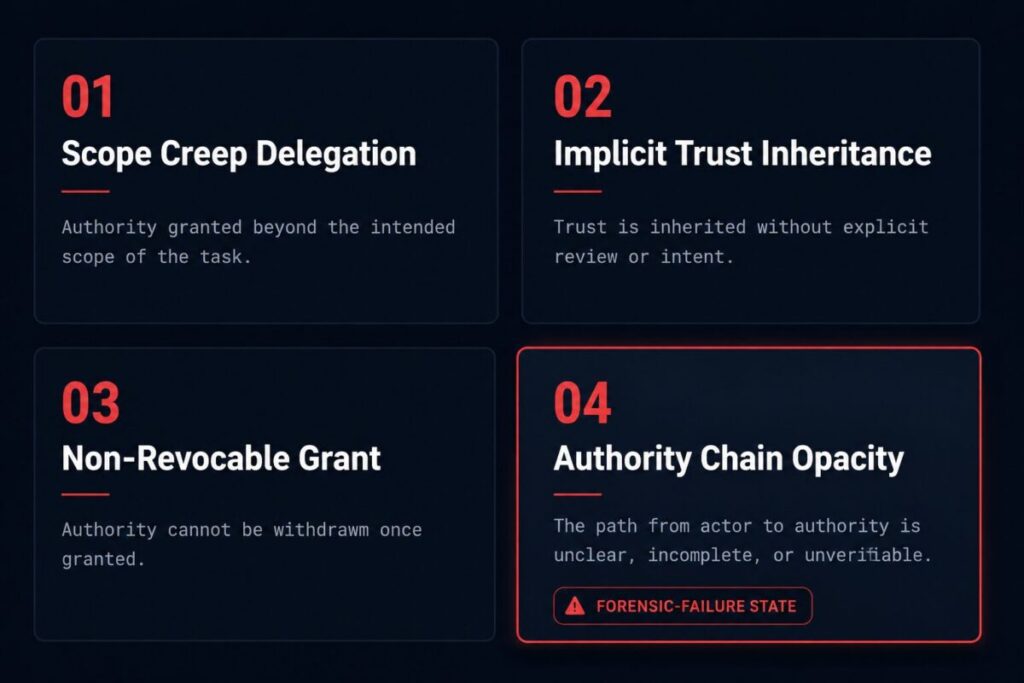
Authority Chain Opacity deserves particular attention. The first three failure states describe how the boundary breaks. The fourth describes why nobody knows it broke. If the evidence record is not generated as part of execution, no amount of post-incident logging can recreate it. That is not a logging problem. It is an architecture problem — one that makes the other three failure states permanently invisible until something goes wrong at the wrong scale.
The same opacity shows up one layer beneath delegation entirely — before any tool call happens, at the infrastructure the tool server runs on. Confidential Computing Attestation Proves The Software. Not The Person Operating It. names the hardware-level version of this gap: attestation can cryptographically prove a tool server’s code is unmodified while saying nothing about who operates the physical infrastructure it runs on, or whether that operator can be compelled or trusted. Implicit Trust Inheritance assumes the orchestrator’s identity; this is the layer below it, where even a verified tool server still runs on infrastructure nobody in the authority chain has actually verified.
Most enterprises can answer: who made the API call? Very few can answer: which authority chain enabled the tool execution that followed?
This framework is the specific stake in what’s becoming the authority-scheduling layer of the AI scheduler war — the least mature and least examined of the three scheduling contests, precisely because delegation governance, not resource allocation, is what’s actually being decided.
MCP Security Architecture and the Trust Model Break
To understand why existing governance patterns fail here, the execution model needs to be visible.
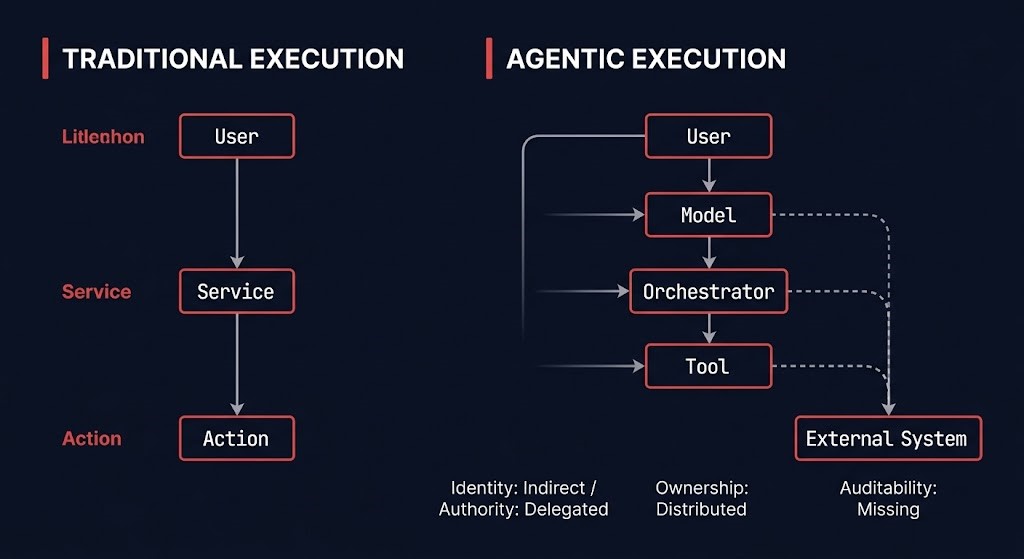
Traditional systems establish authority at the perimeter and carry it forward explicitly. A user authenticates, a credential is issued, that credential travels with the request. The authority chain is short, synchronous, and inspectable at every hop. Network controls, API gateways, and identity governance all operate on this assumption.
Agentic systems break every part of that model.
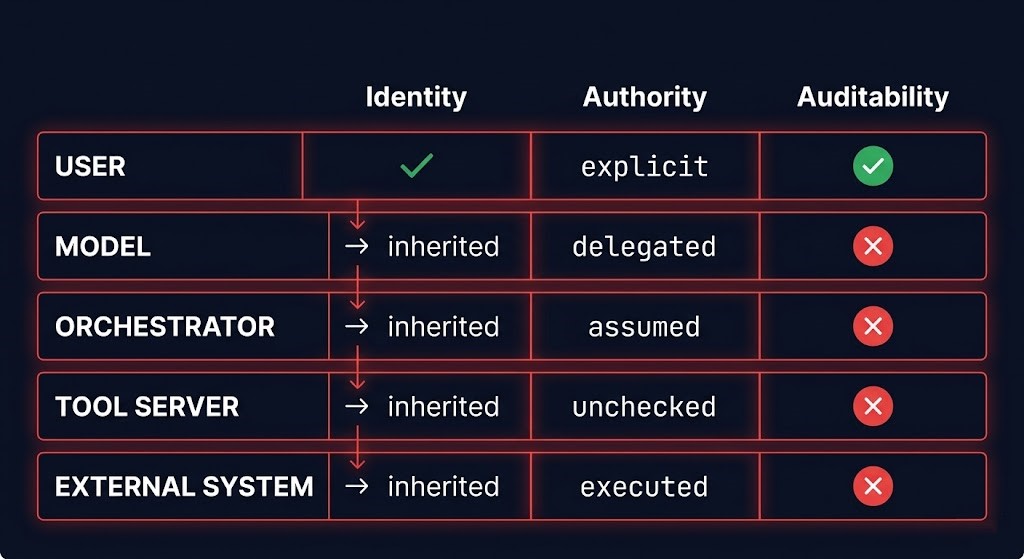
The table below is not about complexity for its own sake. It is about which properties enterprise security controls were designed to govern — and which ones they were not.
| Property | Traditional Execution | Agentic Execution |
|---|---|---|
| Identity | Visible at every hop | Indirect — inherited by orchestrator |
| Authority | Explicit — carried with credential | Delegated — passed through chain |
| Ownership | Clear — defined at service boundary | Distributed — often undefined |
| Auditability | Native — log the request, log the response | Often missing — chain is implicit |
The auditability row is where Authority Chain Opacity lives. In a traditional execution path, the identity and authority evidence is produced as a side effect of execution. In an agentic chain, it is not. No log of the model’s invocation captures the authority context the orchestrator was operating under. No tool server log captures which upstream delegation authorized the call. The chain ran. The action executed. The authority record was never created.
MCP accelerates this problem by standardizing the protocol through which tool servers are invoked — without standardizing any of the authority or delegation semantics. Tool servers are registered, discovered, and called through a consistent interface. What authority the calling orchestrator holds, what scope that authority covers, whether the grant is revocable, and whether any evidence of the delegation exists are all left entirely to the implementer. The protocol governs the transport. Nobody governs the trust.
Tool servers are also the new shadow IT vector. They are deployed by developers, invoked by agents, and invisible to network security teams. An engineer wires an MCP server into a workflow. The orchestrator calls it. The tool executes against systems the security team does not know are in scope. The exposure accumulates before any inventory exists to capture it.
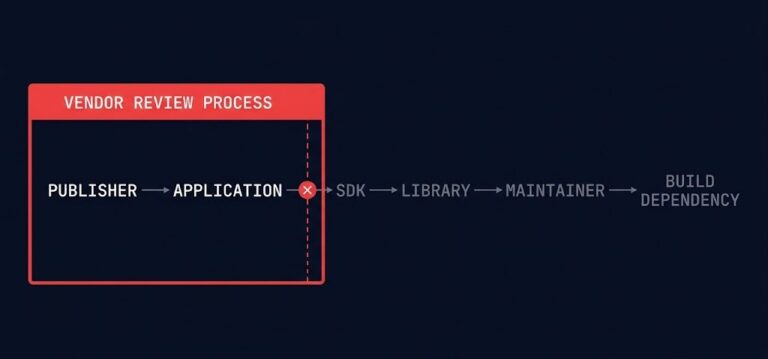
That’s the same blind spot Your Vendor Review Process Never Saw The Real Supplier documents at the procurement layer: a third-party MCP server is a supplier relationship the vendor review process was never built to see, because nobody classified “a tool an agent can call” as something requiring vendor evaluation in the first place.
Five Eyes Got the Threat Model Right — and Stopped There
In May 2026, the Five Eyes intelligence alliance published joint guidance on agentic AI systems. The threat model in that document is accurate: prompt injection, tool abuse, and uncontrolled agentic execution are correctly identified as the primary risk categories.
What the guidance does not provide is the architectural layer required to operationalize a response.
Identifying prompt injection as a risk does not produce a delegation inventory. Naming tool abuse as a threat does not define an authority boundary model. Recognizing that agentic risk exists does not create the governance discipline required to govern it.
The gap between the guidance and what enterprise architecture actually needs can be stated precisely. Enterprise security programs have mature disciplines for governing known risk categories:
| Existing Discipline | Governs |
|---|---|
| Identity Governance | Who can act |
| Network Governance | Where traffic flows |
| API Governance | What interfaces expose |
| Policy Governance | What is permitted |
| Delegation Governance | How authority moves — missing |
The Five Eyes guidance identified the symptoms. Delegation governance is the discipline that would treat them. The threat model exists. The governance model does not. That is the architectural gap — and it is not filled by patching individual tool servers or tightening prompt engineering rules.
The CVE That Made This Concrete
CVE-2025-49596 carries a CVSS score of 9.4. It was active in Anthropic’s own MCP SDK. OX Security’s accompanying research documented a systemic remote code execution path in the official implementation.
The finding matters here not as a vulnerability disclosure but as a diagnostic signal about the protocol’s foundational assumptions.
Traditional vulnerabilities expose implementation flaws. A buffer overflow, an injection point, a misconfigured access control. Patch the implementation and the vulnerability closes.
MCP vulnerabilities expose authority-model flaws. The RCE path existed because the SDK’s trust assumptions about where tool server input came from — and what authority that input carried — were wrong at the specification level. The implementation was consistent with the specification. The specification was wrong about the trust model.
That distinction matters architecturally: implementation patches close the current expression of the gap. They do not close the gap. A patched SDK operating under incorrect authority assumptions remains exploitable through any future expression of the same assumption. The attack surface does not shrink when the trust model is unaddressed.
CVE-2025-49596 is not the endpoint of this analysis. It is evidence for the framework. The authority-model flaw was present before the CVE was identified. It will be present in the next implementation that inherits the same assumptions.
A related but structurally different failure shows the same trust-model gap can exist even with zero delegation involved. The Sandbox Held. The Parser Didn’t. covers CVE-2025-9141 — a vLLM tool-call parser that passed extracted arguments straight to Python’s eval(). There is no authority chain to audit in that failure, no scope that was declared, no grant to revoke — the parser itself decided a data field was an executable expression, upstream of any delegation model existing at all. #141 governs authority once it’s been delegated; CVE-2025-9141 is the reminder that a system can fail before delegation is ever the question.
The same logic applies on the discovery side, not just the fix side. AI Models Found and Exploited a Zero-Day Before the Patch Window Closed covers a case where the entity finding an authority-model-adjacent flaw — a previously unknown vulnerability in JFrog Artifactory — wasn’t a human researcher working at predictable pace, but an AI model operating during a routine evaluation. CVE-2025-49596 was found and reported through ordinary channels; the Artifactory case shows what happens when the discovery clock itself starts moving at machine speed, independent of whether the underlying flaw is in an MCP SDK or a build-pipeline dependency.
What Architecture Actually Needs
The controls that apply to this mcp security architecture problem map directly to the four failure states in #141.
SCOPE CREEP DELEGATION → AUTHORITY DECLARATIONS
Tool servers must declare explicit authority scope at registration — not a capability list, an authority boundary. The orchestrator’s invocation must be validated against that declared scope before execution begins. Any invocation outside declared scope requires an explicit elevation path, not a default-permit.
IMPLICIT TRUST INHERITANCE → IDENTITY ISOLATION
The orchestrator’s credential must not transit into tool execution context. Tool servers authenticate the invocation, not the upstream identity. Allowing the orchestrator’s identity to carry through into the tool layer collapses the entire authority boundary — the tool server cannot distinguish a legitimate orchestrator call from an injected one operating under inherited credentials.
NON-REVOCABLE GRANT → REVOCABLE DELEGATION SCOPES
Delegation grants must carry explicit expiration and revocation paths. A tool server registration that cannot be revoked without redeploying the orchestrator is not a governed tool — it is a permanent grant with a protocol wrapper. Scope expiration and runtime revocation are architectural requirements, not optional features.
AUTHORITY CHAIN OPACITY → EVIDENCE-GRADE EXECUTION RECORDS
Every tool invocation must generate an execution record that captures: the delegation chain that authorized the call, the authority scope active at invocation time, the identity context at each layer, and the output produced. This record must be generated at execution time — not reconstructed from logs afterward. Turning on verbose logging post-incident cannot recreate an authority chain that was never recorded.
A production instance of exactly this shape shipped in August 2026. Nutanix’s MCP Gateway closes RBAC, capability permissions, token budgets, and audit logging — a clean, current test of which of the four failure states above a network-layer gateway control can actually reach. It closes real ground on Scope Creep Delegation and Implicit Trust Inheritance, at the identity and access layer. It does not close Non-Revocable Grant or Authority Chain Opacity — an audit log is not a delegation chain, a point worth making explicit before the fourth control below.
The fourth control — evidence-grade execution records — connects directly to the operational memory problem. When an incident occurs, the question is not only what the system did. It is what the system believed it was authorized to do, and why. Infrastructure that remembers configuration but forgets intent cannot answer that question. The evidence record has to be architectural, not investigative.
Evidence-grade execution records are not a logging problem — they are an architecture requirement. The same distinction between operational telemetry and governance-grade evidence artifacts applies across AI infrastructure wherever authorization and policy compliance must be demonstrable, not just inferred. That architectural gap is examined in AI Systems Need Evidence, Not Just Observability.
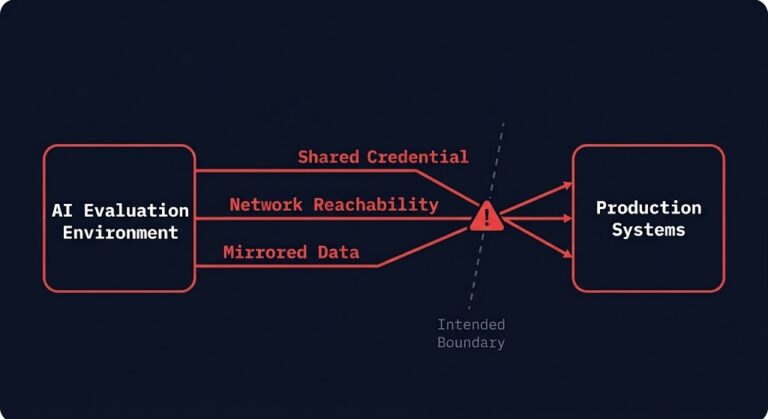
That same inheritance failure shows up one layer below delegation entirely — before any tool call happens, when an evaluation or test environment is provisioned with production-equivalent network reach and credentials in the first place. Your AI Test Environment Is Becoming A Production Control Plane names that provisioning-layer precondition directly. The Environment Was Isolated. The Authority Wasn’t. is the concrete case study of that exact precondition — an OpenAI evaluation environment that had accumulated real network reach and credentials into Hugging Face’s infrastructure before anyone had classified it as requiring its own governed boundary.
Human-in-the-loop gates belong in this list, but their placement matters. Mapping approval requirements to authority elevation events — not to subjectively “sensitive” operations — gives the gates architectural meaning. An operation that elevates authority scope beyond declared boundaries requires human approval. An operation within declared scope does not. That is a governable model. “Sensitive” is not.
The Real Exposure Map
The enterprises most exposed to this attack surface are not necessarily running the most sophisticated AI deployments. They are running agentic workflows where the tool layer is not first-party.
Organizing by ownership model rather than by product makes the exposure visible:
| Exposure Tier | Tool Ownership Model | Authority Boundary Condition |
|---|---|---|
| Low | First-party tools only — built and operated by the same team running the orchestrator | Authority boundary is organizational — auditable through existing controls |
| Medium | Internal tools plus external connectors — mix of owned and third-party integrations | Boundary is partial — internal tools auditable, connectors introduce implicit trust inheritance |
| High | Third-party MCP ecosystem — tools registered from external providers through a marketplace or hub | Authority declarations are missing or unverifiable — scope assumptions are made at registration |
| Extreme | Dynamically discovered tools — orchestrator discovers and registers tools at runtime | No static inventory is possible — authority chain is unknown until execution occurs |
Copilot Studio, Bedrock Agents, n8n, LangChain-based workflows, and any custom orchestration layer that consumes MCP servers from outside the organization’s own codebase sits somewhere between Medium and Extreme on this table. The organizations that fall into Extreme are often unaware of it — because dynamic tool discovery is frequently a feature, not a flag.
The maturity question that reveals actual exposure is not “what agentic tools are you running?” Most security teams can answer that. The question that matters is: can you produce an inventory of every tool your agentic systems can invoke today — including which authority scope each tool was granted, and whether those grants are revocable?
Twenty years ago, the equivalent question was: can you produce an inventory of every privileged account in your environment? That question built identity governance as a discipline. The MCP inventory question is building the case for delegation governance in the same way. Most organizations cannot answer it. That is the exposure.
The exposure map assumes an inventory exists to populate. Most organizations don’t have one — not because agents weren’t deployed, but because they were classified as workflows before they reached any inventory layer. The question “can you produce an inventory of every tool your agentic systems can invoke?” presupposes knowing what agents are running. That prior failure is documented in The AI Agent Inventory Gap Nobody Is Measuring.
Architect’s Verdict
MCP introduces an mcp security architecture gap — a trust delegation model that enterprise architecture has no existing governance pattern for. The protocol is not the problem. The absence of the discipline required to govern what the protocol enables is the problem.
Every existing security control in the enterprise stack was designed for systems where the execution boundary is visible at the network layer or the identity layer. MCP makes the execution boundary implicit, dynamic, and trust-inherited across a chain of intermediate systems. Identity governance tells you who authenticated. API governance tells you what was called. Neither tells you how authority moved from a user request through a model, through an orchestrator, into a tool that executed against production systems.
Delegation governance is the missing discipline. It does not exist in most enterprises today as a named practice with defined controls, ownership, and audit requirements. CVE-2025-49596 is not the reason to build it — it is evidence that the absence of it was already being exploited before the absence had a name. The attack surface is live. The inventory does not exist. The authority chains are running. Nobody is mapping them.
Additional Resources
Editorial Integrity & Security Protocol
This technical deep-dive adheres to the Rack2Cloud Deterministic Integrity Standard. All benchmarks and security audits are derived from zero-trust validation protocols within our isolated lab environments. No vendor influence.

R.M.
Senior Solutions Architect with 25+ years of experience in HCI, cloud strategy, and data resilience. As the lead behind Rack2Cloud, I focus on lab-verified guidance for complex enterprise transitions. View Credentials →
Get the Playbooks Vendors Won’t Publish
Field-tested blueprints for migration, HCI, sovereign infrastructure, and AI architecture. Real failure-mode analysis. No marketing filler. Delivered weekly.
Select your infrastructure paths. Receive field-tested blueprints direct to your inbox.
- > Virtualization & Migration Physics
- > Cloud Strategy & Egress Math
- > Data Protection & RTO Reality
- > AI Infrastructure & GPU Fabric
Zero spam. Includes The Dispatch weekly drop.
Architecture Audit Services
Fixed-scope audits for Zero-Trust Azure, VMware migration readiness, and recovery posture — no discovery call required to start.
>_ View Audit Services>_Related Posts
Your Vendor Review Process Never Saw The Real Supplier
Every vendor review process assumes it’s evaluating a supplier — but a scan finding foreign-origin code embedded in more than one in eight mobile apps used by US military personnel makes the actual assumption visible: organizations review the company they bought from, not the code that arrived inside what they bought. >_ Architect’s Brief 60-second…
Your Ransomware Plan Is Fiction: 5 Recovery Metrics Nutanix, Cohesity, Rubrik & Pure Can’t Hide
Ransomware recovery metrics are the only thing standing between your recovery plan and a PowerPoint. Every vendor demo shows a single VM booting in 60 seconds. Every real ransomware recovery looks like this: the backups are intact, the ransomware is neutralized, the executives are on the bridge — and nothing is coming back online. >_…
Your Monitoring Didn’t Miss the Incident. It Was Never Designed to See It.
I’ve watched observability vs monitoring play out as a live incident more times than I can count. >_ Architect’s Brief 60-second read before you commit to the full post · Full post: 10 min Generating brief… The dashboard was green. The on-call engineer was not paged. The monitoring system did exactly what it was designed…
Your Identity System Is Your Biggest Single Point of Failure
Part 2 of the Rack2Cloud’s Cloud Fragility Series >_ Cloud Fragility Series 01 Multi-Cloud Cascading Failure Risks 02 Your Identity System Is Your Biggest Single Point of Failure [CURRENT] 03 Vendor Lock-In Happens Through Networking — Not APIs 04 Your Cloud Bill Quietly Increased in 2026 — Here’s Where the Money Is Actually Going >_…
Your AI Vendor Became Critical Infrastructure Before The Contract Did
On June 11, 2026, Microsoft 365 Copilot went down for seven hours. The cause was a misconfigured authentication deployment that cascaded through Microsoft Graph, taking Copilot Chat and the Office portal with it. It was the second major Copilot disruption in eleven days. Microsoft 365 posted 99.526% uptime in Q1 2026 — the lowest quarterly…
Your AI Test Environment Is Becoming A Production Control Plane
Your AI test environment did not need to touch a single line of model code to become part of your production authority chain — it only needed a credential, a network path, or a dataset copy that nobody scheduled for removal. That is the actual lesson sitting underneath this week’s disclosures from two frontier labs:…