

VMware Licensing Disputes Are the New Audit Risk
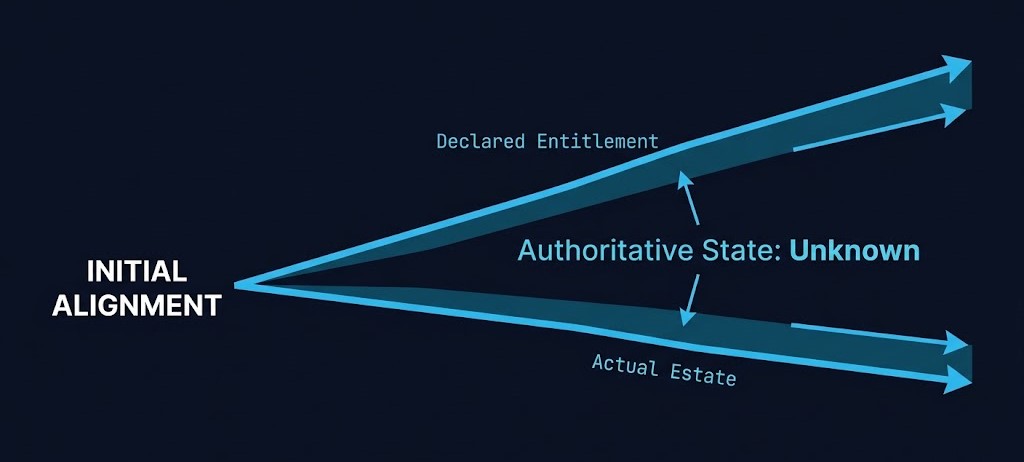
Audit risk used to show up after a licensing negotiation closed. Increasingly, it shows up while the negotiation is still open — because a dispute in progress is exactly the condition a vendor audit is built to detect.
T-Mobile is currently living this. The carrier is negotiating with Broadcom to preserve perpetual license terms rather than accept a forced subscription conversion, while simultaneously pulling thousands of VMs out of its VMware estate as part of a broader exit. Neither action is unusual on its own. Together, and in motion at the same time, they produce something a vendor’s audit team recognizes immediately: an environment where the paper trail and the running estate are both changing, and nobody outside the negotiation can say with confidence which one is authoritative right now.
This isn’t a T-Mobile story. It’s a structural one. Any enterprise mid-dispute — regardless of vendor, regardless of how good-faith the negotiation is — ends up standing in the same exposure.
Procurement Events, Compliance Events
Most organizations treat licensing negotiations as procurement events. Vendors increasingly treat them as compliance events.
That’s the entire shift in one sentence, and it changes the lens through which everything downstream should be read. A procurement event has a start date, an end date, and a negotiating team that owns the outcome. A compliance event has neither — it has a state, and that state is either defensible or it isn’t, on whatever day someone decides to look.
During a live VMware licensing dispute, four things are usually true at once: decommissioning is underway, migration to an alternative platform is underway, licensing terms themselves are under active dispute, and entitlement status — what’s actually owned versus what’s actually claimed — is unresolved pending the outcome.
That’s the shift from a procurement conversation to an audit risk condition, and it happens well before anyone actually books an audit. At that point, the dispute is no longer about licensing terms. It’s about authoritative state. Nobody can say with confidence what the organization is entitled to run, what it is actually running, or how those two realities still align.
Worth naming: this exposure sits specifically inside the Consolidator camp’s bet. Staying on VMware and absorbing Broadcom’s economics is a defensible position — but it’s a bet that the vendor relationship stays stable, and a live dispute is exactly the condition where that bet stops paying off.
The Four Ambiguities That Compound
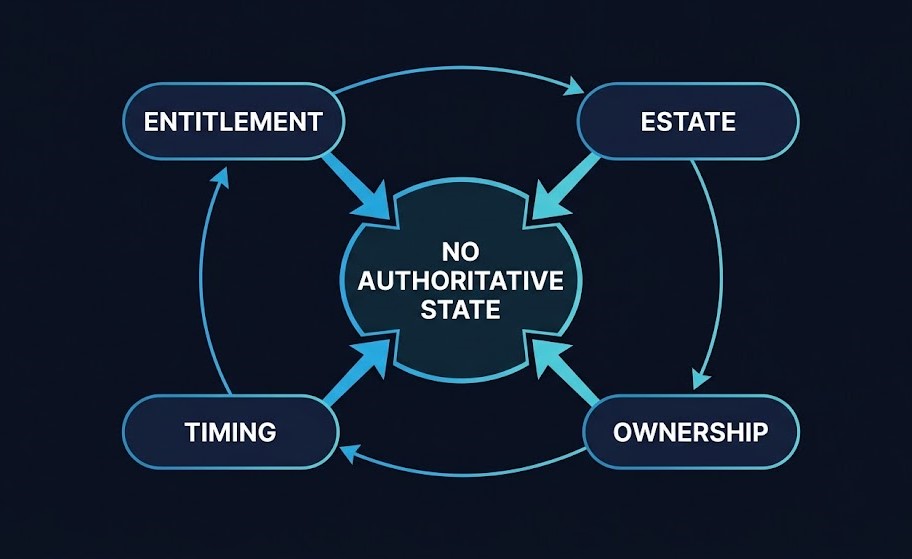
Pull apart what “unresolved entitlement status” actually means during a dispute, and it separates into four distinct ambiguities — and they don’t arrive one at a time.
01 — ENTITLEMENT AMBIGUITY
“We think we still own this.” The negotiation hasn’t concluded, so which licenses survive in what form is genuinely unknown, not just undocumented.
02 — ESTATE AMBIGUITY
“We aren’t sure what’s still running.” Decommissioning and migration are both in flight, so the actual footprint is a moving number, not a fixed one.
03 — OWNERSHIP AMBIGUITY
“We don’t know who can prove any of the above.” Legal, procurement, and infrastructure each hold a different piece of the answer, and no single party owns producing a unified, defensible position.
04 — TIMING AMBIGUITY
“We’re changing the environment while negotiating.” This is the compounding factor — it turns the first three ambiguities into one continuously shifting target, because the answer to any of them depends on which day it’s asked.
Why the Dependency Audit Comes First
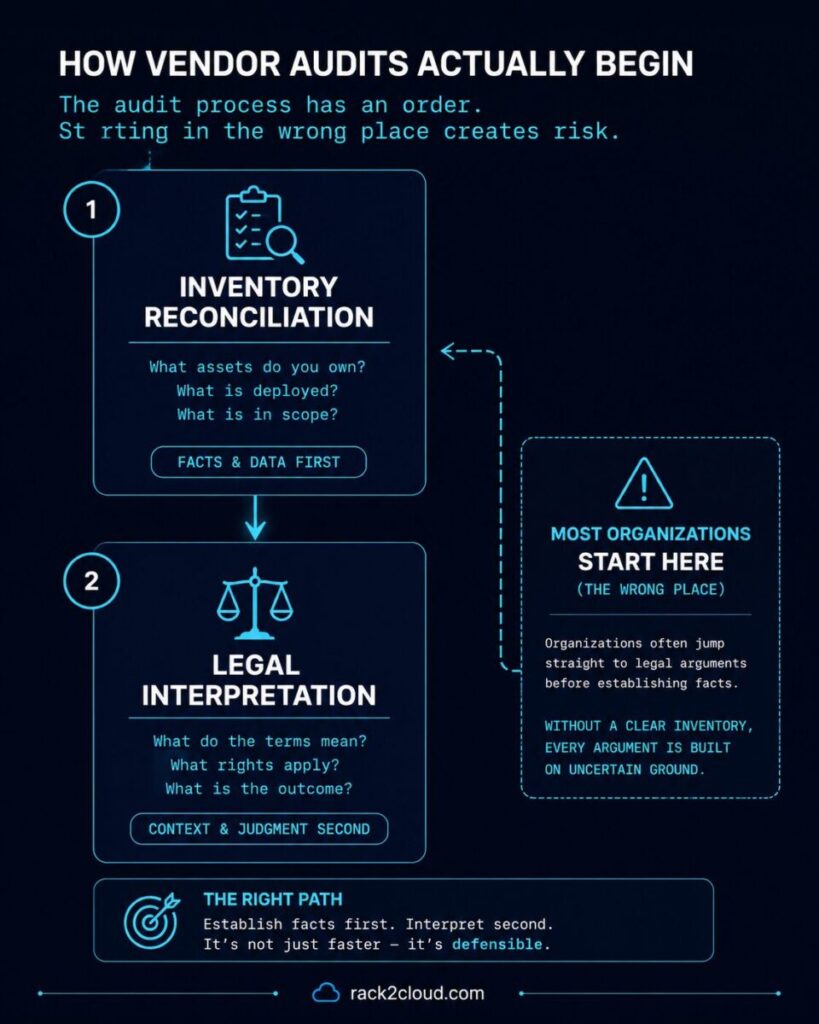
Vendor audits rarely begin with legal interpretation. They begin with inventory reconciliation.
Before an organization can defend its entitlement position, it must first prove what depends on the software being disputed — which workloads, which teams, which downstream systems assume that a given VMware capability is still present and licensed. That’s not a legal question. It’s a visibility question, and most organizations mid-dispute discover they can’t answer it cleanly, because the same forces creating Estate Ambiguity above are also eroding the dependency map they’d need to answer it.
This is the same failure the Dependency Visibility Boundary framework (#143) describes: organizations lose the ability to reconstruct what they actually depend on once operational authority has accumulated past the point any single document or team can account for it. A licensing dispute doesn’t create that condition — it exposes it, on a timeline set by someone else’s audit trigger rather than the organization’s own readiness. Any migration underway during a dispute inherits this same visibility requirement, covered in more depth in the VMware Migration Strategy stage of the Virtualization Learning Path.
There’s a sharper version of this risk specifically for organizations mid-dispute and mid-migration at the same time: the tooling used to execute the exit can itself be entitlement-gated by the same vendor relationship under dispute. Your VMware Exit Plan Assumed a Tool You Didn’t Control covers a case where VDDK access narrowed to the Broadcom account relationship directly — for an organization already in a contested entitlement conversation, that’s not a hypothetical, it’s the exact mechanism the dispute puts at risk.
Skip that reconciliation, and a licensing dispute stops being a negotiation problem — it becomes an audit risk event with no inventory behind it to defend.
That same unmapped dependency surface doesn’t only expose audit risk — it exposes recovery risk. The System Recovered. Your Recovery Boundary Didn’t. covers the DR-side version of this failure directly: a license activation service invisible to the recovery plan, sitting outside the organization’s ownership, that can leave a fully-restored system unable to function mid-incident — the same visibility gap this post covers for audits, expressed as a recovery-time dependency instead of a compliance one.
Cost Risk Is Not Audit Risk
Most conversations about VMware licensing exposure still default to a cost framing — how to estimate true-up exposure, how to model VVF/VCF core counts, how to negotiate a better renewal. All of that matters, but it’s answering a different question than the one an audit asks.
| Cost Risk | Audit Risk | |
|---|---|---|
| Nature | Financial | Legal / compliance |
| Owner | Budget owner | Legal, procurement, compliance |
| Pattern | Predictable | Event-driven |
| Response | Can be optimized | Must be defensible |
Most organizations understand the left column well. Very few understand the right — and the gap between the two is where audit risk actually lives. Industry-wide, software audits are already an expensive, common outcome even without a dispute in progress: recent ITAM research puts a meaningful share of enterprises well past seven figures in cumulative audit-related spend over a few years. A dispute doesn’t create that baseline risk. It concentrates it, on a shorter and less predictable timeline.
Audit exposure is also largely indifferent to intent. An organization can be actively decommissioning systems, genuinely reducing usage, and negotiating in good faith — and still be increasing its audit exposure the entire time, precisely because good-faith change in progress is what produces the ambiguity an audit is built to find. The VMware renewal decision an organization made two years ago rarely accounted for this; renewal timing was optimized against cost, not against the possibility of a mid-cycle dispute. The VMware Licensing Cost Model tool is useful for the cost side of this equation — it does not, and cannot, address the audit-defensibility side.
Architect’s Verdict
The organizations most exposed to audit risk are not always the ones violating licensing terms. They’re the ones that can no longer prove the authoritative state of the environment while it is changing.
That distinction matters because it means audit exposure isn’t primarily a compliance failure — it’s a visibility failure that compliance happens to expose. Entitlement Ambiguity, Estate Ambiguity, Ownership Ambiguity, and Timing Ambiguity don’t require bad faith to compound. They require only that a dispute run long enough for the environment to keep moving underneath it.
Once authoritative state becomes uncertain, every conversation about entitlement, compliance, and risk becomes harder to defend — not because the organization did anything wrong, but because nobody can currently say, with evidence, what’s actually true.
Additional Resources
View 5 more resources
Editorial Integrity & Security Protocol
This technical deep-dive adheres to the Rack2Cloud Deterministic Integrity Standard. All benchmarks and security audits are derived from zero-trust validation protocols within our isolated lab environments. No vendor influence.

R.M.
Senior Solutions Architect with 25+ years of experience in HCI, cloud strategy, and data resilience. As the lead behind Rack2Cloud, I focus on lab-verified guidance for complex enterprise transitions. View Credentials →
Get the Playbooks Vendors Won’t Publish
Choose the architecture problems you care about. Get field-tested playbooks and frameworks delivered to your inbox.
- > AI Infrastructure & Inference Economics
- > Cloud Strategy & Hidden Cost Models
- > Virtualization & Deterministic Migration
- > Kubernetes, IaC & Modern Infrastructure
- > Data Protection & Recovery Engineering
Zero spam. Includes The Dispatch weekly drop.
Need Architectural Guidance?
Independent review before major infrastructure decisions.
- > Validate assumptions
- > Identify hidden dependencies
- > Quantify migration risk
- > Challenge vendor narratives
Triage · Advisory · Fractional · Direct Hire