

The Third Incident Is the One That Should Worry You
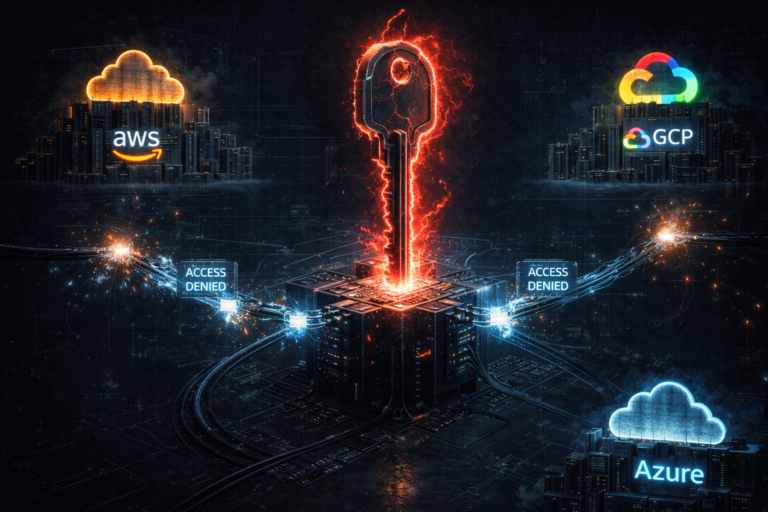
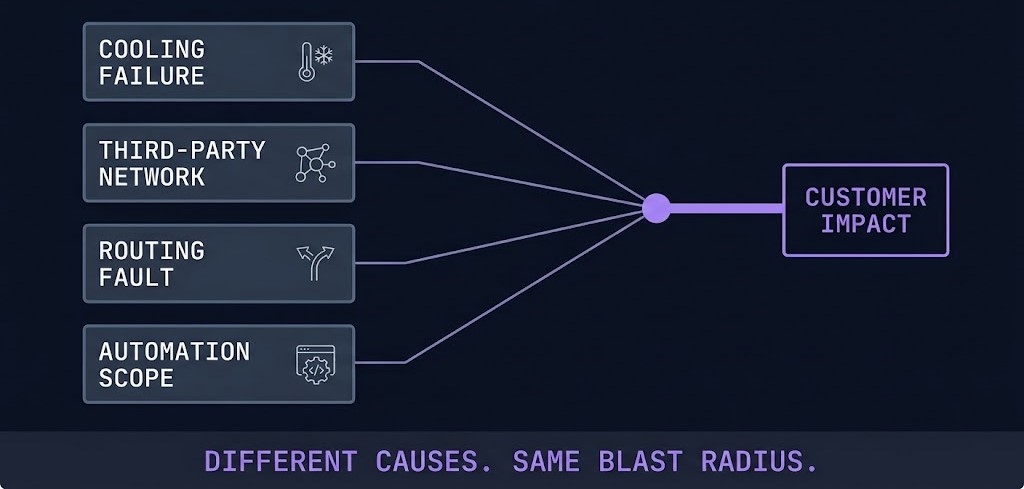
Blast radius — not the specific failure that triggers it — is the property four unrelated cloud outages in five weeks have in common, and it’s the property almost nobody is fixing. Three separate AWS incidents in eleven weeks had three unrelated causes: a data center cooling failure in May, a third-party network dependency in June, an internal routing fault on July 24. Azure’s West US region went down the day before that, on July 23, for a fourth, entirely different reason. Four causes. One outcome, every time: full customer-facing impact.
None of these incidents are remarkable in isolation. Hyperscalers have outages; that’s not news. What’s worth stopping on is the pattern across them — because if you ask what changed after each one, the honest answer is a process, not a system. That gap is what this post is actually about.
Four Incidents, Four Causes, One Outcome
This is a cloud strategy architecture question before it’s an incident-response question, because blast radius is decided at design time, not during the postmortem. Treat the sequence as evidence, not as a news recap. In May 2026, a chiller hardware failure inside a Northern Virginia data center triggered a thermal event and a loss of cooling — a physical-plant problem, contained to one facility. In June 2026, a disruption traced to a third-party network provider — not AWS’s own internal systems — cascaded into AWS-linked services anyway, an external-dependency problem with no AWS-side root cause at all. On July 24, AWS lost connectivity between its US-WEST-2 region in Oregon and the Seattle Metro for roughly 80 minutes — a networking-hardware routing fault at the region’s boundary, internal to AWS this time, and severe enough to take down Apple Pay, DoorDash, Reddit, Hulu, and PlayStation Network simultaneously. AWS classified it internally as “impaired,” not a full regional outage — a genuine distinction, and one worth holding onto, because it means the blast radius showed up before the incident even reached the company’s own top severity tier.
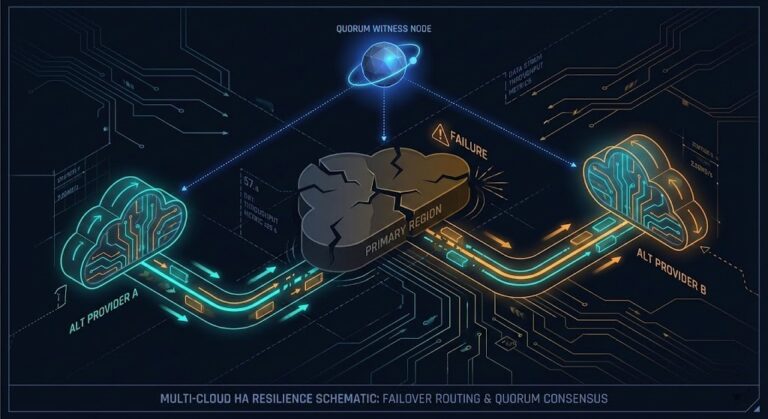
The day before that, on July 23, Microsoft Azure’s West US region lost inbound and outbound connectivity for nearly five hours. The cause: a maintenance-automation bug that scoped a routine device-isolation job too broadly, pulling IP routes from devices that were never supposed to be touched. Four incidents. Four unrelated causes — a chiller, a third-party peer, an internal router, an automation script. Every one of them produced the same shape of outcome: full customer-facing impact, cascading into services well beyond the infrastructure layer where the fault actually lived.
Different causes. Same customer experience. That repetition is the actual signal — not any one of the four root causes individually.
What The Industry Keeps Fixing
Every one of these incidents will get, or has already gotten, a response. That’s not a criticism — it’s the correct reflex. A cooling failure produces a cooling review: redundant chiller capacity, better thermal alerting, a revised maintenance schedule for the facility involved. A third-party network incident produces a vendor review: tighter SLAs, a second peering relationship, closer monitoring of that specific dependency. A routing fault produces a routing review: hardware replacement, additional route-convergence testing, revised change windows for that class of device. An automation bug produces an automation guardrail: tighter scoping checks, additional review gates before a maintenance job executes, a fix to the specific logic that expanded the isolation perimeter too far.
None of those responses are irrational. Every incident produces pressure to fix the thing that just failed. Cooling failures create cooling reviews. Routing failures create routing reviews. Automation failures create automation guardrails. The problem is that every one of those fixes is scoped to the cause of the last incident. Customers experience the consequence instead.
The Blast Radius Nobody Is Fixing
Strip the four causes away and look only at what happened next in each case: a single-domain failure — one facility, one vendor relationship, one router, one script — propagated to the full customer-facing surface of the platform. Not cooling. Not networking. Not routing. Not automation. The shared property across all four incidents is blast radius, and it’s the one property none of the four incident-specific fixes above actually addresses.
That’s the distinction worth sitting with. A better chiller doesn’t change how far a *different* kind of failure propagates. A second network peer doesn’t change how far a routing fault propagates. Each fix hardens the platform against a repeat of the exact failure that just happened, and does nothing about the structural property that let that failure — or the next unrelated one — reach every downstream service in the first place. Causes changed, four times over. Consequences did not change once. Cascading failure is what an unbounded blast radius looks like once it’s in motion — the mechanism is the same regardless of which single point started it.
Blast radius names the property. Concentration risk prices it — the same structural exposure, expressed as a number instead of a postmortem finding, before the fourth incident instead of after it.
The Azure Example Matters
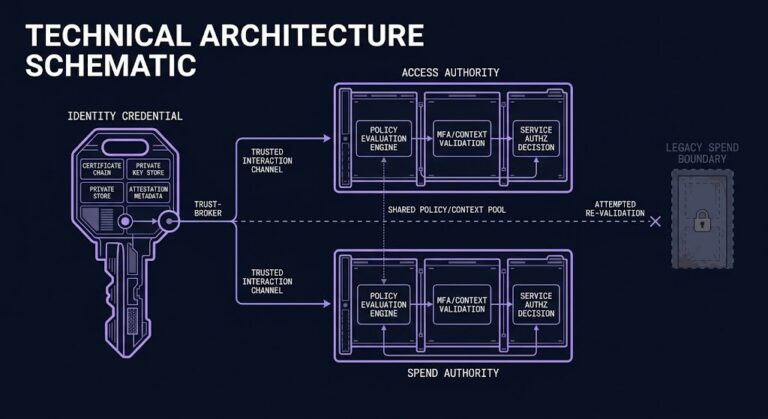
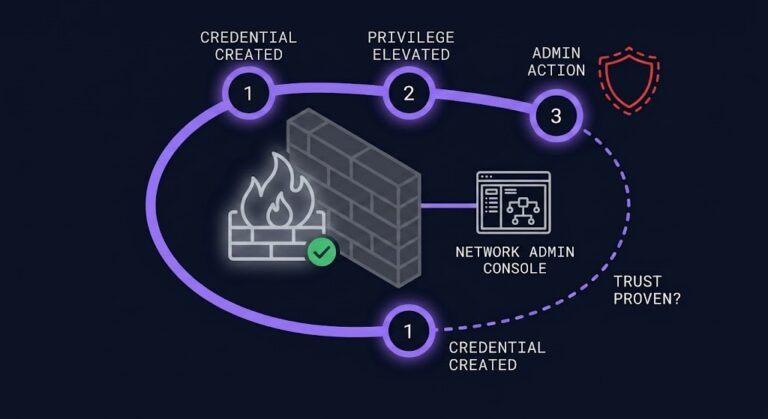
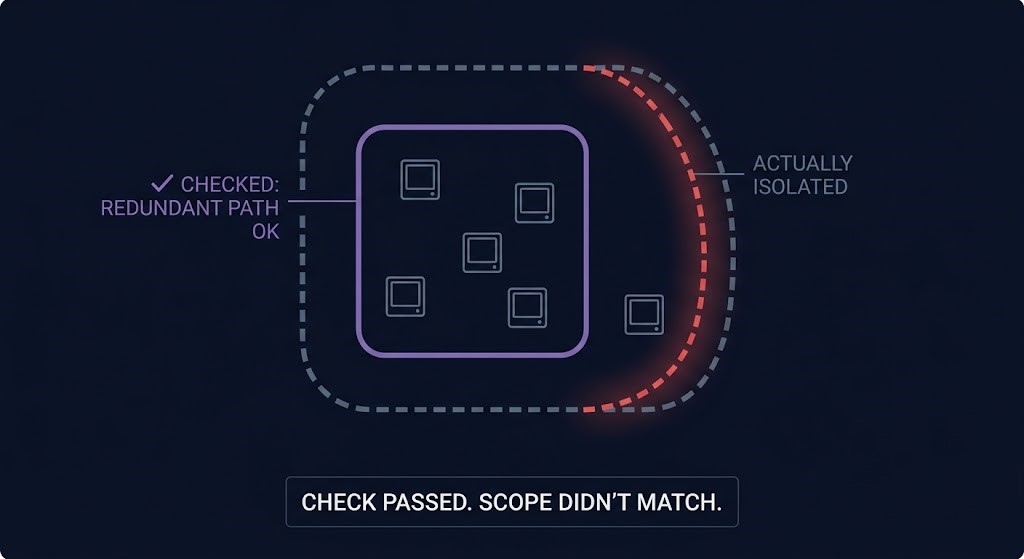
Azure’s July 23 incident is the sharpest evidence in this set, because it’s the one case where the guardrail actually worked as designed — and the outage happened anyway. Microsoft’s process included a real check: before isolating a device for routine maintenance, engineers confirmed that at least one of two redundant network paths to the facility would remain operational. That check passed. It was a legitimate guardrail, correctly executed, not a corner someone cut.
What failed was scope. The automation that carried out the isolation included additional devices beyond the ones the redundancy check had actually evaluated, and pulled IP routes from all of them — including routes the checked redundancy depended on. The guardrail asked the right question about the wrong boundary. Nobody skipped the check. The architecture simply allowed the automation to touch more than the check had accounted for, and a passing check left the system exposed anyway.
THE CENTRAL OBSERVATION
The failure wasn’t that nobody checked. The failure was that the architecture allowed a passing check to leave the system exposed.
That’s a more uncomfortable finding than “a check was skipped,” because there’s no obvious procedural fix for it. You can’t review your way out of a boundary problem with a better checklist item — the checklist already ran and returned green. The gap sits one layer below the procedure, in what the automation was architecturally permitted to touch in the first place. It’s the same gap failover theater describes at the availability layer — a control that demonstrably works and still doesn’t constrain the failure it was built to contain.
Why Guardrails Aren’t Architecture
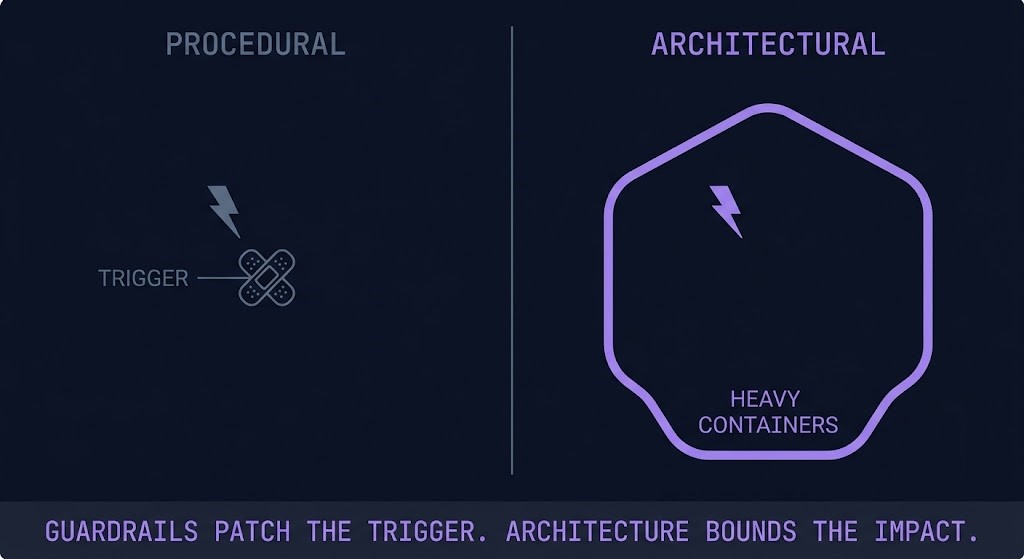
Guardrails and architecture solve different problems, and the four incidents above make the difference concrete rather than semantic. A guardrail is scoped to a known failure mode, procedural in enforcement, and specific to the incident that produced it — the chiller alert, the vendor SLA, the routing-hardware replacement, the automation scope check. Architecture is structural, persistent regardless of which failure mode triggers it, and independent of which specific cause shows up next.
Procedural Thinking Architectural Thinking
What failed? What allowed this failure to matter?
How do we stop this cause? How do we constrain impact regardless of cause?
Fix the trigger Bound the blast radius
Incident-specific Failure-mode-independent
Guardrails reduce the chance of a known mistake. Architecture limits the damage of mistakes you haven’t imagined yet. Both are legitimate engineering investments — the industry needs cooling alerts and vendor SLAs and automation scope checks. But a portfolio made entirely of incident-specific guardrails will always have a blind spot exactly the shape of the next failure mode nobody has had yet, because guardrails are built retrospectively, one cause at a time, and blast radius is a property of the system that exists before any specific cause shows up.
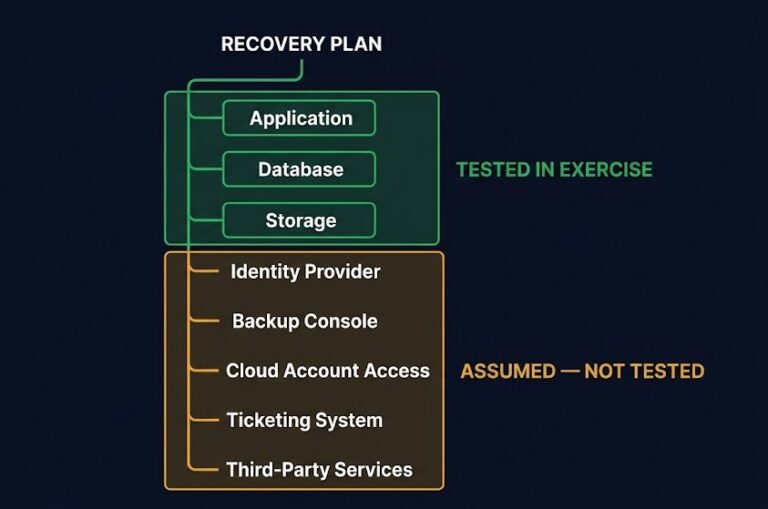
This is adjacent to territory this site has mapped before, without being any of it. Governance Surface Area (Framework #84) names the total set of interfaces — consoles, CLIs, APIs — through which infrastructure can be changed and therefore must be governed; this post isn’t asking whether those interfaces are governed, it’s asking whether governing them contains a failure’s consequences once one interface produces one. Operating Model Transfer Gap (Framework #137) explains why operational context gets lost during a platform migration, when what a source platform implicitly provided has to be explicitly rebuilt on the target; this post asks why operational context gets lost without any migration at all, between one incident and the very next one on the same platform. Continuity Execution Boundary (Framework #163) is the recovery-side version of a similar gap — infrastructure recovery validated as executable while the ownership decisions needed to actually resume business operations go untested; blast radius is the pre-incident version of the same blind spot, before recovery even becomes the question. Adjacent to all three. Subordinate to none.
The same property shows up outside the cloud entirely. When a wildfire forced a ten-day evacuation of a Spokane VA medical center in August 2026, the failure domain wasn’t the building that burned — it was every function sharing that building’s location. Blast radius isn’t a cloud-specific concept. It’s what determines how far any single-domain failure reaches, whether the domain is a region, a facility, or a vendor relationship.
What The Third Incident Actually Reveals
The third incident in any sequence like this isn’t diagnostic because it’s the third. It’s diagnostic because it’s the point where the pattern stops being explainable as bad luck and starts being a question about what actually changed in between. After the first incident, an organization deserves the benefit of the doubt — nobody predicted it, nobody should have. After the second, the pattern is confirmed, and the response to it is the real test. By the third, the evidence is in: not about whether the organization responded, but about what kind of thing it changed.
DIAGNOSTIC QUESTION
“After the second incident, what changed? If the answer is a document, a process, or a review board, the third incident is still waiting for you. If the answer is system behavior, blast-radius boundaries, or authority distribution, you’re probably changing architecture.”
That question works on any organization’s own incident history, not just a hyperscaler’s public postmortems. It’s answerable in one sentence, and the honest version of that sentence is usually more revealing than the incident review that produced it.
Architect’s Verdict
The lesson from AWS wasn’t that cooling failed. Or networking. Or routing. The lesson was that three unrelated failures, and a fourth at Azure, produced the same customer outcome every time — the exact thing architecture is supposed to prevent regardless of which cause shows up.
Most organizations are currently measuring the wrong thing after an incident. They ask whether the specific cause was found and fixed, and by that measure, all four of these incidents look like successes — root cause identified, remediation applied, postmortem published. None of that measures whether the next unrelated failure, whatever it turns out to be, will reach the same amount of the platform. That’s a different question, and right now almost nobody is asking it as a standing architectural property rather than a fresh incident-specific review.
When different failures keep producing the same result, the problem isn’t the incident anymore. It’s the blast radius.
Additional Resources
Editorial Integrity & Security Protocol
This technical deep-dive adheres to the Rack2Cloud Deterministic Integrity Standard. All benchmarks and security audits are derived from zero-trust validation protocols within our isolated lab environments. No vendor influence.

R.M.
Senior Solutions Architect with 25+ years of experience in HCI, cloud strategy, and data resilience. As the lead behind Rack2Cloud, I focus on lab-verified guidance for complex enterprise transitions. View Credentials →
Get the Playbooks Vendors Won’t Publish
Field-tested blueprints for migration, HCI, sovereign infrastructure, and AI architecture. Real failure-mode analysis. No marketing filler. Delivered weekly.
Select your infrastructure paths. Receive field-tested blueprints direct to your inbox.
- > Virtualization & Migration Physics
- > Cloud Strategy & Egress Math
- > Data Protection & RTO Reality
- > AI Infrastructure & GPU Fabric
Zero spam. Includes The Dispatch weekly drop.
Need Architectural Guidance?
Unbiased infrastructure audit for your migration, cloud strategy, or HCI transition.
>_ Request Triage Session