

The Rise Of The Cloud Arbitration Layer
The Cloud Arbitration Layer is emerging as the invisible authority tier between business intent and cloud execution — making decisions before architects ever review the outcome. Nobody built it on purpose. It assembled itself out of tools that were each solving a narrower problem, and none of them were ever asked to coordinate with the others.
This Isn’t a Multi-Cloud Tooling Problem
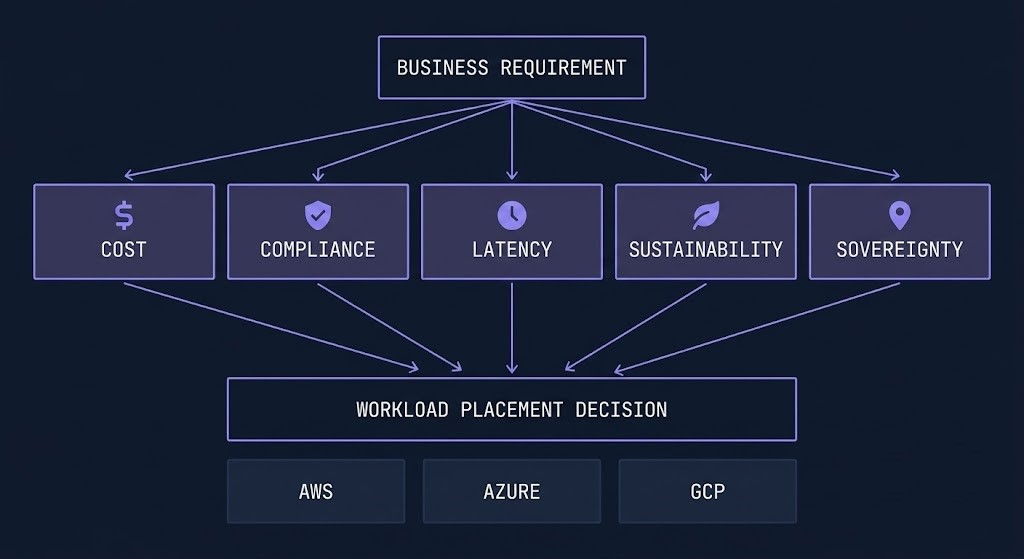
Read that first paragraph again and the easy misreading is obvious: “oh, another multi-cloud management platform post.” It isn’t. Multi-cloud tooling is the substrate this argument is made of, not the subject of it. The subject is a question nobody’s asking yet: when a FinOps engine, a compliance policy, and a placement optimizer each independently constrain where a workload runs, who is actually making the architectural decision?
The honest answer, in most environments, is: no one person, and no one system designed to be the one making it. Each tool is doing exactly its job. The composite outcome — where a workload actually lands, what data actually moves, which region actually gets used — is the product of several correct decisions colliding, with no layer above them reconciling the result. That composite outcome is what deserves a name, and “multi-cloud management” doesn’t describe it. Arbitration does.
This is also why the framing matters more than the tooling: cloud governance has been quietly displacing cloud architecture as the discipline that actually determines outcomes, and an unplanned arbitration tier is what that displacement looks like once it’s fully automated. The architecture was designed. The governance — who decided, who reviews, who can reverse it — wasn’t, and that gap is exactly what shows up as this framework’s failure state later in this post.
You Probably Already Have One
This is easier to recognize in your own environment than in the abstract, because the pieces are already there, doing their individual jobs quietly:
A FinOps platform recommends moving a workload to a cheaper region. A cloud provider’s own recommender suggests resizing an instance class. An AI-driven scheduler shifts inference workloads toward whichever GPU pool has capacity this hour. A compliance enforcement engine blocks a deployment because a tag is missing. A sovereignty-aware routing policy silently redirects a dataset away from a region it would otherwise have landed in. A platform engineering catalog only exposes three approved instance shapes, quietly constraining every option nobody upstream ever debated.
Individually, every one of those is a sensible, well-scoped piece of automation. Collectively, they are a Cloud Arbitration Layer — and the architect who designed the ownership model for any one of those tools almost certainly wasn’t asked to design for what happens when all of them are running at once.
DIAGNOSTIC QUESTION
“Can you name every system in your environment currently allowed to move, block, or reroute a workload without an architect’s sign-off — and who reviews what it decided?”
Most architects can name two or three of these systems immediately. Almost none can produce the complete list on request — which is itself the finding.
The Five Arbitration Vectors
Every tool doing this work is arbitrating along one of five recognizable vectors. Naming them separates “automation exists” from “arbitration is happening,” and gives the condition a vocabulary that survives beyond this one post.
FRAMEWORK #166 — CLOUD ARBITRATION LAYER
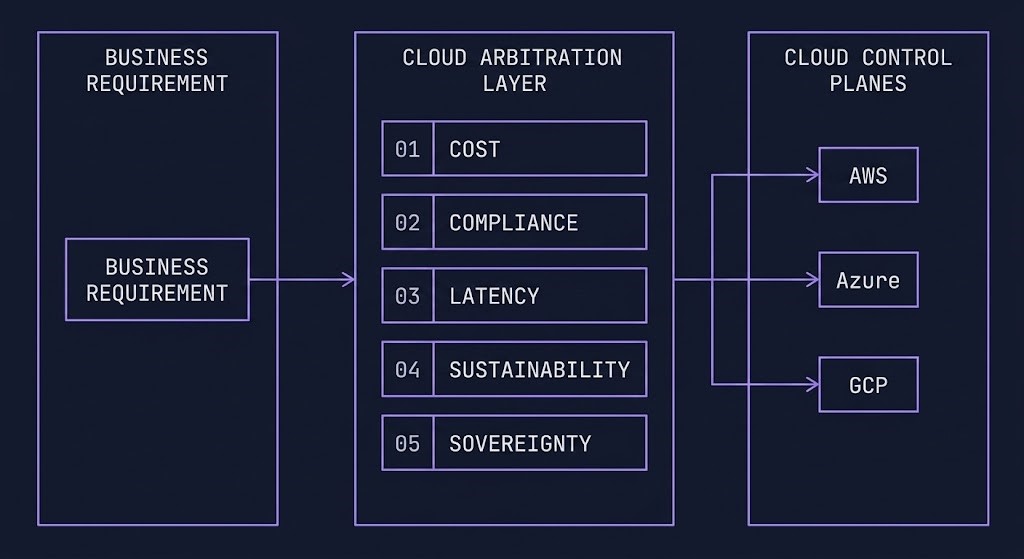
An unplanned authority tier sitting above individual cloud control planes, arbitrating workload and data decisions across five vectors before an architect ever reviews the outcome.
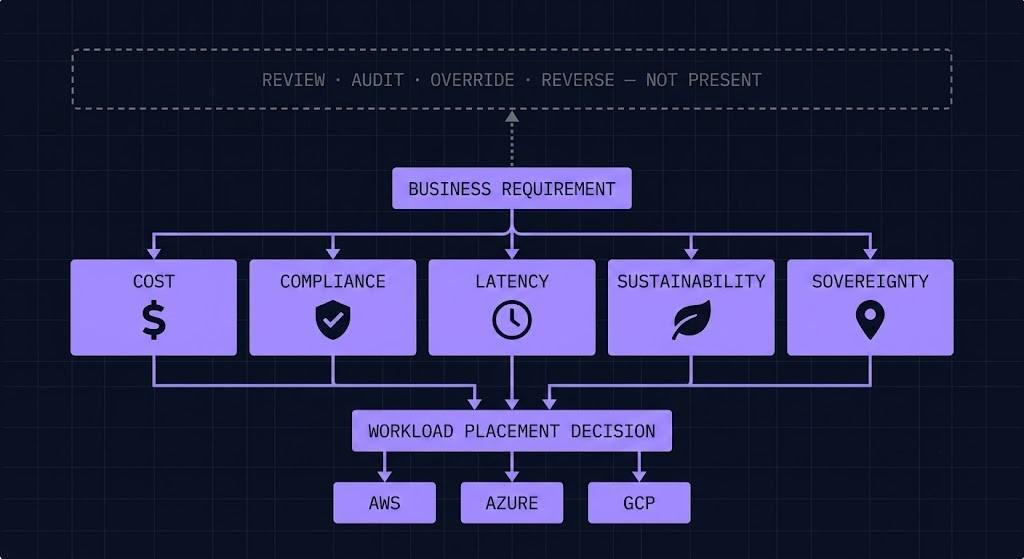
The requirement never touches a control plane directly. It passes through five engines first — and the control plane executes whatever they collectively produced.
01 — COST
FinOps automation recommending or executing placement, resizing, or purchasing-commitment decisions based on price signals — the vector most architects already recognize, and the one that makes people mistake this whole condition for a FinOps problem.
02 — COMPLIANCE
Policy enforcement engines blocking, redirecting, or constraining a deployment against a regulatory or internal-governance rule — correct in isolation, and a source of collisions the moment another vector wants the opposite outcome.
03 — LATENCY
Placement and scheduling systems optimizing for proximity to users, data, or other services — increasingly automated as workload graphs get more complex, and increasingly willing to override a cost- or compliance-driven placement to hit a performance target.
04 — SUSTAINABILITY
Carbon-aware workload placement shifting execution toward lower-carbon regions or time windows — the newest and least mature vector, but already shipping in production scheduling tools, and already capable of conflicting with a latency-driven placement.
05 — SOVEREIGNTY
Jurisdictional and data-residency routing that redirects or denies placement based on where data is legally permitted to sit — frequently the vector with veto power over all four others, and just as frequently the one nobody remembered to check before the other four made their call.
The EU AI Act’s enforcement timeline is the Compliance vector made concrete. Compliance enforcement isn’t a policy discussion anymore — it’s an infrastructure decision that has to execute on a deadline, which means the compliance engines sitting inside a Cloud Arbitration Layer aren’t advisory. They block deployments, redirect data residency, and gate workload placement against a regulatory clock that doesn’t care whether an architect had time to review the exception. That’s the vector’s real character: not “flag for review,” but “execute or fail the audit.”
Sovereignty is also the vector most likely to be arbitrating on a claim nobody’s verified. A sovereignty-aware routing policy is only as trustworthy as the evidence chain behind it — jurisdictional, key-custody, operational, and supply-chain proof, not a checkbox in a vendor’s compliance page. Framework #134’s own argument applies directly here: an arbitration engine that redirects data based on an unevidenced sovereignty claim isn’t reducing risk, it’s automating a marketing assertion at the control-plane level, with veto power over the other four vectors.
Defining the Cloud Arbitration Layer
Naming a framework loosely enough that every recommendation engine qualifies destroys it within a quarter. A Cloud Arbitration Layer exists when four conditions hold together — not when any one of them is present alone.
A CLOUD ARBITRATION LAYER EXISTS WHEN
- Multiple cloud-related inputs are evaluated.
- A decision is produced or constrained as a result.
- That decision influences workload placement, execution, routing, governance, or operation.
- The decision occurs before an architect directly reviews it.
That last condition is the one that actually matters, and it’s why the boundary needs counterexamples, not just a positive definition:
| Not necessarily a Cloud Arbitration Layer | Potentially a Cloud Arbitration Layer |
|---|---|
| Static reporting dashboard | Placement optimizer |
| Read-only cost analysis | FinOps automation engine |
| Inventory reporting tool | Sovereignty-aware routing platform |
| — | Compliance enforcement engine |
| — | AI workload scheduler |
The left column observes. The right column decides, constrains, or acts — and does it before anyone with architectural authority has seen the input, let alone the output. A tool only earns a place in the right column when it’s actually making or gating a decision, not merely reporting on one someone else already made.
Arbitration, Not Filtering
This is close enough to two existing Cloud Strategy frameworks that the difference needs to be explicit, or the three collapse into each other in a reader’s memory.
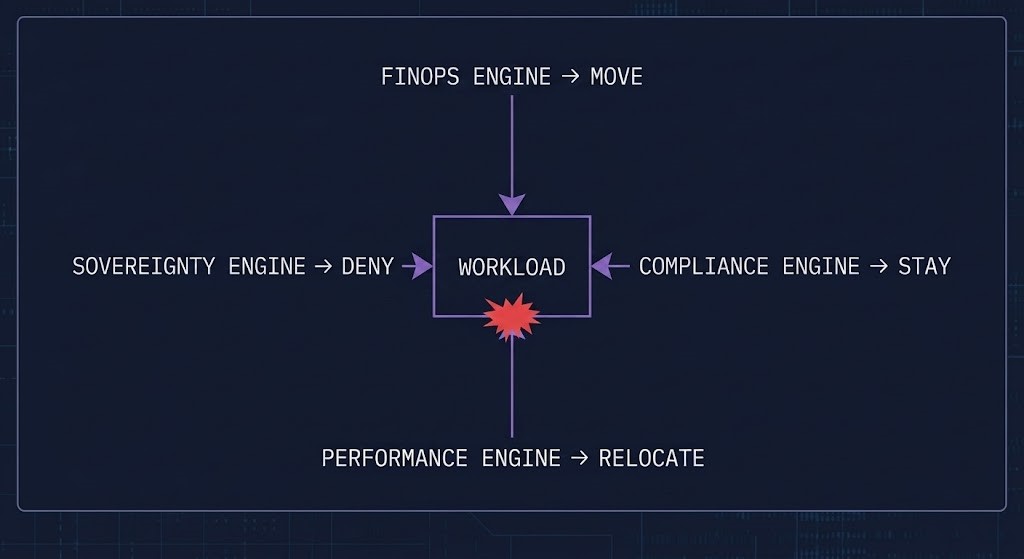
Framework #161 — Decision Origination Boundary describes a financial scoring mechanism narrowing the option set an architect will see, before any architectural authority reviews what got excluded. That’s a filtering problem: one mechanism, one economic lens, acting before a human looks. The Cloud Arbitration Layer is a different shape entirely — not one mechanism filtering, but multiple independent mechanisms actively competing to decide. FinOps says move the workload. Compliance says keep it where it is. A performance engine says relocate it somewhere else again. A sovereignty policy says none of the above is legal. That’s arbitration among competing authorities, not a single option set getting pre-filtered — and it’s the reason this earns its own framework rather than becoming a #161 sub-case.
Framework #152 — Operational Authority Boundary asks whether an authority model that’s already been defined actually reaches the execution plane inside a single control plane. This post assumes that question is answered and asks what happens when a layer nobody designed inserts itself above and across several control planes that #152 never anticipated arbitrating between. Additive, not competing.
Framework #157 — Cross-Cloud Ownership Boundary is a design question: does a survivable ownership model exist across providers for Decision, Execution, Governance, and Recovery? The Cloud Arbitration Layer assumes an ownership model exists on paper and shows an automated layer overriding it in practice regardless of what that model says. #157 asks who owns the outcome. This asks who selected it — ownership versus selection, and they can both be correctly designed while this gap still exists between them.
One more worth naming, from a different pillar entirely: Framework #165 — Authority Arbitration Gap describes the same underlying shape — multiple legitimate authorities, no arbitration mechanism where their scopes meet — but at the GitOps reconciler-loop level, inside a single infrastructure automation platform. The Cloud Arbitration Layer is the cloud-strategy, cross-provider analog. Same structural gap, different plane, different pillar.
A fourth reference point, this time a contrast in how authority forms rather than where: Framework #135 — Control Plane Ownership Boundary describes authority accumulating deliberately, when a platform that already owns state and policy extends that ownership into workflow and approvals. The Cloud Arbitration Layer is the opposite formation pattern — nobody extended anything on purpose, five correctly-functioning engines simply produced a composite decision none of them was assigned to own. Same absence of accountable authority, opposite origin story.
Arbitration Without Accountability
None of the five vectors above are individually a problem. Each one is a defensible, often well-engineered piece of automation solving a real problem in its own scope. The failure isn’t in any single engine’s logic. It’s in the composite: the layer produces a real architectural decision, and nothing above it can approve, audit, override, or explain that decision after the fact.
This is what makes Arbitration Without Accountability distinct from a simple automation failure. Nothing crashed. Nothing errored. Every engine did exactly what it was built to do. The workload landed somewhere, for reasons that are individually traceable to five different systems and collectively traceable to none of them — because no system was ever assigned to own the composite outcome, only the input.
Architectural Relationships
Why It Connects
Extends the pre-review-decision shape from single-mechanism filtering into multi-engine arbitration — #161 is one lens narrowing options; #166 is several lenses actively competing to decide.
Explore Framework →Cross-Cloud Ownership Boundary
Why It Connects
Adjacent but distinct: #157 designs who owns the outcome across providers. #166 assumes that design exists and shows an unplanned layer selecting the outcome regardless of what the ownership model says.
Explore Framework →Operational Authority Boundary
Why It Connects
Adjacent question, different plane: #152 asks whether authority reaches execution inside one control plane. #166 asks where authority originates once multiple control planes and an unplanned arbitration tier are in play.
Explore Framework →Control Plane Ownership Boundary
Why It Connects
Contrasts formation pattern: #166 is authority accumulating by accident, five correct engines with no reconciling layer. #135 is the deliberate counterpart — a platform that already owns state and policy extending that ownership on purpose.
Explore Framework →Why It Connects
Mirror-image condition at a different plane: #165 is multiple legitimate reconciler loops with no arbitration layer inside one automation platform. #166 is the same missing-arbitration shape at the cross-provider, cloud-strategy level.
Explore Framework →One more sibling, from the same week: Your Identity Provider Was Never Your Spend Boundary describes the inverse failure shape — not too many legitimate deciders arbitrating a workload, but too few checks on one identity’s spend authority once it’s compromised. Arbitration Without Accountability is a crowding problem. That post is a containment problem. Both are what happens when nobody designed the layer that was supposed to catch the composite outcome.
The next question — who audits the arbitrators, once an organization admits the layer exists — doesn’t have an answer in this pillar yet. That’s a governance-tooling gap worth watching, not a framework worth naming before the shape of the answer is actually clear.
Architect’s Verdict
The Cloud Arbitration Layer isn’t a new category of tool. It’s what you get when five existing categories of tool are all correctly doing their jobs at once, with no layer above them designed to reconcile what they collectively produce.
The real problem was never that automation makes decisions — automation has always made decisions, and it’s usually made them better than the manual process it replaced. The problem is that an authority tier formed without anyone deciding to build one, and authority that nobody designed is authority nobody can audit, challenge, or reverse when it gets something wrong. Arbitration is happening in your environment right now, correctly, by every individual engine’s own logic. The composite decision it produces belongs to no one.
That’s not a tooling gap. It’s a governance gap wearing five different vendor logos.
Additional Resources
Editorial Integrity & Security Protocol
This technical deep-dive adheres to the Rack2Cloud Deterministic Integrity Standard. All benchmarks and security audits are derived from zero-trust validation protocols within our isolated lab environments. No vendor influence.

R.M.
Senior Solutions Architect with 25+ years of experience in HCI, cloud strategy, and data resilience. As the lead behind Rack2Cloud, I focus on lab-verified guidance for complex enterprise transitions. View Credentials →
Get the Playbooks Vendors Won’t Publish
Field-tested blueprints for migration, HCI, sovereign infrastructure, and AI architecture. Real failure-mode analysis. No marketing filler. Delivered weekly.
Select your infrastructure paths. Receive field-tested blueprints direct to your inbox.
- > Virtualization & Migration Physics
- > Cloud Strategy & Egress Math
- > Data Protection & RTO Reality
- > AI Infrastructure & GPU Fabric
Zero spam. Includes The Dispatch weekly drop.
Architecture Audit Services
Fixed-scope audits for Zero-Trust Azure, VMware migration readiness, and recovery posture — no discovery call required to start.
>_ View Audit Services>_Related Posts
Your Monitoring Didn’t Miss the Incident. It Was Never Designed to See It.
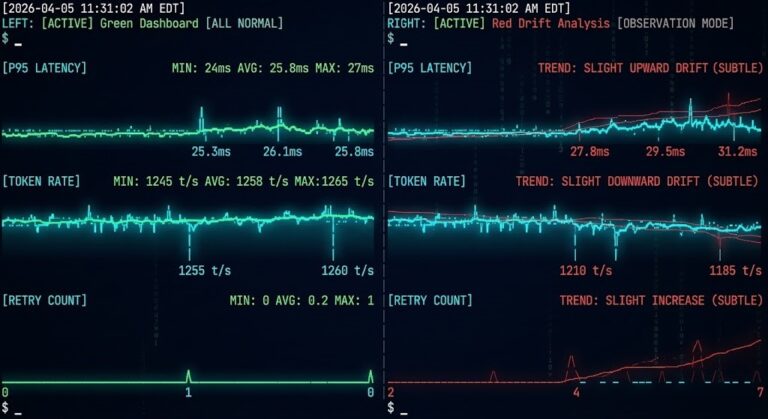
I’ve watched observability vs monitoring play out as a live incident more times than I can count. >_ Architect’s Brief 60-second read before you commit to the full post · Full post: 10 min Generating brief… The dashboard was green. The on-call engineer was not paged. The monitoring system did exactly what it was designed…
Your Kubernetes Cluster Isn’t Out of CPU — The Scheduler Is Stuck
Compute Tier 1 Authority Cascades to ➔ >_ Architect’s Brief 60-second read before you commit to the full post · Full post: 9 min Generating brief… [Storage] [Network] 🚨 Failure Signature Detected Grafana shows cluster CPU utilization is under 50%, but pods are stuck in Pending. Events show: 0/10 nodes are available: 10 Insufficient cpu….
Your Identity System Is Your Biggest Single Point of Failure
Part 2 of the Rack2Cloud’s Cloud Fragility Series >_ Cloud Fragility Series 01 Multi-Cloud Cascading Failure Risks 02 Your Identity System Is Your Biggest Single Point of Failure [CURRENT] 03 Vendor Lock-In Happens Through Networking — Not APIs 04 Your Cloud Bill Quietly Increased in 2026 — Here’s Where the Money Is Actually Going >_…
Your Identity Provider Was Never Your Spend Boundary
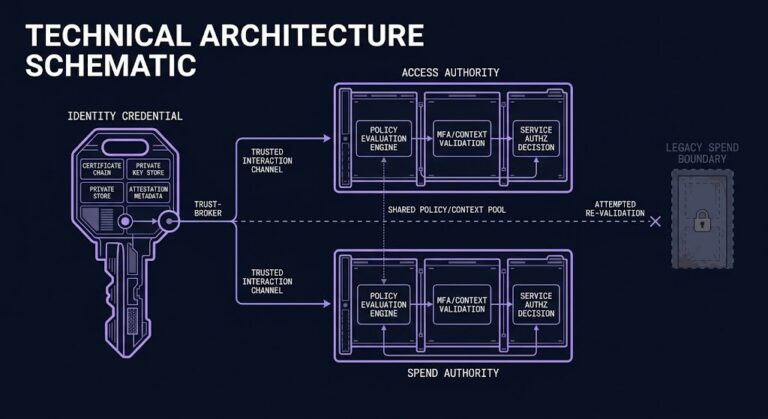
Every enterprise cloud governance program assumes a spend boundary sits somewhere between identity and money — a checkpoint that catches compromised access before it becomes compromised spend. It doesn’t exist. Not as a distinct control. Not as a separate policy layer. Not anywhere in the architecture most organizations have actually built. >_ Architect’s Brief 60-second…
Your Identity Controls Passed. Your Authorization Chain Failed.
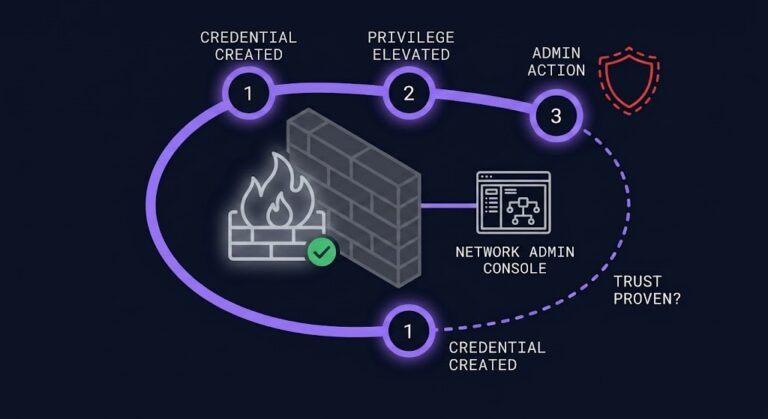
A credential chain functioned exactly as it was designed to. No firewall failed. No exploit executed. No malware bypassed a control. A red team walked past physical and social barriers using nothing more exotic than a plausible pretext, and came out the other side holding network admin credentials — issued correctly, authorized correctly, working exactly…
Your DR Test Passed. The Assumptions Didn’t.
DR plan failure rarely happens where you tested. It happens at the assumptions the exercise never reached — the dependencies that weren’t in scope, the runbook written for last year’s architecture, the authority chain nobody tested at 2am.