

Why C-Suite Leaders Struggle With AI Consumption Pricing
AI consumption pricing broke the model executives used to govern infrastructure spend. One-third of business leaders — 33%, according to KPMG’s Q2 2026 Global AI Pulse survey of more than 2,145 C-suite and senior executives across 20 countries — cite limited understanding of usage costs as a key deployment challenge for AI agents. It changed what infrastructure spending actually measures, replacing capacity-based economics with costs generated by runtime behavior.
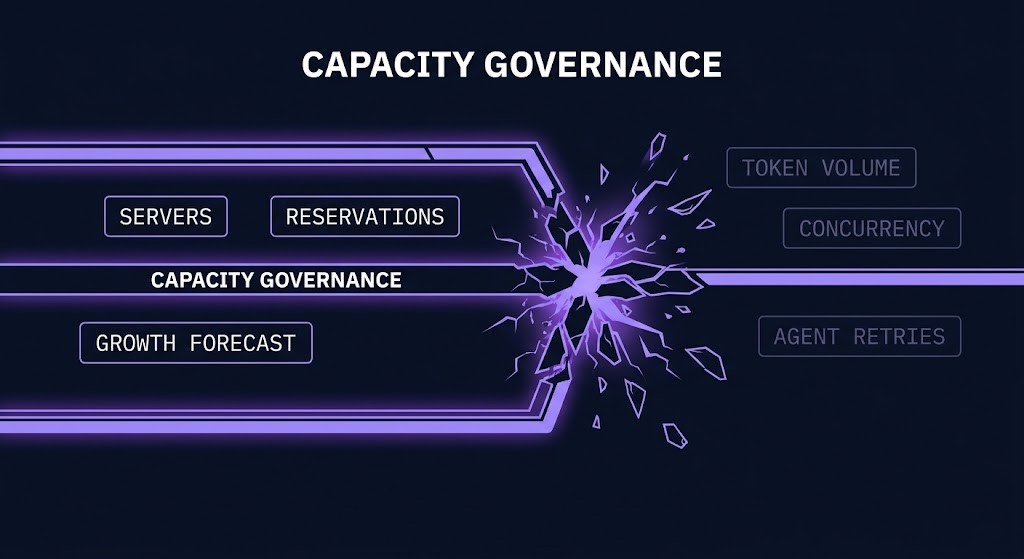
How AI Consumption Pricing Broke The Capacity Planning Model Executives Learned
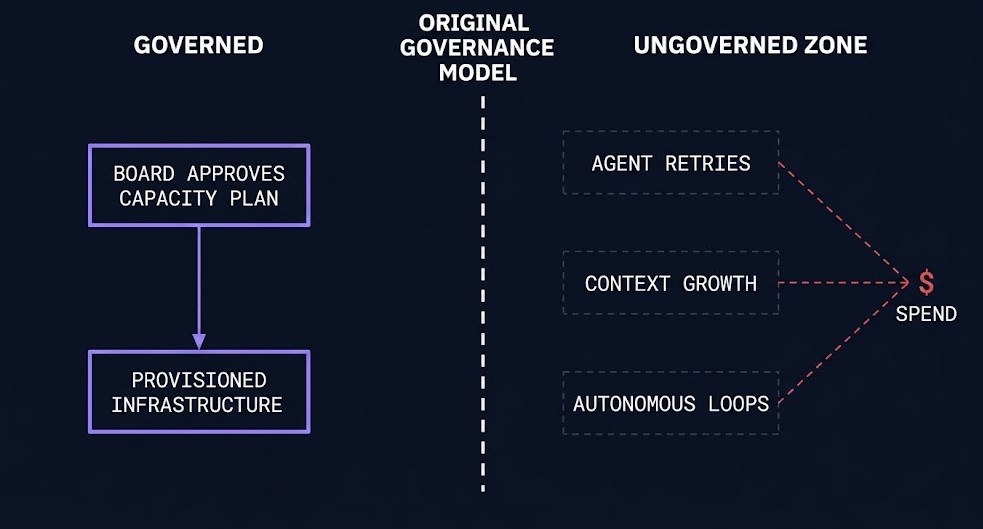
For twenty years, the executive question about infrastructure was a capacity question. Buy servers: how much capacity do we need? Rent instances: how many are running? Reserve resources: how much growth did we budget for? Each of these questions had a stable answer a board could approve, audit, and hold someone accountable to. Cloud computing changed the mechanics — capex became opex, procurement cycles compressed from years to minutes — but it didn’t change the shape of the question. Executives still governed infrastructure spend by asking how much capacity the organization was committing to.
AI consumption pricing breaks that pattern entirely. There’s no capacity commitment to approve. There’s no reservation to forecast against. The bill is generated after the fact, by what a system actually did — not by what was provisioned in advance. A board that spent two decades getting comfortable asking “how many instances” now has to reason about a cost structure where the answer to “how many instances” tells them almost nothing about what they’ll pay.
This is why KPMG’s finding lands as a deployment challenge rather than a line-item surprise. Usage-based AI pricing didn’t just get harder to forecast — it moved the locus of cost control away from the budgeting cycle entirely and into the runtime. How to Read a Cloud Bill Like an Architect teaches the skill of reconstructing what a bill is telling you after the fact. What follows is what happens when that same bill reflects decisions no governance process ever reviewed in the first place.
The exposure isn’t evenly distributed. AI consumption pricing hits hardest in financial services, healthcare, and real-time transaction systems — domains where inference cost scales nonlinearly with transaction volume, and where a governance gap shows up as a P&L surprise rather than a rounding error. Those are also the domains with the least tolerance for a bill nobody can fully explain after the fact.
AI Spending Is Determined By Runtime Decisions
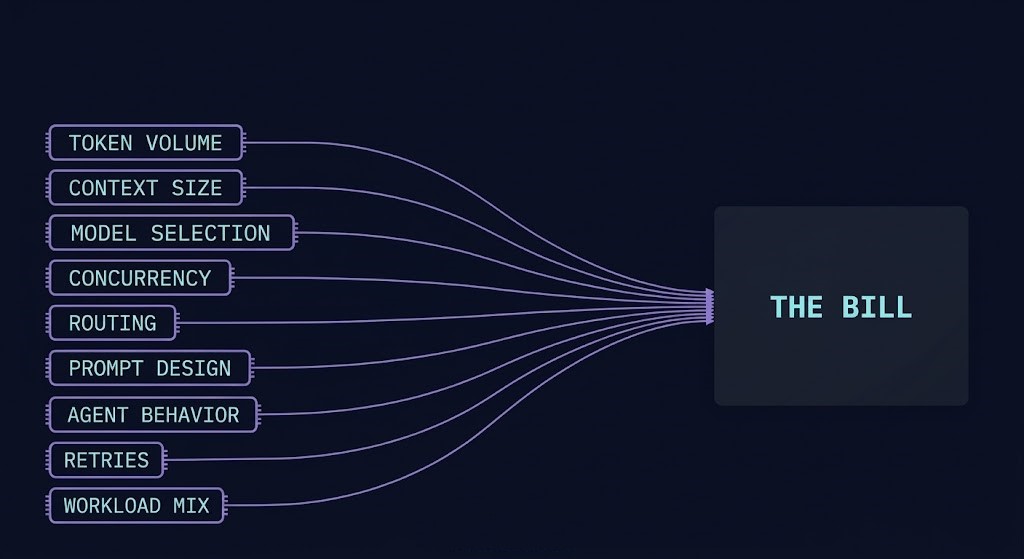
Consumption-based AI pricing is generated by what happens after deployment, not by what was provisioned before it. Nine variables determine the bill on any given day, and none of them are capacity questions:
WHAT ACTUALLY GENERATES THE BILL
- Token volume — how much text moves through the model, in and out
- Context size — how much history or reference material rides along with every call
- Model selection — which model handles the request, and at what price tier
- Concurrency — how many requests run at once
- Routing decisions — which model or endpoint a request gets sent to (see Cost-Aware Model Routing in Production)
- Prompt design — how efficiently a prompt is constructed
- Agent behavior — how many steps an autonomous loop takes before it stops
- Retries — how many times a failed or unsatisfactory call gets repeated
- Workload mix — the blend of cheap and expensive call types running at once
Agent deployments make this concrete in a way a single chatbot call never did — which is exactly why KPMG’s survey singled out AI agents as the point where the confusion surfaces first. An agent that makes five tool calls to answer one question, retries twice because a downstream API timed out, and carries a growing context window across each step isn’t running a fixed workload. It’s generating cost through its own runtime decisions, none of which a capacity plan ever modeled. Your AI System Doesn’t Have a Cost Problem. It Has No Runtime Limits. makes the same case one layer down the stack — the fix was never a bigger budget, it was a ceiling on the behavior generating the spend.
| Executive Assumption | AI Reality |
|---|---|
| More users means more cost | Sometimes, but model behavior matters more |
| Same workload means predictable cost | Runtime choices can change cost dramatically |
| Budget controls spending | Runtime behavior controls spending |
| Capacity planning limits exposure | Consumption can scale unexpectedly |
That fourth row is the one worth sitting with. Capacity planning was never really about predicting demand precisely — it was about setting a ceiling. AI consumption pricing removes the ceiling.
Why Visibility Alone Doesn’t Solve The Problem
KPMG’s survey found more than one comprehension gap. Alongside the 33% who cite limited understanding of usage costs, 42% report only partial visibility into their AI spending. The instinct — buy a dashboard, add a chargeback report, close the visibility gap — is the same instinct that has driven cloud FinOps tooling for a decade. Cost Visibility Is Not Cost Control made the case that visibility and control are two separate capabilities. The gap here goes one layer deeper — even perfect visibility into what was spent doesn’t explain what generated it.
Visibility tells you what happened. It doesn’t tell you why. A dashboard can show a cost spike on Tuesday. It can’t tell a CFO that an agent loop doubled inference volume because a downstream API started timing out and the retry logic had no ceiling. That distinction — between seeing a number move and understanding the runtime decision that moved it — is the entire problem AI consumption pricing creates, and no amount of additional reporting closes it.
The 42% figure is the more diagnostic of the two KPMG stats, because it isolates the layer visibility tooling genuinely can’t reach. A team can have complete line-item visibility into every API call and still not know that a routing default just shifted half its traffic to a more expensive model — because routing is a runtime decision, not a reporting event. Dashboards report on the past. They don’t govern the decision that’s about to happen.
AI Workloads Break Traditional FinOps Models covers the practitioner-level version of this same failure — instrumentation and cost allocation built for provisioned infrastructure buckling under AI workloads. The gap this post is describing sits one level above the tooling: even a FinOps team with working instrumentation is reporting on behavior a board was never set up to govern in the first place.
The New Governance Question Is Architectural, Not Financial
Old Governance Question: How much infrastructure are we willing to buy? New Governance Question: What workload behaviors are we willing to permit?
That’s the shift. The first question is one boards have asked for decades and know how to govern — set a ceiling, review requests against it, hold someone accountable to the number. The second question has no equivalent muscle yet. Permitting a workload behavior — an agent that retries without a ceiling, a routing policy that defaults to the most expensive model, a context window that grows without a truncation policy — is an architecture decision with a financial consequence, not a budget line with a technical footnote. Moving governance closer to those runtime decisions is a cloud strategy problem before it’s a finance problem.
That missing muscle shows up even before runtime enters the picture. The AI Tool Budget Became An Infrastructure Budget covers the earlier version of the same gap: most organizations still route AI tooling spend through the software-procurement gate, with no mechanism to flag the moment consumption behavior crosses into infrastructure-grade spend — the classification failure sitting one step upstream of the governance question this post raises.
Rack2Cloud’s Economic Gravity Boundary framework (#131) describes the point at which economics constrains which architectural outcomes are viable among those already on the table. This post argues the inverse: architecture — specifically, the runtime behaviors a system is allowed to exhibit — is what generates the economics in the first place. See both sides of that boundary at the Economic Architecture stage of the Cloud Architecture Learning Path. It’s also the same shift FinOps Moved the Goalposts. Now It’s Influencing What Gets Built. (Framework #161) describes one layer earlier — economic evaluation quietly filtering which architectural options ever reach a decision-maker. Here, the filtering has moved further downstream, into the runtime itself, which is exactly why it’s harder to see coming.
KPMG’s data backs this up at the outcome level: organizations with strong visibility into AI spending were roughly five times more likely to report achieving ROI on their AI investment — 15% versus 3% — than those without it. But the lesson isn’t that dashboards solve the problem; the same survey shows comprehension and visibility as two separate gaps. The lesson is that governance has to move closer to the runtime decisions generating the cost in the first place, not just closer to the number those decisions produce.
Architect’s Verdict
AI consumption pricing didn’t create a communication problem. It created a governance vacuum — a class of infrastructure spending generated by decisions no existing approval process was built to review.
The real problem isn’t that boards can’t read a bill. It’s that the thing generating the bill — an agent’s retry logic, a routing default, a context window with no ceiling — was never treated as an architecture decision requiring the same scrutiny as a capacity request. It shipped as a technical default, and the economics followed wherever the defaults happened to point.
Runtime behavior controls spending now. Governance that still asks how much infrastructure was bought is trying to govern AI economics from a layer that no longer generates the cost.
Additional Resources
View 3 more resources
Editorial Integrity & Security Protocol
This technical deep-dive adheres to the Rack2Cloud Deterministic Integrity Standard. All benchmarks and security audits are derived from zero-trust validation protocols within our isolated lab environments. No vendor influence.

R.M.
Senior Solutions Architect with 25+ years of experience in HCI, cloud strategy, and data resilience. As the lead behind Rack2Cloud, I focus on lab-verified guidance for complex enterprise transitions. View Credentials →
Get the Playbooks Vendors Won’t Publish
Choose the architecture problems you care about. Get field-tested playbooks and frameworks delivered to your inbox.
- > AI Infrastructure & Inference Economics
- > Cloud Strategy & Hidden Cost Models
- > Virtualization & Deterministic Migration
- > Kubernetes, IaC & Modern Infrastructure
- > Data Protection & Recovery Engineering
Zero spam. Includes The Dispatch weekly drop.
Need Architectural Guidance?
Independent review before major infrastructure decisions.
- > Validate assumptions
- > Identify hidden dependencies
- > Quantify migration risk
- > Challenge vendor narratives
Triage · Advisory · Fractional · Direct Hire