

Virtualization Sprawl: When Every Team Owns A Different Infrastructure Reality
Virtualization sprawl isn’t caused by a team failing to own its platform. It’s caused by every team owning its platform correctly, on its own schedule, under its own assumptions — while the assumptions between those teams never get reconciled.
The Broadcom Shock Didn’t Cause Fragmentation. It Exposed Assumptions Nobody Aligned.
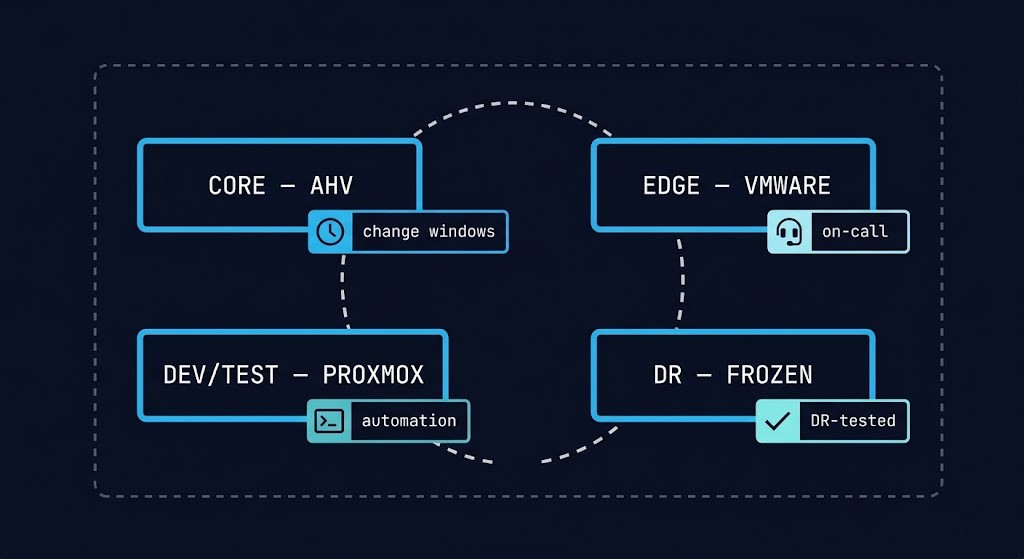
By the time Broadcom closed the VCSP partner program — non-renewal notices went out January 26, 2026, open opportunities had to close by March 31 — most organizations didn’t have one VMware exit decision to make. They had several, running in parallel, on different clocks, each owned cleanly by whoever held the budget and the risk for that slice of the estate.
That parallel-decision problem is not the subject of this piece. The VMware Exit Has Entered the Coexistence Era already did the work of naming what multi-platform coexistence becomes at the technical layer — Framework #1, Fragmented Control Plane: RBAC, DR orchestration, and tooling that diverge at the platform boundary once VMware and an alternative hypervisor run side by side indefinitely. That’s the virtualization architecture question of who governs the platforms, and it’s a question with a real, named answer already on the site.
This piece is one layer up from that. Assume the platform boundary is already governed well — every platform has a clear technical owner, every control plane has an accountable authority. Virtualization sprawl still happens, because the platforms aren’t what diverges first. The teams operating them diverge first, in ways that have nothing to do with which hypervisor sits underneath.
A third layer exists alongside these two, worth flagging rather than folding in: VMware Private AI Cloud Doesn’t Eliminate Fragmented Control Planes — It Creates an Authority Relay takes Framework #1’s coexistence-layer question and asks it again inside a single vendor’s own stack — not platforms diverging at a boundary, and not teams diverging on assumptions, but domains inside one “unified” console that were never actually reconciled with each other.
Four Teams, Four Sets of Assumptions
Pull the pattern out of any environment past its first full budget cycle since the licensing shock, and it tends to resolve into something close to this:
FOUR INDEPENDENT EXITS, FOUR SETS OF INHERITED ASSUMPTIONS
- Core platform — migrated to Nutanix AHV, and inherited AHV’s own assumptions about patch cadence, RBAC, and support escalation along with the hypervisor.
- Edge and remote sites — stayed on VMware, renewal-locked, and kept operating under assumptions built for a platform the rest of the estate was actively leaving.
- Dev/test — moved to Proxmox on cost grounds, and picked up a completely different set of operational assumptions than either of the above without anyone auditing whether they were compatible.
- DR and backup — frozen mid-migration, operating under assumptions that were only ever meant to hold for a transition window that has no funded end date.
Four teams, four sets of assumptions became five, then six once you count the parts of the estate that rarely make it into the first pass of any inventory — VDI and EUC still running its own Horizon stack under its own change-management assumptions because nobody wanted to touch a user-facing platform mid-crisis, and the specialty application cluster still on Hyper-V or a legacy platform operating under assumptions nobody has revisited since it was built.
Every one of these was a reasonable decision, made by a team that understood its own platform well. That’s what makes virtualization sprawl hard to see from inside any single team’s decision. The organization doesn’t experience four unreasonable decisions. It experiences four internally consistent sets of assumptions that were never checked against each other.
Four Operational Assumptions Nobody Reconciled
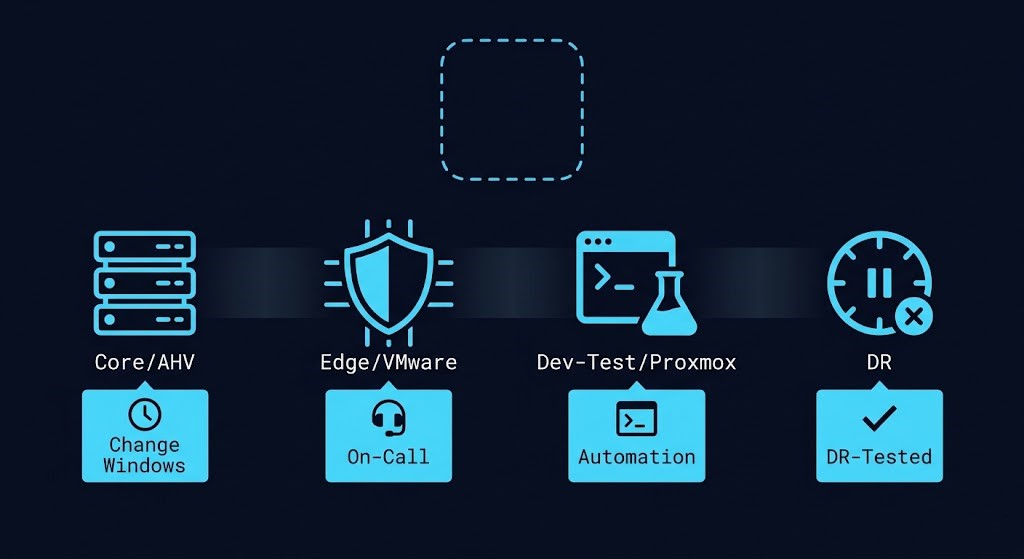
Strip away the hypervisor labels and the actual divergence sits in four places — none of which are platform-specific:
01 — CHANGE WINDOWS
Platform patches monthly. Edge patches quarterly, tied to a change-freeze calendar nobody else has visibility into. DR patches only during exercises. Three operational calendars, running independently, and nobody realizes there are three until an incident needs to cross all of them at once.
02 — ON-CALL MODELS
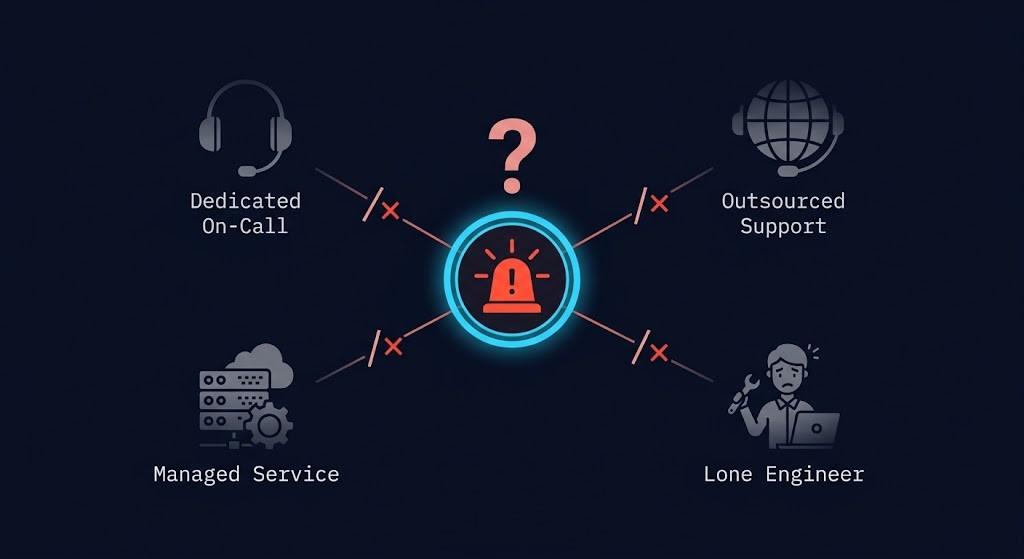
One team owns its own on-call rotation. One outsources support to a reseller. One runs under a managed-service contract. One relies on whichever project engineer last touched the environment. Incident ownership isn’t ambiguous within any single team — it’s ambiguous the moment an incident crosses the boundary between them.
03 — AUTOMATION STANDARDS
One team automates through Terraform. One scripts in PowerShell. One does everything through the GUI, by hand, every time. One has no automation at all. This isn’t a hypervisor problem — a hypervisor swap won’t fix it. It’s an operational-standards problem that happens to be visible at the platform layer.
04 — WHAT “DR TESTED” MEANS
One team considers DR tested when a full failover has run clean. Another considers replication sufficient. A third considers current backups enough. A fourth has no defined standard at all. Same company, four different definitions of the word “tested” — each one internally defensible, none of them compatible with the others.
DIAGNOSTIC QUESTION
“If the platform team patches monthly and the DR team only patches during exercises, what’s the organization’s actual patch posture on any given Tuesday — and can any single person in the building answer that alone?”
Every team here made a defensible platform choice — hypervisor selection itself has become close to commoditized, and the operational gap between AHV, Proxmox, and VMware keeps shrinking. What doesn’t shrink on its own is the gap between four sets of assumptions about how those platforms get operated day to day. That gap doesn’t close because a migration completed. It closes only if someone checks the four answers against each other, and most organizations never assign that as anyone’s job.
The Virtualization Sprawl Assumption Tax
The cost of this doesn’t show up as a line item. It shows up as friction that gets attributed to something else — a slow migration, an “immature” team, a platform that “just doesn’t perform as well.” Laid out directly:
| Dimension | Cost |
|---|---|
| Escalation ownership | A 2 a.m. outage lands on a team whose on-call model assumes managed-service coverage, while the actual incident needs someone who understands a platform their contract never scoped |
| Change-window collisions | A maintenance window on one platform overlaps a change freeze on another, and the collision surfaces the week it causes an outage — not before |
| Automation skill non-transferability | Every new hire, every cross-training effort has to account for teams that share almost no operational tooling in common, even when they share adjacent infrastructure |
| “Definition of done” disputes | A compliance audit asks whether DR is tested across the estate, and the honest answer is four different answers, each correct within its own team’s definition |
Escalation ownership belongs at the top of that list on purpose. Compliance and DR get the attention in planning documents, but they’re rarely where the pain is felt first. The first place an organization actually feels virtualization sprawl is a production incident at 2 a.m., when the on-call engineer discovers that their own team’s assumptions about who handles this platform don’t match what’s actually running.
What Alignment Actually Requires
It would be easy to describe virtualization sprawl as an ownership gap. It isn’t, and the distinction matters. Every team in the four-team example above owns its platform. Nobody is unaccountable. What’s genuinely missing is a separate function — reconciling the assumptions those four accountable teams operate under, not owning any platform itself.
Ownership exists locally. Alignment doesn’t exist globally. That’s the whole failure mode in one sentence, and it’s why this doesn’t get fixed by assigning a platform owner — every platform already has one. It gets fixed by someone explicitly checking whether “patch cadence” means the same thing on all four calendars, whether “on-call” means the same escalation path on all four rotations, and whether “DR tested” means the same evidence on all four platforms.
Control Plane Ownership Boundary established the same pattern one layer down, at the technical control plane: authority has to be explicit, or ambiguity fills the vacuum by default. The version here operates on assumptions instead of control planes, but the underlying logic is identical — ambiguity doesn’t wait for someone to notice it.
The comparison worth being precise about is Configuration Drift Is the Symptom. Ownership Is the Problem., which diagnoses systems diverging from an intended state nobody enforced — a single system failing to hold its own configuration. Virtualization sprawl is a different failure entirely: not one system drifting, but four teams’ worth of correct, locally-owned operating assumptions that were never checked against each other. Multi-Cloud Coherence Is an Ownership Problem, Not a Technology Problem makes the closer version of this argument — clouds diverging from a common governance model — but even that is a platform-governance claim. This is narrower still: not who governs the platforms, but who reconciles the people running them.
The same shape shows up one register over, applied to a platform’s tool count instead of its team count: tool sprawl’s cost model makes the identical argument about integration maintenance, duplicate capability, and governance surface — every tool individually owned and correctly justified, the compounding relationships between them owned by no one. Virtualization sprawl is that same ownership gap running through people and assumptions instead of tools and subscriptions.
Architect’s Verdict
Virtualization sprawl reads like a technology story — three or four hypervisors, a licensing crisis, a series of migrations. It isn’t one, and it isn’t the coexistence story either. It’s what happens after the platforms are already governed well and the teams running them still drift apart.
The chain is short and repeats reliably: a team chooses independently, under real time pressure and a real budget constraint, and owns that choice competently. A second team does the same, under different constraints, and owns its choice just as competently. Neither decision is wrong. Neither team is unaccountable. What never happens is a check on whether their assumptions about patch cadence, on-call coverage, automation standards, and DR readiness still agree with each other — because reconciling assumptions across teams was never assigned as a job the way owning a platform was.
Every migration in this pattern can succeed on its own terms, every team can be fully accountable for what it owns, and the estate still fragments. That’s the tell that the problem was never really about who owns what. It’s about what nobody ever checked.
Additional Resources
View 4 more resources
Editorial Integrity & Security Protocol
This technical deep-dive adheres to the Rack2Cloud Deterministic Integrity Standard. All benchmarks and security audits are derived from zero-trust validation protocols within our isolated lab environments. No vendor influence.

R.M.
Senior Solutions Architect with 25+ years of experience in HCI, cloud strategy, and data resilience. As the lead behind Rack2Cloud, I focus on lab-verified guidance for complex enterprise transitions. View Credentials →
Get the Playbooks Vendors Won’t Publish
Choose the architecture problems you care about. Get field-tested playbooks and frameworks delivered to your inbox.
- > AI Infrastructure & Inference Economics
- > Cloud Strategy & Hidden Cost Models
- > Virtualization & Deterministic Migration
- > Kubernetes, IaC & Modern Infrastructure
- > Data Protection & Recovery Engineering
Zero spam. Includes The Dispatch weekly drop.
Need Architectural Guidance?
Independent review before major infrastructure decisions.
- > Validate assumptions
- > Identify hidden dependencies
- > Quantify migration risk
- > Challenge vendor narratives
Triage · Advisory · Fractional · Direct Hire