

VMware Private AI Cloud Doesn’t Eliminate Fragmented Control Planes. It Relocates Them.
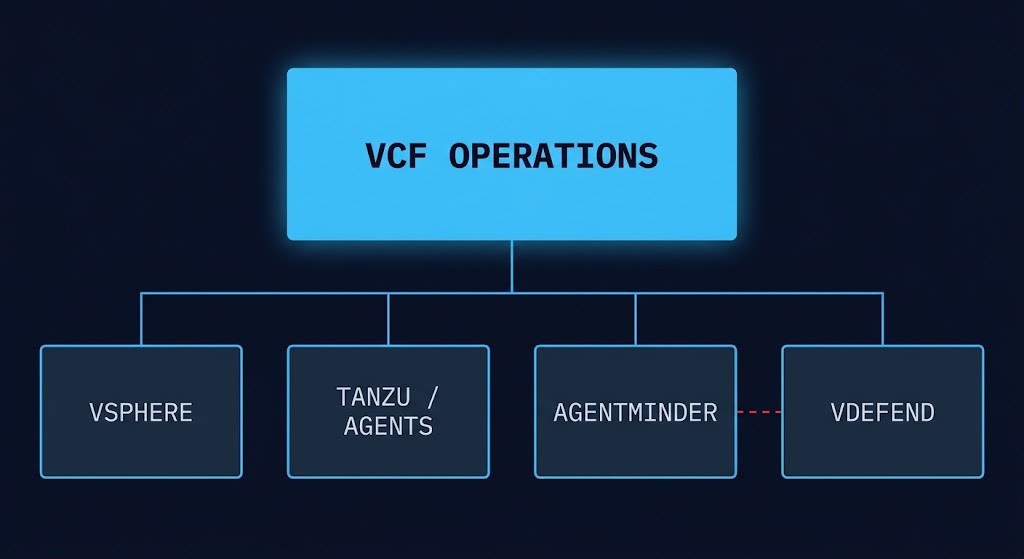
Authority relay is what VMware’s new Private AI Cloud architecture actually produces once a real incident crosses more than one of its layers — not the unified control plane Broadcom’s marketing at VMware Explore 2026 promises. Broadcom used the September 3 close of the event to introduce VMware Private AI Cloud and VMware AI Factory, positioning VMware Cloud Foundation (VCF) 9 as a single operating layer spanning enterprise AI inference, agentic applications, containers, and traditional virtual machines. The pitch is unification. The architecture underneath it is coordination — and those are not the same claim, even though the marketing language treats them as interchangeable.
The Claim, Tested Against Framework #1
Rack2Cloud already has a name for what happens when infrastructure authority splits across platforms with no common governor: Fragmented Control Plane, the operational condition that emerges when VMware and an alternative hypervisor run side by side during a migration that never fully completes — RBAC, DR orchestration, and tooling diverging at the platform boundary because nothing forces them back into alignment. That framework was built for a specific shape of problem: two or more platforms, each claiming real authority, with no arbiter between them.
VCF 9’s Private AI Cloud pitch inverts the setup. Broadcom isn’t describing two competing platforms. It’s describing one platform — VCF’s existing management stack — extended to also govern inference, agentic workloads, and the security policy that constrains them, alongside the virtualization layer it already ran. Broadcom’s own framing at Explore was that VMware Cloud Foundation becomes the operating layer through which enterprises build, run, secure, and govern AI while keeping data under their own control. That’s a claim about consolidation, not coexistence — which means Framework #1, built for the coexistence case, doesn’t automatically apply. The right test isn’t whether this is the same failure mode. It’s whether “one platform, several newly annexed domains” produces a different failure mode that deserves its own name. It does — the rest of this piece names it: authority relay.
What “Unified” Actually Requires
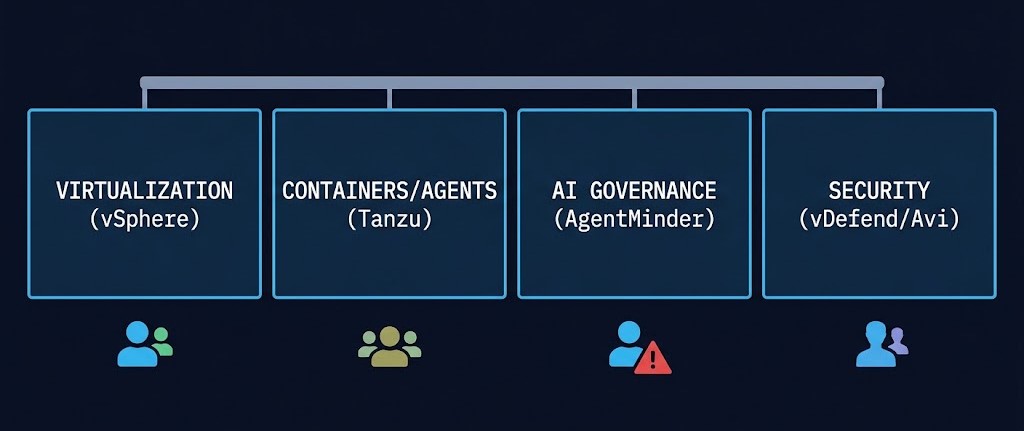
Strip the marketing framing and the architecture spans four distinct operational domains, now presented through a common VCF management layer:
- The virtualization layer — vSphere, the hypervisor and compute substrate VCF has always governed.
- The container/agentic layer — Tanzu, extended with governed data foundations for agent workloads.
- The AI governance layer — AgentMinder, the new control plane assigning agents identities, missions, authorized tools, and runtime policy.
- The security/policy layer — vDefend and Avi, providing lateral security, API protection, and controls meant to keep agents inside their authorized boundaries.
Each of these is a real, separately-engineered system with its own failure modes, its own upgrade cadence, and — this is the part the “unified operating layer” language obscures — its own operational ownership inside most enterprises. A platform team runs vSphere. A different team increasingly owns Tanzu and agent governance. Security owns vDefend. VCF Operations sits on top, coordinating all four, but coordinating is not the same verb as replacing.
Fragmented vs. Federated — And The Distinction That Actually Matters
Framework #1’s Fragmented Control Plane names a horizontal problem: multiple authorities, no common governor, and a conflict that’s visible almost immediately because there’s no single console papering over it. That’s the failure-domain-design question this site’s own Virtualization Control Plane Architecture Learning Path stage covers directly — centralized vs. distributed authority models, and what each one costs when a failure domain has to be located under pressure. VCF 9’s architecture is a vertical variant of the same underlying question — “who has authority when something breaks” — but the visibility profile is inverted:
| Fragmented (Framework #1) | Authority Relay | |
|---|---|---|
| Authority structure | Multiple authorities | One coordinating authority |
| Common governor | None | Exists (VCF Operations) |
| Authority conflict | Visible immediately | Hidden until something breaks |
| Where failure occurs | Between platforms | Between layers, under one console |
| Escalation path | Unclear from the start | Appears unified — until you actually need it |
That last row is the real finding, and it’s the sentence worth building the whole piece around: authority here hasn’t been unified. It’s been coordinated. A coordinating layer can schedule, monitor, and route policy across four domains without actually holding operational authority over any of them when one fails. The distinction that survives contact with an actual incident isn’t “does VCF Operations show you everything in one pane of glass” — it does — it’s “does VCF Operations actually own the remediation when the AI governance layer and the hypervisor disagree about what happened.”
Where the Test Fails: A Cross-Layer Incident
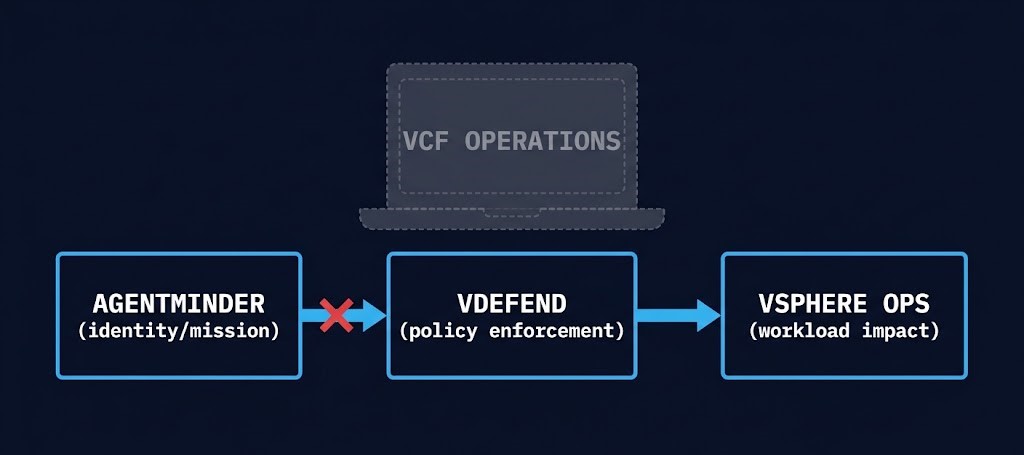
Take a concrete case of the authority relay in practice. An agentic workload, governed by AgentMinder, is granted access to a tool it shouldn’t have — a policy misconfiguration, not a breach. vDefend’s runtime policy should have caught it and didn’t. The agent’s action touches a VM-hosted service running on the vSphere layer underneath, and that service now behaves incorrectly.
Under the “unified operating layer” framing, VCF Operations is where this incident should be diagnosed and resolved — one console, one authority. In practice: AgentMinder owns the agent-identity and mission-scoping question (was the agent authorized to request this?). vDefend owns the policy-enforcement question (why didn’t the runtime control block it?). vSphere ops owns the workload-impact question (what actually broke, and how do we roll it back?).
THE PRACTICAL PROOF
VCF Operations can show all three teams the same incident timeline. It cannot resolve the disagreement between them about whose control failed — because that authority was never actually centralized. Only the visibility was.
The escalation path looked unified right up until the point where someone needed it to actually adjudicate, not just display.
This is the authority relay mechanism the “Fragmented vs. Federated” table above is describing, and it’s genuinely distinct from Framework #1’s failure shape: #1’s fragmentation is discovered on day one, because nobody claimed to have solved it. This one is discovered mid-incident, specifically because someone did.
Authority Relay — A Named Pattern, Not A Framework Yet
The mechanism above earns a name. Testing it against the incident section settled which one: “Federated Control Plane”, “Coordinated Authority” and “Layered Authority” all describe the architecture Broadcom shipped, not the failure it produces — every other Rack2Cloud framework name (Phantom Capacity, Patch Visibility Debt, Capacity Illusion Index) names the failure, not the design. “Delegated Authority” implies the top layer intentionally handed down authority with accountability preserved, which isn’t what’s wrong here — nothing was delegated, the subordinate systems always owned their own domains. The term that survives is Authority Relay: an incident has to be physically relayed, handed off between AgentMinder, vDefend, and vSphere ops in sequence, because the coordinating layer that appeared to hold authority only ever held visibility.
This stays a named pattern, not a numbered framework, deliberately. One vendor’s one announcement is a single data point, and framework promotion on this site has always required transferability — a mechanism observed generating a second and third independent example, not just a well-argued first one. Watch for the same shape elsewhere before revisiting: Microsoft Entra Agent ID’s own governance layer, other agent-identity/mission-scoping platforms following AgentMinder’s model, or any other integrated AI control plane making a similar “unified operating layer” claim over previously separate domains. If that pattern repeats, Authority Relay earns a number then, cleanly, with real evidence of recurrence behind it instead of one vendor’s marketing framing.
A related but distinct case worth noting, not folding in: Nutanix Put MCP Behind a Gateway. The Real Problem Is Authority. examines NAI 2.8’s MCP Gateway against the same visibility-versus-authority split this post draws, at a narrower scope — a single connection point rather than four coordinated domains. It isn’t a second Authority Relay data point; the gateway never claims to unify anything, so there’s no coordination-without-adjudication gap to test. What it shares with this post is the underlying instinct being corrected: a well-built governance layer is easy to mistake for having closed the authority question underneath it, whether that layer is a console coordinating four domains or a gateway governing one connection.
Architect’s Verdict
VMware Private AI Cloud does not eliminate the fragmented control plane problem. It creates an authority relay instead — the same underlying question relocated from between competing platforms, where it was visible on day one, to between coordinated layers inside a single vendor’s stack, where it’s invisible until an incident forces someone to find out who actually owns the failure.
What most coverage of this announcement will miss is the difference between a unified console and a unified authority. VCF Operations genuinely does give architects one place to look. It does not give them one place to fix. The four domains it now spans — virtualization, containers, agent governance, and security policy — kept their separate operational ownership, separate escalation paths, and separate failure modes; only the dashboard got consolidated.
Ask the question Broadcom’s marketing won’t: when the AI governance layer and the hypervisor disagree about what happened, who actually has the authority to decide — not who has the dashboard to watch it happen.
Additional Resources
View 2 more resources
Editorial Integrity & Security Protocol
This technical deep-dive adheres to the Rack2Cloud Deterministic Integrity Standard. All benchmarks and security audits are derived from zero-trust validation protocols within our isolated lab environments. No vendor influence.

R.M.
Senior Solutions Architect with 25+ years of experience in HCI, cloud strategy, and data resilience. As the lead behind Rack2Cloud, I focus on lab-verified guidance for complex enterprise transitions. View Credentials →
Get the Playbooks Vendors Won’t Publish
Choose the architecture problems you care about. Get field-tested playbooks and frameworks delivered to your inbox.
- > AI Infrastructure & Inference Economics
- > Cloud Strategy & Hidden Cost Models
- > Virtualization & Deterministic Migration
- > Kubernetes, IaC & Modern Infrastructure
- > Data Protection & Recovery Engineering
Zero spam. Includes The Dispatch weekly drop.
Need Architectural Guidance?
Independent review before major infrastructure decisions.
- > Validate assumptions
- > Identify hidden dependencies
- > Quantify migration risk
- > Challenge vendor narratives
Triage · Advisory · Fractional · Direct Hire