

Phantom Capacity: Why Texas Couldn’t Tell Real Demand From Noise
Phantom capacity is the planning problem underneath Texas’s decision to freeze new data center grid connections, and the problem has less to do with megawatts than with whether the demand signals feeding the queue can be trusted. On August 3, Governor Greg Abbott ordered the Public Utility Commission of Texas and ERCOT to stop approving new grid connections for data centers until every pending request could be audited. The stated rationale was power and water usage. Underneath that rationale sits a planning-architecture problem: nobody — not ERCOT, not the PUCT, not the developers filing the requests — could say with confidence how much of the capacity sitting in the interconnection queue represented projects that would actually get built.
That distinction matters more than the headline. Most coverage of this story is framed as an AI-power-consumption problem: too many data centers, not enough grid. That framing is wrong, or at least incomplete. If ERCOT had 474 gigawatts of verified, committed load in its queue, nobody would be writing about a moratorium — they’d be writing about a generation shortfall, which is a different problem with different solutions. The story exists because Texas can’t tell the difference between a data center that will get built and a placeholder reservation filed to lock in a queue position. That’s not a power problem. It’s a planning-signal problem, and it shows up anywhere a system accepts reservations as a proxy for demand.
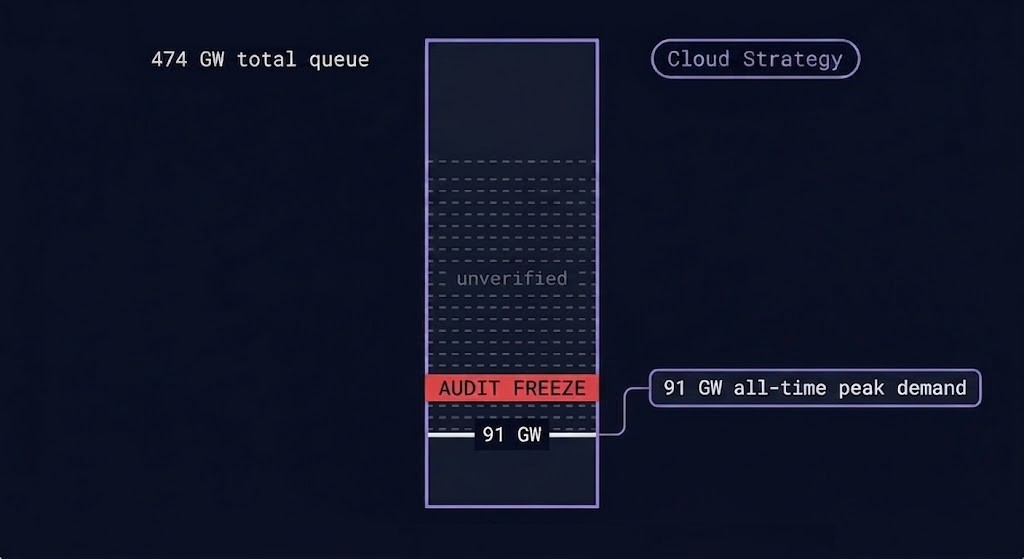
The Mismatch
ERCOT’s interconnection queue — the process by which any large electricity consumer requests a formal connection to the Texas grid — currently holds requests representing 474 gigawatts of queued capacity. The state’s all-time peak demand, set July 22, was 91,089 megawatts. The queue contains requests representing more than five times Texas’s all-time peak demand, and roughly 90 percent of that queued capacity is attributed to data centers.
Abbott’s directive forced ERCOT to suspend its Batch Zero interconnection study — the mechanism meant to start sorting through the backlog and notify developers of their standing — until a comprehensive audit of the entire queue is complete. Neither ERCOT nor the PUCT has published a timeline for when that audit concludes or when approvals resume. BloombergNEF estimates the freeze puts roughly 49.8 gigawatts of projects at risk of delay — about 20 percent of the entire US data center development pipeline, concentrated in a single state’s decision.
None of this means the AI-driven demand growth is fictional. Confirmed, committed data center load in Texas is real and substantial, and utilities across multiple states are already straining to add generation fast enough to meet it. The problem Texas is confronting is narrower and more specific: a planning system was asked to make multibillion-dollar generation and infrastructure decisions based on a queue of requested capacity that mixed real commitments with speculative placeholders, and had no way to tell them apart. That’s the same planning tension examined from the demand side in AI Has Reopened The Capacity Planning Problem.
Why Reservation Systems Create Phantom Demand
Every capacity-reservation system — a grid interconnection queue, a cloud reserved-instance program, a GPU allocation pool — has to make a design choice at intake: how much proof of intent does a request need to provide before it counts toward planning?
Lower that bar and the system becomes easier to use. Requests get filed faster, more of them get filed, and the queue looks like it’s capturing demand. Raise that bar and the system becomes harder to use, but every request in the queue carries more weight, because it survived some cost to file.
That’s not a minor tradeoff to be optimized away with better tooling. Reservation volume and reservation credibility are frequently opposing forces, and a system rarely gets to maximize both at once. A grid operator, a cloud provider, or a platform team choosing a low-friction intake process is implicitly choosing volume over credibility — and choosing to defer the cost of finding out which requests were real to whoever has to plan against that queue later.
Texas built exactly that kind of low-friction intake. Filing an interconnection request cost developers relatively little, and speculative filers — developers hedging multiple sites, brokers testing feasibility, projects that may never secure financing — had every incentive to file early and file often, since a queue position is valuable and nearly free to claim. ERCOT’s queue grew to 474 gigawatts not because Texas demand grew that large, but because the queue itself became a cheap option to hold, independent of whether the underlying project ever gets built.
Phantom Capacity in Four Other Systems
The Texas queue is an unusually visible instance of a pattern that shows up anywhere a planning system treats a reservation, allocation, quota, commitment, or forecast as evidence of future consumption without requiring it to prove that first. These aren’t technically equivalent objects — a reservation isn’t a commitment, a quota isn’t a forecast — but each is a planning signal, and each becomes Phantom Capacity the moment a system relies on it without validating it. The same four questions expose the pattern in every domain: what signal does the system accept, what validation is missing, who absorbs the cost when the signal is wrong, and what happens once phantom capacity accumulates at scale.
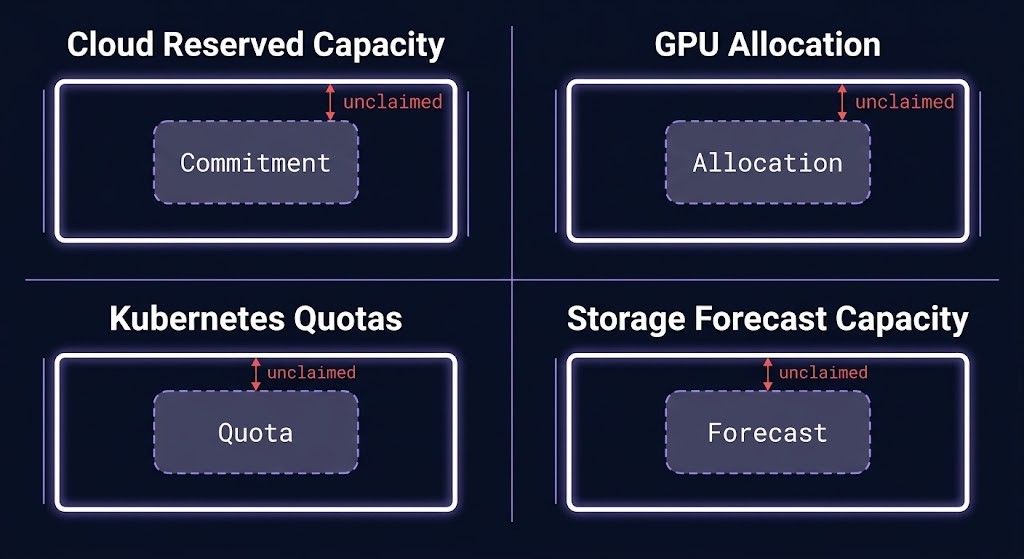
Cloud Reserved Capacity
Cloud reserved-capacity programs turn a customer’s stated future consumption into a financial commitment, but the commitment itself does not guarantee the purchased capacity will be consumed — the signal accepted is a purchase decision, not evidence of an actual workload. The validation missing is usage verification against the commitment over time. The cost of the gap is absorbed by whoever owns the cloud budget line, since reserved capacity that goes unused is capacity paid for and never consumed rather than capacity simply not purchased. This is economic phantom capacity rather than a literal reservation queue — the mechanism differs from ERCOT’s, but the failure shape is the same: a financial artifact standing in for validated demand. At scale, unreconciled commitments across a large estate quietly convert a cost-optimization tool into a standing tax nobody is actively tracking — the economic consequence examined in The Cost of Idle Capacity Nobody Budgets For, which looks at what happens to the budget once a phantom reservation has already converted into paid-for, unconsumed capacity, distinct from the planning distortion this framework names.
GPU Allocation Pools
GPU allocation requests inside an enterprise are typically accepted on the strength of a project justification, not sustained utilization data — a team requests a cluster allocation for a training run or an inference workload, and the request itself becomes the planning signal. What’s missing is any requirement that the allocation prove ongoing need before it’s renewed or expanded. The infrastructure team absorbs the cost in the form of capacity that shows as “allocated” on every dashboard while sitting substantially idle, and the platform can’t tell a genuinely GPU-constrained team from one holding capacity it isn’t using. At scale, this is precisely the allocation-governance crisis already reshaping AI infrastructure planning across the industry — teams retain GPU allocations defensively because the reservation is cheap and the cost of losing access later is uncertain, the same asymmetry that filled ERCOT’s queue, a pattern examined in GPU Allocation Governance Is the Next AI Infrastructure Crisis.
Kubernetes Quotas
A ResourceQuota isn’t a reservation — it constrains what a namespace may consume, it doesn’t set aside physical capacity. The Phantom Capacity condition shows up one step later, when that requested quota gets treated as evidence of expected cluster demand rather than as the consumption ceiling it actually is. Quotas are typically sized generously during onboarding, against a rough estimate of future need rather than measured pod-level consumption, and the validation missing is any recurring reconciliation between requested quota and observed utilization. The platform team absorbs the cost through a cluster that appears resource-constrained on paper long before it’s actually constrained in practice, which distorts every subsequent node-scaling decision built on quota totals instead of usage data. At scale, quota sprawl becomes indistinguishable from real capacity pressure until someone runs the reconciliation nobody scheduled. That raises the next architectural question: who actually has the authority to decide whether a capacity claim remains legitimate? Autoscaling Is an Authority System, Not a Capacity System examines that authority boundary.
Storage Forecast Capacity
A growth projection isn’t literally a reservation either — it’s an estimate. It becomes Phantom Capacity when that forecast materially drives procurement or allocation decisions without being reconciled against observed consumption. Storage capacity planning frequently accepts departmental growth projections — often years out — as the basis for procurement and expansion decisions, with no mechanism forcing those projections to be revisited against actual accumulation rates. The cost is absorbed by whoever owns the storage procurement budget, who ends up provisioning years ahead of a demand curve that may never arrive as projected. At scale, over-provisioned storage becomes one of the quieter and more persistent forms of stranded capital in an infrastructure budget, because unlike compute, nobody is forced to reconcile it on any regular cycle.
Worth drawing a hard line here rather than letting the resource overlap blur it: Google’s TPU rationing is real, evidenced, physical scarcity — its own demand, Meta’s demand, and its Cloud customers’ demand are all confirmed, and the compute still doesn’t exist to cover them. Nothing there resembles a queue padded with unvalidated placeholders. Phantom Capacity is a trust problem — whether a system has earned the right to believe its own signal. Google’s shortage is an arithmetic problem — confirmed demand that doesn’t sum to available supply, forcing an explicit prioritization decision instead of a validation one. Related resource, different failure.
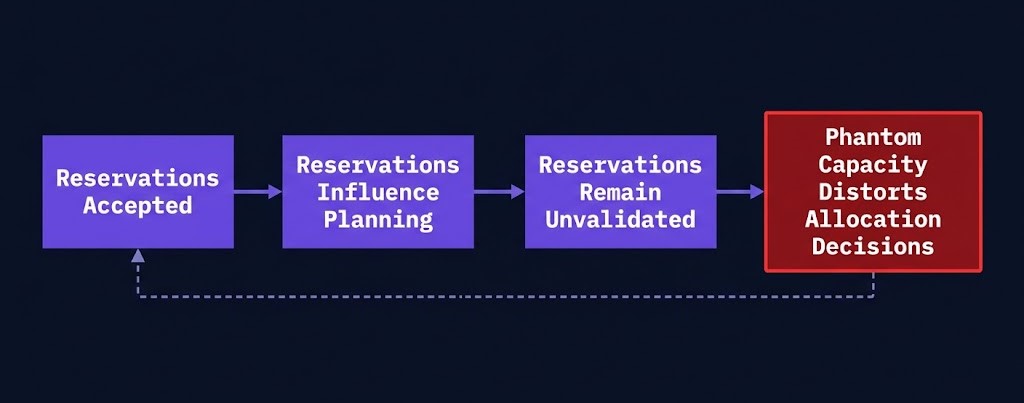
Framework #171 — Phantom Capacity
Framework #171 sits within the Economic Architecture stage of Cloud Strategy because the framework concerns how capacity commitments influence economic and infrastructure planning.
FRAMEWORK #171 — PHANTOM CAPACITY
Capacity that appears committed inside a planning system but lacks sufficient evidence that it will ever be consumed.
The distortion surfaces only when the system is forced to reconcile — usually under external pressure, not on its own schedule.
A reservation, allocation, quota, commitment, or forecast becomes Phantom Capacity when the planning system treats it as evidence of future consumption without sufficient validation — the framework isn’t limited to formal reservation systems, it applies anywhere a planning artifact gets promoted into a demand signal. Applied directly: an ERCOT queue position, yes. A GPU allocation pool, often. A cloud quota request, frequently. A storage forecast, sometimes. A reserved-instance commitment, it depends entirely on whether anything checks utilization against it afterward.
The failure state is worth naming precisely: planning systems begin optimizing for the artifacts of the reservation process itself — queue position, request volume, aggregate reserved capacity — rather than for validated consumption intent, because no mechanism exists to prove reservations will convert into actual demand. The system isn’t simply wrong about demand. It is rationally optimizing against the wrong signal, because the wrong signal is the only one it was built to collect.
Architectural Relationships
No architectural relationships are currently mapped for this framework in the registry.
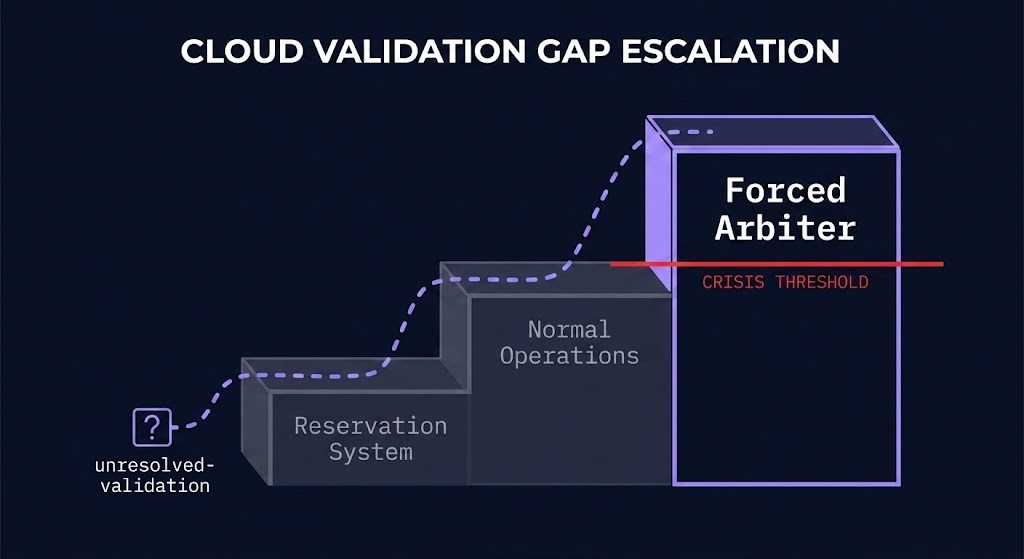
Forced Arbiters
Systems that avoid building a validation layer don’t eliminate the validation work. They defer it — and deferred validation work doesn’t disappear, it accumulates until something forces a reconciliation nobody scheduled.
That’s the part of the Texas story that generalizes furthest beyond Texas. ERCOT couldn’t tell which of its 474 gigawatts of queued capacity was real. The PUCT couldn’t either. The normal interconnection process wasn’t designed to resolve that credibility question at this scale. So when the gap between queued capacity and plausible demand became large enough to threaten grid planning itself, the only entity positioned to force a reconciliation was the governor, acting outside the queue’s own process entirely.
That’s the pattern: a planning system built for low-friction intake eventually produces a credibility gap large enough that somebody outside the system has to become the validator, under crisis conditions, instead of the design having anticipated the need. In an enterprise, that somebody is rarely a governor. It’s a platform team forced into an emergency quota audit after a cluster reports false capacity pressure. A FinOps team called in after a reserved-capacity reconciliation reveals a budget line that’s been wrong for two fiscal quarters. A procurement committee freezing new storage requests after a forecast-versus-actual review finally gets scheduled. An executive steering group stepping in because nobody below them owns the composite question of whether the demand pipeline is real.
The identity of the forced arbiter changes. The sequence that produces one doesn’t.
Wisconsin’s regulators supplied a sharper instance of the same sequence a year later, and a different kind of arbiter. Oracle’s power guarantee for its Port Washington AI campus shows what happens when the forced arbiter isn’t a governor acting outside the process, but a credit-rating threshold built directly into the process itself — the PSC’s tariff didn’t wait for a crisis to force reconciliation, it priced the possibility of one into Oracle’s cost of capital before the campus’s demand forecast has had time to resolve either way.
What Validation Actually Looks Like
Every reservation system that survives long enough eventually introduces some form of friction back into intake — not because friction is desirable, but because friction is frequently the only mechanism that produces a credible signal. The options aren’t equally strong, and the right choice for any given system depends on how much a false reservation actually costs.
| Validation Mechanism | Proof of Intent |
|---|---|
| Periodic recertification | Low |
| Expiration windows | Low–Medium |
| Utilization thresholds | Medium |
| Milestone requirements | Medium–High |
| Deposits / financial commitments | High |
Periodic recertification — simply asking holders to reconfirm a reservation still applies — is the cheapest control to implement and the easiest to ignore; a reservation holder loses almost nothing by reconfirming a request they never intend to consume. Expiration windows force a reservation to be actively renewed or it lapses, which raises the cost of holding phantom capacity indefinitely but still doesn’t require proof the capacity will be used. Utilization thresholds tie continued reservation to demonstrated consumption — the first mechanism on this list that actually measures the thing the reservation claims to represent. Milestone requirements go further, tying reservation validity to concrete progress markers (permits filed, contracts signed, hardware ordered) that are expensive to fabricate. Deposits and financial commitments are the strongest signal available, because they make holding a phantom reservation cost something real, which is the only pressure that reliably separates a genuine future need from a cheap option on a queue position.
The mechanism a system chooses is really a statement about how much a false positive costs. ERCOT’s queue cost almost nothing to enter and offered real strategic value to hold — that combination will produce phantom capacity in any system, at any scale, regardless of the domain. Seeing a signal is not the same as the signal being trustworthy — the distinction explored in Cost Visibility Is Not Cost Control.
The same signal-versus-reality gap shows up even where there’s no reservation queue at all. Two Nodes Can Preserve Availability. They Can’t Preserve N+1 Capacity. examines it at the infrastructure layer: quorum status tells an operator the cluster is up, the same way a queue position tells ERCOT a project is real — both are signals the system was built to collect, and neither one validates the thing that actually determines whether the plan survives contact with a failure.
Architect’s Verdict
A capacity reservation is not a demand signal until the system has earned the right to trust it. Texas didn’t discover that it had too much data-center demand. It discovered that its planning system could not reliably distinguish demand from the requests claiming to represent it — and the resulting gap became large enough that validation had to be imposed from outside the system.
What most coverage of this story misses is that frictionless intake was a design choice, not an inevitability. Nobody forced ERCOT to make filing an interconnection request nearly free. That choice optimized for a queue that looked comprehensive and turned out to be mostly unverifiable — the same choice every low-friction planning system makes, from a cloud console’s reserved-instance purchase flow to a Kubernetes namespace request form, usually without anyone framing it as a choice at all. If a reservation, allocation, quota, commitment, or forecast materially influences capacity, procurement, or budget decisions, it needs a defined validation path before it’s allowed to carry that weight — the stronger the consequence of a false positive, the stronger the evidence of intent needs to be.
Don’t ask how much capacity has been requested. Ask how much of that request has earned the right to influence the decision. That’s the boundary between a planning system that measures demand and one that merely counts reservations.
Additional Resources
View 4 more resources
Editorial Integrity & Security Protocol
This technical deep-dive adheres to the Rack2Cloud Deterministic Integrity Standard. All benchmarks and security audits are derived from zero-trust validation protocols within our isolated lab environments. No vendor influence.

R.M.
Senior Solutions Architect with 25+ years of experience in HCI, cloud strategy, and data resilience. As the lead behind Rack2Cloud, I focus on lab-verified guidance for complex enterprise transitions. View Credentials →
Get the Playbooks Vendors Won’t Publish
Choose the architecture problems you care about. Get field-tested playbooks and frameworks delivered to your inbox.
- > AI Infrastructure & Inference Economics
- > Cloud Strategy & Hidden Cost Models
- > Virtualization & Deterministic Migration
- > Kubernetes, IaC & Modern Infrastructure
- > Data Protection & Recovery Engineering
Zero spam. Includes The Dispatch weekly drop.
Need Architectural Guidance?
Independent review before major infrastructure decisions.
- > Validate assumptions
- > Identify hidden dependencies
- > Quantify migration risk
- > Challenge vendor narratives
Triage · Advisory · Fractional · Direct Hire