

The Capacity You Paid For But Never Used
The capacity you paid for and the capacity your business actually consumed are almost never the same number, and the gap between them is where this hidden cost lives — not in a utilization dashboard, but in a decision that was made before anyone could know which number would win. You bought capacity because you couldn’t afford not to have it. Then demand failed to arrive. The infrastructure worked perfectly. The investment didn’t.
That sentence is the whole problem, and it’s worth sitting with before reaching for an explanation, because the easy explanations are all wrong. Nobody forgot to check a dashboard. Nobody made an obviously bad call. The capacity was sized against a real forecast, approved through a real review, and justified by real business risk. The failure isn’t visible anywhere in that process — which is exactly why it’s a hidden cost rather than an operational one.
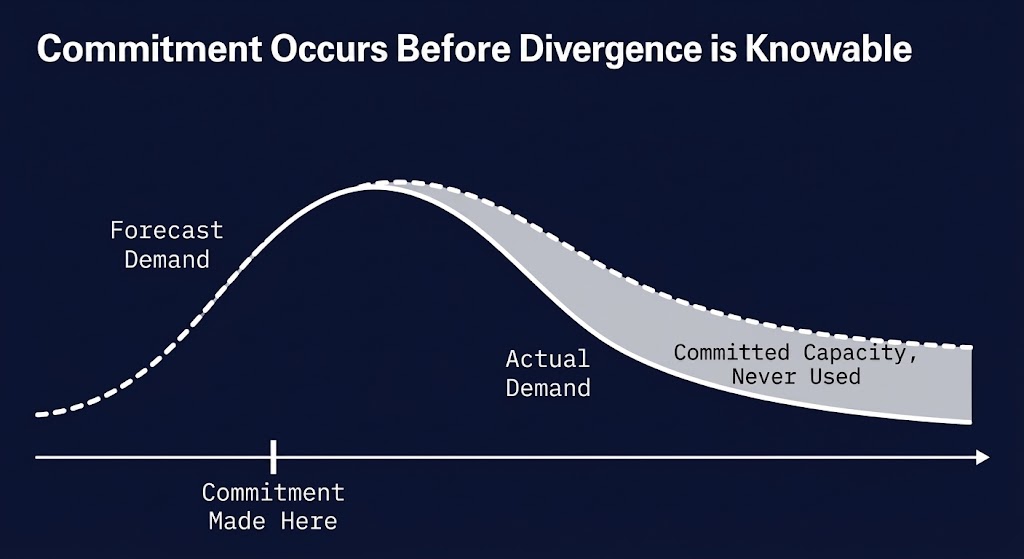
Capacity Purchased Is Not Capacity Used
The capacity you paid for splits into at least four different numbers the moment anyone tries to talk about it precisely, and most capacity conversations collapse them into one — which is where the confusion starts. There’s capacity purchased — what showed up on the invoice or the capital request. There’s capacity available — what’s actually provisioned and ready to take load. There’s capacity reserved — held against a specific future condition: failover, burst, contractual minimum, geographic redundancy. And there’s capacity consumed — the only one of the four that shows up on a utilization dashboard.
Cost reviews often collapse these distinctions by treating consumption as the proxy for whether the original capacity decision was justified. That’s backwards, or at least incomplete — the other three numbers are where the actual decision got made, and by the time consumption tells you something went wrong, the commitment that caused it is usually years old and hard to unwind.
This isn’t an argument that unused capacity is automatically a problem. Some of it is protecting the organization from something worse than its own cost. The point of this piece isn’t to measure how much capacity sits unused — plenty of infrastructure content already does that well. The point is to ask why the commitment got made without anyone modeling what happens if it stays unused for longer, or more completely, than the forecast assumed.
The Capacity You Paid For Gets Committed Before the Demand Resolves
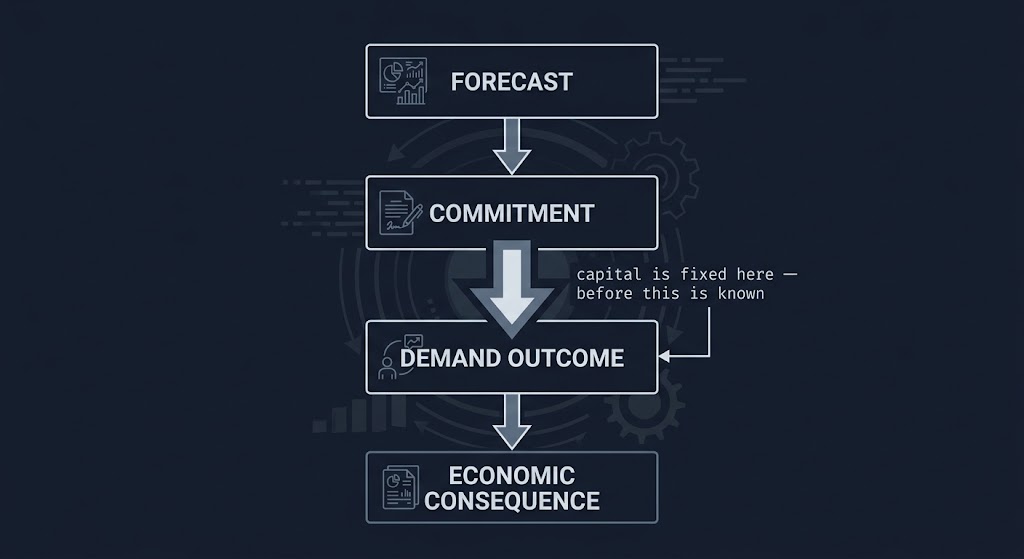
Here’s the sequence that matters, and it’s worth stating plainly because the rest of the piece depends on getting the order right — this is the moment the capacity you paid for actually gets decided, well before anyone knows whether it was needed. A demand forecast — peak load, failover capacity, burst headroom, contractual minimums, expected growth — gets translated into a fixed, present-tense expenditure. Capacity gets reserved, colocated, installed, or contractually committed. At that moment, something changes that doesn’t get named often enough: uncertain future demand has just become certain present-day capital.
That conversion — uncertain demand into committed capital — is the actual hidden-cost boundary. It doesn’t happen gradually. It happens at the moment of approval, and it happens whether or not the forecast turns out to be right. Nothing about the commitment decision itself is wrong. Architects don’t buy average demand; they buy enough capacity to survive the demand state that would hurt the most if it arrived and wasn’t covered. That’s rational risk management, not overprovisioning.
What a typical capacity model prices at that moment is fairly complete on one side: peak demand, headroom, SLA targets, resilience margins, expected growth curves. All real inputs, all reasonably well understood. What often receives less attention is what happens on the other side of the forecast — the side where demand comes in lower than assumed, for longer than assumed, with no clean way to give the capacity back.
The Question Every Capacity Model Skips
This is the part of the mechanism that doesn’t show up in most capacity-planning conversations, and it’s the actual subject of this piece. Plenty of capacity and procurement models are genuinely sophisticated about the upside case — the forecast being too low, and what it costs if the organization can’t respond fast enough. The FinOps Foundation, for example, provides a specific methodology for measuring unused commitment-discount cost after the commitment exists. The architectural question comes earlier: whether that downside was given comparable weight when the commitment itself was approved.
That asymmetry is the actual failure. The decision gets built as though the only risk worth pricing is running out. The far more common outcome — demand arriving lower than assumed, for longer than assumed, with capital already spent and hard to walk back — often has no equivalent line item in the review that approved the commitment.
That’s the actual hidden cost, and it’s worth being precise about what kind of failure this is. It isn’t a monitoring gap — nobody failed to notice the capacity sat unused; the dashboard shows exactly that. It’s an absence at the point of decision, not a blind spot afterward. The capital commitment happens before anyone can know whether the demand assumption will hold, and the model that authorized the commitment never asked what the organization owes if the assumption turns out to be wrong in the other direction. The capital commitment happens before anyone can know whether the demand assumption will hold, and the model that authorized the commitment never asked what the organization owes if the assumption turns out to be wrong in the other direction. That’s a different failure than the one the Texas grid surfaced — where the planning system couldn’t validate whether reservations represented real demand at all, not just whether the demand estimate might run high or low. Phantom Capacity covers that upstream validation gap; this piece covers what happens after a valid-seeming commitment still fails to convert into consumption.
Oracle’s Wisconsin power guarantee shows the two failures colliding. Wisconsin’s regulators forced Oracle to answer, in dollars, the exact downside question this piece argues most capacity models skip — not eventually, once a utilization report comes back low, but immediately, priced into a multibillion-dollar letter of credit before the campus’s demand forecast has had time to resolve either way. That’s the downside-pricing exercise this piece is arguing for, except imposed from outside the commitment rather than built into the model that approved it.
Worth drawing the boundary the other direction too: this piece’s whole mechanism assumes the demand forecast turned out to be wrong. <a href=”/google-tpu-rationing-compute-authority/”>Google’s TPU rationing</a> is the case where it didn’t — internal demand, Cloud customer demand, and Meta’s demand were all real and confirmed, and Google’s own capacity still couldn’t cover it. Nothing about that shortage is a capital commitment sitting unused; it’s the opposite failure, a commitment that turned out to be undersized against demand that showed up exactly as forecast or higher. Same asset class, inverse direction.
Stranded Capacity Risk: A Bounded Example, Not the Whole Model
When the capacity you paid for does have an existing framework attached to it, it’s usually this one. Rack2Cloud’s Framework #78, Stranded Capacity Risk, is the clearest existing example — bounded specifically to on-premises capacity sized against a forecast peak, fixed in advance, that becomes stranded when the forecast shifts. Its failure state is narrow by design: unlike cloud capacity, fixed on-prem infrastructure can’t shed load between peaks — it’s owned whether or not it’s drawing demand. That’s a real instance of the broader pattern this piece describes, not the pattern itself. This piece covers the general case, including capacity that can technically be released, transferred, or resold — #78 covers the specific case where that exit doesn’t exist. A second framework, #79 Economic Persistence Bias, is worth one boundary sentence for the same reason: it explains why organizations keep carrying an existing decision once made; this piece starts earlier, with capacity that never achieved the utilization the commitment assumed in the first place.
Two adjacent pieces of Rack2Cloud analysis deserve real differentiation on where the capacity you paid for actually ends up, because the overlap is closer than a framework-boundary footnote. The Cost Of Idle Capacity Nobody Budgets For asks whether unused capacity retains strategic value after it exists — its Waste Idle / Deferred Idle / Strategic Idle typology is the right lens for classifying capacity already sitting on the books. This piece asks the question one step earlier: whether the original commitment adequately modeled the downside case before that capacity existed at all. And the GPU-specific version of this same pattern already has a name — Reservation Waste, the FOMO-procurement failure mode where capacity gets reserved against burst demand that never materializes at the assumed scale. That analysis documents what the failure looks like once it’s happened, in GPU infrastructure specifically. This piece asks the prior question, independent of asset class: why did the decision model that authorized the commitment never price that outcome as a live possibility, whether the asset is a GPU, a colocation contract, or a rack of owned hardware.
Two-node edge topologies are the sharpest version of this same unpriced-downside asymmetry, playing out in real time. Two Nodes Can Preserve Availability. They Can’t Preserve N+1 Capacity. covers a case where the capacity model gets the upside math right — Red Hat’s own TNA guidance recommends sizing each node at roughly 50% utilization — but that same 50% headroom looks like waste on a dashboard until the day one node fails and the survivor has to absorb everything the other one was carrying. The commitment was priced correctly. Nobody modeled how visible the downside would look before it happened.
(Framework #90, Capacity Illusion Index, is a different problem entirely — capacity that looks available but structurally can’t be consumed, a scheduling and fragmentation failure, not a demand-forecast one — and doesn’t need more than this sentence to stay clear of it.)
One more boundary worth drawing before the practitioner questions below: this whole piece assumes the cost model counted the capacity correctly and the organization simply never consumed it. Dependency Residue is the same blind spot read backwards — a cost the organization keeps consuming after the cost model has already stopped counting it, because a transformation program declared the dependency eliminated on a schedule the dependency never agreed to.
When Demand Doesn’t Arrive
Most of the time, when a demand forecast resolves lower than assumed, the capacity you paid for simply sits there. The capital is spent, the asset exists, and there’s rarely a market on the other side willing to take it off the organization’s hands at anything close to what it cost. That’s the default shape of this problem: pay, commit, hold, discover the demand never arrived, and absorb the loss because there’s nowhere for the capacity to go.
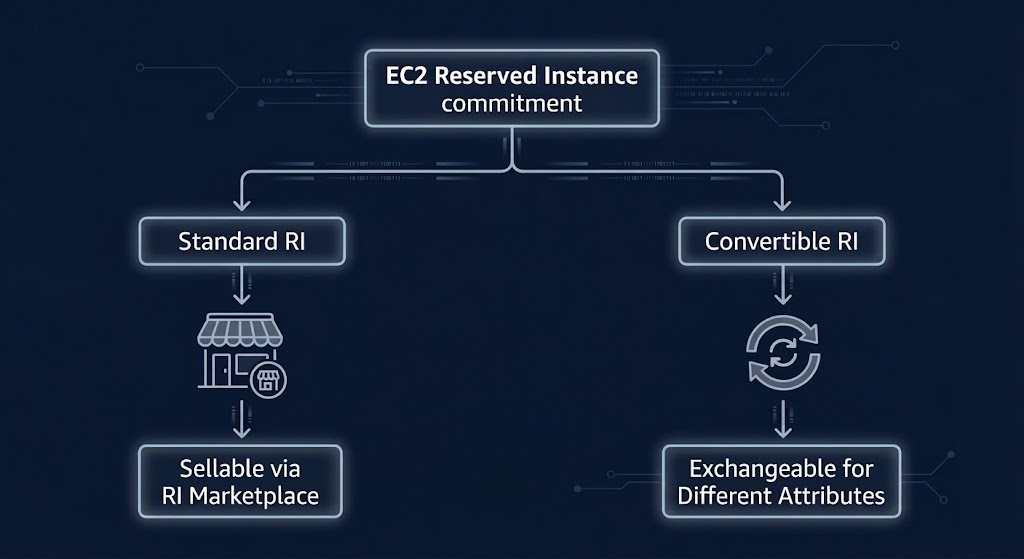
The exit path is a property of the commitment itself. AWS, for example, states that EC2 Reserved Instances cannot be canceled after purchase; Standard RIs can be sold through its Reserved Instance Marketplace, while Convertible RIs can be exchanged for different attributes but cannot be sold there. That’s a concrete example of why exit flexibility is a structural property of a commitment, not a generic characteristic of capacity — “committed” doesn’t describe a single level of recoverability, which is exactly the distinction the practitioner table below is trying to expose.
Which raises the more useful architectural question: how much of the cost of an unrealized demand forecast comes from the capacity itself, and how much comes from the structure of the commitment that made it hard to exit? The hidden cost isn’t invisible because nobody can measure it — the FinOps Foundation’s own commitment-waste methodology above proves it’s measurable. It’s hidden because measurement typically arrives after the commitment, while recoverability was partly determined by the commitment structure chosen at the time the decision was made.
Before You Approve The Next Commitment
None of this is useful to an architect unless it changes what happens the next time the capacity you paid for is still just a proposal, not yet a commitment. The practical instrument here isn’t a formula — a genuinely defensible one would need a clean unit for every variable, and at least one term in any version of this equation (how hard the capacity is to unwind) resists being reduced to a single number without becoming decorative. What’s more useful is a short set of questions applied before the commitment is signed, not after the utilization report comes back low:
| Question | What It Exposes |
|---|---|
| What demand assumption justified this capacity? | Original forecast |
| What happens if actual demand is materially lower? | Downside exposure |
| How long can the capacity remain underutilized before it matters? | Duration |
| Can the commitment actually be reduced once it’s in place? | Exit flexibility |
| Can the capacity be transferred or resold if demand doesn’t arrive? | Exit value |
| What value remains if the demand never materializes at all? | Recoverable value |
| Which specific decision made this commitment difficult to unwind? | Structural cause |
None of these questions require new tooling or a new metric to compute. What they require is asking them at the point of approval, which is precisely the point where most capacity models stop asking anything at all.
Architect’s Verdict
The problem was never the capacity you paid for. It’s converting uncertain demand into committed capital without modeling what happens when the demand never arrives.
Unused capacity isn’t automatically waste, and it isn’t automatically a mistake — plenty of it is doing exactly the job it was bought to do simply by being there. The failure this piece describes isn’t that capacity goes unused. It’s that the decision model which approved the commitment priced the need to be ready and never priced the cost of being wrong.
That absence doesn’t show up until the capacity you paid for has already gone unused long enough to matter.
Same series, same shape, different asset class: the next piece in this series asks the equivalent question about tooling instead of compute — not how much you’re paying per seat, but what accumulates in the relationships between tools once enough of them are adopted.
Additional Resources
View 4 more resources
Editorial Integrity & Security Protocol
This technical deep-dive adheres to the Rack2Cloud Deterministic Integrity Standard. All benchmarks and security audits are derived from zero-trust validation protocols within our isolated lab environments. No vendor influence.

R.M.
Senior Solutions Architect with 25+ years of experience in HCI, cloud strategy, and data resilience. As the lead behind Rack2Cloud, I focus on lab-verified guidance for complex enterprise transitions. View Credentials →
Get the Playbooks Vendors Won’t Publish
Choose the architecture problems you care about. Get field-tested playbooks and frameworks delivered to your inbox.
- > AI Infrastructure & Inference Economics
- > Cloud Strategy & Hidden Cost Models
- > Virtualization & Deterministic Migration
- > Kubernetes, IaC & Modern Infrastructure
- > Data Protection & Recovery Engineering
Zero spam. Includes The Dispatch weekly drop.
Need Architectural Guidance?
Independent review before major infrastructure decisions.
- > Validate assumptions
- > Identify hidden dependencies
- > Quantify migration risk
- > Challenge vendor narratives
Triage · Advisory · Fractional · Direct Hire