

Oracle’s $7 Billion Wisconsin Power Guarantee Isn’t Really About Power
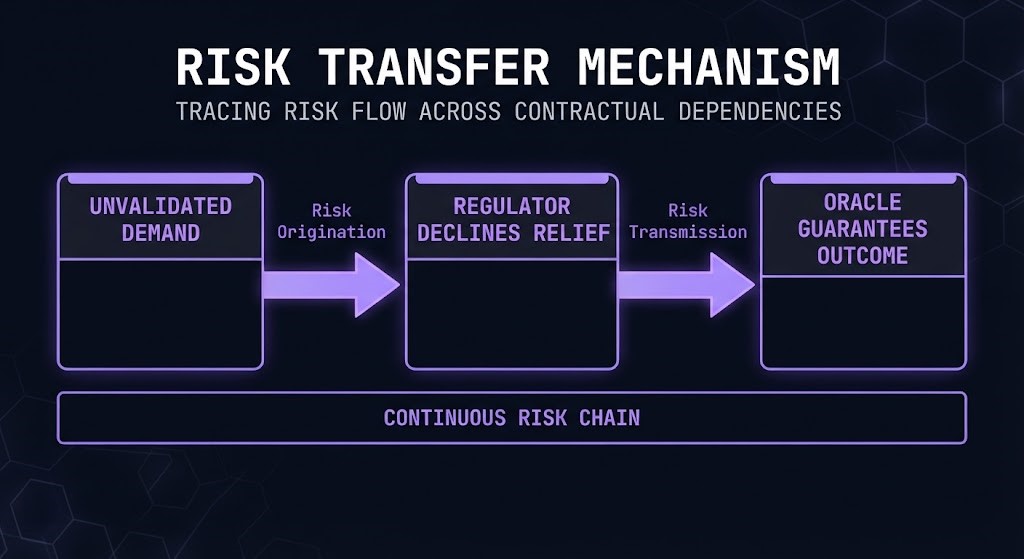
Oracle’s power guarantee for a nearly one-gigawatt Wisconsin AI campus was never really a story about electricity. Oracle says it may ultimately have to post more than $7 billion in financial security, likely in the form of a letter of credit, at a financing cost that could exceed $100 million a year, to back power commitments behind the Lighthouse Campus it’s building in Port Washington with Vantage and OpenAI. Oracle asked the commission to reconsider. The commission declined. What’s actually being disputed here isn’t power generation, and it isn’t Oracle’s balance sheet. It’s who carries the consequences when a planning system has to commit infrastructure before future demand has been realized.
The Missing Validation Layer
Every large infrastructure commitment starts life as a claim about future demand. A cloud reservation, a GPU allocation, an interconnection queue position, a multi-year power commitment — all of them are promises that something will be consumed later, made by a party that isn’t paying the full cost of being wrong. Planning systems have to act on these promises before the underlying consumption exists to validate them — the infrastructure decision can’t wait for realization, because by the time demand is realized, the capacity to serve it either already exists or it’s too late to build.
The pattern shows up the same way across infrastructure domains, at different layers:
| Capacity Commitment | What’s Actually Unverified |
|---|---|
| Cloud capacity reservations | Whether the future workload materializes |
| GPU allocation pools | Whether reserved compute converts into real consumption |
| Interconnection queue position | Whether the buildout behind the request ever happens |
| Power guarantee | Whether the planned buildout converts into realized campus load |
This is the same failure shape enterprise architects already manage inside their own cloud strategy — reserved-instance commitments that outlive the workloads that justified them, GPU pools sized to a forecast nobody re-checks. Wisconsin’s regulators are now managing the identical problem at grid scale, for a single customer large enough to move the state’s entire electricity market.
Regulators Refuse to Absorb the Risk
The Public Service Commission of Wisconsin tightened its rules for large data center developers this spring: any customer below an A-/A3 credit rating has to post collateral sized to the power infrastructure built specifically to serve it. Oracle’s S&P rating sits at BBB-, two tiers below the exemption bar — and was downgraded further while this dispute was underway. Oracle asked the commission to revisit the requirement. Wisconsin’s regulators, per Financial Times reporting, declined to take action, on the stated basis that the rule protects existing ratepayers from absorbing the cost if a project this large doesn’t deliver the demand it promised.
That’s the tell. The commission isn’t disputing that the campus will probably get built. It’s refusing to let the possibility that it won’t sit anywhere near ordinary electricity customers. Wisconsin didn’t build a mechanism that requires existing ratepayers to absorb the uncertainty. It built one that makes Oracle provide the financial security if the expected demand doesn’t materialize.
The Risk Didn’t Disappear
Regulators rejected relief. The underlying problem — a nearly-1GW campus’s committed power hasn’t yet converted into consumed power, and won’t for years — didn’t get solved by that decision. It just landed somewhere. Oracle is now the party financially guaranteeing an outcome that, months or years from now, either happens or doesn’t.
Risk transfer is often mistaken for risk reduction. They are not the same thing. The forecast behind this campus is exactly as unrealized today as it was before the PSC’s decision — the only thing that changed is who’s holding the bag if it turns out to be wrong.
Oracle Becomes the Forced Arbiter
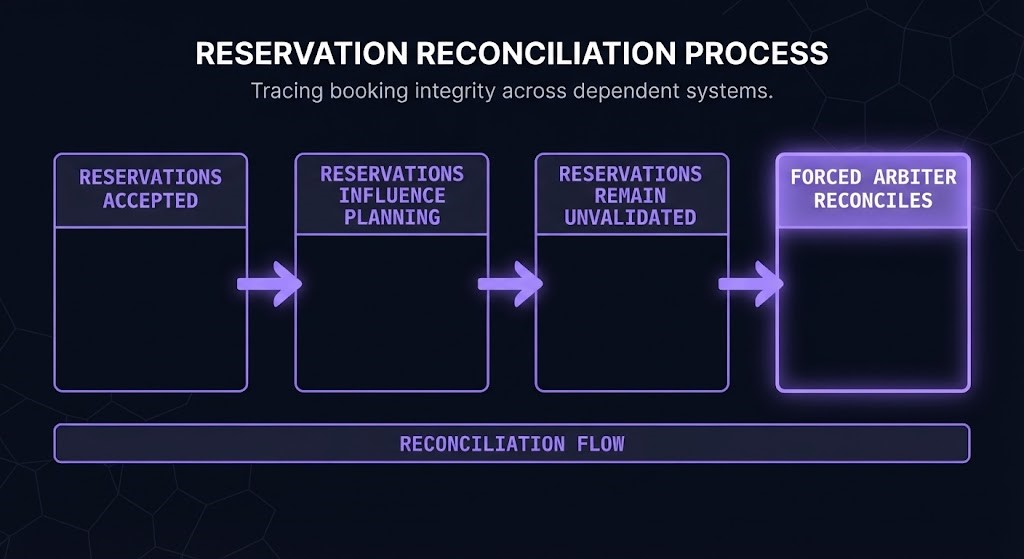
This is where the pattern has a name. Framework #171, Phantom Capacity, describes what happens when a reservation, allocation, quota, commitment, or forecast gets treated as validated demand before anything actually validates it — first named against ERCOT’s interconnection queue, where requests representing 474GW sat against a 91GW all-time peak, almost entirely undifferentiated data-center demand. The framework also names a sub-pattern for what happens next, one that’s mostly stayed in the background until now: Forced Arbiters — systems that avoid building a validation layer don’t eliminate the validation work, they defer it until an external party is compelled to reconcile projected demand against real demand, usually under pressure rather than by design.
Wisconsin’s regulators didn’t eliminate the underlying validation problem. They assigned the financial consequence of getting the forecast wrong to Oracle. Oracle didn’t volunteer to become the party that reconciles projected campus demand against actual campus demand — Wisconsin’s tariff made Oracle responsible for the financial consequences of that reconciliation, priced in basis points and letters of credit. Oracle isn’t performing the validation itself; it’s absorbing the cost of that validation being deferred. In Framework #171’s own terms, that role has a name: Oracle became the Forced Arbiter, not by choice, but because the state built a mechanism that requires one.
Why Architects Should Care
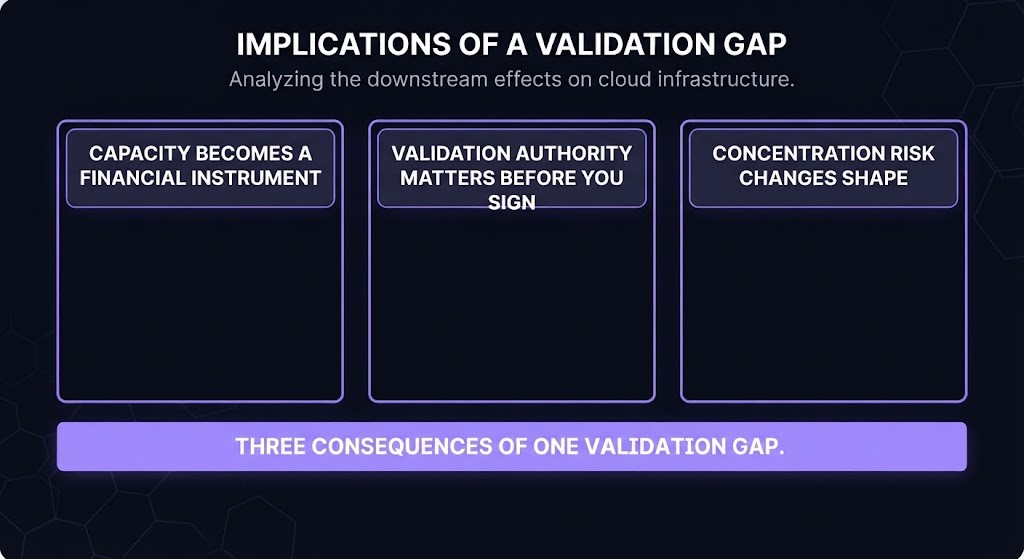
Three consequences follow, and none of them are specific to Oracle or to Wisconsin.
Capacity commitments are becoming financial instruments. Power, GPUs, colocation space, AI clusters — the underlying pattern is the same one already playing out with reserved compute capacity moved into structured financial products: buyers increasingly pay for the uncertainty created by demand nobody has validated, not just for the resource itself. The capacity you already paid for and never used shows exactly how far that financialization has already gone with GPU reservations. Wisconsin’s power guarantee exposes the same economic mechanism at a different unit of capacity: megawatts instead of compute hours.
Validation authority matters before you sign. Before signing a long-term capacity commitment, ask who owns validation authority — and who owns the financial consequence when the forecast fails. Someone always ends up holding the reconciliation — a utility, a regulator, a vendor, or eventually the customer. Architects negotiating power-dependent or capacity-dependent contracts should be asking this explicitly, not assuming it’s been handled because nobody mentioned it.
Concentration risk changes shape. If regulators increasingly require hyperscalers to backstop the infrastructure commitments created by their own expansion, their balance-sheet decisions start affecting architecture choices that have nothing to do with them directly. That’s a different exposure profile than the one most cloud concentration risk modeling accounts for today — it isn’t just “what happens if my provider has an outage,” it’s “what happens if my provider’s financing structure changes because a state regulator somewhere else decided it had to.”
Google’s own TPU allocation hierarchy is the same exposure from a different angle — not a regulator deciding a vendor’s financing structure, but the vendor’s own declared prioritization deciding which customers get served at all. Google TPU Rationing Is Not a Supply Story. It’s an Authority Story traces what happened once Google ranked its own frontier research and products ahead of Cloud customers: Meta got rationed, and Google itself had to lease $920 million a month in external GPU capacity to cover what its own allocation decision displaced. The exposure generalizes past Oracle and Wisconsin — a vendor’s internal allocation authority is a risk your architecture inherits whether or not you negotiated for it.
None of this is abstract for long. Wisconsin isn’t an isolated case. More states are putting financial protections around the infrastructure required to serve very large data-center loads — which means more infrastructure providers are likely to discover they’ve become forced arbiters whether they priced for it or not.
Infrastructure Architecture Review
If your architecture depends on a vendor’s capacity commitments — power, compute, or otherwise — the Infrastructure Architecture Review examines where validation authority actually sits in that dependency chain, before a regulator or a balance sheet decides it for you.
Learn more →Architect’s Verdict
Oracle’s power guarantee was never a dispute about electrons. It was a dispute about who owns the consequence when a planning system can’t prove its own demand signal — and Wisconsin’s regulators answered that question by rule rather than by leaving it to chance.
Most enterprises carry this same unvalidated-demand exposure in smaller, quieter forms — a reserved-instance commitment, a GPU pool, a colocation contract — without ever being forced to name who’s actually holding the risk if the forecast is wrong. Wisconsin just made that question unavoidable for a company that can absorb a $100 million answer. Most organizations can’t, and most never find out until the bill arrives.
Risk transfer isn’t risk reduction. It’s just a decision about whose name goes on the guarantee.
Additional Resources
Editorial Integrity & Security Protocol
This technical deep-dive adheres to the Rack2Cloud Deterministic Integrity Standard. All benchmarks and security audits are derived from zero-trust validation protocols within our isolated lab environments. No vendor influence.

R.M.
Senior Solutions Architect with 25+ years of experience in HCI, cloud strategy, and data resilience. As the lead behind Rack2Cloud, I focus on lab-verified guidance for complex enterprise transitions. View Credentials →
Get the Playbooks Vendors Won’t Publish
Choose the architecture problems you care about. Get field-tested playbooks and frameworks delivered to your inbox.
- > AI Infrastructure & Inference Economics
- > Cloud Strategy & Hidden Cost Models
- > Virtualization & Deterministic Migration
- > Kubernetes, IaC & Modern Infrastructure
- > Data Protection & Recovery Engineering
Zero spam. Includes The Dispatch weekly drop.
Need Architectural Guidance?
Independent review before major infrastructure decisions.
- > Validate assumptions
- > Identify hidden dependencies
- > Quantify migration risk
- > Challenge vendor narratives
Triage · Advisory · Fractional · Direct Hire