

Google TPU Rationing Is Not a Supply Story. It’s an Authority Story.
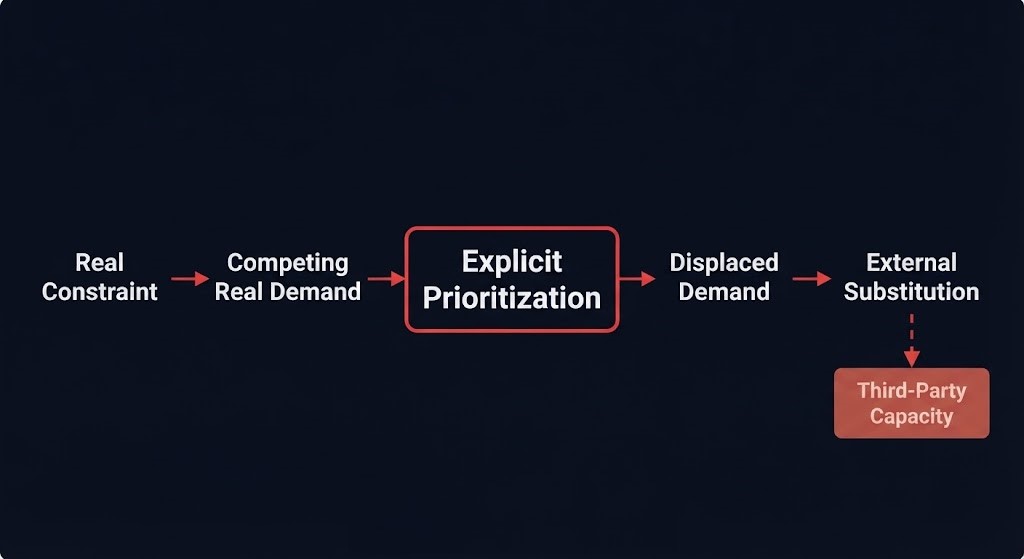
TPU rationing at Google is not primarily a story about running out of chips. It’s a story about what happens the moment real demand for a finite resource exceeds what that resource can supply: allocation stops being a capacity-management exercise and becomes an authority decision, made by someone, with consequences that land somewhere specific.
Alphabet has said plainly that it’s operating in what CFO Anat Ashkenazi called a “supply-constrained environment” — a real ceiling, not a forecasting error. DeepMind CEO Demis Hassabis has traced the bottleneck to a handful of component suppliers behind every advanced accelerator on the market, not to Google specifically mismanaging anything. The TPU shortage is genuine, physical, and shared across the industry. The relevant point is that the constraint is physical rather than a failure to distinguish validated demand from an untested planning signal.
What’s underneath the shortage is the part worth an architect’s attention: once the shortage is real, somebody has to decide where the compute goes. Google made that decision visibly, in public, on an earnings call — and the consequences of that decision are now showing up outside Google’s walls, in the form of a rationed customer and a $920-million-a-month lease from a rocket company.
The important architectural question is therefore not simply how much compute exists, but who has standing to allocate it when supply cannot satisfy every legitimate demand.
The Constraint Is Real, Not a Signal Problem
Before going further, it’s worth being precise about what kind of shortage this is, because it determines what kind of argument follows.
This is not a planning system mistaking an unvalidated signal for real demand. Google’s available capacity is real. Its internal demand is real. Its Cloud customers’ demand is real. The constraint does not depend on a reservation, forecast, or commitment that might later prove to be phantom. The constraint traces to physical component availability — high-bandwidth memory supply from a small number of manufacturers — not to a queue full of placeholder requests nobody validated.
That distinction matters because it changes what kind of TPU rationing story this actually is. This isn’t a story about trustworthy versus untrustworthy demand signals. It’s a story about what an organization does when every signal is trustworthy and the total still doesn’t fit.
TPU Rationing Forces a Decision: Who Gets the Compute
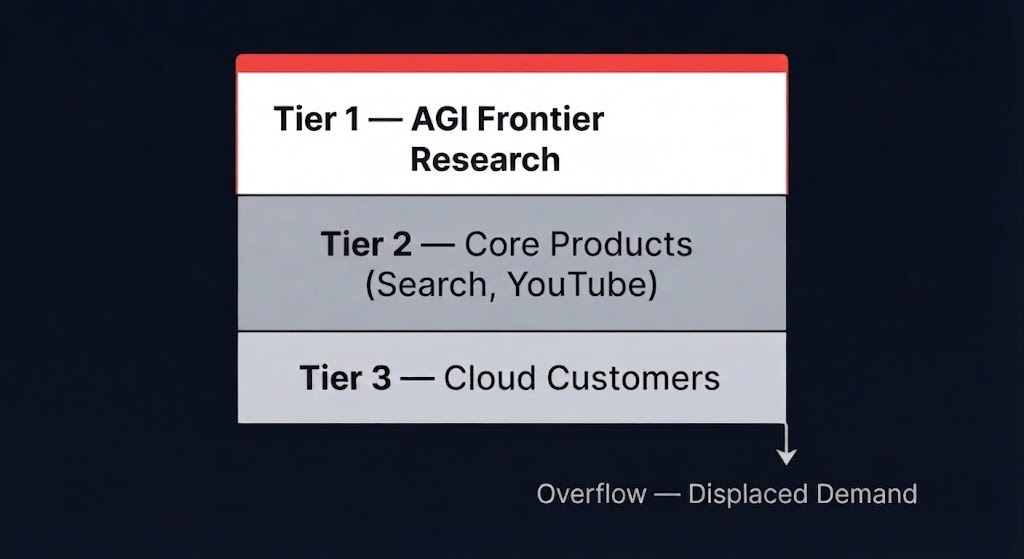
Google didn’t discover this problem quietly. Alphabet CEO Sundar Pichai stated the allocation hierarchy directly to analysts, placing frontier AGI work first — described as the foundation everything else at the company depends on — while describing Cloud alongside Search and YouTube in the allocation of the remaining capacity.
That’s worth sitting with as an architectural fact rather than a business one. A hyperscaler with enormous capital resources still cannot manufacture accelerator supply on demand, which means even Google has to run an explicit prioritization policy over a resource it designs, builds, and owns. Scarcity didn’t just constrain Google’s customers. It forced Google itself into the same allocation-authority position every enterprise platform team eventually reaches internally — the position described directly in GPU Allocation Governance Is the Next AI Infrastructure Crisis, where the failure mode is having no one with standing to say no. Google’s difference is that it does have someone with standing to say no — Pichai said it publicly. The interesting question is what happens once that authority actually gets exercised at scale.
The Allocation Decision Has a Downstream Address
Declaring a priority order doesn’t make the demand it deprioritizes disappear. It has to go somewhere.
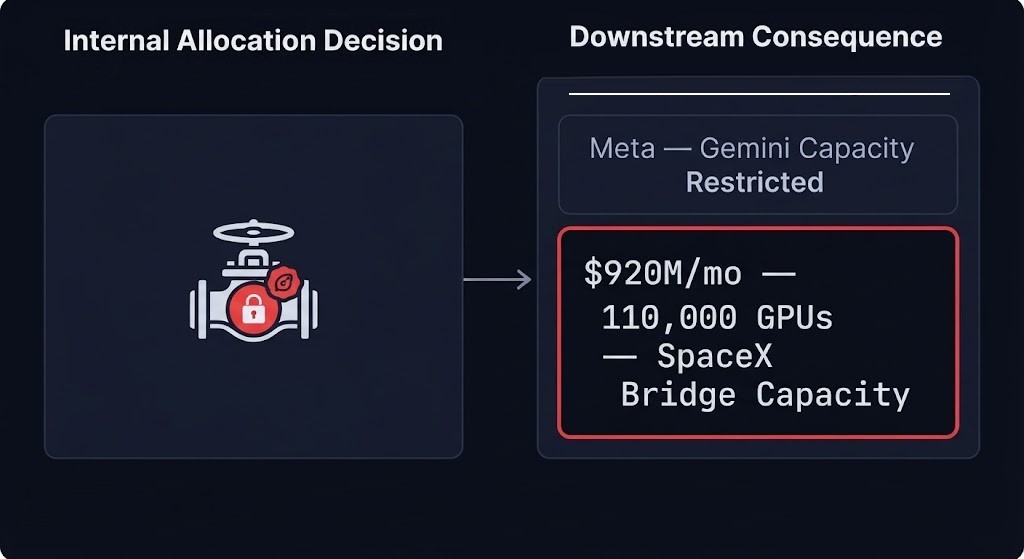
Around March 2026, Google told Meta it could not supply the Gemini compute capacity Meta had requested. The shortfall was large enough to disrupt several of Meta’s internal AI projects, and Meta responded by instructing staff to conserve their AI usage — the mirror image, one company downstream, of the same scarcity Google is managing internally. Meta wasn’t a marginal Gemini customer either; it was rationed precisely because its demand was large enough to matter.
This is the part of the mechanism that’s easy to miss if you only look at Google’s side of the ledger: allocation authority doesn’t just decide who gets served first inside one organization. Once that organization is also a vendor, the same decision reallocates who else has to find compute somewhere else, on someone else’s timeline.
Bridge Capacity Is the Architecture’s Admission
The clearest evidence of how tightly this constraint bound Google isn’t the Meta restriction. It’s what Google did to address the resulting capacity gap.
Google agreed to pay SpaceX roughly $920 million a month for access to about 110,000 Nvidia GPUs — hardware housed in xAI’s data centers. Google itself described the arrangement as “bridge capacity” for surging demand on Gemini Enterprise.
That phrase is more architecturally honest than it probably intended to be — TPU rationing doesn’t just decide who waits. It determines which demand remains inside Google’s available capacity and which demand has to seek capacity somewhere else. A bridge connects two points that aren’t naturally joined; nobody calls a data center they built for themselves a bridge. Calling the arrangement bridge capacity is effectively an admission that the internal architecture cannot currently absorb all of the demand it is being asked to serve. The external GPU lease becomes the visible downstream response to that allocation constraint.
It’s also not a new trade. Vertical Integration Is Turning AI Stacks Into A Competitive Moat names the same exchange from the enterprise side: guaranteed capacity secured through a vendor-coordinated deal, in exchange for dependency on infrastructure you don’t control. Google is normally the vendor offering that trade to its own Cloud customers. Here, for a slice of its own demand, Google is the one making it. The arrangement shows that the same capacity-for-dependency trade can operate in both directions when supply is constrained.
This Is Not Phantom Capacity
TPU rationing and Phantom Capacity share a resource but not a mechanism, and it’s worth naming that boundary explicitly — accelerator capacity is the same resource that shows up in Framework #171, Phantom Capacity and in Oracle’s Wisconsin power guarantee. The mechanism here is different, and the difference is the point.
| Phantom Capacity (#171) | TPU rationing |
|---|---|
| A capacity signal is treated as validated demand when it isn’t | Capacity and competing demand are both real and evidenced |
| Failure mode: nothing checks the signal against reality | Failure mode: confirmed supply can’t cover confirmed demand |
| Allocation can look healthy while the underlying demand is unresolved | Allocation necessarily requires an explicit prioritization decision |
| Produces a hidden, latent arbitration problem | Produces a visible, exercised arbitration decision |
Phantom Capacity is a story about trust — whether a planning system has earned the right to believe its own queue. TPU rationing is a story about arithmetic — real numbers that don’t sum to enough, forcing a real decision about who waits. Related resource, different failure. The distinction matters because scarcity alone does not make an event Phantom Capacity.
Formal Authority, Informal Allocation
One more thread is worth a qualified mention, without leaning on it. Google’s declared policy — AGI frontier work first — is a clean, public, top-down allocation hierarchy. Reporting on the internal researcher experience describes something messier sitting underneath it: accounts of DeepMind researchers queuing for the same TPUs Google is selling externally, with allocation reportedly running less through the declared policy than through informal, seniority-based routing inside research teams.
Formal policy says one thing. If operational practice runs differently underneath it, declared allocation authority and actual allocation authority aren’t necessarily the same thing. That would put the operational problem closer to the allocation-authority issue described in GPU Allocation Governance Is the Next AI Infrastructure Crisis — but it would not establish the same failure mode. This isn’t offered as proof Google has that same failure. It’s offered as a reason the stated hierarchy shouldn’t be read as the whole allocation story.
Architect’s Verdict
Google does not currently have enough internally controlled accelerator capacity to satisfy all of those competing demands simultaneously — internal frontier research, its own products, its Cloud customers, and the external commitments it’s already signed. That’s a narrower, more precise claim than “Google ran out of chips,” and it’s the one that actually generalizes.
The real lesson isn’t about TPUs specifically. It’s that scarcity, once it’s real and acknowledged, doesn’t resolve itself. Somebody has to decide which workloads get served first, which commitments get deferred, and where the displaced demand goes next. Google made that decision in public. The Meta restriction and the SpaceX lease are what the decision looks like once it leaves the boardroom and lands on someone else’s infrastructure bill.
Compute can always be acquired somewhere. What changes, once the original allocation can’t satisfy demand, is who ends up paying for the gap, and on whose terms.
Additional Resources
Editorial Integrity & Security Protocol
This technical deep-dive adheres to the Rack2Cloud Deterministic Integrity Standard. All benchmarks and security audits are derived from zero-trust validation protocols within our isolated lab environments. No vendor influence.

R.M.
Senior Solutions Architect with 25+ years of experience in HCI, cloud strategy, and data resilience. As the lead behind Rack2Cloud, I focus on lab-verified guidance for complex enterprise transitions. View Credentials →
Get the Playbooks Vendors Won’t Publish
Field-tested blueprints for migration, HCI, sovereign infrastructure, and AI architecture. Real failure-mode analysis. No marketing filler. Delivered weekly.
Select your infrastructure paths. Receive field-tested blueprints direct to your inbox.
- > Virtualization & Migration Physics
- > Cloud Strategy & Egress Math
- > Data Protection & RTO Reality
- > AI Infrastructure & GPU Fabric
Zero spam. Includes The Dispatch weekly drop.
Architecture Audit Services
Fixed-scope audits for Zero-Trust Azure, VMware migration readiness, and recovery posture — no discovery call required to start.
>_ View Audit Services>_Related Posts
Your Vendor Review Process Never Saw The Real Supplier
Every vendor review process assumes it’s evaluating a supplier — but a scan finding foreign-origin code embedded in more than one in eight mobile apps used by US military personnel makes the actual assumption visible: organizations review the company they bought from, not the code that arrived inside what they bought. >_ Architect’s Brief 60-second…
Your Monitoring Didn’t Miss the Incident. It Was Never Designed to See It.
I’ve watched observability vs monitoring play out as a live incident more times than I can count. >_ Architect’s Brief 60-second read before you commit to the full post · Full post: 10 min Generating brief… The dashboard was green. The on-call engineer was not paged. The monitoring system did exactly what it was designed…
Your Identity Controls Passed. Your Authorization Chain Failed.
A credential chain functioned exactly as it was designed to. No firewall failed. No exploit executed. No malware bypassed a control. A red team walked past physical and social barriers using nothing more exotic than a plausible pretext, and came out the other side holding network admin credentials — issued correctly, authorized correctly, working exactly…
Your DR Test Passed. The Assumptions Didn’t.
DR plan failure rarely happens where you tested. It happens at the assumptions the exercise never reached — the dependencies that weren’t in scope, the runbook written for last year’s architecture, the authority chain nobody tested at 2am.
Your AI Vendor Became Critical Infrastructure Before The Contract Did
On June 11, 2026, Microsoft 365 Copilot went down for seven hours. The cause was a misconfigured authentication deployment that cascaded through Microsoft Graph, taking Copilot Chat and the Office portal with it. It was the second major Copilot disruption in eleven days. Microsoft 365 posted 99.526% uptime in Q1 2026 — the lowest quarterly…
Your AI Test Environment Is Becoming A Production Control Plane
Your AI test environment did not need to touch a single line of model code to become part of your production authority chain — it only needed a credential, a network path, or a dataset copy that nobody scheduled for removal. That is the actual lesson sitting underneath this week’s disclosures from two frontier labs:…