

The Hypervisor Has Become A Commodity. Operations Have Not.
Hypervisor commoditization is changing how organizations evaluate virtualization platforms, but it is not reducing the operational complexity required to run them successfully. Twenty years ago, choosing a hypervisor was a technology decision. Ten years ago, it became an ecosystem decision. Today, the decision itself has stopped carrying the weight it used to — and most organizations haven’t updated their evaluation criteria to match.
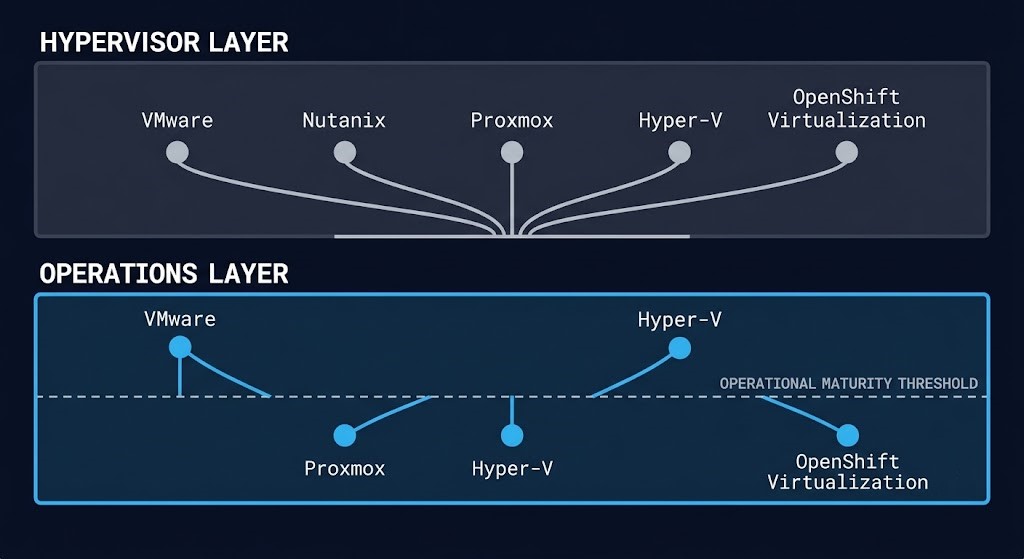
Hypervisor Commoditization Ended the Feature War
VMware, Nutanix, Proxmox, Hyper-V, OpenShift Virtualization, and KubeVirt all provide competent virtualization today. Not identical — each has genuine architectural differences in scheduling, storage integration, and networking models — but competent, in the sense that matters for this argument: none of them will fail an organization on core VM execution, resource scheduling, or basic HA. That wasn’t true a decade ago, when hypervisor choice determined whether specific workload classes were even viable.
This is the defining fact of virtualization architecture in 2026. The feature war that defined the 2010s — live migration, storage vMotion, distributed resource scheduling, software-defined networking — is mostly over, not because any vendor won it outright, but because the entire category matured past the point where those features were differentiating. Every credible platform has them now. Burwood Group’s 2026 review of the post-Broadcom hypervisor landscape makes the same point from the buyer side: organizations evaluating alternatives are no longer running a like-for-like hypervisor swap, they’re reassessing long-term platform strategy — the hypervisor itself increasingly one input among several, not the central decision it used to be.
Hypervisor commoditization doesn’t mean the platforms are interchangeable. It means the variance between them has stopped being where organizational outcomes are decided.
Kubernetes adoption produces the identical misreading one layer up the stack. Kubernetes did not replace virtual machines — it reduced the virtualization layer’s visibility to the application team the same way commoditization reduced its visibility to the buying decision. Reduced visibility read as reduced relevance is the same failure mode in both directions: a hypervisor market that stopped differentiating on features didn’t stop needing to be operated, and a control plane that stopped needing manual placement decisions didn’t stop needing infrastructure underneath it.
The same misreading shows up a layer down the stack, at the NIC instead of the control plane. VMware’s retreat from its SmartNIC-based network offload wasn’t a verdict on the silicon — it’s what happens when a specialized capability layer’s own dependency stops clearing its value threshold once the conventional path closes the gap the capability was built to beat. Commoditization pressure doesn’t stop at the hypervisor boundary; it reaches into every layer that promised to out-perform the thing it was offloading from.
Commodities Don’t Eliminate Complexity
CPU became a commodity. Storage became a commodity. Hypervisors are moving in the same direction, and the same lesson applies each time: commodity does not mean unimportant. Commodity means the differentiation has moved somewhere else.
Nobody argues that CPU choice stopped mattering once x86 became commoditized — they argue that the interesting engineering problems moved from instruction-set selection to scheduling, thermal management, and workload placement. Storage went through the same transition: the media itself commoditized, and the hard problems relocated to data placement, tiering, and failure-domain design. Hypervisor commoditization is following the identical pattern. The VM execution layer is no longer where the hard problems live. The hard problems moved into how the platform is operated once it’s running.
This is the distinction that matters for the rest of this post, and it’s worth being precise about it, because it’s easy to collapse into a claim this article isn’t making. This is not an argument that hypervisor choice doesn’t matter — that’s a migration-strategy question, and a different post already covers it: the operating model you migrate to matters more than the hypervisor you migrate away from is a claim about organizational structure and migration sequencing. This post is making a narrower, market-level claim: hypervisor feature differentiation is collapsing as the category matures, and that collapse is what’s driving the economics underneath every current VMware renewal decision — organizations aren’t just negotiating price anymore, they’re negotiating against a backdrop where the thing they’re paying a premium for has stopped being scarce.
Why Organizations Still Experience Radically Different Outcomes
Two organizations can standardize on the same platform — same hypervisor, same version, same reference architecture — and produce opposite outcomes eighteen months later. One runs predictable maintenance windows, clean upgrade cycles, and fast incident recovery. The other accumulates patch debt, discovers its DR runbook doesn’t match production, and burns a weekend every quarter on an upgrade that should have taken an afternoon.
The platform didn’t cause the difference. Operations did.
This is precisely the pattern documented in Your VMware Exit Was Successful — the First Incident Will Tell You If That’s True: the migration event itself is not where success or failure gets decided. It’s decided in the operational posture the organization brings to the platform afterward — whether incident response, capacity planning, and recovery procedures were actually rebuilt for the new environment or just copy-pasted from the old one and hoped to hold. A commoditized hypervisor market makes this more visible, not less, because it removes platform capability as a convenient excuse. When every platform is competent, “the hypervisor couldn’t do X” stops being an available explanation for a bad outcome.
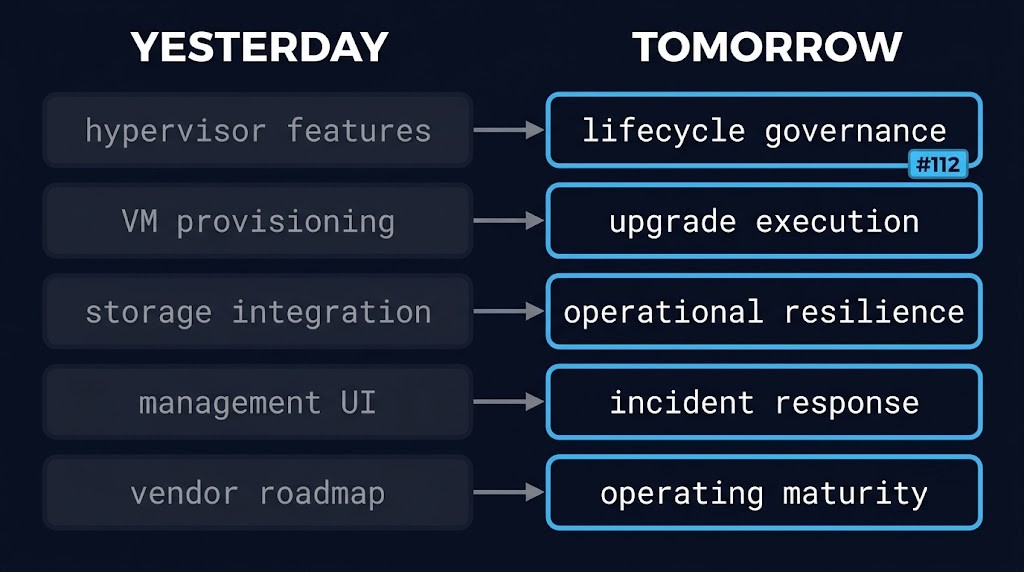
The New Differentiators
Hypervisor commoditization is what drives this convergence: differentiation moves into operational domains that cannot be commoditized as easily. Lifecycle governance is one of the clearest examples.
| Yesterday’s Differentiator | Tomorrow’s Differentiator |
|---|---|
| Hypervisor features | Lifecycle governance |
| VM provisioning | Upgrade execution |
| Storage integration | Operational resilience |
| Management UI | Incident response quality |
| Vendor feature roadmap | Organizational operating maturity |
Lifecycle governance deserves the top row, and not as a convenient example — it’s the mechanism that explains why this shift happens at all. Framework #112, Lifecycle Governance Horizon, defines the forward window within which platform upgrade, support, and licensing decisions remain actively governed; once an organization drifts past that window, lifecycle debt accumulates without anyone deciding to accept it. That’s not a hypervisor-specific problem — it’s an operating-discipline problem that surfaces through the hypervisor because the hypervisor is where lifecycle events (upgrades, EOL transitions, support renewals) physically land. A commoditized hypervisor market doesn’t shrink this window. It just makes it the primary place where operational maturity gets tested, because the platform itself has stopped being the variable.
A live example of a vendor competing on exactly this axis showed up within weeks of this post. Proxmox’s Arm64 Bet Runs On Lifecycle Parity, Not A Feature Release reads Proxmox VE 9.2’s Arm64 edition the same way this post reads lifecycle governance generally: the interesting signal isn’t the feature — a second CPU architecture working — it’s the sustained operational cost of keeping that architecture on the same release cadence, support window, and HCL discipline as x86-64, indefinitely. That’s the Lifecycle Governance Horizon applied to architecture support instead of patch cadence: the same operating-discipline question, one layer earlier in the vendor relationship.
The OS layer made the same kind of bet independently. Canonical’s Arm64-specific kernel live-patching investment inside Ubuntu 26.04 is the identical lifecycle-governance signal this section just named, one layer higher in the stack — and reading it against Proxmox’s Arm64 hypervisor edition together is what turns a single vendor’s roadmap choice into a directional signal.
Gartner’s IT Infrastructure and Operations Maturity Model makes the same point at the organizational level, independent of any specific technology: maturity is measured by the presence of standardized, proactive, cross-departmental process — change management, release management, governance structure — not by which tools or platforms are in use<sup>2</sup>. The table above is the virtualization-specific expression of that same general finding.
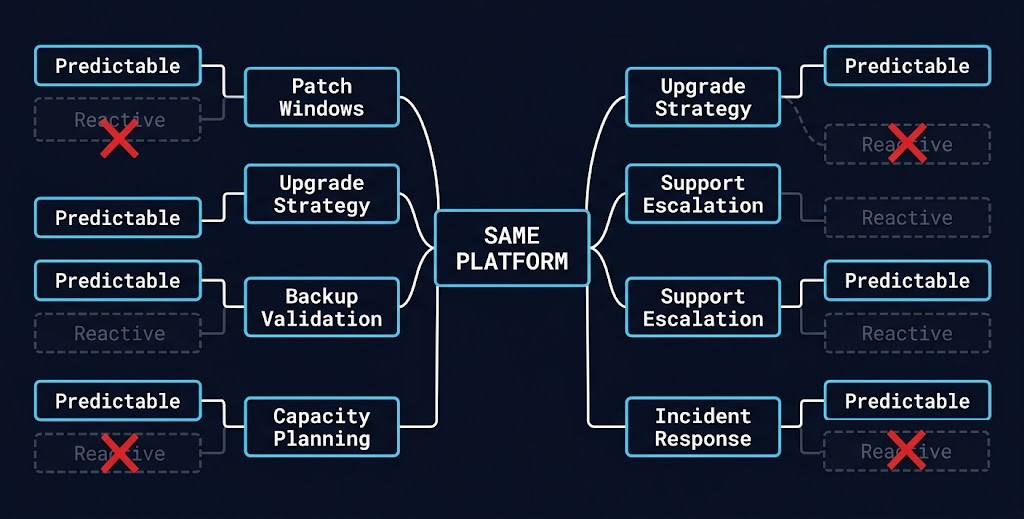
Where Operations Still Creates Winners And Losers
The operational differentiators aren’t abstract. They show up in specific, recurring decision points:
01 — PATCH WINDOWS
Whether patching is a scheduled, tested, low-drama event or a scramble that gets deferred until the next CVE forces the issue.
02 — UPGRADE STRATEGY
Whether major version upgrades follow a validated, rehearsed path or get treated as one-off projects reinvented each time. Upgrade Physics: Designing for Rolling Maintenance Without Stopping Production documents exactly this mechanism — the difference between an upgrade path designed for production continuity and one assumed to work because it worked in the lab.
03 — BACKUP VALIDATION
Whether recovery points are actually tested against restore, or whether “backups are running” gets mistaken for “backups are recoverable.”
04 — SUPPORT ESCALATION
Whether the organization has a working relationship with vendor support built before an incident, or is establishing that relationship for the first time during one.
05 — CAPACITY PLANNING
Whether resource headroom is modeled against actual growth, or discovered when a scheduler starts making bad placement decisions under pressure.
06 — INCIDENT RESPONSE
Whether the runbook reflects the platform actually in production, or the platform that was in production before the last migration.
This is the layer where Virtualization Deterministic Operations becomes the relevant reference point — not as an abstract principle, but as the concrete standard against which each of the six items above can be measured. Deterministic operations means the outcome of a patch cycle, an upgrade, or an incident response is predictable in advance, not discovered in the moment. That predictability is exactly what a commoditized hypervisor market rewards and an undisciplined one punishes.
None of these six items appear on a feature comparison matrix. All six determine whether a virtualization platform actually delivers the availability and cost profile it was purchased for.
Why The Market Keeps Misdiagnosing The Problem
Most platform evaluations still compare feature matrices — snapshot performance, storage protocol support, GPU passthrough capability, management API completeness. These comparisons aren’t wrong, exactly. They’re just increasingly beside the point, because they measure the layer that hypervisor commoditization has already flattened.
The comparison that actually predicts outcomes is operational-maturity requirements: what does this platform demand of an organization’s patch cadence, upgrade discipline, and incident response capability — and does the organization currently have that capability, or is it assuming it will develop it during the deployment? This is exactly the comparison The Next Virtualization Battle Is Operational Simplicity argues the market is starting to run in practice — scoring platforms on operational demand rather than feature count. A platform that’s technically superior but demands an operating discipline the organization doesn’t have will underperform a “good enough” platform paired with strong operations, every time. This is the misdiagnosis at the center of most stalled virtualization strategies: organizations keep re-running the feature comparison, when the comparison that would actually change the outcome is a different one entirely.
That comparison gets harder, not easier, once an organization is running more than one platform at once. An estate with two or three independently governed virtualization domains can have every platform pass its own operational-maturity bar and still have no answer to whether they behave consistently with each other — Operational Parity Is Becoming The Real Virtualization Challenge names that escalation directly.
Architect’s Verdict
Hypervisor commoditization is real, measurable, and accelerating — every credible platform now provides competent core virtualization, and the technical gap that used to justify a premium has largely closed. That collapse in feature differentiation is not the same claim as “the hypervisor doesn’t matter,” and treating it that way is how this argument gets misread.
What most organizations miss is that commoditization doesn’t remove complexity — it relocates it. The hard problems didn’t disappear when CPU and storage commoditized, and they aren’t disappearing now. They moved into lifecycle governance, upgrade execution, and incident response, and those are organizational disciplines, not platform features. No hypervisor vendor can sell an organization its way out of that gap.
The market spent twenty years competing on hypervisor capability. It will spend the next decade competing on operational execution.
Additional Resources
View 6 more resources
Editorial Integrity & Security Protocol
This technical deep-dive adheres to the Rack2Cloud Deterministic Integrity Standard. All benchmarks and security audits are derived from zero-trust validation protocols within our isolated lab environments. No vendor influence.

R.M.
Senior Solutions Architect with 25+ years of experience in HCI, cloud strategy, and data resilience. As the lead behind Rack2Cloud, I focus on lab-verified guidance for complex enterprise transitions. View Credentials →
Get the Playbooks Vendors Won’t Publish
Choose the architecture problems you care about. Get field-tested playbooks and frameworks delivered to your inbox.
- > AI Infrastructure & Inference Economics
- > Cloud Strategy & Hidden Cost Models
- > Virtualization & Deterministic Migration
- > Kubernetes, IaC & Modern Infrastructure
- > Data Protection & Recovery Engineering
Zero spam. Includes The Dispatch weekly drop.
Need Architectural Guidance?
Independent review before major infrastructure decisions.
- > Validate assumptions
- > Identify hidden dependencies
- > Quantify migration risk
- > Challenge vendor narratives
Triage · Advisory · Fractional · Direct Hire