

Infrastructure Already Has An Authority Layer. HCP Terraform Is Just Proving It First.
Every agentic system that touches infrastructure eventually needs an authority layer — a system of record that can say yes, no, or not yet, and make the answer stick. That question sits at the center of modern infrastructure and IaC architecture, and Rack2Cloud has spent the last year mapping control-plane shifts across infrastructure, AI, networking, CI/CD, and governance — the CLI, the network, the console, the SaaS layer, even the platform team’s own budget. That question is settled: control planes matter, and whoever doesn’t explicitly own theirs eventually loses it to whoever does. The more useful question, and the one this post is actually about, is which systems already possess the primitives required to become the next one.
The Wrong Question
The industry conversation about agentic infrastructure keeps asking “will AI manage infrastructure?” as if it’s a capability question — a matter of model quality, reasoning depth, tool-calling reliability. It isn’t. An agent that can reason perfectly about a Terraform plan still has to execute that plan through something, and that something already has an owner, a policy engine, an approval history, and a state file with your name on the last commit.
The real question is structural, not capability-based: which system already holds the primitives an authority layer requires, and does it get to keep them once agents start asking for permission instead of humans?
That’s a control-plane ownership question. It’s the same question this site has been circling for a year — your CI/CD pipeline claiming it was the real control plane, the console operating as a shadow one, infrastructure forgetting configuration while forgetting who owned reconciling it, the platform team discovering its budget was the actual enforcement mechanism all along. Each of those pieces established that ownership matters and that it’s rarely where people assume. None of them answered what specifically lets a system claim that ownership in the first place. That’s the gap this post closes.
The IaC and provisioning layer specifically is running the same progression Framework #115, Control Plane Capture mapped across Cisco, AWS, Google, Azure, Broadcom, Red Hat, Datadog, and ServiceNow — just through a vendor category that wasn’t in that post’s table when it published. Same Domain Entry-to-Authority Consolidation arc, different starting point.
What Authority Actually Requires
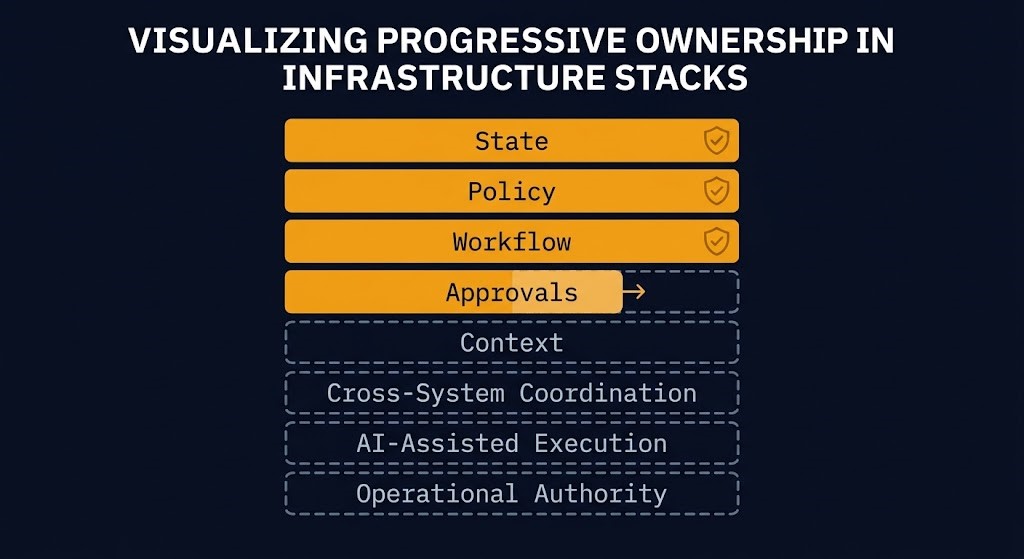
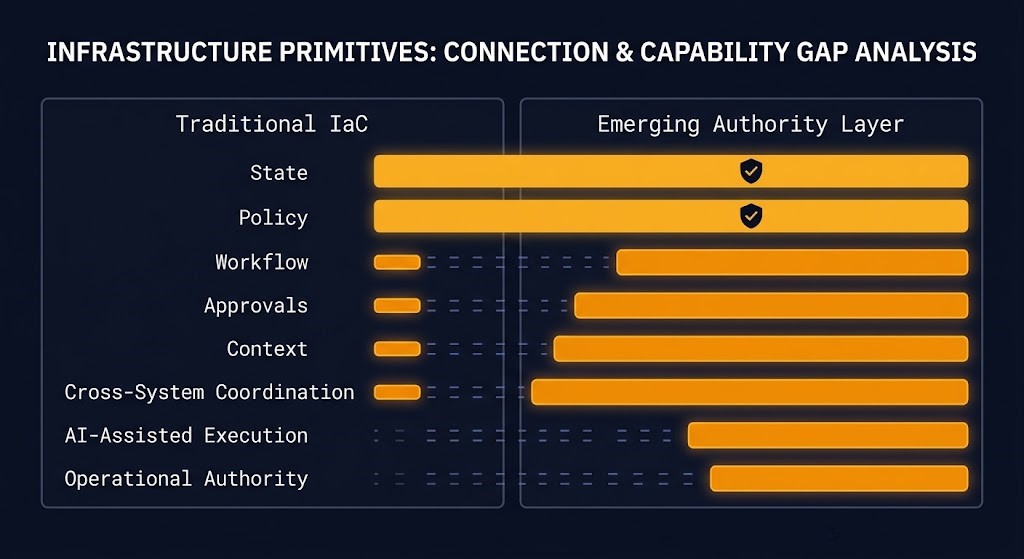
Ownership of an authority layer isn’t a single capability — it’s an accumulation of primitives, and most infrastructure platforms only hold some of them today.
| Primitive | Traditional IaC | Emerging Authority Layer |
|---|---|---|
| State | Owns | Owns |
| Policy | Partial | Owns |
| Workflow | Limited | Owns |
| Approvals | External | Coordinates |
| Context | Minimal | Retains |
| Cross-System Coordination | Minimal | Coordinates |
| AI-Assisted Execution | None | Emerging |
| Operational Authority | Undefined | Consolidating |
Read the right-hand column top to bottom and the argument makes itself before a single sentence of prose does — the same accumulation logic behind the SaaS control plane problem, where the platform that quietly owns the most operational rows wins the ownership question by default: a platform that already owns state and policy doesn’t need to win a new market to become the authority layer for agentic operations. It needs to extend the ownership it already has into approvals, context, and coordination — the row where “Limited” and “Minimal” turn into “Coordinates” and “Retains.” That’s not a new product category. It’s the next column of an existing one.
This is the exact condition Framework #135 — Control Plane Ownership Boundary names: the point at which control-plane authority must be explicitly owned, because where enforcement authority is undefined, multiple systems can modify infrastructure state with no identifiable accountable owner. It’s also this pillar’s own Control Plane Boundaries stage question in different language — who has the right to change infrastructure. Agentic execution doesn’t create this boundary. It just raises the cost of ignoring it — an undefined owner is an inconvenience when a human is the one asking for change; it’s an open door when an agent is.
FRAMEWORK #135
Control Plane Ownership Boundary
The point at which control-plane authority must be explicitly owned — where ownership of enforcement authority is undefined, multiple systems can modify infrastructure state with no identifiable accountable owner.
Architectural Relationships
Coordination Density
Why It Connects
Governs the connection — Control Plane Ownership Boundary traces its authority-ambiguity failure back to rising coordination/orchestration overhead.
Explore Framework →Authority Arbitration Gap
Why It Connects
Constrains the connection — #135 is the absence of any accountable owner; #165 assumes ownership is correctly assigned within each scope, and the gap sits in the missing arbitration layer between them.
Explore Framework →A related but distinct condition is worth naming before this post moves from the framework to the vendor evidence: internal developer platforms hit this same boundary from the deferred-ownership side rather than the deliberate-extension side — a mediating layer that accumulates influence with no chartered authority behind it. HCP Terraform extending its already-owned state and policy into workflow and approvals is Framework #135 crossed in the opposite direction: deliberately, by a platform that earned the authority rather than merely inherited proximity to the decision.
A third case sits between those two: claimed extension without earned ownership. VMware Private AI Cloud Doesn’t Eliminate Fragmented Control Planes — It Creates an Authority Relay tests VCF Operations against this same primitives table and finds it coordinating AI governance and security policy — the table’s own word for the columns it doesn’t yet own — while Broadcom’s marketing describes the result as unified. Deliberate extension earns the “owns” column over time; VCF Operations is claiming it before the primitives back it up.
HCP Terraform as Evidence, Not the Argument
Self-test for this section before it ships: strip every mention of HashiCorp, Terraform, HCP, Spacelift, env0, and Pulumi. If the paragraph still communicates a claim about capability ownership, it earned its place. If it collapses into “and then HashiCorp announced X,” it’s vendor analysis wearing an architecture headline, and it gets cut or rewritten.
HCP Terraform already owns state — that’s the original product. It already owns policy, through Sentinel and OPA integration sitting inside the same run pipeline that provisions the infrastructure the policy governs. It already owns a version of workflow: run triggers, VCS-driven plans, structured approval gates between plan and apply. None of that is new, and none of it required an AI narrative to justify building it — it was the product roadmap for policy-as-code and run governance for years before “agentic” entered anyone’s vocabulary.
What’s new is the row underneath: context retention across runs, cross-workspace coordination, and now AI-assisted operations sitting inside that same run pipeline rather than bolted on as a separate tool. That’s the evidence — not proof that HCP specifically wins, but proof of the mechanism: a platform doesn’t need to build an authority layer from nothing when it already owns four of the eight rows in the table above. It needs to extend ownership it already has into the rows it doesn’t, and the fastest way to do that is inside the pipeline it already controls, not next to it.
That’s a materially different claim than “HCP Terraform is becoming the control plane” — a version of that argument has already been made from the AI Infrastructure side, and doesn’t need repeating here. This one is narrower: the platforms most likely to become the agentic authority layer are the ones that already own state and policy, and HCP is the clearest current instance of a platform extending exactly that ownership forward — a claim about the mechanism, with HCP as the worked example, not the subject.
Worth distinguishing from a structurally opposite failure in the same territory: the Cloud Arbitration Layer is what happens when nobody extends anything on purpose — five correctly-functioning engines produce a composite decision none of them was assigned to own. This post’s argument is the deliberate mirror image: a platform extending ownership it already holds, on purpose, into rows it doesn’t yet own.
The Substitution Test
Run the argument again with the vendor removed. Replace HCP Terraform with Spacelift, env0, Pulumi Cloud, Azure Deployment Environments, or whatever platform exists by the time you’re reading this. The observation doesn’t change: whichever of these already owns state and policy is closer to owning the authority layer than any AI-native tool starting from zero. The strategic conclusion — capability ownership beats model quality as the deciding factor — survives the swap intact.
What doesn’t survive the swap is anything about pricing tiers, licensing terms, or the Terraform-vs-OpenTofu decision. Those are real questions, and this site has written about them elsewhere. They’re not this argument. The moment this thesis needs a pricing example to hold up, it’s stopped being an architecture argument and started being a vendor comparison — and that’s the tell that the piece has drifted, not a footnote to add.
What Would Disprove This Thesis?
An architectural model is only useful if you can say what would break it. Four conditions would:
01 — STATE BECOMES COMMODITIZED
If state storage and locking become a fully interchangeable utility layer — the way object storage did — then owning state stops being a structural advantage, and the whole “owns four of eight rows” argument loses its anchor.
02 — POLICY BECOMES PORTABLE
If policy-as-code engines decouple fully from their execution platform — a real OPA-everywhere trajectory, not just multi-cloud policy syntax — enforcement authority migrates independently of whoever runs the plan.
03 — APPROVAL WORKFLOWS GET EXTERNALIZED
If ServiceNow, Jira, or a dedicated approval-orchestration layer reclaims the approval chain from the IaC platform itself, “Approvals: Coordinates” moves out of the IaC column entirely — and the table’s whole right-hand side gets rewritten.
04 — AGENT ORCHESTRATION BECOMES ITS OWN MARKET LAYER
If the winning agent-coordination platform sits structurally above Terraform — calling it as one tool among many rather than running inside its pipeline — then IaC platforms stay execution surfaces, and the authority layer forms somewhere else entirely.
None of these are impossible. All four are worth watching for specifically, because any one of them is the signal that this thesis needs revisiting — not vibes, a specific structural shift in one of the eight rows above.
The Strategic Question for Architects
If authority-layer ownership is the deciding factor, vendor selection for IaC tooling stops being a tooling decision and becomes a governance decision — you’re not picking a provisioning engine, you’re picking who arbitrates infrastructure change once agents are asking for it as often as humans are.
That reframes the diligence questions worth asking any IaC vendor’s roadmap right now:
- Does policy enforcement live inside the same pipeline as execution, or is it a separate product you’re expected to integrate yourself?
- Does the platform retain context across runs, or does every run start blind to what the last one decided?
- When an agent initiates a change, does the platform’s existing approval chain apply automatically, or does agent-initiated change route around it by default?
Those three questions are an informal version of a harder one: once a platform accumulates this much authority, can anyone actually audit it, challenge it, delegate it, or revoke it — or does it just execute? Framework #154 — Governance Legitimacy Boundary names the formal version and the failure state on the other side of it: Governance Theater, where authority executes and nothing above it can prove who granted it, who reviews it, or who can take it back. This post has argued about how the authority accumulates. Whether that accumulated authority is legitimate is a separate question, and not one a vendor roadmap answers by itself.
A platform that answers all three in its favor isn’t just a better provisioning tool. It’s further along toward being the authority layer than its feature list would suggest — and a platform that can’t answer them yet is telling you something about where the actual risk sits, independent of how good its AI features look in a demo.
Architect’s Verdict
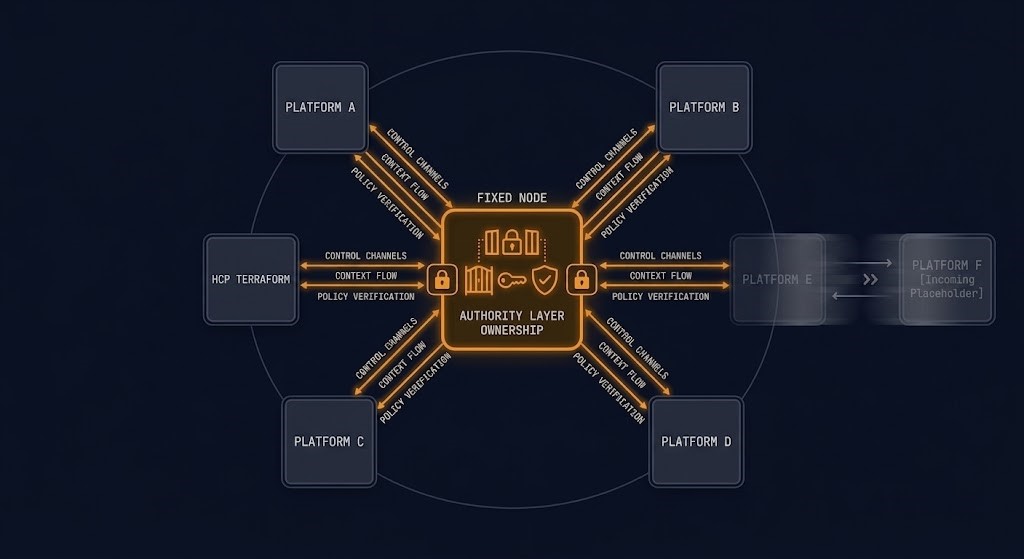
The agentic infrastructure control plane will not be built from scratch. It will be claimed by whichever system already owns the primitives — state, policy, and increasingly workflow and approvals — because rebuilding those from zero costs more than extending ownership you already have.
Most of the industry conversation about AI and infrastructure is still asking whether AI can be trusted to manage infrastructure. That’s the wrong layer of the question. The real one is which system already holds the authority to say yes, and whether your organization has explicitly decided that — or is about to discover it during an incident, the same way every other undefined control-plane boundary gets discovered.
HCP Terraform didn’t create this condition. It’s just the platform currently making the most visible bet on it.
Additional Resources
View 5 more resources
Editorial Integrity & Security Protocol
This technical deep-dive adheres to the Rack2Cloud Deterministic Integrity Standard. All benchmarks and security audits are derived from zero-trust validation protocols within our isolated lab environments. No vendor influence.

R.M.
Senior Solutions Architect with 25+ years of experience in HCI, cloud strategy, and data resilience. As the lead behind Rack2Cloud, I focus on lab-verified guidance for complex enterprise transitions. View Credentials →
Get the Playbooks Vendors Won’t Publish
Choose the architecture problems you care about. Get field-tested playbooks and frameworks delivered to your inbox.
- > AI Infrastructure & Inference Economics
- > Cloud Strategy & Hidden Cost Models
- > Virtualization & Deterministic Migration
- > Kubernetes, IaC & Modern Infrastructure
- > Data Protection & Recovery Engineering
Zero spam. Includes The Dispatch weekly drop.
Need Architectural Guidance?
Independent review before major infrastructure decisions.
- > Validate assumptions
- > Identify hidden dependencies
- > Quantify migration risk
- > Challenge vendor narratives
Triage · Advisory · Fractional · Direct Hire