

The Company Didn’t Run Out Of Data. It Ran Out Of Time.
Every recovery plan assumes a business survival window wide enough to outlast the outage it’s designed for — most never test whether that assumption holds, because the number that would prove it isn’t one recovery planning tracks. On March 29, 2026, a cyberattack hit ZEGO Textilveredelungszentrum, a 37-year-old German textile-finishing firm in Aschaffenburg. Production stopped for nearly six weeks. By July, the company had filed for insolvency. It hadn’t closed — ZEGO is still operating, still trying to restructure, still telling customers and suppliers it intends to come through the other side. But the insolvency filing itself is the evidence that matters here: something failed before the systems did.
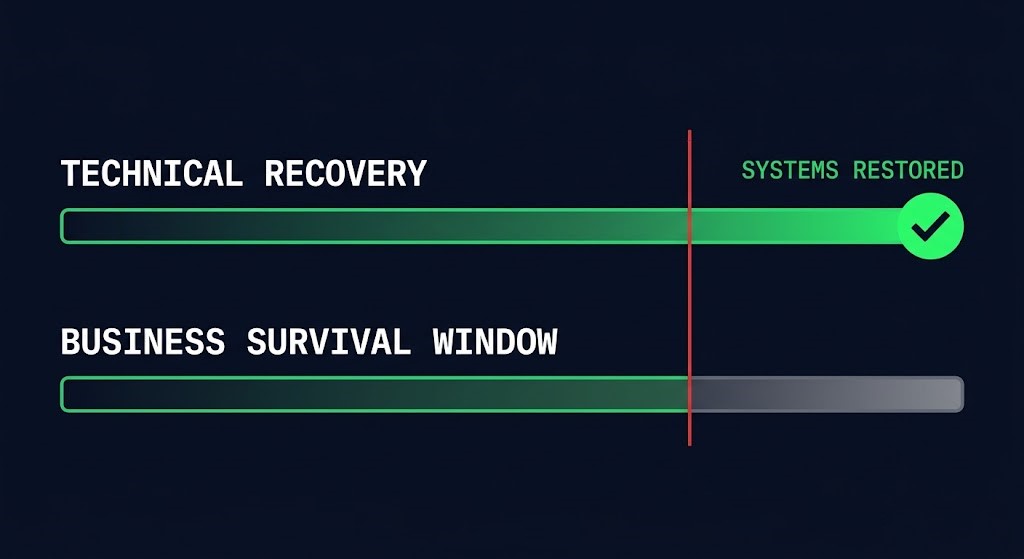
Recovery Succeeded. Insolvency Followed Anyway.
This isn’t a story about the recoverability gap (Framework #148) — ZEGO’s systems came back. It isn’t the architecture of premature closure either — nobody declared victory on a signal that turned out to be lying; the recovery was real. And it isn’t quite a continuity execution boundary problem (#163) — that framework asks whether continuity was ever independently verified once recovery succeeded. Here, assume it was. Assume the systems genuinely came back, the business genuinely resumed shipping product, every technical claim about the recovery was true. ZEGO still ended up in insolvency proceedings.
That’s the part worth sitting with. Recovery planning has a well-developed vocabulary for whether systems can be restored and whether that restoration can be trusted. It has almost no vocabulary for whether the organization survives long enough to benefit from either one.
The Clock Recovery Plans Don’t Track
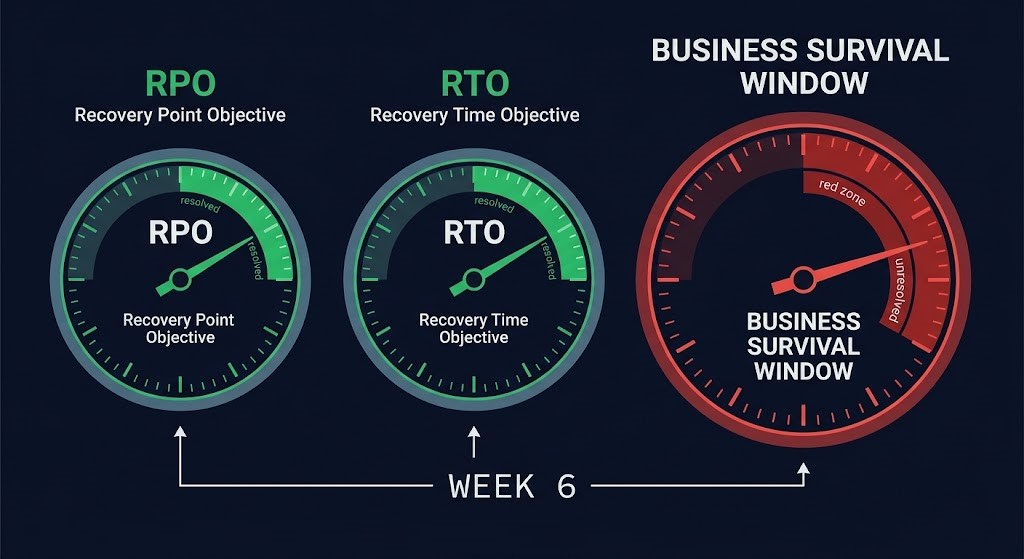
Most recovery programs are built around two measurements — the RPO, RTO, and RTA vocabulary that’s supposed to design the infrastructure around it:
| Clock | Question |
|---|---|
| RPO | How much data can be lost before recovery starts? |
| RTO | How quickly can systems return once recovery starts? |
| Business Survival Window | How long can the organization absorb the disruption before the damage becomes permanent, regardless of what recovery eventually delivers? |
RPO and RTO are technical clocks. They measure the recovery program against itself — against its own backups, its own runbooks, its own failover targets. The business survival window measures something the recovery program doesn’t control at all: payroll that still has to run, suppliers deciding whether to keep extending credit, customers deciding whether to reroute orders to a competitor who didn’t go dark for six weeks, lenders deciding whether the numbers still support the business they financed. None of that pauses while recovery is in progress. All of it is still running against a clock recovery planning was never built to watch.
The failure condition is simple to state and almost never modeled: operational recovery time can exceed the business survival window even when the recovery itself works exactly as designed.
Why Insolvency Can Follow a Successful Recovery
The instinct is to treat ZEGO’s outcome as a recovery failure — six weeks is a long outage, surely something in the DR plan didn’t hold. Maybe. But the company’s own public statements point somewhere more uncomfortable: the outage length wasn’t the failure. The outage length was simply longer than the business could economically absorb, independent of whether the eventual recovery was clean.
Recovery and survival are governed by different constraints, and they deteriorate at different rates. A recovery team can spend six weeks methodically doing everything right — validating backups, rebuilding segments clean, confirming no backdoors remain — while, on a completely separate timeline, contracts go unfulfilled and get reassigned, cash reserves that were sized for a two-week disruption run past their planning horizon, and lenders start asking questions the business can’t yet answer. The recovery team’s six weeks and the business’s six weeks are the same six weeks. They are not the same six weeks in terms of what each side can absorb.
This is why “the systems came back” and “the company is fine” are not the same claim, and treating them as one is the actual design gap. A recovery plan that hits every RTO target can still arrive too late to matter to the balance sheet — not because anything in the plan was wrong, but because nothing in the plan was measuring the business survival window that actually decided the outcome.
One variable sits upstream of both clocks and decides how fast the survival window drains: whether the business could keep operating at all while its systems were down. ZEGO’s production stopped for nearly six weeks. An operation that can run in a degraded, manually coordinated mode for even part of that window burns its survival margin more slowly than one whose every production decision routes through systems that are now unavailable. That question is what a ransomware production shutdown exposes — and it is the one lever that changes the survival math without changing the recovery timeline.
How Far the Same Mechanism Can Go
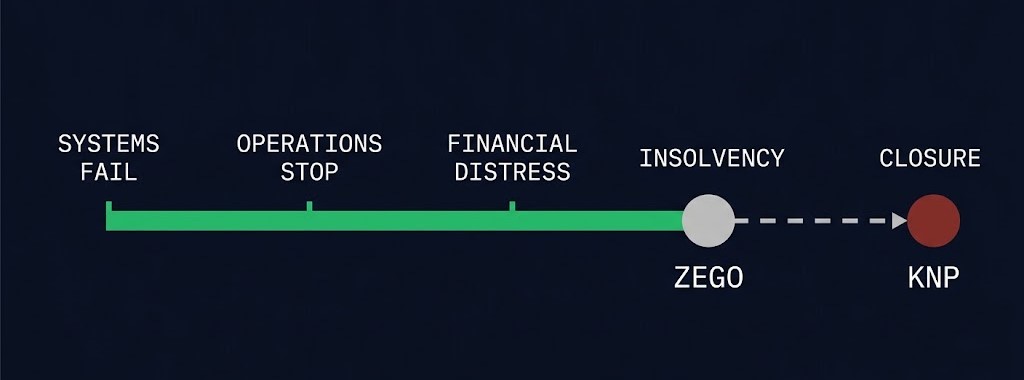
Whether continuity itself holds once recovery architecture runs is a separately tested question at the Learning Path’s disaster recovery and failover stage — and a different one than this post is asking. Assume that test was passed. ZEGO is still trading. Insolvency protection in Germany is explicitly structured to allow that — the filing opened a restructuring process, not a closure. But the same mechanism, given a longer disruption or a thinner cash position, doesn’t stop at insolvency.
Knights of Old, a 158-year-old UK logistics firm (trading as KNP Logistics), was hit by the Akira ransomware group in June 2023. Where ZEGO’s case demonstrates recovery succeeding while the business survival window still closed, KNP’s case is different in one important respect worth being precise about: reporting indicates KNP’s backups were also compromised, and the company was working from degraded systems and unreliable financial data when it lost the ability to meet its lenders’ reporting requirements. KNP isn’t a second instance of “recovery worked and it still wasn’t enough” — it’s evidence of where the same underlying pressure (operational disruption outlasting what the organization can financially absorb) ends when nothing arrests it. By September 2023, the company had ceased operations entirely. Over 700 jobs went with it.
Two companies, two different technical outcomes, one shared mechanism: the length of the disruption mattered less than how long each organization could survive it.
Architect’s Verdict
Recovery planning asks whether systems can return. It’s gotten good at answering that question — RPO and RTO targets, tested failover, validated backups, all measuring the technical side of the promise with increasing precision.
Business survival depends on a different question entirely: whether the organization can endure the wait. That’s not a technical measurement, and most recovery programs have no owner for it, no target for it, and no test that would catch it failing.
ZEGO’s systems came back. The company didn’t run out of data, didn’t run out of backups, didn’t run out of technical options. It ran out of time — a business survival window nobody on the recovery side was watching, because nobody on the recovery side was ever asked to.
Additional Resources
View 2 more resources
Editorial Integrity & Security Protocol
This technical deep-dive adheres to the Rack2Cloud Deterministic Integrity Standard. All benchmarks and security audits are derived from zero-trust validation protocols within our isolated lab environments. No vendor influence.

R.M.
Senior Solutions Architect with 25+ years of experience in HCI, cloud strategy, and data resilience. As the lead behind Rack2Cloud, I focus on lab-verified guidance for complex enterprise transitions. View Credentials →
Get the Playbooks Vendors Won’t Publish
Choose the architecture problems you care about. Get field-tested playbooks and frameworks delivered to your inbox.
- > AI Infrastructure & Inference Economics
- > Cloud Strategy & Hidden Cost Models
- > Virtualization & Deterministic Migration
- > Kubernetes, IaC & Modern Infrastructure
- > Data Protection & Recovery Engineering
Zero spam. Includes The Dispatch weekly drop.
Need Architectural Guidance?
Independent review before major infrastructure decisions.
- > Validate assumptions
- > Identify hidden dependencies
- > Quantify migration risk
- > Challenge vendor narratives
Triage · Advisory · Fractional · Direct Hire