

vCenter Compromise Changes the ESXi Trust Boundary
A vCenter compromise changes what a host-level control is worth, because the system that administers the control can also change it. Kaspersky’s Global Emergency Response Team (GERT) published an incident report on Securelist on 13 November 2026 in which an adversary destroyed an organization’s virtualization estate over 10 days, and the ransom notes named the BlackNevas group. No virtualization-layer vulnerability was exploited. Every action against ESXi ran through legitimate VMware management interfaces, and the full account is in the Kaspersky GERT report on Securelist.
The claim here is narrow. It rests on one documented sequence, the Host Profile change that enabled SSH on ESXi hosts, and on what the report leaves unsaid. It does not give the incident date, how the attackers obtained their credentials, or a binary to analyze. The argument needs none of that.
What the Report Establishes, and What It Does Not
The decision this post makes belongs to virtualization architecture: whether a host control counts as independent when the management plane that administers it is compromised. Before the argument, the evidence boundary.
The management plane carries this weight because of concentration. The report notes that compromising it gives an attacker reach over many hosts, where a guest compromise normally affects one operating system. A vCenter compromise is therefore a question about every host the appliance administers, not about one.
| Claim | Status in the report |
|---|---|
| No virtualization-layer vulnerability was exploited; actions ran through legitimate VMware management interfaces | Stated |
| Credentials from systems outside the virtualization estate reached both vCenter Server Appliances | Stated; how the credentials were obtained is not stated |
A Host Profile change enabled SSH on target ESXi hosts, timed from vpxa.log and vobd.log | Observed |
| Direct SSH sessions to the ESXi hosts then came from the vCenter appliance IP | Stated |
| Backup infrastructure was disrupted before ESXi impact | Stated; not argued here |
| Incident date | Not stated; only the 13 November 2026 publication date is given |
| ESXi encryptor, Ligolo-ng binary, installer script | Not available; no hashes |
| Veeam vulnerabilities | Cited as context; the report says neither was seen exploited in this case |
Two rows sit outside this post. The backup-first sequence is documented in the report and argued elsewhere on this site. The Veeam vulnerabilities explain how backup tampering commonly happens, not what happened here. That leaves the Host Profile sequence.
The Host Profile Sequence Turned a Compliance Mechanism Into an Access Path
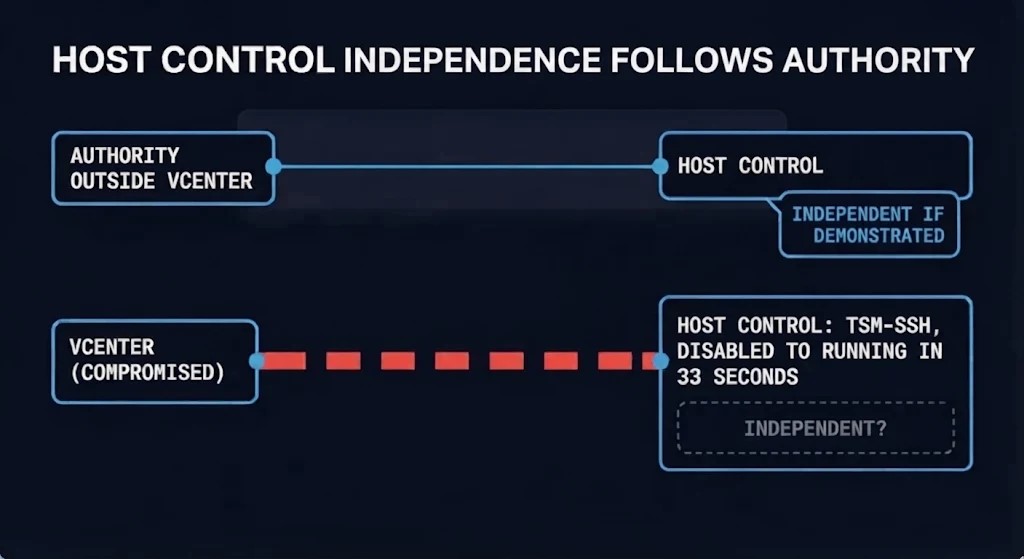
A Host Profile captures host configuration and enforces it across a single host, a cluster, or every host associated with the profile. It can include Tech Support Mode (TSM) and TSM-SSH settings. In this incident the adversary used it to change the TSM-SSH service state on target ESXi hosts from disabled by policy to running.
| Offset | Source | Observed event |
|---|---|---|
| T+0 | vCenter | Host configuration read through the Host Profile workflow (vpxa.log) |
| T+10m18s | vCenter | Configuration change pushed to enable SSH (vpxa.log) |
| T+10m51s | vCenter / ESXi | TSM-SSH reached RUNNING (vpxa.log and vobd.log) |
Thirty-three seconds separated the push from the running service, and about eleven minutes separated the first configuration read from a host that accepted remote SSH. Direct SSH sessions to the ESXi hosts then originated from the vCenter appliance’s IP address, a source a management network would normally trust.
Read the configuration, apply a desired state, observe the result. That is also what a compliance remediation looks like. The report’s point is that a malicious change can look structurally similar to a legitimate one, and that what tells them apart is context: authorization, timing, the source account, the change window, and whether the desired state weakens security.
The report does not say whether any control would have stopped the push, and this post does not claim one would. ESXi accepted a configuration change from vCenter, as it is designed to. That is the property under examination. A host takes its desired state from the management plane, so a vCenter compromise reaches host state through the same channel as legitimate administration.
DIAGNOSTIC QUESTION
“Who can change SSH state on an ESXi host through vCenter in your environment, and what would tell their change apart from a compliance remediation?”
Where vCenter Compromise Breaks Host-Level Independence
Three statements about a host control are easy to run together. It is configured through vCenter. It is enforced by the ESXi host. It can be changed by whoever holds enough vCenter authority. The first two say where a control lives. Only the third says who controls it, and independence depends on the third.
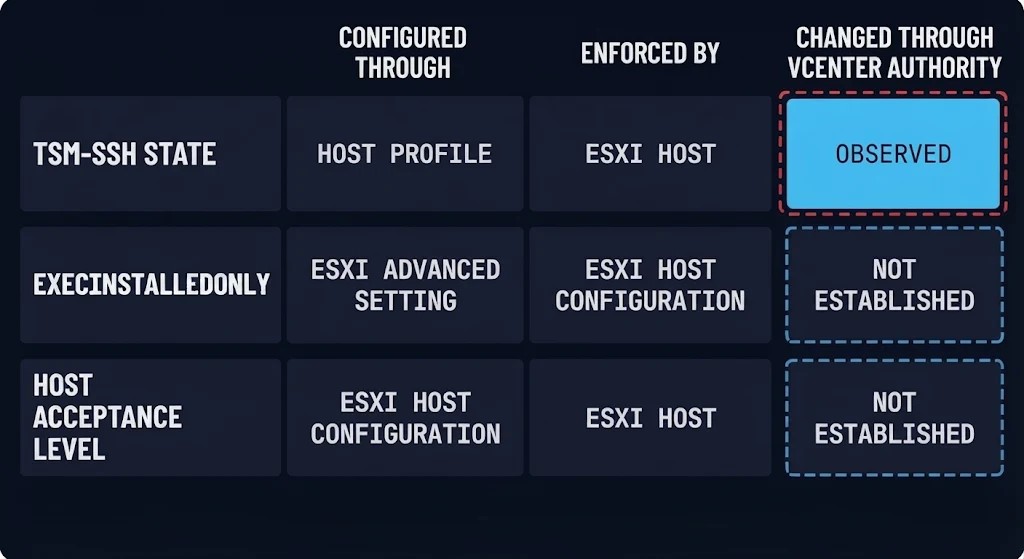
| Host control | Configured through | Enforced by | Changed through vCenter authority |
|---|---|---|---|
| TSM-SSH state | Host Profile in vCenter | ESXi host | Observed: a Host Profile change pushed it, and TSM-SSH reached RUNNING |
execInstalledOnly (runtime) | ESXi advanced setting | ESXi host | Not established in this incident |
| Host acceptance level | ESXi host configuration | ESXi host | Not established in this incident |
The report lists the last two as controls an attacker may try to weaken and treats a change to either as highly suspicious. It does not show either being changed through vCenter here, so the table claims one row.
ESXi did not fail in the Host Profile sequence. The report shows a host reaching the state the management plane pushed. A control enforced locally is local in where it runs, not in who can change it. A host control whose desired state is set from a compromised vCenter inherits the compromise. A control whose authority is independently administered may retain a separate trust boundary, but that independence must be demonstrated rather than assumed.
A vCenter compromise does not have to defeat the control. It can change what the control is told to enforce, and the compliance mechanism then delivers the change.
The governance side of this is already on the site. The Hypervisor Is Becoming a Policy Enforcement Point establishes that hypervisor enforcement decisions are binding and that the review of them lags. This post asks the next question: who can change the state those decisions are made against.
Tier 0 Follows the Authority the Management Plane Holds
The report’s recommendation is to treat vCenter as a Tier 0 asset. The label alone does little. What makes it earn the designation is what a compromise of the management plane lets an attacker do, and three questions measure that.
- Can the management plane change host access? In this incident, yes, and it is the one answer the evidence fully supports: the Host Profile change enabled SSH on the hosts.
- Can it influence or control workloads? The report says vCenter can hold that authority in general, through powering VMs and applying Host Profiles. It does not say how the VMs in this incident were stopped.
- Can it undermine recovery? The report describes backup infrastructure disrupted before ESXi impact. It does not tie vCenter itself to that disruption, and that sequence is the Recovery Dependency Collapse argument in Your Backup System Is Part of the Blast Radius, not repeated here.
These answers inform a designation. They do not produce a universal one. A yes to the first question does not classify every vCenter deployment. It tells you which authority your classification has to account for in your environment, where the management plane is a design layer, a subject the Virtualization Control Plane Architecture stage covers. The same appliance can carry more or less authority depending on what your hosts, workloads and recovery paths let it reach. Tier 0 is the output of that authority, not an attribute of the product. The question to put to your own estate is what a vCenter compromise would be able to reach, not what the appliance is called.
Architect’s Verdict
A management plane cannot be treated as an independent authority boundary when it can rewrite the controls that supposedly protect the infrastructure beneath it. The Securelist report describes one vCenter compromise that shows it: a Host Profile read, a pushed change, and a host with SSH running thirty-three seconds later, reached through interfaces VMware designed for exactly that job.
The underlying problem is how independence gets judged. A control is usually called independent because of where it runs, on the host, below the management layer, enforced locally. That tells you where the control lives. It does not tell you who can change its state, and the second question is the one a vCenter compromise answers.
The report leaves real gaps. The credentials’ origin, the incident date and the encryptor are not established, and nothing here depends on them. What the evidence supports is smaller and harder to dismiss: a host control is independent only if its authority is, and an authority that runs through vCenter inherits whatever vCenter becomes.
Additional Resources
Editorial Integrity & Security Protocol
This technical deep-dive adheres to the Rack2Cloud Deterministic Integrity Standard. All benchmarks and security audits are derived from zero-trust validation protocols within our isolated lab environments. No vendor influence.

R.M.
Senior Solutions Architect with 25+ years of experience in HCI, cloud strategy, and data resilience. As the lead behind Rack2Cloud, I focus on lab-verified guidance for complex enterprise transitions. View Credentials →
Get the Playbooks Vendors Won’t Publish
Choose the architecture problems you care about. Get field-tested playbooks and frameworks delivered to your inbox.
- > AI Infrastructure & Inference Economics
- > Cloud Strategy & Hidden Cost Models
- > Virtualization & Deterministic Migration
- > Kubernetes, IaC & Modern Infrastructure
- > Data Protection & Recovery Engineering
Zero spam. Includes The Dispatch weekly drop.
Need Architectural Guidance?
Independent review before major infrastructure decisions.
- > Validate assumptions
- > Identify hidden dependencies
- > Quantify migration risk
- > Challenge vendor narratives
Triage · Advisory · Fractional · Direct Hire