

Agent-Swarm Coordination Ceiling
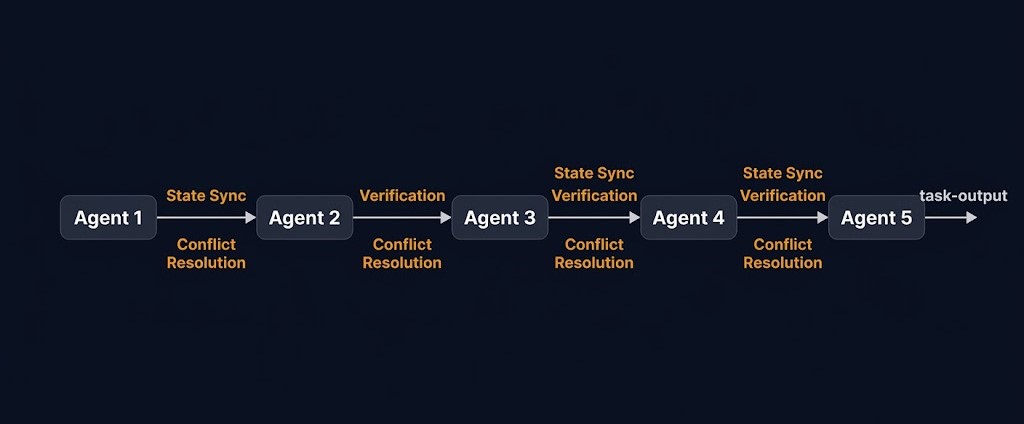
Agent fleets carry a scaling assumption, and the agent coordination ceiling is where that assumption runs out.
Enterprise teams building agentic systems inherit this assumption from every prior wave of automation — add capacity, get more output. It held for compute. It held for headcount, within limits. It does not hold cleanly for agent fleets, and the reason isn’t that the agents are unreliable or the models aren’t capable enough. It’s that coordination is not overhead sitting outside the task. It’s part of the task, and as fleets grow, it starts consuming more of the task than the additional agent contributes to it.
The Second Workload
Every agent added to a fleet does two things at once: it contributes reasoning toward the task, and it introduces additional coordination work — through handoffs, shared state, arbitration, verification, or communication with the agents its topology connects it to. The first is the work anyone’s provisioning for. The second is a workload most teams don’t budget for until it’s already dominant. The distributed-systems name for much of it is state synchronization across handoffs, and Agentic AI Is Recreating Problems Distributed Systems Already Solved walks the failure classes a multi-agent chain inherits — this post asks what that inheritance costs the task.
Rack2Cloud has already named the infrastructure-side version of this problem directly: Coordination Density (Framework #132) established that agentic systems require governance and orchestration capacity that doesn’t scale linearly with execution capacity — the CPU cycles spent arbitrating state, routing tool calls, and enforcing policy grow faster than the GPU cycles spent actually reasoning, and most capacity models still only measure the second. That’s the right question for a capacity planner: can the infrastructure sustain the coordination this fleet requires?
That puts this post at the intersection of two framework lineages this site has already mapped: #132 and its downstream chain established the governance and infrastructure consequences of coordination density; #139 through #174 established the economics of secondary work in automation. This post examines where those two patterns meet in task performance.
This post asks a different question, on the other side of the same boundary: when coordination becomes dominant, what happens to the thing the fleet was assembled to produce? Not whether you can afford to coordinate five agents instead of one — whether the fifth agent is still making the task better, or just making it more expensive to finish.
When Coordination Starts Consuming the Task
The shape of the answer depends heavily on how the fleet is organized, and it’s worth being precise about that before reaching for any number. A 2026 controlled study published in Nature Machine Intelligence — Kim et al., holding task prompts, tools, and compute budgets constant across 260 configurations spanning six benchmarks, five architectures, and three model families — found that single-agent baseline performance is the strongest predictor of whether adding coordination helps or hurts, with the effect showing task-, model-, and architecture-dependent peaks and degradation rather than one universal threshold. In the study’s matched-compute experiments, hybrid systems required 44.3 reasoning turns versus 7.2 for the single-agent baseline — 6.2× as many — while the authors fit total reasoning turns against agent count with a super-linear exponent of 1.724. The result is not that multi-agent systems universally fail; it is that coordination can consume enough of a fixed reasoning budget that additional agents eventually stop translating into proportional performance gains.
That’s the actual lesson behind the agent coordination ceiling, and it’s a better one than “swarms don’t work.” The question isn’t how many agents is too many. It’s whether, for this task and this topology, another agent is increasing useful progress or increasing what it costs to produce it — and that answer depends on the shape of the coordination, not just the count.
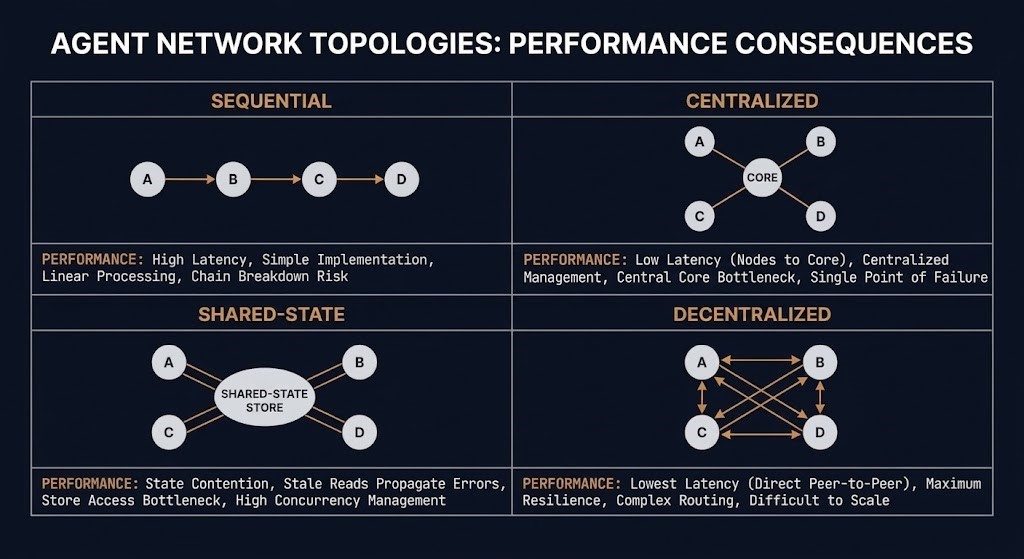
Topology is where that shape lives:
| Topology | Performance consequence |
|---|---|
| Sequential | Each handoff adds latency the next agent inherits, compounding across the chain |
| Centralized | The coordinator becomes a bottleneck every agent waits behind |
| Shared-state | Agents contend for the same state, and stale reads propagate errors downstream |
| Decentralized | Interaction paths multiply as the fleet grows; synchronization burden can become the dominant coordination problem |
None of these are failure modes in the sense of a crash. They’re the mechanisms that produce the agent coordination ceiling — the point where an added agent’s coordination burden outpaces its contribution — quietly, without an error anywhere in the logs, in a system that’s still technically running correctly. It is the same quiet-failure property AI Didn’t Reduce Engineering Complexity. It Moved It traces to the behavior layer: the infrastructure reports healthy while the output degrades.
What the Coordination Workload Actually Looks Like
None of this is theoretical when it fails. The MAST taxonomy — developed from systematic analysis of 200 annotated multi-agent execution traces across seven open-source MAS frameworks (MetaGPT, ChatDev, HyperAgent, OpenManus, AppWorld, Magentic, and AG2), later scaled to over 1,600 traces — sorts what coordination failure actually looks like into three observable categories.
01 — SYSTEM DESIGN ISSUES
Unclear role boundaries, repeated work nobody deduplicates, and tasks that never terminate cleanly. The fleet was never given an unambiguous division of labor, so agents fill the gap with assumptions that don’t match each other’s.
02 — INTER-AGENT MISALIGNMENT
One agent’s output gets ignored, misread, or acted on out of sequence by another. The information technically crossed the handoff. What the receiving agent did with it wasn’t what the sending agent intended.
03 — TASK VERIFICATION
Work gets marked complete before it’s actually correct, or verification itself is incomplete — checking that a step ran, not that it ran right. The fleet’s confidence in its own output outpaces the evidence for it.
The Automation Economics Lineage
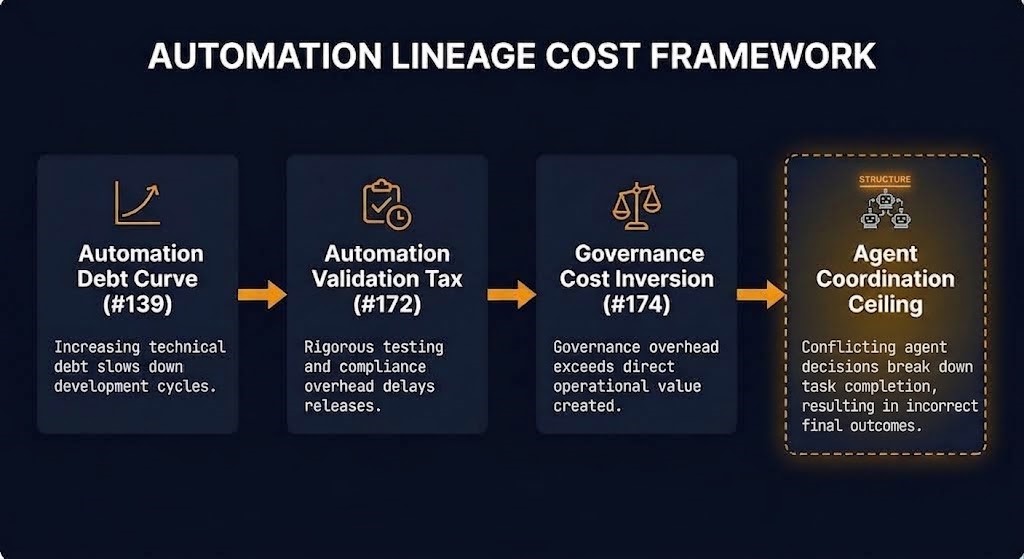
The agent coordination ceiling isn’t a new failure mode. It’s a familiar one, arriving in a domain that didn’t expect to inherit it — the same secondary-work economics the Modern Infrastructure & IaC pillar tracks across automation, validation, and governance.
| Framework | What it established |
|---|---|
| #139 — Automation Debt Curve | Automation creates a second environment to operate — pipelines, tests, ownership — and its cost surfaces only once that environment gets expensive to maintain |
| #172 — Automation Validation Tax | Trusting automated output requires ongoing verification work, independent of whether the automation is well-built |
| #174 — Governance Cost Inversion | Controls meant to reduce automation risk can eventually consume more value than the risk they prevent |
| Agent Coordination Ceiling | The same secondary-work pattern, appearing as task-performance degradation rather than infrastructure cost — coordination itself becomes part of the task workload |
Automation, validation, governance — each framework names a cost that shows up after the thing it’s attached to starts scaling. None of them predicted agent swarms specifically; they weren’t written with agents in mind. What they established is the pattern agent fleets are now the newest system to rediscover: secondary work compounds, and eventually the system spends more effort managing the work than producing it. The Governance & Drift stage of the Modern Infrastructure & IaC Learning Path covers the governance end of this progression in more depth.
Coordination Load Ratio. Not a formula, and not an industry metric — an architectural diagnostic. Coordination activity required per unit of useful task progress. The question worth asking as a fleet grows isn’t how many agents you’re running. It’s whether each additional agent is increasing useful task progress, or primarily increasing what it takes to produce it.
Architect’s Verdict
The agent coordination ceiling isn’t new physics. It’s the same curve the lineage above already mapped: automation creates secondary work, secondary work requires validation and governance, and eventually the system spends more effort managing the work than producing it. Framework #132 measured that relationship on the infrastructure side — whether the coordination substrate can sustain the load. This post measures its performance signature — the point where another agent stops producing proportional improvement in the actual outcome.
AI didn’t create this curve, and agent swarms aren’t a special case that breaks the pattern. What’s different is where the curve becomes visible. Every prior automation wave let the coordination cost hide in a budget line or a headcount request before anyone had to reckon with it directly. Agent fleets put it inside the task itself, in the same run, on the same clock — which means the ceiling shows up in the output before anyone gets a chance to not notice it.
The fleet that keeps adding agents without asking whether the last one helped isn’t scaling. It’s paying a tax it hasn’t measured, in a currency — task quality — that doesn’t show up on an infrastructure invoice.
Additional Resources
Editorial Integrity & Security Protocol
This technical deep-dive adheres to the Rack2Cloud Deterministic Integrity Standard. All benchmarks and security audits are derived from zero-trust validation protocols within our isolated lab environments. No vendor influence.

R.M.
Senior Solutions Architect with 25+ years of experience in HCI, cloud strategy, and data resilience. As the lead behind Rack2Cloud, I focus on lab-verified guidance for complex enterprise transitions. View Credentials →
Get the Playbooks Vendors Won’t Publish
Choose the architecture problems you care about. Get field-tested playbooks and frameworks delivered to your inbox.
- > AI Infrastructure & Inference Economics
- > Cloud Strategy & Hidden Cost Models
- > Virtualization & Deterministic Migration
- > Kubernetes, IaC & Modern Infrastructure
- > Data Protection & Recovery Engineering
Zero spam. Includes The Dispatch weekly drop.
Need Architectural Guidance?
Independent review before major infrastructure decisions.
- > Validate assumptions
- > Identify hidden dependencies
- > Quantify migration risk
- > Challenge vendor narratives
Triage · Advisory · Fractional · Direct Hire