

GOVERNANCE & DRIFT
Where ownership already exists, and the only question left is whether it still holds.
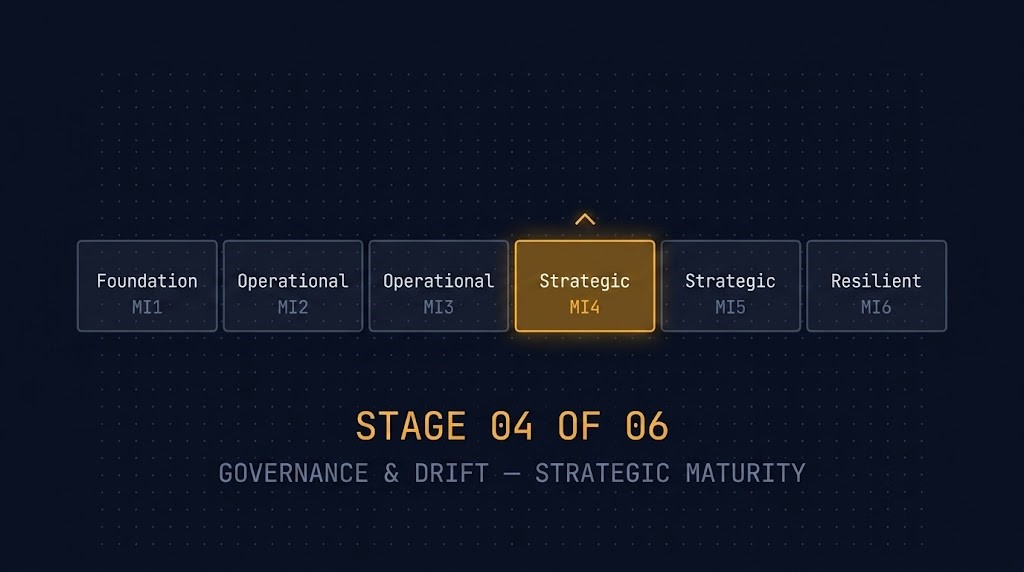
MATURITY POSITION — STAGE 4 OF 6
- Current Stage: Governance & Drift
- Primary Architectural Concern: Whether governance stays effective once ownership already exists — as exceptions accumulate, reconciliation lapses, and security posture quietly decays even inside fully compliant systems
- Primary Failure Mode: Permanent Exception — the point where an authorized departure from governed state never returns, because nobody was left owning the return
- Stage Outcome: Reader can name the moment a temporary exception has quietly become permanent architecture, and can distinguish active drift from the kind of governance decay that produces no drift event to catch
- Next Stage: MI5 — Economics of Automation — When does automation stop saving money?
Governance drift is what happens after infrastructure ownership has already been assigned — the discipline of keeping declared intent and enforced state aligned once that assignment is no longer new. MI2 settled who has the right to change infrastructure. MI3 settled what happens once other teams depend on what that ownership produces. MI4 exists because neither of those answers holds by default over time: policy drifts even inside systems with a named authoritative reconciler, incidents force exceptions that were never designed to close, and security posture can degrade while every configuration-reconciliation check still passes clean.
None of that requires anyone to make a mistake. A system can be fully owned, fully documented, and fully compliant with its own declared state, and still be quietly governed worse with every quarter that passes — because governance was built to catch state that diverges from declaration, not state that matches declaration while its underlying value erodes. This stage is about the gap between passing every check and actually staying governed.
That gap generalizes beyond configuration governance. Why Infrastructure Survivability Fails After The Design Review makes the equivalent argument about recovery capability specifically: a system can pass every design review and every restore test and still be ungoverned in exactly this stage’s sense, because nobody was assigned to keep confirming the capability still holds.
The Modern Infrastructure & IaC Path Is an Intent-Governance Progression
| Stage | Architectural Question |
|---|---|
| MI1 — Declarative Infrastructure | When does infrastructure deserve to become code? |
| MI2 — Control Plane Boundaries | Who has the right to change infrastructure? |
| MI3 — State & Dependency Architecture | How does infrastructure become a platform product? |
| MI4 — Governance & Drift | How is infrastructure governed over time? |
| MI5 — Economics of Automation | When does automation stop saving money? |
| MI6 — Infrastructure Survivability | Can your infrastructure survive the loss of its control plane? |
MI4 assumes MI2’s ownership question is already answered. It does not assume that ownership stays effective on its own — that durability question is this stage’s entire job, and MI5/MI6 both inherit whichever governance posture MI4 leaves them with.
WHY THIS STAGE EXISTS — PERMANENT EXCEPTION
Most organizations believe governance is working as long as no drift alarm is firing. In practice, an authorized exception can sit unreconciled indefinitely, and a fully compliant system can lose real security value, while every dashboard stays green the entire time.
Stage Anchor Question
How is infrastructure governed over time?
Not: who owns the change? MI2 already answered that. MI4 answers a quieter question — once ownership exists, does it keep working, or does it erode through exceptions nobody closes and decay nothing was built to detect?
This stage’s own framework progression names how governance actually fails, one link at a time:
| Framework | Problem Introduced |
|---|---|
| #4 Drift Origin Model | Drift begins |
| #151 Infrastructure Evidence Gap | Drift can no longer be proven |
| #159 Emergency Reconciliation Gap | Drift can no longer be corrected |
Permanent Exception is the terminal outcome of that progression: governance knows a violation exists, nobody owns remediation, and what began as a temporary bypass quietly becomes the system’s actual architecture.
Prerequisite note: this progression assumes Framework #133 Policy Intent Drift (MI2’s anchor) has already established who owns reconciliation in the first place. #133 is not part of this stage’s reading sequence — it’s the ownership answer MI4 takes as given before asking whether that ownership holds up.
Stage Anchor Framework — Emergency Reconciliation Gap
Emergency Reconciliation Gap (#159)
The structural absence of a defined path back from an authorized configuration exception to a governed, IaC-tracked state. Four variables govern whether an emergency change closes this gap or falls into it: Bypass Authority, Change Latency Budget, Reconciliation Ownership, and Closure Deadline.
Named Failure State: Permanent Exception — nobody owns bringing the system back · Related: Framework #140 State Gravity (MI3, moderate relationship — both describe governance gaps opening at the moment engineering effort alone stops being sufficient) · Framework #133 Policy Intent Drift (MI2 anchor, strong dependency — the ownership question MI4 assumes is already settled)
Why Architects Misjudge Governance
A clean drift dashboard is mistaken for governed infrastructure. Drift detection only catches divergence from declared state. It says nothing about whether an authorized exception from months ago was ever supposed to still exist, or whether the declared state itself still deserves the security value it once had.
Incident-time bypasses are treated as one-time events. An emergency change made under incident pressure looks like a closed exception the moment the incident ends. Without an explicit Reconciliation Ownership assignment and a system-enforced Closure Deadline, it isn’t closed — it’s just no longer being watched.
Compliance is mistaken for security. A system where declared and enforced state match perfectly can still lose real security value every day — unrotated credentials, unpatched-but-technically-compliant baselines, permission creep inside policy — because reconciliation tooling was scoped to catch variance, not decay.
What This Stage Is Not
Not a repeat of MI2’s ownership question. MI2 asks who has the right to change infrastructure. MI4 assumes that’s already answered and asks whether the answer still holds once exceptions, incidents, and time enter the picture.
Not a policy-engine comparison. This stage isn’t about choosing between OPA, Sentinel, or any other policy-as-code tool. Those are implementation choices in service of the governance questions this stage actually asks.
Not an incident-response runbook. This stage doesn’t walk through how to run an incident. It explains why the exceptions incidents force so often outlive the incident itself.
Not drift detection itself. Detecting that state has diverged from declaration is Framework #4’s scope. MI4 is what happens after — whether that divergence gets proven, corrected, or quietly becomes permanent.
>_ Estimated Reading Depth
| Format | Count | Estimated Time | Notes |
|---|---|---|---|
| Architecture articles — Cluster 01 | 2 | ~28 min | Governance Lineage (anchor) — #4 → #151, drift’s origin through the point proof disappears |
| Architecture articles — Cluster 02 | 2 | ~28 min | Incident-Time Collision & the Quiet Failure — #159 culmination + #162 parallel failure |
| Permanent Exception Failure Patterns Grid | 1 | ~8 min | Five failure patterns — read last, closing the reading sequence as the culminating framework failure |
| Total stage depth | 4 | ~64 min | Strategic stage — assumes MI2’s ownership model and MI3’s platform-formation understanding are both already in place |
Reading Depth: ~64 min estimated across 4 articles. Final duration recalculated after article publication based on actual word count.
>_ Where To Enter This Stage
Enter here if MI2’s ownership question is already settled for the systems you’re evaluating and you want to know whether that ownership is still holding — whether exceptions from past incidents have quietly become permanent, or whether a fully compliant system might still be losing real security value. If you’re arriving without MI2/MI3 context, Cluster 02 (#159/#162) reads fine standalone as an incident-governance case study, but Cluster 01’s proof-chain argument assumes you already understand why ownership questions arise in the first place.
Skip-ahead criteria: Architects who can already name every currently-open emergency exception in their environment, who owns closing each one, and by what deadline, may consider entering at MI5 — Economics of Automation. If any exception’s owner or deadline is unclear, complete this stage first.
>_ Architecture Maturity Position
| Stage | Name | Maturity Level | Stage Question |
|---|---|---|---|
| MI1 | Declarative Infrastructure | Foundation | When does infrastructure deserve to become code? |
| MI2 | Control Plane Boundaries | Operational | Who has the right to change infrastructure? |
| MI3 | State & Dependency Architecture | Operational | How does infrastructure become a platform product? |
| MI4 ← YOU ARE HERE | Governance & Drift | Strategic | How is infrastructure governed over time? |
| MI5 | Economics of Automation | Strategic | When does automation stop saving money? |
| MI6 | Infrastructure Survivability | Resilient | Can your infrastructure survive the loss of its control plane? |
>_ Stage Reading Sequence
GOVERNANCE & DRIFT BEGINS HERE
The sequence below moves through two clusters in order. Cluster 01 establishes the governance lineage — where drift originates, and the point at which it can no longer be proven rather than just detected. Cluster 02 shows what that lineage collides into: an incident-time exception that never closes, and a quieter parallel failure where nothing ever drifted at all, yet security value still eroded. The failure patterns grid sits at the very end — Permanent Exception is the culminating framework failure this whole stage builds toward, not a midpoint to resolve before continuing.
Reading out of sequence is possible. Cluster 02 reads fine standalone as an incident-governance case study for readers arriving without MI2/MI3 context.
Architectural question: Where does drift come from, and when does it stop being provable?
Where does drift come from, and when does it stop being provable?
Framework #4 establishes that drift has traceable origins. Framework #151 shows what happens when a pipeline can still reproduce an outcome but can no longer prove it was authorized.
Architectural question: What happens when governance meets an incident it wasn’t built for — loudly and quietly?
What happens when governance meets an incident it wasn’t built for?
Framework #159 is the loud failure: an authorized exception that never returns. Framework #162 is the quiet one: nothing ever drifted, and security value eroded anyway.
>_ Common Governance & Drift Failure Patterns
>_ Stage Graduates Can Now
You can now see how a platform forms and where its state actually lives — MI3 gave you that. What Strategic maturity adds at this stage is the ability to tell the difference between infrastructure that’s merely undrifted and infrastructure that’s actually governed, and to name the exact moment an exception stops being temporary.
- Name where a currently-open emergency exception sits against Bypass Authority, Change Latency Budget, Reconciliation Ownership, and Closure Deadline
- Recognize when a pipeline that runs cleanly still can’t prove what authorized it
- Distinguish active drift (#4) from governance decay that produces no drift event at all (#162)
- Identify a Permanent Exception before it hardens into the system’s actual architecture
- Place Framework #159 alongside its MI3 counterpart, Framework #140 State Gravity — both are governance gaps that open once engineering effort alone stops being sufficient
>_ Where Do You Go From Here
ARCHITECTURE REVIEW
Infrastructure Architecture Review
A structured review of open exceptions, reconciliation ownership, and where governance has quietly stopped catching what it was built to catch.
[+] Request Assessment →WEEKLY DISPATCH
Weekly Dispatch
Architecture signals, framework updates, and new content from across the five pillars — delivered weekly for senior infrastructure architects.
[+] Subscribe →>_ Frequently Asked Questions
Q1. What is Governance & Drift about?
A: Governance & Drift is the study of whether infrastructure stays governed after ownership has already been assigned — not the act of assigning ownership itself. It covers what happens when authorized exceptions never close, when a compliant system’s execution can’t be proven authorized, and when security value quietly decays inside infrastructure that never technically drifted at all.
Q2: How does this stage differ from MI2’s ownership question?
A: MI2 asks who has the right to change infrastructure — a question about authority. MI4 assumes that authority question is already answered and asks whether it holds up over time: does the assigned owner still enforce what they were assigned to enforce, once exceptions and incidents enter the picture?
Q3: What does Permanent Exception mean?
A: Permanent Exception is Framework #159’s named failure state — the point at which an authorized departure from governed infrastructure state never returns, because Reconciliation Ownership and a Closure Deadline were never assigned when the exception was authorized. It’s a governance failure, not a technical one: the drifted resource is a symptom, not the cause.
Q4: Why is Framework #133 Policy Intent Drift referenced here but not part of the reading sequence?
A: 133 is MI2’s own anchor framework — it establishes who owns reconciliation in the first place. MI4 takes that ownership assignment as a precondition rather than re-arguing it, so its anchor post lives in MI2’s sequence. This stage cites #133 as a prerequisite throughout, but doesn’t duplicate its reading-sequence card.
Q5: What does Framework #162 Security Entropy Accumulation add beyond #159?
A: #159 describes a loud failure — an exception everyone knows exists. #162 describes the quiet mirror image: declared and enforced state match perfectly, every reconciliation check passes, and security value still degrades over time, because reconciliation tooling was never scoped to detect anything except state-vs-declared variance.
Q6: Who should read this stage vs. jump straight to MI5 Economics of Automation?
A: Read this stage first if you can’t yet name every currently-open emergency exception in your environment, who owns closing it, and by what deadline. MI5’s automation-economics questions assume you already understand what unresolved governance exceptions cost — that accounting is this stage’s entire job.
>_ Related Systems
MI3 — State & Dependency Architecture. The prerequisite stage — how infrastructure becomes a platform, before this stage asks whether its governance holds up.
Open Stage →MI5 — Economics of Automation. The next stage — when automation stops saving money, once unresolved governance exceptions have a real carrying cost.
Open Stage →Policy Drift Is the Real Day-2 Failure in GitOps. Framework #133 anchor post — the ownership answer this stage takes as its prerequisite.
Open Post →Why Infrastructure Survivability Fails After The Design Review. This stage’s Permanent Exception pattern, generalized to recovery capability: a capability that passed every review and has no owner re-validating it isn’t governed, it’s unverified.
Open Post →Infrastructure Standards Without Enforcement Become Documentation Debt. This stage’s Standard/Enforcement/Evidence model, applied directly: #159 and #162 are what happens when Layers 02 and 03 fail respectively — this post names the three-layer structure both frameworks sit inside.
Open Post →Framework #154 Governance Legitimacy Boundary. Cross-pillar: governance legitimacy over time at the organizational layer — the conceptual peer to Permanent Exception at the execution layer.
Open Post →NIST SP 800-128 — Guide for Security-Focused Configuration Management. Standards-level reference for lifecycle control and auditability — the doctrinal layer underneath #151 and #159.
Open Reference →OpenGitOps — Principles. Declarative governance and reconciliation-ownership doctrine, directly adjacent to the #133 lineage this stage assumes.
Open Reference →