

kube-proxy IPVS Deprecation Is Three Dates, Not One

The kube-proxy IPVS deprecation is three milestones with three different consequences. The deprecation warning shipped in Kubernetes 1.35, and the feature-gates reference lists a KubeProxyIPVS gate from 1.37. The project’s plan, in KEP-5495, makes 1.40 the release where ipvs mode turns off by default and 1.43 the release where the code is removed. Those enforcement and removal milestones remain planned. A cluster running mode: ipvs is not facing one deadline. It is facing an upgrade path with a planned point where kube-proxy exits with an error unless someone overrides a feature gate. This post covers the lifecycle and the sequencing decision it creates. It makes no performance claim and no claim about any distribution’s defaults, and nothing in it was tested on a cluster.
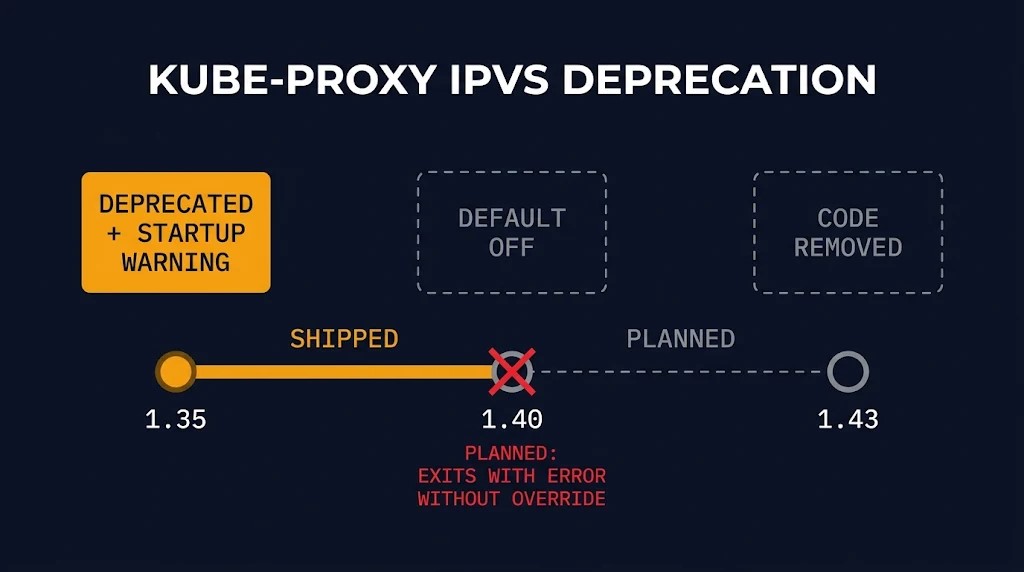
The kube-proxy IPVS Deprecation Has Three Milestones
The kube-proxy IPVS deprecation is a modern infrastructure lifecycle problem: a component stays in the product while support is staged out of it, and the sources use the same verbs for steps that have happened and steps that are planned. The table keeps them apart. Shipped means a source describes the change as present in a release. Planned means a project document states an intention for a release. Proposal means a KEP whose status is provisional.
| Release | What changes | Status | Source |
|---|---|---|---|
| 1.35 | ipvs is deprecated; kube-proxy logs a warning when started in ipvs mode | Shipped | KEP-5495 Stage 1; Kubernetes docs |
| 1.37 | KubeProxyIPVS feature gate exists, default true, stage Deprecated | Shipped, per the feature-gates docs | Feature gates reference |
| 1.40 | Gate default flips to false; kube-proxy started in ipvs mode without the override exits with an error listing iptables and nftables | Planned | KEP-5495 Stage 3; the docs say disabled by default from 1.40 |
| 1.43 | pkg/proxy/ipvs is removed; the docs say ipvs mode “will be fully removed” | Planned | KEP-5495 Stage 4; virtual IPs docs |
| 1.46 | KubeProxyIPVS gate is removed | Planned | KEP-5495 cleanup stage only |
| 1.40 (separate KEP) | nftables becomes the default backend | Proposal | KEP-5343, status provisional |
SOURCE NOTE
The November 16 SIG Network blog post says the project plans to remove ipvs in Kubernetes 1.40. KEP-5495’s staged plan makes 1.40 the default-off and error transition and 1.43 the code removal, and the Kubernetes docs and the v1.37 sneak peek align with the KEP. These statements differ on the removal version, and the difference has not been reconciled here. The table tabulates the staged plan because it is the only source that lists each step.
The KEP-5343 row is the only one that is not about ipvs itself. Its status is provisional and its alpha stage targets 1.37, so a 1.40 default change is a proposal, and this post does not count it as part of the lifecycle.
What Each Milestone Asks of the Owner
Each stage of the kube-proxy IPVS deprecation asks something different of the owner. The 1.35 and 1.37 milestones ask for nothing operational. ipvs mode still runs, it logs a warning, and the gate defaults to on. The 1.35 pod resize guide flagged the deprecation and advised planning a migration, but it names no later milestone, so it cannot tell a reader which upgrade is the one that matters.
The 1.40 milestone is the cliff, if the plan holds. The first upgrade that takes a mode: ipvs cluster to 1.40 meets a kube-proxy that, per the KEP, exits with an error unless the KubeProxyIPVS gate is overridden. The docs describe the gate as the way to re-enable the mode. This post did not test the override and does not claim it works in 1.40. The 1.43 milestone removes the code the override re-enables.
The owner decision is sequencing, not a date. No primary source read for this post gives a calendar date for 1.40 or 1.43, so a calendar deadline would be invented. What an owner can decide now is the order: which backend the cluster lands on, and whether that change happens before the upgrade that crosses 1.40 or inside it. Changing the proxy backend in the same window as a minor-version upgrade puts two changes in one rollback. That is this post’s judgment about operations, not a project recommendation, and it is the choice the three-date framing exists to expose.
Who Is Actually Exposed
Exposure to the kube-proxy IPVS deprecation is an explicit mode: ipvs. The 1.37 docs name iptables as the default mode, so a cluster that never set the mode is not in this population. The v1.37 sneak peek gives a check for clusters whose kube-proxy reads a kube-proxy ConfigMap in kube-system: search the config.conf key for mode:. A cluster configured another way, by command-line flags or an installer’s own mechanism, needs a different check, and the sources do not cover one.
This post did not examine distribution defaults, installer behavior or CNI dependencies. It cannot say which managed or packaged clusters run ipvs without the owner having chosen it.
What Changes When You Leave IPVS
The kube-proxy IPVS deprecation ends in one of two destinations, and the blog names both. nftables is the recommended one for clusters running Kubernetes 1.36 or later on nodes with kernel 5.13 or later, and the docs repeat the kernel requirement for that mode. The blog ties 1.36 to performance and scaling fixes that were not backported to earlier releases. For everything else the blog’s fallback is iptables, with a recommendation to reboot each node after changing the configuration, not just restart kube-proxy. It also notes Red Hat’s plan to remove the iptables API from RHEL and says that leaves the iptables backend with a long-term support problem of its own.
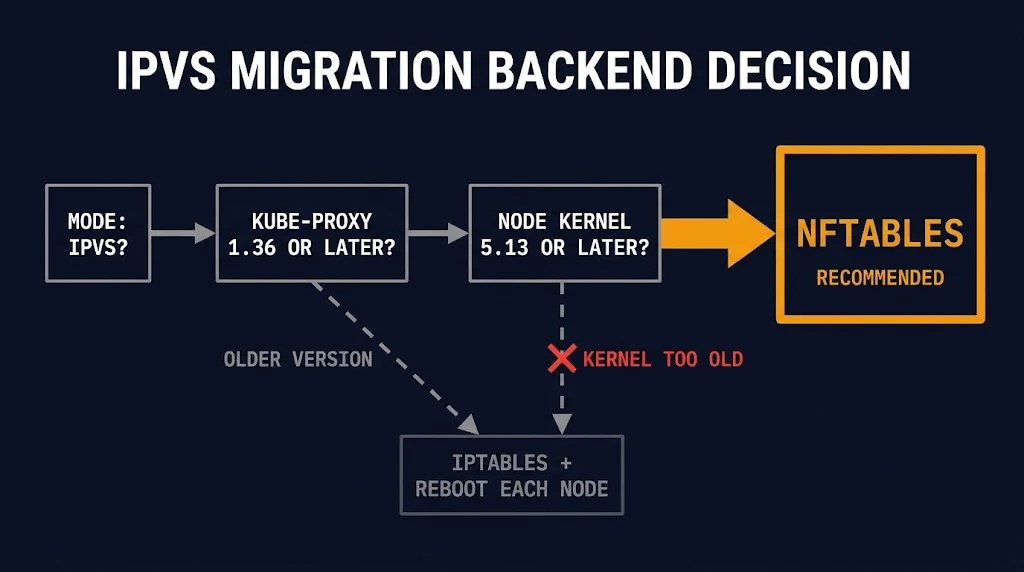
Three kinds of change follow the move. The first is configuration. The blog describes the switch to nftables as a kube-proxy configuration change plus a restart, which for kubeadm clusters means mode in the kube-proxy ConfigMap, and says any ipvs-specific options must be replaced with their nftables counterparts. The second is scheduling. iptables and nftables select endpoints randomly, so a configured IPVS scheduler does not carry over, and the blog argues that most IPVS schedulers were never useful as kube-proxy uses them.
The third is behavior. The docs list four differences, written for a move from iptables mode to nftables:
FOUR DOCUMENTED DIFFERENCES
- NodePort addresses.
nftablesdefaults to--nodeport-addresses primary, so NodePort Services answer only on the node’s primary addresses, not on every local IP. - Firewalls.
nftablesmode adds no accept rules for NodePorts, so a local firewall must allow the NodePort range. - Conntrack.
iptablesmode installs a workaround for a kernel bug before 6.1 that resets long-lived TCP connections; fornftablesmode the docs say to run kube-proxy with--conntrack-tcp-be-liberal. - Localhost NodePorts. These did not work in
nftablesmode originally, and are now Alpha in 1.37 behindKubeProxyNFTablesLocalhostNodePorts.
These are documented for iptables to nftables, not tested on ipvs. The docs say ipvs mode uses the iptables API underneath, but which of the four an ipvs cluster would hit is not established here.
What This Post Does Not Establish
This account of the kube-proxy IPVS deprecation gives no release dates for 1.40 or 1.43, because the primary sources do not. The 1.40 and 1.43 behavior is planned, not shipped, and the 1.46 gate removal appears only in the KEP. KEP-5343 is provisional. The KEP itself is inconsistent about the lock on the gate in 1.43, so this post states removal in 1.43 as the KEP and docs give it and leans on nothing about the lock. The blog publishes a latency comparison and the docs make performance statements, and this post draws no performance conclusion from either.
It did not examine distribution defaults, CNI behavior or installer settings, and it ran nothing on a cluster. Troubleshooting differences between ipvsadm and nft, and which kube-proxy metrics exist in each mode, are not stated in the sources read. The docs mention a metric that counts localhost NodePort connections in iptables mode, and this post does not know whether it exists on an ipvs cluster, so it does not tell anyone to read it there.
What to Check This Week
Start the kube-proxy IPVS deprecation check with the mode. Run the sneak peek’s mode: search against the kube-proxy ConfigMap, or read whatever configures kube-proxy on clusters that do not use one. Then compare three numbers against the destination the blog describes: the kube-proxy version against 1.36, the node kernel against 5.13, and the list of ipvs-specific options in the configuration, starting with the scheduler. If a cluster fails the version or the kernel check, its destination is iptables plus a node reboot, and the RHEL note applies to it.
Then ask which clients depend on NodePort reachability on addresses other than the primary one, or on localhost. The sources do not give a method for finding them. They name the dependency, and it is the question to put to application owners before any backend change, whether that change happens before 1.40 or inside the upgrade that crosses it.
Architect’s Verdict
The kube-proxy IPVS deprecation is three milestones, and the sources let a reader collapse them into one. Deprecation shipped in 1.35 and asks for nothing. Default-off is planned for 1.40, and it is the point where an ipvs cluster’s upgrade path changes. Removal is planned for 1.43 and ends the override. One of those is a fact about a release; the other two are intentions, and the project’s own documents disagree on one of them.
The real problem is that “deprecated” reads as a calendar item with a long runway, when the owner decision is an order of operations. The cluster that moves to nftables or iptables on its own schedule changes one thing at a time. The cluster that waits changes the proxy backend and the Kubernetes version in the same rollback, with a kernel check and a node reboot possibly attached.
Treat the 1.40 milestone of the kube-proxy IPVS deprecation as the upgrade you sequence around, and treat every date in this timeline as a plan until the release ships it. A deprecation warning is the project’s notice that it has started a countdown, not a date on your calendar.
Additional Resources
Editorial Integrity & Security Protocol
This technical deep-dive adheres to the Rack2Cloud Deterministic Integrity Standard. All benchmarks and security audits are derived from zero-trust validation protocols within our isolated lab environments. No vendor influence.

RM
I’m a Senior Solutions Architect with 25+ years of experience in HCI, cloud strategy, and data resilience. I lead Rack2Cloud, delivering lab-verified guidance for complex enterprise transitions. View Credentials →
Get the Playbooks Vendors Won’t Publish
Choose the architecture problems you care about. Get field-tested playbooks and frameworks delivered to your inbox.
- > AI Infrastructure & Inference Economics
- > Cloud Strategy & Hidden Cost Models
- > Virtualization & Deterministic Migration
- > Kubernetes, IaC & Modern Infrastructure
- > Data Protection & Recovery Engineering
Zero spam. Includes The Dispatch weekly drop.
Need Architectural Guidance?
Independent review before major infrastructure decisions.
- > Validate assumptions
- > Identify hidden dependencies
- > Quantify migration risk
- > Challenge vendor narratives
Triage · Advisory · Fractional · Direct Hire