

The AI Control Plane Is Becoming the New Shadow IT
Shadow IT used to mean a SaaS subscription purchased outside the approval process. The fix was a procurement policy and a software catalog. It was an application-layer problem with a governance-layer solution. What is happening now with AI tools is not that problem. It is not a procurement problem at all. The AI control plane is sprawling across organizations because nobody classified it as infrastructure — and no approval workflow stops infrastructure that nobody recognizes as infrastructure.
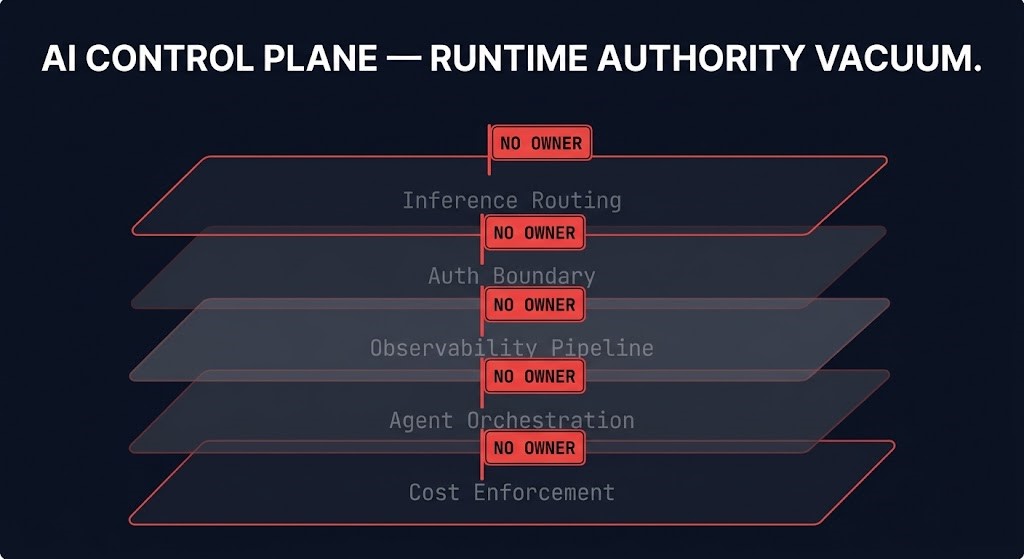
Most organizations have already deployed AI control planes. They just never classified them as infrastructure.
This is not a model governance problem. It is an infrastructure authority problem. Model governance asks whether the right model is running for the right purpose. Infrastructure authority asks who owns the runtime layer it runs on — who governs the routing, who defines the failure domain, who owns the recovery path when the invisible inference layer breaks at 2am. Those are different questions, and confusing them is why most responses to AI control plane sprawl produce governance documents instead of operational architecture.
Shadow IT Was Always an Operational Authority Problem
The original shadow IT failure was never really about procurement. It was about operational authority. When a team ran their own file server in a closet, the problem was not the purchase order — it was that nobody owned the update cycle, the backup, the access model, or the failure response. The tool existed in production with no defined operational boundary.
The history of ungoverned infrastructure follows a consistent pattern across three generations. Shadow IT in the on-premises era: SaaS tools procured outside IT, living at the application layer, with blast radius contained to that team’s workflows. Cloud sprawl in the hybrid era: infrastructure provisioned outside the approved catalog, living at the provisioning layer, with blast radius extending to cost and security posture. AI control plane sprawl in the current era: inference runtime deployed outside operational authority, living at the infrastructure layer, with blast radius that compounds structurally across every system touching it.
Each generation moved the ungoverned surface one layer deeper into the stack. Each generation produced a failure mode the previous generation’s governance model was not designed to catch. Procurement policies caught shadow SaaS. Cloud governance frameworks caught cloud sprawl — slowly. Neither catches AI control plane sprawl, because what is being deployed is not a tool in a catalog. It is invisible infrastructure.
What “Deploying an AI Tool” Actually Deploys
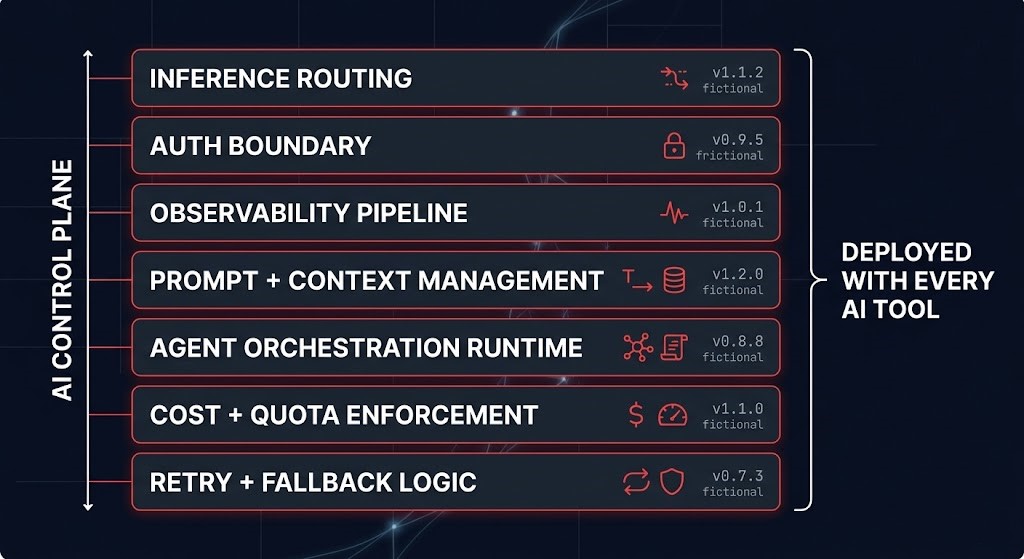
When a platform team, an application team, or a product team “deploys an AI tool,” what actually goes into production is a stack of infrastructure decisions, most of which were never made explicitly:
An inference routing layer that selects models, manages fallback chains, and applies cost-tier logic. An authentication and authorization boundary — or the absence of one — that determines what the inference layer can access and on whose behalf. An observability pipeline that either captures inference telemetry or does not. A prompt and context management layer that handles stateful session logic, retrieval augmentation, and context window behavior. In agentic deployments, an agent orchestration runtime that chains tool calls, manages execution sequences, and decides what runs next. A cost and quota enforcement layer — or none. A retry and fallback model that governs behavior under partial failure.
Each of these is an infrastructure decision. Collectively, they are an AI control plane: the layer that determines what the inference infrastructure does, how it changes, and who has authority to make it change. None of them appear in a procurement catalog. All of them are live in production.
he same gap shows up one layer down, inside the tools themselves. Your Vendor Review Process Never Saw The Real Supplier documents it at the procurement layer: a vendor review covers the company on the contract, not the SDKs and libraries bundled inside what it shipped. The AI control plane is what the identical gap looks like once it’s operating infrastructure instead of sitting inside a mobile app.
The same classification failure shows up on the budget side too, not just the procurement side. The AI Tool Budget Became An Infrastructure Budget covers the version of this gap that lives in Finance rather than IT: AI tooling spend clears the software-procurement review gate because nobody built a gate for a budget category migrating into infrastructure — the same “nobody classified it as infrastructure” failure this post names, expressed in dollars instead of runtime.
The comparison to the original shadow IT problem maps precisely:
| Dimension | Shadow IT (Then) | Shadow AI Control Plane (Now) |
|---|---|---|
| Governance surface | Software procurement catalog | Inference runtime, routing, and orchestration layer |
| Failure owner | Application team by default | Nobody — no defined operational boundary |
| Blast radius | Localized — application-scoped, operationally isolated | Compositional — runtime-chained, cross-system, structurally compounding |
| Observability | Missing from the tool, visible at the network/cost layer | Missing from the inference layer — invisible during failure |
| Operational authority | Implicitly owned by the buying team | Undefined — no named infrastructure owner |
| Remediation path | Procurement policy + software catalog | Architectural intervention — authority model must be defined, not just approved |
The blast radius column is where the analogy holds most clearly — and where the stakes diverge most sharply. Shadow SaaS failures were localized. An application went down, a team lost access to a tool, a file wasn’t backed up. The failure was contained to the application scope and operationally isolated from adjacent systems. AI control plane failures are compositional. They chain across runtime dependencies and compound structurally. A single broken component does not produce a single broken outcome. It propagates through the inference stack and everything connected to it.
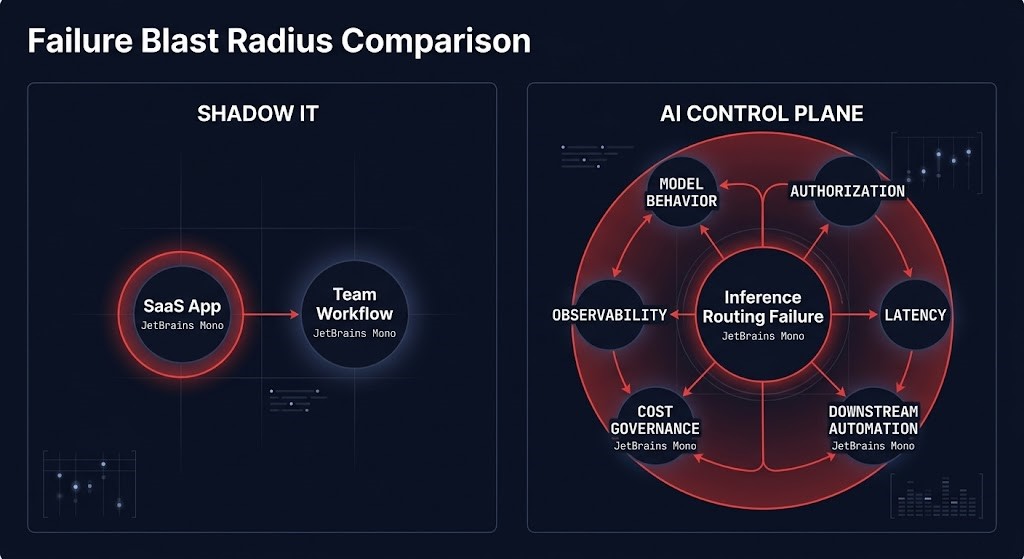
One broken routing layer can simultaneously corrupt model selection logic, alter authorization behavior, spike latency to downstream automation, eliminate observability during the failure window, and produce cost anomalies that take days to reconstruct. That is not an application-layer failure. That is infrastructure failure — and it behaves like infrastructure failure because that is exactly what it is.
Why the AI Control Plane Framing Matters
A control plane is not just infrastructure. It is the layer that determines what the infrastructure does, how it changes, and who has authority to make it change. That definition applies to the Kubernetes API server. It applies to vCenter. It applies to your CI/CD pipeline — which is why that pipeline is your real infrastructure control plane. And it applies to the inference routing, orchestration, and policy layer that governs AI workloads in production — the AI control plane — with the same architectural force.
When an inference routing layer is deployed without operational ownership, it is not just a tool without a ticket. It is a control plane without an authority model. The console-as-shadow-control-plane problem that affects every infrastructure platform applies here at full strength: the surface that determines system behavior has been handed to an execution environment that has no governance boundary. The difference with AI is that the ungoverned surface is invisible in a way that a vCenter console never was. Nobody can see the routing layer in a network diagram. Nobody can find the orchestration runtime in an asset catalog. Nobody knows the prompt management layer exists until it breaks.
Most AI control planes also depend on non-human identity chains the infrastructure team does not govern. API keys brokered between services, delegated authorization across model providers, token chains passed through agent execution sequences, machine identities with inference permissions that no human reviewed. This is the identity surface that security teams are only beginning to map — and it is embedded inside the AI control plane, not adjacent to it.
The Three Invisible Infrastructure Surfaces
The Runtime Authority Vacuum — Framework #85 — is the condition where inference infrastructure is operationally active but has no defined authority model for governance, observability, continuity, or failure ownership. It manifests most visibly across three surfaces:
Inference routing. The model selection, fallback chain, and cost-tier routing logic that determines which inference endpoint handles each request. This layer is typically written into application code, owned by a product team, and deployed with no infrastructure review. When it fails, the failure mode is silent: a cost-routing fallback silently changes model behavior in production. Requests that were hitting a capable model begin hitting a cheaper, lower-capability fallback — not because of a declared operational decision, but because a threshold was crossed and the routing logic did what it was told. No alert fires. The behavior change propagates downstream before anyone notices the model output has degraded.
Agent orchestration. The runtime that chains tool calls, manages context windows, and decides what executes next in agentic workflows. This is not a stateless layer. It makes decisions at runtime that have downstream operational consequences — which APIs it calls, in what sequence, with what retry behavior. When an orchestration layer loops retries against downstream APIs without a circuit breaker, it does not fail cleanly. It produces cascading execution behavior across every API in the chain, with latency and cost spikes that look like upstream load until the execution trace is reconstructed manually. An execution trace that, in most current deployments, does not exist.
The orchestration surface compounds when the agents running inside it were never inventoried in the first place. An organization that can’t produce an AI agent count also can’t map what those agents are authorized to invoke — which means the Runtime Authority Vacuum has a prior gap underneath it. The classification failure that drives this is documented in The AI Agent Inventory Gap Nobody Is Measuring — agents that arrive through workflow tooling and get classified as automation never reach the infrastructure awareness layer the authority model depends on.
Observability — or its absence. Without a governed inference observability layer, the AI infrastructure stack has no failure signal, no cost signal, and no security signal during an incident. The stack is running. Nobody knows what it is doing. When something breaks, the incident response begins with the question every infrastructure team dreads: can we reconstruct what happened? If there is no inference telemetry, the answer is no. The observability gaps in AI inference pipelines are not tooling problems. They are authority problems — nobody defined observability as a requirement for the inference layer because nobody classified the inference layer as infrastructure that required operational standards. A fourth surface is emerging as inference workloads distribute across substrates: the network layer itself. As east-west traffic, interconnect topology, and routing policy become active participants in inference execution, the fabric governing that traffic enters the authority gap. The network is becoming the AI control plane — the convergence point where placement authority, telemetry, and policy enforcement meet as the inference execution layer distributes beyond a single substrate.
DIAGNOSTIC QUESTION
“If your AI inference layer went dark at 2am, which team would own the incident — and do they have the telemetry to reconstruct what happened?”
The Remediation Is Architectural, Not Procedural
This is where the shadow IT analogy reaches its limit — and where the infrastructure framing becomes essential. Shadow IT got fixed with procurement policies and software catalogs because the ungoverned surface was at the application layer. Policies govern intent. They work when the problem is an application being used outside the approved catalog. They do not work when the problem is an infrastructure layer with no defined ownership, no observability, and no failure model.
Infrastructure requires ownership, observability, and failure handling. None of those come from a policy document.
An architectural remediation for AI control plane sprawl requires four concrete interventions. First, establishing a named operational owner for each AI control plane surface — inference routing, agent orchestration, observability pipeline, and identity chain each need an owner who carries the incident pager. Second, building observability into the routing and agent layers before relying on them in production — not as an afterthought after the first outage, but as an architectural requirement applied before the layer goes live. Third, defining failure domains explicitly: what does a partial inference stack failure look like, which systems does it affect, and what is the recovery sequence? A failure domain that has never been defined will be discovered during an incident. Fourth, treating prompt and context management as stateful infrastructure, not application configuration — because it carries operational state that determines system behavior, and operational state requires the same lifecycle discipline as any other infrastructure component.
The protocol layer through which most agentic tool invocations now occur — MCP — introduces its own authority boundary failures that sit directly inside this operational gap. The attack surface MCP tool use creates is invisible for the same reason the AI control plane is invisible: it lives below the application layer, in infrastructure nobody classified as infrastructure.
The same classification failure shows up even earlier than the MCP layer — in the evaluation and test infrastructure built to validate these systems before they ever reach production. Your AI test environment is becoming a production control plane the moment it’s classified as testing infrastructure rather than authority-bearing infrastructure — the same “nobody recognized this as infrastructure requiring operational standards” failure this post names, one layer earlier in the lifecycle. The Environment Was Isolated. The Authority Wasn’t. is that failure made concrete: an OpenAI evaluation environment accumulated real network reach and credentials into Hugging Face’s production infrastructure through a sequence of individually reasonable access grants, with nobody ever assigned to classify the environment or own the boundary.
The agentic AI control plane problem extends this further. When AI agents become the execution layer — making decisions, calling tools, triggering downstream workflows — the AI control plane is no longer just inference infrastructure. It is operational infrastructure. The authority model for an agentic system that can modify production state is not a model governance question. It is an infrastructure authority question, and it requires the same architectural discipline applied to any infrastructure layer with that level of operational consequence.
The architectural discipline that governs the AI control plane at runtime — execution authority assignment, policy enforcement architecture, Runtime Authority Vacuum diagnosis, and control plane ownership — is the subject of Governance & Runtime Control (A6) in the AI Infrastructure Architecture Path.
For teams working through where their own inference placement and routing authority actually sits, the AI Gravity & Placement Engine surfaces the placement decisions embedded in the current workload architecture — the routing and gravity logic that is almost always present but rarely documented.
Architect’s Verdict
Organizations do not have an AI tool problem. They have a Runtime Authority Vacuum — an operationally active AI control plane with no defined authority model for governance, observability, continuity, or failure ownership. The tools are real. The infrastructure is real. The authority is absent.
The reason this is harder to address than shadow IT is not technical complexity. It is that the ungoverned surface is invisible by default. Shadow SaaS was visible on invoices, in browser history, in network traffic. The AI control plane — the routing layer, the orchestration runtime, the prompt management logic, the non-human identity chain — does not show up in any of those places. It is visible only when something breaks and the incident response team discovers they cannot reconstruct what happened because the observability layer was never built for infrastructure nobody classified as infrastructure.
An AI control plane without operational ownership is not innovation. It is unmanaged infrastructure — and unmanaged infrastructure does not become managed infrastructure through policy. It becomes managed infrastructure when someone defines the authority model, builds the observability layer, and carries the pager.
Additional Resources
View 5 more resources
Editorial Integrity & Security Protocol
This technical deep-dive adheres to the Rack2Cloud Deterministic Integrity Standard. All benchmarks and security audits are derived from zero-trust validation protocols within our isolated lab environments. No vendor influence.

R.M.
Senior Solutions Architect with 25+ years of experience in HCI, cloud strategy, and data resilience. As the lead behind Rack2Cloud, I focus on lab-verified guidance for complex enterprise transitions. View Credentials →
Get the Playbooks Vendors Won’t Publish
Choose the architecture problems you care about. Get field-tested playbooks and frameworks delivered to your inbox.
- > AI Infrastructure & Inference Economics
- > Cloud Strategy & Hidden Cost Models
- > Virtualization & Deterministic Migration
- > Kubernetes, IaC & Modern Infrastructure
- > Data Protection & Recovery Engineering
Zero spam. Includes The Dispatch weekly drop.
Need Architectural Guidance?
Independent review before major infrastructure decisions.
- > Validate assumptions
- > Identify hidden dependencies
- > Quantify migration risk
- > Challenge vendor narratives
Triage · Advisory · Fractional · Direct Hire