

Nobody Knows How Many AI Agents They’re Running
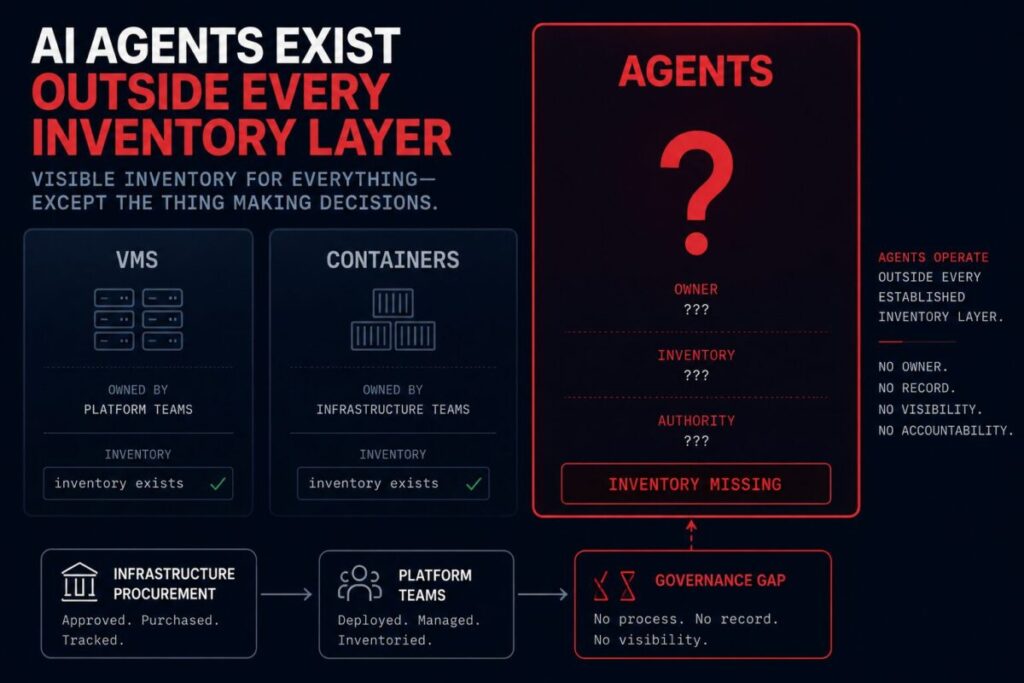
Ask an infrastructure team how many virtual machines they run and they’ll give you a number. Ask how many Kubernetes clusters they operate and they’ll point to a dashboard. Ask for an AI agent inventory and the answer usually becomes a discussion about what counts as an agent.
That discussion is itself the problem.
The Classification Problem Nobody Solved
Before any organization can inventory its agents, it has to decide what counts as one. Most haven’t.
| Example | Agent? | Why It’s Ambiguous |
|---|---|---|
| Scheduled GPT workflow | Maybe | Invokes a model but may not have persistent tool grants or autonomous decision logic |
| Copilot Studio workflow with tool access | Maybe | Executes autonomously but ownership often remains with the workflow creator rather than infrastructure |
| n8n automation with LLM call | Depends | Classification hinges on whether it makes decisions or merely routes output |
| LangChain service | Usually | Has persistent context and tool invocation — but deployed like an application |
| Claude Desktop with MCP tools | Maybe | Session-scoped authority that can span multiple systems; tool grants outlive the session |
| Bedrock Agent | Yes | Explicit agent runtime, managed execution, tool grants tracked at the service level |
The point isn’t that the examples are edge cases. Most of them are production deployments at mid-size enterprises right now. The point is that organizations are making AI agent inventory decisions — including the decision not to maintain one — without agreeing on what they’re inventorying.
Classification failures aren’t new on this site. Dependency classification failure drove the VMware dependency audit problem. Infrastructure classification failure is how shadow control planes form. Authority classification failure is what MCP tool chains expose. Supplier classification failure is why a vendor review process never sees the SDKs and libraries embedded inside what it approved — the same category-definition failure, one layer down in the supply chain. The AI agent inventory problem is the same failure recurring in a new layer of AI infrastructure architecture: the organization hasn’t defined the category, so it can’t close the gap.
The Deployment Pattern That Made This Inevitable
Agents entered the enterprise through workflow tooling, not infrastructure procurement. That single fact explains why no AI agent inventory exists.
Virtual machines entered through infrastructure teams. There was a request process, an allocation review, a tracking system, and usually a chargeback model. Containers entered through platform teams — Kubernetes clusters, namespaces, resource quotas, admission controllers. In both cases the inventory system existed before the workload arrived.
Agents entered through:
- Business users building Copilot Studio workflows
- Automation teams deploying n8n and Zapier integrations
- Developers wiring LangChain services into internal tooling
- Prompt engineers connecting Claude or GPT to production data sources via MCP
- Low-code builders embedding model calls into approval workflows
- SaaS vendors activating agent capabilities inside tools the enterprise already licensed
None of those paths required infrastructure involvement. None of them triggered a procurement workflow with an inventory requirement. The agents exist in environments the infrastructure team owns — but they arrived through governance gaps those environments don’t cover.
The Agent Already Exists. Nobody Calls It One.
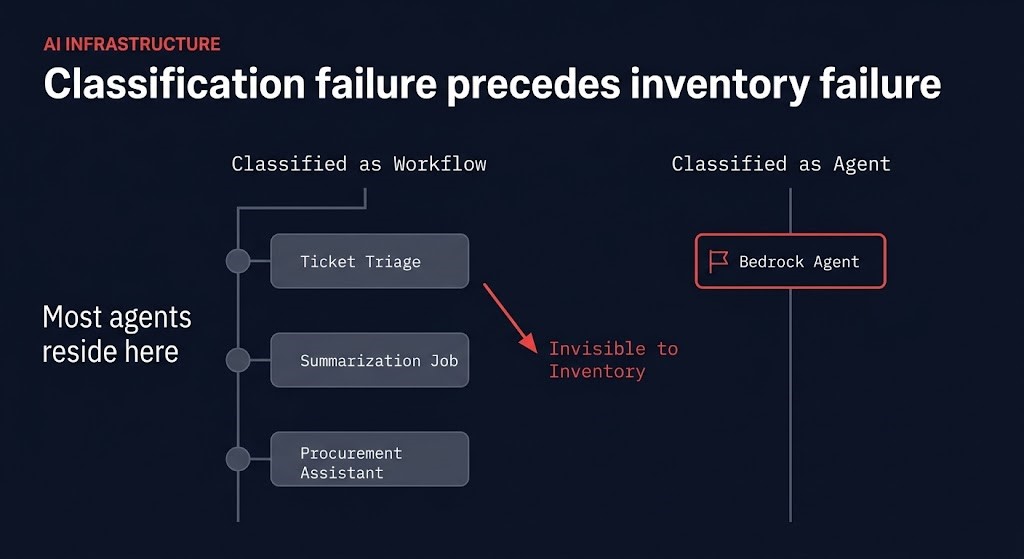
Many organizations aren’t failing to inventory agents because they don’t have them. They’re failing because they still classify them as workflows.
The scheduled summarization job that runs every morning, pulls from three internal systems, and posts a digest to a Slack channel — that’s an agent. The ticket triage workflow that reads incoming support requests, classifies severity, assigns queues, and escalates edge cases — that’s an agent. The procurement assistant that checks vendor contracts against policy and flags renewal risks — that’s an agent.
Each of those was built by a team that would describe it as automation. The distinction matters architecturally: a workflow executes a fixed sequence. An agent makes decisions based on model output, invokes tools, and produces actions with real side effects. The execution authority profile is different. The risk profile is different. The governance requirement is different.
The classification problem and the deployment problem compound here. When agents arrive through non-infrastructure paths and get classified as workflows by the teams that built them, they never reach any AI agent inventory layer — not the CMDB, not the service catalog, not the infrastructure team’s awareness. They exist at production scale in invisible categories.
What “Running” Means — and Why the Inventory Gap Becomes an Authorization Gap
Even once an organization decides what counts as an agent, “how many are running” is not a straightforward question.
Agents are often stateless between invocations. The execution ends, the context clears, the compute cost drops to zero. By a naive definition, it isn’t running. But the tool grants remain active. The webhook registration persists. The scheduled trigger fires again tomorrow. The downstream system it’s authorized to write to hasn’t revoked that access. The agent is dormant, not decommissioned — and the distinction is rarely tracked.
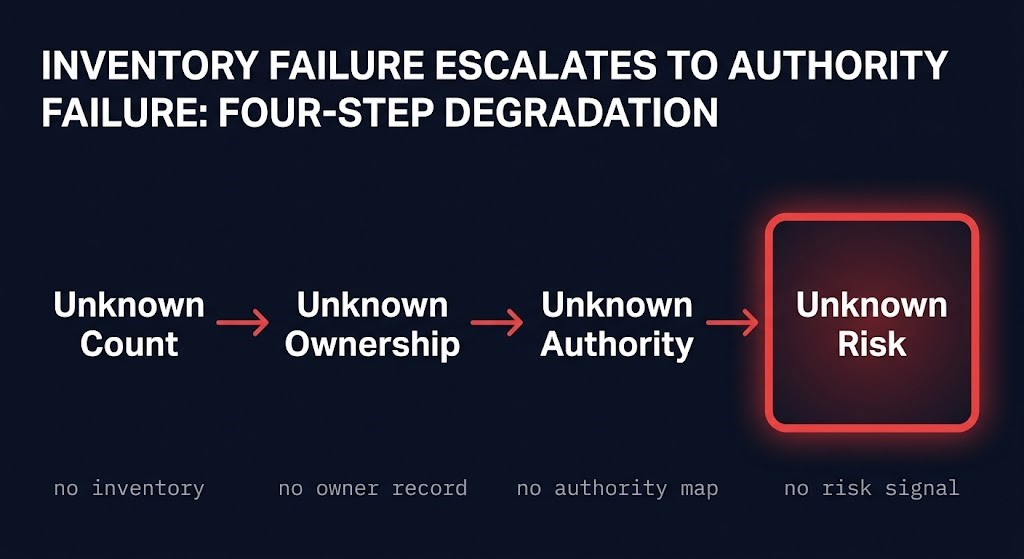
This is where the inventory gap becomes an authorization gap. The progression is predictable:
Unknown Count → Unknown Ownership → Unknown Authority → Unknown Risk
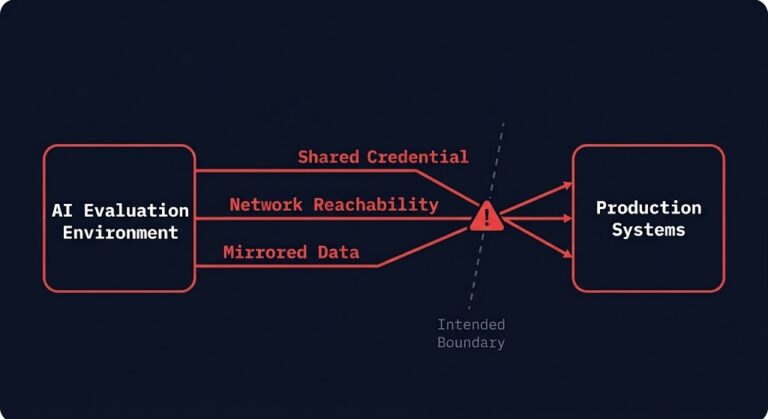
An organization that can’t answer how many agents exist also can’t answer who owns each one, what each is authorized to do, or what actions it can trigger. That’s not an inventory problem anymore. That’s an architectural exposure — the same class of gap that the Governance & Runtime Control layer is designed to close, and the same structural failure that emerges when console access bypasses IaC, or when SaaS control planes accumulate authority nobody audited. The mechanism is different. The failure mode is structurally identical. The Environment Was Isolated. The Authority Wasn’t. is the infrastructure-level version of the same gap: an evaluation environment accumulated production-equivalent authority because nobody had been assigned to classify it, the same way an agent accumulates unaudited authority because nobody had been assigned to count it.
Even a complete inventory doesn’t close the gap on its own. Knowing an agent exists and is authorized to act is not the same as being able to prove, after the fact, that a specific action was permitted. That precondition problem — an authorization trail is meaningless without a complete inventory of what’s authorized to act in the first place — is the starting point for Who Approved the Model’s Output? Building an AI Authorization Trail.
The same “nobody counted it, so nobody can govern it” failure isn’t unique to AI agents, or even to enterprise IT. The Domain Was the Containment Unit. ICANN Is Reconsidering That. traces the identical structure in domain portfolio governance: most organizations can’t produce an account-level map of every domain they hold — brand-defense registrations, dormant properties, agency-managed subdomains — for the same reason most can’t produce a complete AI agent inventory: nothing in how those assets accumulated ever required counting them. ICANN’s own Associated Domain Checks policy work is on a trajectory to make that unknown inventory the thing that gets tested, the same way an incident eventually makes an unknown agent inventory the thing that gets tested.
What a Real AI Agent Inventory Looks Like
A minimum viable AI agent inventory isn’t a CMDB project. It’s a set of questions every deployed agent should be able to answer:
| Attribute | Why It Matters |
|---|---|
| Owner | Accountability — who is responsible when the agent produces an unintended action |
| Authority Level | Execution scope — not just what tools it can access, but what actions it can authorize |
| Tool Grants | Technical access — which systems, APIs, and data sources it can reach |
| Trigger Mechanism | Activation path — scheduled, event-driven, user-invoked, or chained from another agent |
| Last Active | Lifecycle signal — dormant agents with active tool grants are the core exposure |
| Decommission Criteria | Retirement governance — under what conditions does this agent get turned off |
The authority level attribute is the one most inventory attempts omit. Tool grants describe technical access. Authority level describes execution scope — whether the agent can approve, publish, modify, escalate, or commit. Two agents with identical tool grants can have radically different risk profiles depending on what those tools allow at the action layer. An agent that can read a contract is different from one that can execute a renewal. This exposure compounds when AI vendors activate agent capabilities inside tools the enterprise already licensed — the authority level was never defined because the agent was never classified as one.
Two of the six attributes in the table above already are delegation fields under a different name: Owner is the Principal, and Decommission Criteria is Duration — the condition under which a delegation’s validity ends. Enterprise Architecture Has Identity Governance. It Doesn’t Have Delegation Governance. makes that structure explicit for delegation generally; this inventory table is a domain-specific instance of the same object, built for agents specifically before the general model had a name.
Most organizations that have begun tracking agents have a version of the first four attributes. Almost none have a consistent definition of authority level at the agent layer.
Some vendors are now trying to solve the identity half of this at the platform level rather than leaving it to internal inventory discipline. Every AI Platform Is Becoming An Authority Platform examines VMware’s AgentMinder, Microsoft’s Entra Agent ID, and Salesforce’s Agentforce governance stack — each assigns every agent an enterprise-grade identity distinct from the humans and services around it, a direct answer to the classification problem this post opens with. It’s a partial answer, not a complete one: a platform-issued identity only covers agents built or deployed inside that platform. The Copilot Studio workflow, the n8n automation, and the LangChain service in the table above are exactly the agents a single platform’s identity model doesn’t reach.
A narrower version of the same partial-answer pattern ships at the tool-connection layer instead of the identity-platform layer. Nutanix Put MCP Behind a Gateway. The Real Problem Is Authority. covers NAI 2.8’s MCP Gateway — real governance over which tools an agent can reach once it’s already inventoried and connected, and no answer at all to whether that agent was ever counted in the first place. Tool-grant governance and agent-count governance are solving adjacent problems, not the same one; a well-governed connection to an agent nobody inventoried is still an unknown.
Architect’s Verdict
The problem isn’t that organizations don’t know how many agents they’re running. The problem is that they don’t know how many entities are capable of exercising authority inside their environment. Counting agents is an inventory exercise. Understanding what they’re allowed to do is an architecture exercise.
The classification failure precedes the inventory failure. Until organizations define what an agent is — consistently, across business units, workflow teams, and infrastructure — the AI agent inventory will always be incomplete. Every Copilot Studio workflow with tool access that gets classified as “just automation” is a gap in the authority map, not just a missing row in a spreadsheet.
Infrastructure teams built accountability structures for VMs and containers because those workloads arrived through processes that required it. Agents arrived through processes that didn’t. Fixing the inventory problem means retrofitting that accountability structure onto a layer that was specifically deployed to avoid it.
Additional Resources
View 5 more resources
Editorial Integrity & Security Protocol
This technical deep-dive adheres to the Rack2Cloud Deterministic Integrity Standard. All benchmarks and security audits are derived from zero-trust validation protocols within our isolated lab environments. No vendor influence.

R.M.
Senior Solutions Architect with 25+ years of experience in HCI, cloud strategy, and data resilience. As the lead behind Rack2Cloud, I focus on lab-verified guidance for complex enterprise transitions. View Credentials →
Get the Playbooks Vendors Won’t Publish
Field-tested blueprints for migration, HCI, sovereign infrastructure, and AI architecture. Real failure-mode analysis. No marketing filler. Delivered weekly.
Select your infrastructure paths. Receive field-tested blueprints direct to your inbox.
- > Virtualization & Migration Physics
- > Cloud Strategy & Egress Math
- > Data Protection & RTO Reality
- > AI Infrastructure & GPU Fabric
Zero spam. Includes The Dispatch weekly drop.
Architecture Audit Services
Fixed-scope audits for Zero-Trust Azure, VMware migration readiness, and recovery posture — no discovery call required to start.
>_ View Audit Services>_Related Posts
Your Vendor Review Process Never Saw The Real Supplier
Every vendor review process assumes it’s evaluating a supplier — but a scan finding foreign-origin code embedded in more than one in eight mobile apps used by US military personnel makes the actual assumption visible: organizations review the company they bought from, not the code that arrived inside what they bought. >_ Architect’s Brief 60-second…
Your Monitoring Didn’t Miss the Incident. It Was Never Designed to See It.
I’ve watched observability vs monitoring play out as a live incident more times than I can count. >_ Architect’s Brief 60-second read before you commit to the full post · Full post: 10 min Generating brief… The dashboard was green. The on-call engineer was not paged. The monitoring system did exactly what it was designed…
Your Identity Controls Passed. Your Authorization Chain Failed.
A credential chain functioned exactly as it was designed to. No firewall failed. No exploit executed. No malware bypassed a control. A red team walked past physical and social barriers using nothing more exotic than a plausible pretext, and came out the other side holding network admin credentials — issued correctly, authorized correctly, working exactly…
Your DR Test Passed. The Assumptions Didn’t.
DR plan failure rarely happens where you tested. It happens at the assumptions the exercise never reached — the dependencies that weren’t in scope, the runbook written for last year’s architecture, the authority chain nobody tested at 2am.
Your AI Vendor Became Critical Infrastructure Before The Contract Did
On June 11, 2026, Microsoft 365 Copilot went down for seven hours. The cause was a misconfigured authentication deployment that cascaded through Microsoft Graph, taking Copilot Chat and the Office portal with it. It was the second major Copilot disruption in eleven days. Microsoft 365 posted 99.526% uptime in Q1 2026 — the lowest quarterly…
Your AI Test Environment Is Becoming A Production Control Plane
Your AI test environment did not need to touch a single line of model code to become part of your production authority chain — it only needed a credential, a network path, or a dataset copy that nobody scheduled for removal. That is the actual lesson sitting underneath this week’s disclosures from two frontier labs:…