

GPU Allocation Governance Is the Next AI Infrastructure Crisis
GPU allocation governance is becoming the defining AI infrastructure challenge of 2026 — not because enterprises cannot acquire GPUs, but because they cannot arbitrate who uses them.
The GPU Shortage Didn’t End. It Changed Shape.
By May 2026, VentureBeat’s AI Infrastructure tracker showed “access to GPUs” dropping from the #1 enterprise concern (20.8% of decision-makers) to #4 (15.4%) in a single quarter. Meanwhile, “cost per inference” and “total cost of ownership” surged from #3 to #1 in the same window.
The procurement problem that defined 2024 and early 2025 — lead times of 36–52 weeks, hyperscalers with two years of output reserved, smaller organizations paying premium rates for overflow capacity — is still real. But it stopped being the problem.
Organizations that spent $50M on GPU clusters discovered something uncomfortable: 95% of that capacity sits dark when usage-based billing starts. Not because they can’t buy GPUs. Because they can’t coordinate workloads on the same cluster.
The GPU shortage didn’t disappear. It moved up the stack.
Why GPU Capacity Sits Idle on Busy Clusters
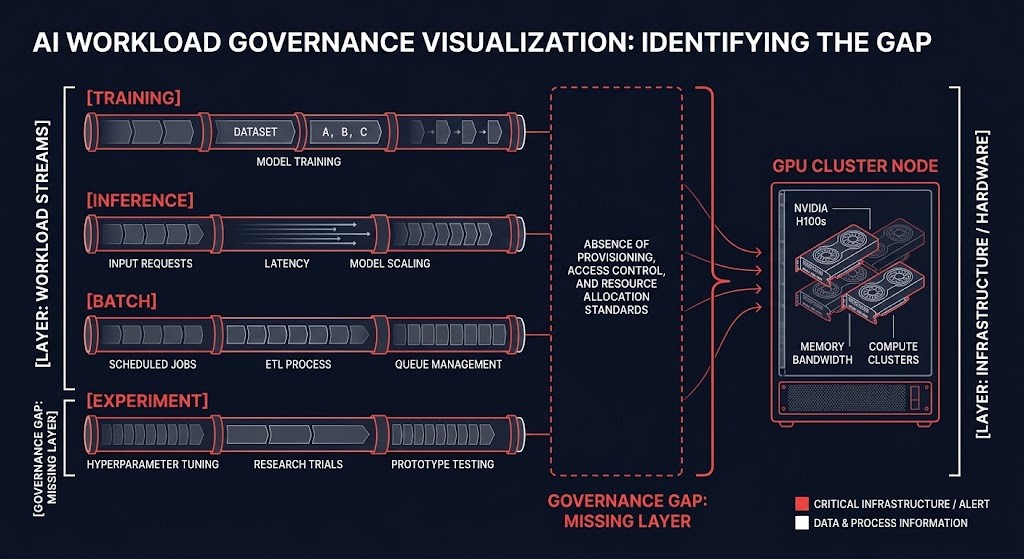
GPU clusters increasingly host four fundamentally different workload classes. Each optimizes for a different outcome, which means capacity that appears available to one workload may be unusable for another.
| Workload Class | Optimization Target |
|---|---|
| Training | Throughput |
| Inference | Latency |
| Batch Analytics | Cost |
| Experimentation | Flexibility |
A cluster optimized for training throughput — sustained GPU memory and high-bandwidth interconnects held for 72-hour jobs — becomes structurally inefficient the moment inference workloads need guaranteed low-latency access on the same hardware. Batch jobs want whatever is available right now and will queue if it isn’t. Experimentation runs for four hours and evaporates, but it contends for the same reserved blocks.
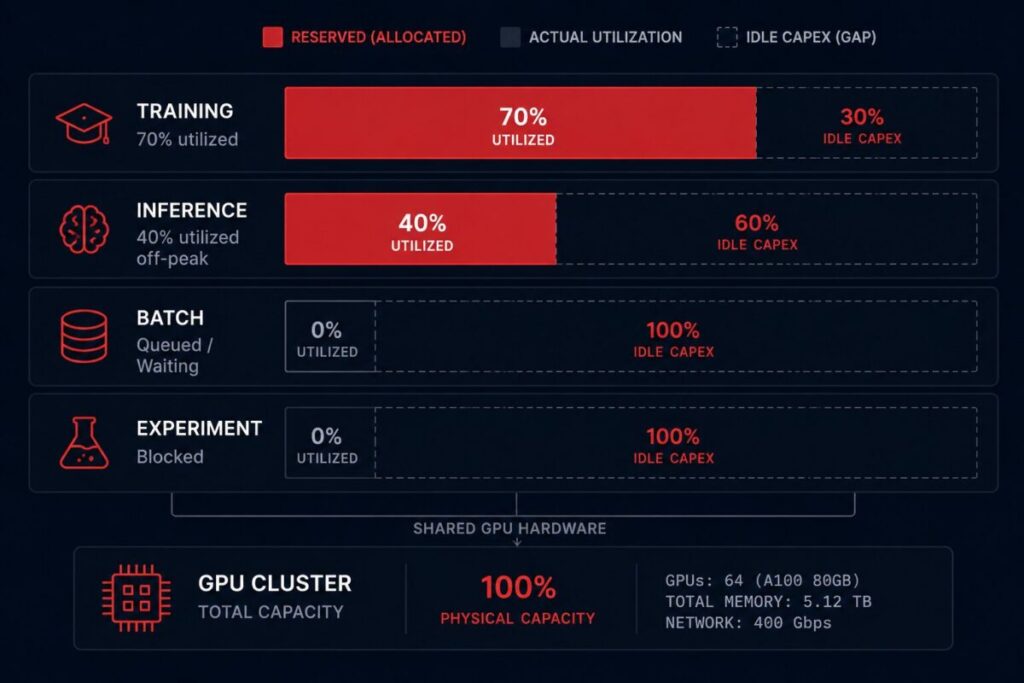
Put all four on the same cluster with static resource allocation — which is what most organizations do — and the math collapses. Training gets a reserved block. It runs at 70% utilization when actually scheduled, sits idle between jobs. Inference gets its own GPU allocation; during off-peak hours, that GPU is dark. Batch jobs queue because both training and inference have reserved capacity. Experiments run on whatever’s left.
Static partitioning on mixed workloads wastes 40–60% of capacity even when the cluster is busy.
And then there is a fifth workload class that compounds the problem. The highest-priority workload is rarely the most efficient one. Executive-sponsored AI initiatives often receive guaranteed access to GPU resources regardless of utilization characteristics, introducing political prioritization into what appears to be a technical allocation problem. That capacity cannot be denied, cannot be reclaimed during idle windows, and does not appear in any utilization dashboard as waste. It is simply reserved.
The cluster dashboard says 82% allocated. The infrastructure team believes capacity is exhausted. The data science team is requesting another GPU purchase. Finance sees tens of millions in idle CapEx. All three are reading the same cluster and reaching different conclusions — because allocation and utilization are not the same metric.
The Allocation Layer Nobody Planned For
Every organization eventually discovers that GPU allocation is an authority problem before it becomes a scheduling problem.
This is the part of AI infrastructure architecture that most platform teams reach without a plan. The acquisition phase has a clear owner: procurement. The deployment phase has a clear owner: infrastructure. The runtime phase has a clear owner: platform engineering.
Allocation governance has no natural owner.
Infrastructure teams own clusters. Data science teams own model workloads. Platform teams own deployment pipelines. Finance owns the CapEx budget. Each group optimizes locally: infrastructure maximizes hardware uptime, data science maximizes experiment throughput, platform maximizes deployment velocity, finance minimizes spend.
Nobody governs globally. More importantly, nobody has the authority to deny requests when demand exceeds capacity. Anyone can approve a GPU allocation request. Very few teams are empowered to refuse one. That is where allocation actually breaks — not in the scheduler, not in the manifest, but in the absence of any declared authority to arbitrate competing demand.
The result is predictable: workloads compete implicitly, utilization degrades quietly, and every team blames a different part of the stack. Infrastructure orders more hardware. Data science queues more jobs. Finance approves more spend. The allocation problem compounds behind a utilization number that looks healthy until you separate allocation from actual work.
Google’s own TPU allocation is the counter-case worth naming here — what it looks like when an organization actually does declare authority instead of leaving it implicit. Alphabet CEO Sundar Pichai stated the priority order directly to analysts, frontier AGI work first, Cloud and every other product fighting over what’s left — which means even a hyperscaler with in-house silicon has to run the same arbitration function this section describes as missing everywhere else. Google TPU Rationing Is Not a Supply Story. It’s an Authority Story traces what happens once that authority actually gets exercised at scale: a rationed customer, and a $920-million-a-month external lease to cover the gap it created.
Some organizations try to solve the supply side of this externally instead — locking in guaranteed capacity through a vendor-coordinated partnership rather than resolving internal allocation authority at all. Vertical Integration Is Turning AI Stacks Into A Competitive Moat names the trade being made there: guaranteed allocation in exchange for vendor dependency. That trade doesn’t eliminate the arbitration problem — it relocates it. A guaranteed capacity block still has to be divided among internal workloads once it lands, and nothing about the vendor relationship answers who inside the organization has standing to say no.
This pattern has direct precedent in the Persistent Inference Residency Stack (Framework #2), which defines where inference workloads live and why they carry a fundamentally different cost model than training. Framework #3 (Inference Residency Creep, same post) shows how that footprint expands over time as more workloads converge on shared models. This post identifies what happens at the layer above: when multiple persistent residents compete for finite GPU inventory simultaneously, allocation becomes the governing problem — and the governance layer was never built.
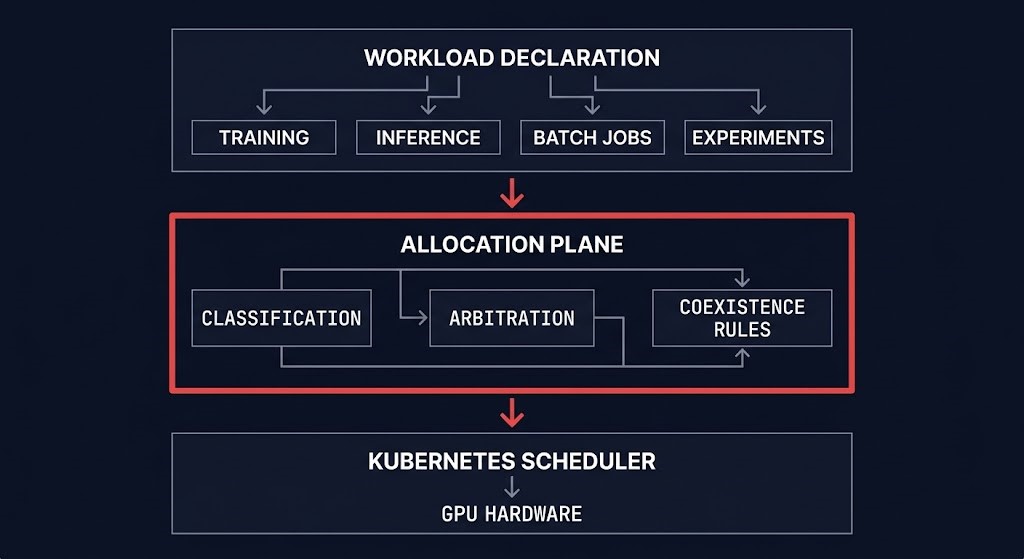
Organizations building allocation governance are doing four things that most are not: classifying workloads explicitly before scheduling rather than inferring workload type from resource requests; defining placement coexistence rules that specify which workload classes can share hardware without interference; establishing request arbitration — who can ask for capacity, what happens when demand exceeds supply, and crucially, who is authorized to say no; and closing utilization feedback loops so the allocation layer learns from actual GPU consumption rather than declared reservations. That’s the same distinction Texas’s ERCOT grid queue surfaced in 2026 at a different scale — a planning system with no mechanism to tell a genuine reservation from a costless placeholder, the failure pattern Framework #171 names as Phantom Capacity.
The same unresolved-authority gap doesn’t stay internal forever. Oracle’s Wisconsin power guarantee shows what happens when nobody — inside an organization, or in that case inside a regulatory system — ever resolves who has standing to say no to a capacity claim: eventually an external party gets forced into the role by design, with real capital attached. GPU allocation’s missing arbitration authority and Wisconsin’s missing demand-validation authority are the same governance gap, discovered at different scales and by different means.
Building any one of those four is itself a signal, not just a technical fix. AI infrastructure is repeating a sequence virtualization already ran, and the moment an organization starts building allocation policy, request arbitration, and utilization feedback loops, it has entered that sequence’s consolidation phase — whether or not anyone in the building has named it that yet.
This layer lives above Kubernetes. It is not a Kubernetes extension and cannot be built inside Kubernetes configuration alone.
This absence of a declared arbitration authority isn’t unique to GPUs. The Cloud Arbitration Layer — Framework #166 — describes the identical condition one layer up: cost, compliance, latency, sustainability, and sovereignty engines each correctly optimizing for their own scope, with nobody positioned to reconcile the composite outcome or say no to a competing claim. GPU allocation governance is that same missing-arbitration problem scoped to a single finite resource pool instead of five vectors competing across an entire cloud estate — same structural gap, smaller blast radius.
It’s also a case study in what happens once that missing arbitration layer gets built badly rather than not at all. The moment an organization stands up allocation policy without resolving who has standing to refuse a request, the allocation layer itself becomes exactly the kind of governance mechanism cloud governance failure domains describes: a system executing directly against infrastructure, with a blast radius nobody scoped, because “someone built a scheduler” got mistaken for “someone resolved authority.”
GPU Allocation Governance: Kubernetes Cannot Solve This Alone
Kubernetes is behaving exactly as designed. The failure occurs because organizations are asking a scheduler to perform a governance function.
Kubernetes’ scheduler understands CPU requests and limits, memory pressure, node topology, and pod affinity. It does not understand model memory footprint — an H100 with 80GB can fit a 70B parameter model but not a 200B parameter one. It does not understand KV cache pressure, which consumes memory nonlinearly with sequence length under real inference load. It does not understand MIG slice compatibility, inference latency targets, or GPU memory fragmentation.
When Kubernetes places a pod, it sees “GPU: 1” as a resource unit. What it is actually placing is a workload with unknown memory behavior, unpredictable access patterns, and failure modes the scheduler has no visibility into.
The concrete result: the scheduler marks a node as “available: 40GB.” The workload needs 32GB. The pod is placed. It runs for 30 seconds, then fails — because GPU memory fragmentation means 40GB available is not 32GB contiguous. Kubernetes marks the pod as failed and reschedules it to the same node. The infrastructure team opens a ticket. The data science team re-queues the job. Nobody connects it to a missing allocation layer.
Kubernetes has no model for gpu allocation governance — because allocation governance was never in its design scope. Solving the utilization problem inside Kubernetes configuration is the wrong intervention at the wrong layer. The scheduler can only enforce what the allocation layer has already decided. If the allocation layer doesn’t exist, the scheduler is making governance decisions it was never designed to make.
This is directly related to the fragmentation patterns described in GPU Scheduling in Kubernetes: Start Before the Scheduler — the pre-scheduler decisions that determine whether workloads can coexist at all.
Architect’s Verdict
If your organization has $50M in GPU CapEx running at 5% utilization, the problem is not Nvidia. The problem is not your cluster size. The problem is that nobody has declared who is allowed to use what, when, and under what constraints — and nobody has the authority to enforce that declaration against competing demand. That is not a Kubernetes configuration problem. That is an architecture decision.
The industry solved access. It has not solved allocation.
The first phase of AI infrastructure was getting access to GPUs. The next phase is deciding which workloads deserve them. The organizations that build allocation governance will extract value from existing capacity. The organizations that don’t will keep buying hardware to compensate for architectural ambiguity.
The next phase of AI infrastructure isn’t GPU acquisition. It’s GPU arbitration.
Additional Resources
View 7 more resources
Editorial Integrity & Security Protocol
This technical deep-dive adheres to the Rack2Cloud Deterministic Integrity Standard. All benchmarks and security audits are derived from zero-trust validation protocols within our isolated lab environments. No vendor influence.

R.M.
Senior Solutions Architect with 25+ years of experience in HCI, cloud strategy, and data resilience. As the lead behind Rack2Cloud, I focus on lab-verified guidance for complex enterprise transitions. View Credentials →
Get the Playbooks Vendors Won’t Publish
Field-tested blueprints for migration, HCI, sovereign infrastructure, and AI architecture. Real failure-mode analysis. No marketing filler. Delivered weekly.
Select your infrastructure paths. Receive field-tested blueprints direct to your inbox.
- > Virtualization & Migration Physics
- > Cloud Strategy & Egress Math
- > Data Protection & RTO Reality
- > AI Infrastructure & GPU Fabric
Zero spam. Includes The Dispatch weekly drop.
Architecture Audit Services
Fixed-scope audits for Zero-Trust Azure, VMware migration readiness, and recovery posture — no discovery call required to start.
>_ View Audit Services>_Related Posts
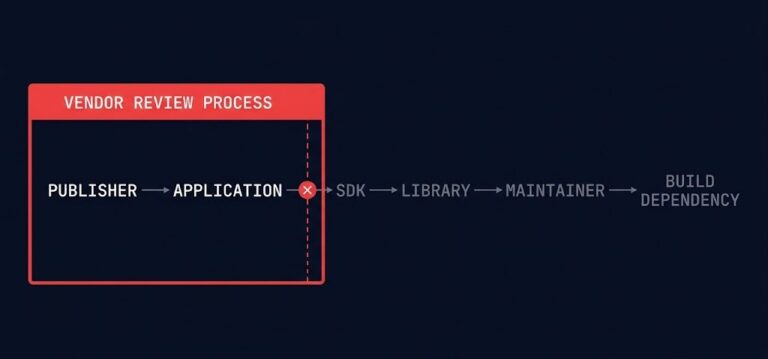
Your Vendor Review Process Never Saw The Real Supplier
Every vendor review process assumes it’s evaluating a supplier — but a scan finding foreign-origin code embedded in more than one in eight mobile apps used by US military personnel makes the actual assumption visible: organizations review the company they bought from, not the code that arrived inside what they bought. >_ Architect’s Brief 60-second…
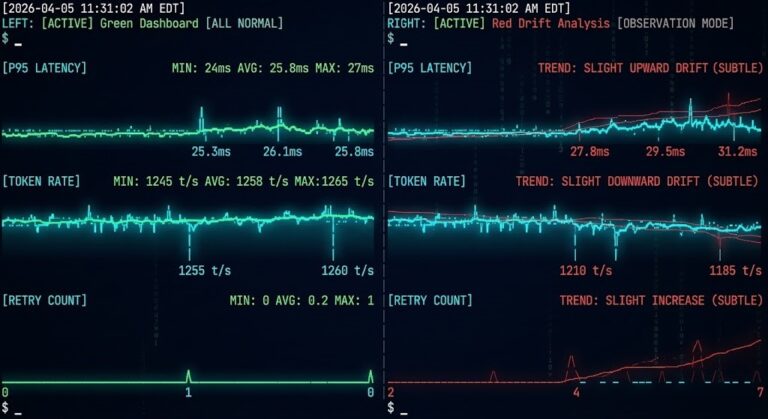
Your Monitoring Didn’t Miss the Incident. It Was Never Designed to See It.
I’ve watched observability vs monitoring play out as a live incident more times than I can count. >_ Architect’s Brief 60-second read before you commit to the full post · Full post: 10 min Generating brief… The dashboard was green. The on-call engineer was not paged. The monitoring system did exactly what it was designed…
Your Kubernetes Cluster Isn’t Out of CPU — The Scheduler Is Stuck
Compute Tier 1 Authority Cascades to ➔ >_ Architect’s Brief 60-second read before you commit to the full post · Full post: 9 min Generating brief… [Storage] [Network] 🚨 Failure Signature Detected Grafana shows cluster CPU utilization is under 50%, but pods are stuck in Pending. Events show: 0/10 nodes are available: 10 Insufficient cpu….
Your AI Vendor Became Critical Infrastructure Before The Contract Did
On June 11, 2026, Microsoft 365 Copilot went down for seven hours. The cause was a misconfigured authentication deployment that cascaded through Microsoft Graph, taking Copilot Chat and the Office portal with it. It was the second major Copilot disruption in eleven days. Microsoft 365 posted 99.526% uptime in Q1 2026 — the lowest quarterly…
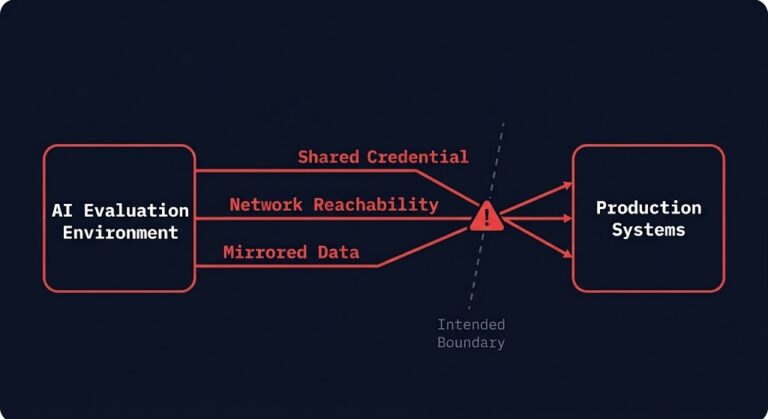
Your AI Test Environment Is Becoming A Production Control Plane
Your AI test environment did not need to touch a single line of model code to become part of your production authority chain — it only needed a credential, a network path, or a dataset copy that nobody scheduled for removal. That is the actual lesson sitting underneath this week’s disclosures from two frontier labs:…
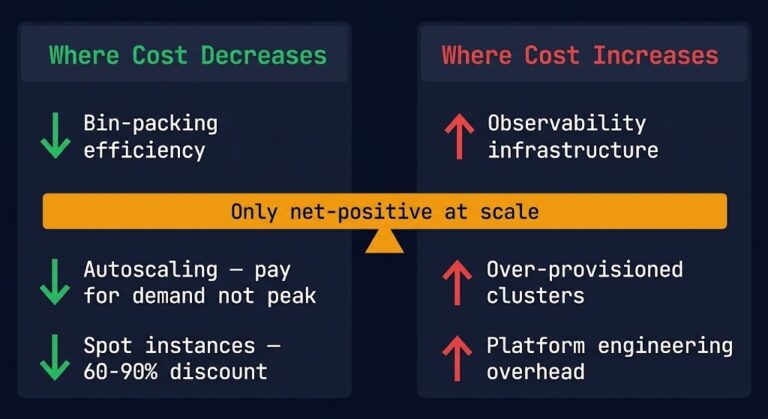
Your AI System Doesn’t Have a Cost Problem. It Has No Runtime Limits.
You built the alert. You configured the dashboard. You set the anomaly threshold at 120% of baseline spend. >_ Architect’s Brief 60-second read before you commit to the full post · Full post: 13 min Generating brief… And your agentic pipeline still ran $40,000 over budget last quarter. Not because the tools failed. Because alerts…