

Proxmox’s Arm64 Bet Runs On Lifecycle Parity, Not A Feature Release
Lifecycle parity is the detail buried inside Proxmox VE 9.2’s release notes that matters more than the feature itself: Proxmox now ships an officially supported Arm64 edition, matching its x86-64 builds on codebase, release cadence, and long-term support commitment, developed with joint NVIDIA and Supermicro validation on Grace Hopper Superchip systems, with certified support at launch for both the Grace and Vera CPU architectures. None of that happened by accident, and none of it is the story most coverage will tell.
Most of what gets written about Proxmox lives in one of two buckets: migration risk (leaving VMware) — the argument Proxmox Isn’t Replacing VMware. It’s Replacing Assumptions. already makes well — or cost comparison (avoiding Broadcom’s licensing terms). This isn’t either of those, and it isn’t a virtualization architecture migration story at all. Nothing here is about whether you should move off VMware, and nothing here depends on Broadcom fatigue. This is about a different question entirely: what does it mean when a hypervisor vendor decides a second CPU architecture is worth fully supporting — not experimenting with, not community-patching, but supporting at the same level as the architecture that built the company? That question matters independent of whether you have a single Arm server in your environment today, because the answer changes how you should read every other vendor’s next “now supports Arm” announcement.
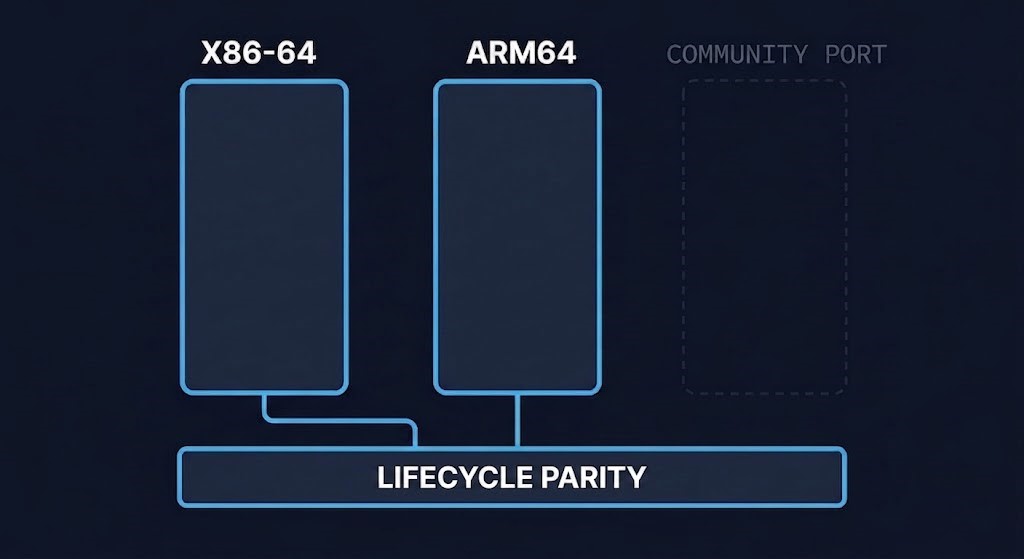
What Actually Shipped
Proxmox VE 9.2’s Arm64 edition is not a side project. It runs the same codebase as the x86-64 release — not a fork, not a stripped-down variant maintained on a separate branch that inevitably drifts behind the primary line. It follows the same release cadence, meaning Arm64 users get feature parity on the same timeline as everyone else, not a lagging port that catches up two point-releases later once the engineering team gets around to it. And it carries the same lifecycle commitment: the same support window, the same upgrade path guarantees, the same long-term maintenance posture that x86-64 customers have relied on for years.
Layered on top of that baseline is the detail that actually elevates this beyond an engineering milestone: joint validation from NVIDIA and Supermicro on Grace Hopper Superchip systems, with the Grace and Vera architectures both certified for support at launch. That’s not Proxmox declaring Arm64 support in the abstract and waiting for hardware vendors to catch up later, the way most “now supports Arm” announcements actually play out. That’s coordinated, simultaneous engineering work — the kind of cross-vendor alignment that takes months of commitment on both sides before a release date is ever announced. Coordinated validation programs like this typically require enough expected demand to justify engineering investment from all parties involved — NVIDIA and Supermicro don’t allocate that kind of joint engineering time casually.
Compare that to how most “Arm support” announcements actually work in enterprise infrastructure: a community-maintained build with a disclaimer at the top of the download page, a “best effort” support tier that quietly means “open a GitHub issue and hope,” a hardware compatibility list with asterisks next to half the entries and “untested” next to the other half. That’s the difference between an engineering exercise and a real, sustained commitment — and Proxmox’s Arm64 edition has none of the qualifiers that mark the former. There’s no separate download path for “the Arm one,” no forum thread explaining which features aren’t quite there yet, no fine print carving out an exception to the support SLA. That absence is the detail worth sitting with, because it’s rarer than the headline feature itself.
Why Lifecycle Parity Is The Signal, Not The Port
This is the argument the rest of the post depends on, so it’s worth being precise about what lifecycle parity actually means, what it costs a vendor to deliver, and why that cost is the thing worth reading as a signal rather than a marketing checkbox.
It’s tempting to read “Arm64 support” as a single, discrete engineering task — port the codebase, run the test suite, ship it. That’s not what happened here, and conflating the two is exactly how most vendor announcements get misread. A port is a point-in-time event. Lifecycle parity is a standing commitment that has to be renewed every release cycle, indefinitely, with no natural end date and no way to quietly wind it down without customers noticing. This is the same layer covered in the Compute Execution Architecture stage of the Virtualization Learning Path — the compute layer is exactly where architecture-level vendor commitments get tested first.
Compatibility Is Not The Same Thing As Support generalizes exactly this distinction beyond a single hypervisor release: compatibility is a technical fact, support is an organizational commitment, and the two decay on independent curves. A port proves the first. Lifecycle parity proves the second. Most vendor “now supports X” announcements only ever prove the first, and count on nobody checking for the difference.
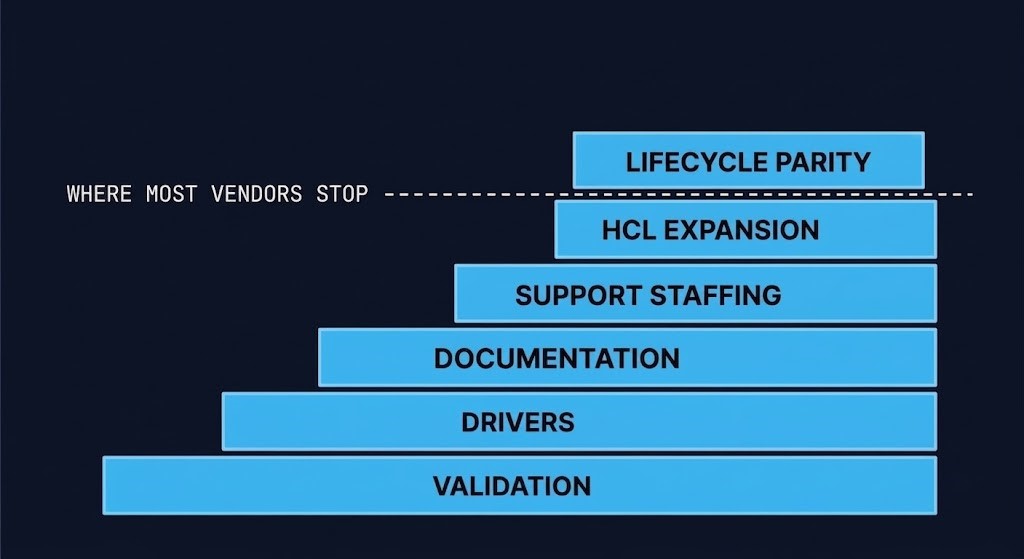
01 — WHAT LIFECYCLE PARITY MEANS
Same codebase. Same release cadence. Same support window. No “community edition” branch, no “experimental” flag, no separate patch schedule running behind the primary architecture. Arm64 gets everything x86-64 gets, on the same day.
02 — WHAT LIFECYCLE PARITY COSTS
Validation testing across the full compatibility matrix. Driver support maintained indefinitely, not until the next major release. Documentation written and kept current for a second platform. A support organization staffed and trained to troubleshoot architecture-specific issues at the same SLA. HCL expansion covering new hardware as it ships. Most vendors stop somewhere on this list — that’s where “supported” quietly becomes “supported, mostly.”
03 — WHY THE COST IS THE SIGNAL
Vendors don’t incur validation, driver maintenance, documentation, support staffing, and HCL expansion by accident, and they don’t sustain that spend indefinitely on a hunch. The expense itself is evidence the commitment is real — proof the vendor believes the architecture is durable enough to be worth the recurring bill, not just newsworthy enough to be worth the announcement.
This is the same diligence instinct Nobody Buys Capability Anymore. They Buy a Promise. argues buyers should be applying across every vendor relationship, not just this one: capability gets a vendor shortlisted, but continuity — proven through sustained, costly behavior rather than a roadmap slide — is what actually earns trust. Lifecycle parity is what that continuity signal looks like before anything has gone wrong to reveal it.
Put plainly: vendors don’t spend this kind of money accidentally. A community port costs a vendor almost nothing — a compiler flag, a disclaimer, a GitHub issue tracker for the handful of people who show up. Full lifecycle parity costs the vendor every quarter for as long as the architecture stays supported. That ongoing cost is not a side effect of the commitment. It is the commitment. An organization does not sign up for a permanent second support obligation to make a press release; it signs up for one because it has already concluded the architecture is going to matter enough, for long enough, that the alternative — half-supporting it and hoping demand doesn’t materialize — is the riskier bet.
Read against current demand, that spend looks exactly like the category The Cost Of Idle Capacity Nobody Budgets For calls Strategic Idle: capacity — engineering capacity, in this case, not compute — held and funded ahead of the utilization that would justify it on a pure consumption basis, because its value comes from existing as an option, not from being exercised yet. A utilization dashboard would flag Proxmox’s Arm64 investment as premature. That’s the same misread the idle-capacity argument names directly.
This is also why the distinction matters more for an infrastructure architect than for a casual reader of release notes. A port tells you what a vendor can technically do. That kind of sustained, budgeted, renewed-every-release investment tells you what a vendor is actually planning around. Those two things get described with identical marketing language, and they are not remotely the same commitment. It’s the same distinction underneath the argument that the hypervisor has become a commodity while operations have not: commoditization pressure is exactly what a vendor is trying to counter when it funds a second architecture at full parity rather than treating it as an afterthought.
The Industry Signal Isn’t Arm. It’s Optionality
Optionality is rarely created by a feature release. It is usually the result of the same lifecycle parity commitment this post has been describing, and this one deserves to be read as an industry signal rather than a Proxmox-specific one.
This is the same trade this site has already named at the pillar level. The Architecture Industry Is Quietly Replacing Optimization With Optionality argues the entire discipline has shifted from asking what performs best now to asking what survives being wrong later — and treats that shift as something happening to buyers, across virtualization, cloud, AI infrastructure, data protection, and governance. What follows here is the same mechanism read from the vendor’s side of the table instead.
For most of the last two decades, x86-64 wasn’t a decision infrastructure vendors made — it was an assumption they inherited. The tooling, the hardware ecosystems, the certification programs, the entire vendor relationship model all grew up around a single architecture, to the point where “which CPU architecture” stopped being a live question for most platform teams. What’s changing now isn’t that Arm is winning that argument. It’s that vendors are increasingly unwilling to have their platform strategy tied to a single CPU roadmap at all — regardless of which architecture currently has momentum.
That’s the deeper pattern Proxmox’s move belongs to, and the same pattern architects designing beyond a single hypervisor vendor have already been navigating at a different layer. Committing real engineering and support budget to a second architecture creates leverage long before adoption becomes widespread: leverage against a single hardware ecosystem’s roadmap decisions, leverage against a single vendor’s supply constraints, leverage against being structurally dependent on one CPU vendor’s pricing and availability. Platform vendors are beginning to treat architecture diversity the way well-run infrastructure teams treat vendor diversity generally — not because they expect to need the alternative tomorrow, but because refusing to build the alternative in advance is itself a form of exposure. Strategic leverage, in both cases, usually comes from preserving options before you need them, not after — the same principle behind why vendor lock-in happens through networking, not APIs: the exposure gets built in long before anyone notices it, at whichever layer nobody was deliberately preserving optionality.
The alternative is a forced version of the same commitment, made later and on someone else’s timeline. March 31 isn’t a deadline — it’s a forced architecture decision for exactly this reason: an organization that never built in optionality eventually has one imposed on it by a vendor’s contract terms instead of choosing it on its own schedule. Proxmox’s Arm64 investment is the deliberate version of that same commitment, made years before any contract forced the question.
None of this requires Arm to actually win a meaningful share of enterprise compute for the decision to already be worth making. Optionality has value independent of whether the option gets exercised. A platform vendor that can credibly say “we run natively, at full support parity, on either architecture” has already changed its negotiating position with every hardware supplier it deals with, whether or not a single customer ever deploys on the second one. That’s the part that gets lost when coverage treats Arm64 support as a feature checkbox: the value isn’t only realized on the day a customer buys Grace or Vera hardware. Some of it is realized the moment the vendor is no longer tied to a single hardware roadmap.
Proxmox isn’t the only vendor making this bet, and it likely won’t be the last. But the specific mechanism — investing in full lifecycle parity for a second architecture before market pressure forces the issue — is the part worth recognizing whenever it shows up again, at any vendor, in any layer of the stack. The architecture is almost incidental to the mechanism. What matters is that a vendor concluded optionality was worth its ongoing cost before anyone forced the question.
What Infrastructure Architects Should Actually Watch
The useful question isn’t “does the vendor support Arm?” That question is already answered by every marketing page in the industry, and it tells you almost nothing about how seriously to take the answer. Marketing copy costs nothing to write and nothing to keep saying, which is exactly why it can’t be the diagnostic. What you actually want to know is whether the answer describes lifecycle parity the vendor is prepared to keep funding, or a claim that happens to be technically true on the day it was published. The more useful lens is a due-diligence model that works well past this specific announcement, and well past Proxmox — one you can point at any vendor’s next architecture-support claim, in any layer of the stack:
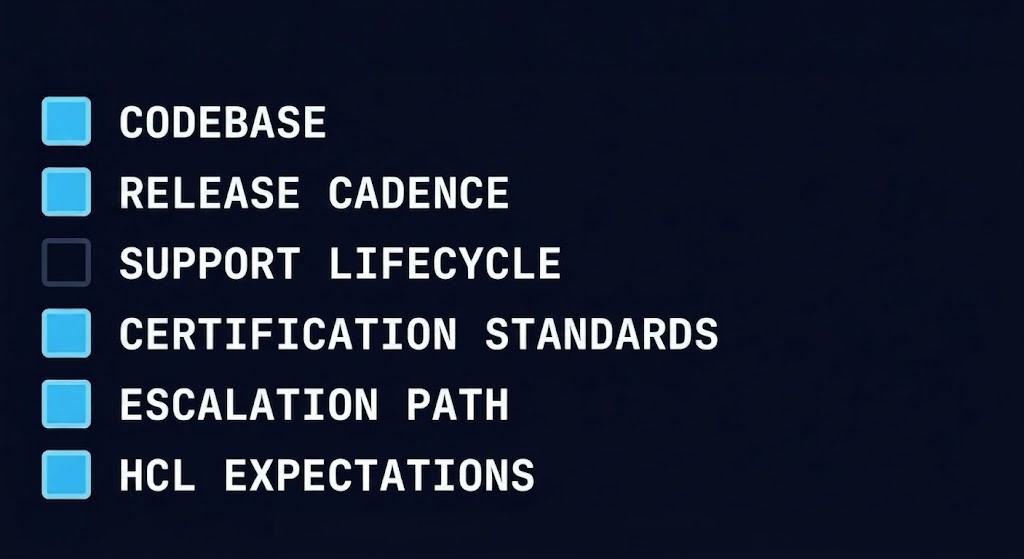
SIX QUESTIONS THAT SEPARATE LIFECYCLE PARITY FROM A FEATURE ANNOUNCEMENT
- Same codebase — not a separate branch maintained on its own timeline.
- Same release cadence — new features land on both architectures the same day, not staggered releases later.
- Same support lifecycle — an identical end-of-support horizon, not a shorter or unstated one.
- Same certification standards — a real HCL, not an asterisked “best effort” hardware list.
- Same escalation path — the same support queue and SLA, not a slower, secondary one.
- Same HCL expectations — new hardware validated on the same timeline, not months behind.
None of those six questions are steps in a sequence — they’re independent indicators, and any one of them answered “no” should downgrade your confidence in the vendor’s stated commitment, regardless of how the other five answer. A vendor that passes all six isn’t just supporting a second architecture. It has committed to lifecycle parity it intends to keep.
The same underlying test, run against a different vendor decision, produces the opposite verdict. When the Offload Doesn’t Earn Its Dependency covers VMware’s retreat from its SmartNIC-based network offload — a dependency the market ultimately wasn’t willing to keep paying for once conventional NICs closed the gap it was built to beat. Read side by side, the two posts are the same due-diligence instinct applied to opposite outcomes: Proxmox’s Arm64 investment is what sustained lifecycle parity looks like; VMware’s SmartNIC walk-back is what it looks like when the underlying value case stops justifying the cost.
Architect’s Verdict
Proxmox’s Arm64 edition is not a feature release, and treating it as one misses what actually happened. When a platform vendor grants a second CPU architecture full lifecycle parity, the architecture becomes the signal. The investment required to maintain that parity reveals a deeper commitment than any feature announcement ever could.
Most vendors never get past the announcement. They ship a community build, a best-effort tier, a hardware list with asterisks — and call it support. The gap between that and what Proxmox actually shipped is the entire argument: the commitment is expensive precisely because it’s real, and the expense is the only proof that matters.
The real underlying problem most coverage of moments like this misses is that “supports X” has become a phrase that means almost nothing on its own, because it costs vendors nothing to say it and almost everything to actually mean it — and the gap between those two states doesn’t show up in a press release. It shows up two years later, in whichever architecture the vendor quietly stopped fully supporting once nobody was watching the release notes closely enough to notice.
Read Arm64 support announcements the way you’d read any other lifecycle-parity claim: not by what’s announced, but by what the vendor was willing to keep paying for after the announcement ended.
Additional Resources
View 6 more resources
Editorial Integrity & Security Protocol
This technical deep-dive adheres to the Rack2Cloud Deterministic Integrity Standard. All benchmarks and security audits are derived from zero-trust validation protocols within our isolated lab environments. No vendor influence.

R.M.
Senior Solutions Architect with 25+ years of experience in HCI, cloud strategy, and data resilience. As the lead behind Rack2Cloud, I focus on lab-verified guidance for complex enterprise transitions. View Credentials →
Get the Playbooks Vendors Won’t Publish
Choose the architecture problems you care about. Get field-tested playbooks and frameworks delivered to your inbox.
- > AI Infrastructure & Inference Economics
- > Cloud Strategy & Hidden Cost Models
- > Virtualization & Deterministic Migration
- > Kubernetes, IaC & Modern Infrastructure
- > Data Protection & Recovery Engineering
Zero spam. Includes The Dispatch weekly drop.
Need Architectural Guidance?
Independent review before major infrastructure decisions.
- > Validate assumptions
- > Identify hidden dependencies
- > Quantify migration risk
- > Challenge vendor narratives
Triage · Advisory · Fractional · Direct Hire