

The Data Act Ends Switching Charges. Exit Costs Remain.
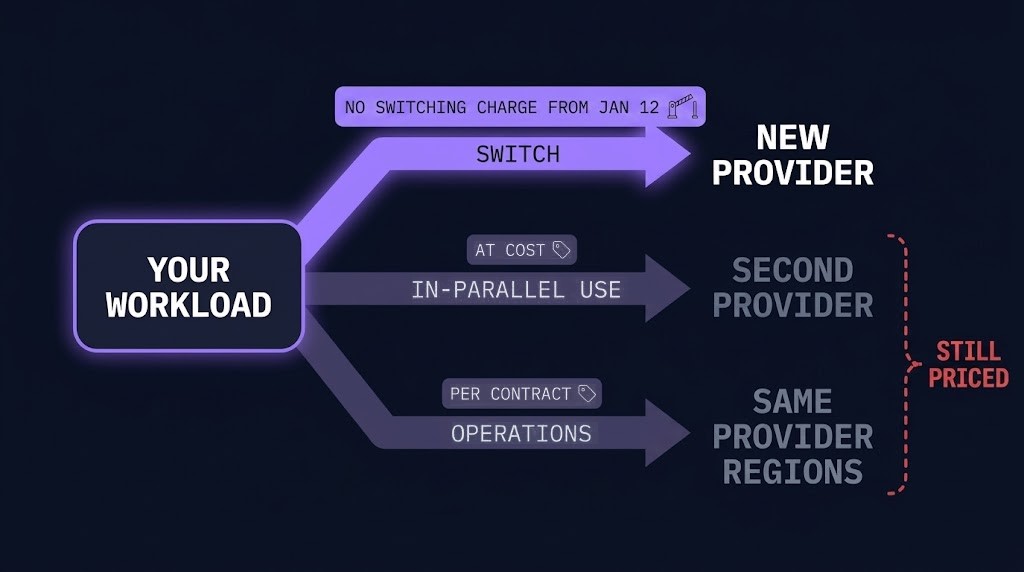
Switching charges end on January 12, 2027, for the data processing services that Regulation (EU) 2023/2854 covers. Exit cost does not end with them. The Data Act changes what a provider may charge for one flow, the switch. It does not change what it costs to stay able to move.
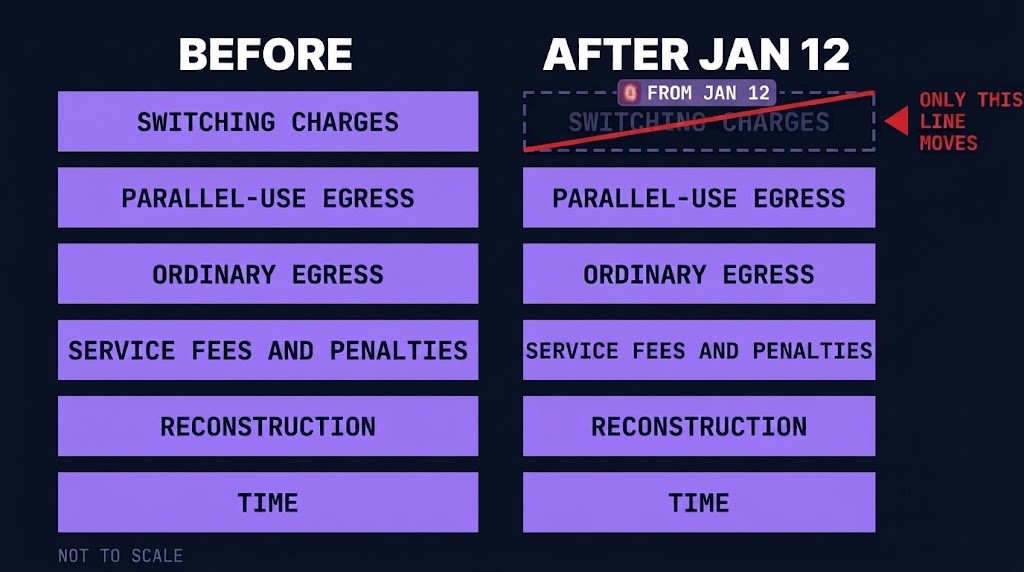
Most exit models carry provider egress as a single line, the shape Exit Cost Architecture describes alongside reconstruction and time. After January 12 that line splits into flows with different legal treatment, and a model that zeroes the whole line understates exit cost wherever the movement is not a switch. This post sorts the flows and adjusts the model. It does not explain Data Act compliance, and it is not legal advice.
What the Data Act Actually Prohibits
For a Cloud Strategy team, the useful question is which transfers the rule reaches. Two definitions carry it. Data egress charges are transfer fees for extracting data from one provider’s infrastructure to a different provider or to on-premises infrastructure (Article 2(35)). Switching charges are charges, other than standard service fees or early termination penalties, that a provider imposes for the switching actions the Act prescribes, and they include data egress charges (Article 2(36)).
Article 29 sets the timetable. From January 11, 2024, providers could impose reduced switching charges, capped at the costs directly linked to the switching process concerned. From January 12, 2027, Article 29(1) allows no switching charges at all. The prohibition attaches to the purpose of the transfer, not to the word egress. This table sorts the flows an exit model has to price.
| Flow | Treatment under the Act | Basis |
|---|---|---|
| Data extracted to a different provider or to on-premises to complete a switch | Switching charge: reduced and cost-capped until January 12, 2027, none from that date | Arts. 2(35), 2(36), 29 |
| Provider support actions the Act requires for the switch | Same as above | Arts. 2(36), 29 |
| Support beyond what the Act requires | Outside the definition; governed by what you agreed in advance | Art. 2(36); contract |
| Egress for in-parallel use of a second provider’s service | Charge permitted only to pass on egress costs incurred; no end date | Art. 34(2), Recital 99 |
| Operational movement that is not a switch: ordinary egress, inter-region transfer, failover, restore | Outside the switching-charge prohibition on the Act’s definitions; treatment follows the purpose of the transfer and your contract | Arts. 2(35), 2(36) |
| Standard service fees | Excluded from the definition of switching charges | Art. 2(36) |
| Early termination penalties | Excluded from the definition; whether a given penalty is proportionate or enforceable is a separate question | Art. 2(36), Recital 89 |
Parallel use is the row architects misread. Recital 99 separates the one-off egress a switch requires from the ongoing egress of running two services together. Article 34(2) lets a provider pass on egress costs for the second, at cost and without margin, and that treatment has no end date. It is a separate charge treatment. A charge’s label does not decide its category; the purpose of the transfer does. A multi-cloud design does not become free on January 12.
The second misread is the middle row. Sitting outside the switching-charge prohibition does not make every such charge valid or enforceable. It means this prohibition does not settle the question, and your contract and other law still do.
Where the Prohibition Does Not Apply
Article 31(1) takes Article 23(d), Article 29 and Article 30(1) and (3) out for data processing services whose majority of main features have been custom-built for an individual customer, or whose components were all developed for that customer, and which are not offered at broad commercial scale via the provider’s service catalogue. The exclusion turns on those stated conditions, so check whether your service meets them rather than assuming that customization does. It is not a full exemption from the switching chapter, and a provider relying on it should tell you before you contract which obligations do not apply.
Separately, the Commission’s November 2025 Digital Omnibus proposal, which commentary says would add relief for some custom-made services and some smaller providers, remains under negotiation and is not current law. The dates and obligations described here are those in the Data Act as currently in force.
Supervisors are not uniform either. The Dutch ACM published draft cloud guidance on October 19 for providers within its remit, and France’s Arcep issued draft guidelines in February on which costs may count toward switching other than egress, and separately on egress fees for multi-cloud customers. Neither is a universal interpretation.
Switching Charges Cover One Flow
An exit model usually names three ways exit gets expensive: a DR plan that cannot execute, a ransomware restore, and a multi-cloud design whose data layer sits with one provider. Run each through the table.
DR failover. A failover between one provider’s regions is ordinary operation, not a switch. A standing second-provider standby may look more like in-parallel use. Neither is a switch unless you are leaving, and neither is reached by the prohibition for that reason alone. Multi-Cloud Failover Is Mostly Theater covers why the data layer decides whether that failover works at all.
Ransomware restore. Restoring from backup is movement for recovery. It is a switch only if the restore is the last step of leaving the provider. Its cost follows your contract and your backup tier, the territory of Ransomware Recovery Time Is an Architecture Problem.
Multi-cloud operation. A second provider used alongside the first is in-parallel use: egress at cost, with no end date.
The classification questions repeat. Is the data leaving to complete a switch? Is the destination a second provider used alongside the first? Is the movement one-off or ongoing? What does the contract say? The Act answers the first question for the flow it names. The rest stay with your contract and your architecture.
What Stays in the Exit Cost Model
Exit Cost Architecture models exit as data movement, reconstruction and time. The Act touches the first, and only the part a provider levies for a switch. Reconstruction, the work of rebuilding the environment on the other side, and time, meaning transfer duration, sequencing and downtime, were never on the provider’s invoice. No January date removes them. Cloud exit validation asks whether the organization survives the move, and a cheaper switch does not answer that.
After January 12, these lines stay in the model:
- Egress for in-parallel use, at cost.
- Ordinary egress and inter-region transfer, per contract.
- Standard service fees and any early termination penalty.
- Reconstruction of the environment on the destination.
- Transfer time, sequencing and downtime.
DIAGNOSTIC QUESTION
“Re-run your exit model on January 13. Which lines are still non-zero, and which of them did you assume would disappear?”
Verify the Contract Before You Re-Baseline
Re-baselining starts from the contract, not from this post. Check these five items against the agreement and the order form.
01 — Charges listed
Article 25(2)(i) has the contract include the switching charges the provider may impose under Article 29. Record each one and its end date.
02 — Pre-contract information
Article 29(4) has the provider give clear information on standard service fees and early termination penalties before you contract. Compare it with what you signed.
03 — Notice and transition
Check the maximum notice period, capped at two months (Article 25(2)(d)), and the mandatory 30-calendar-day transition period (Article 25(2)(a)). If the provider claims that period is technically unfeasible, Article 25(4) requires notice within 14 working days, a justification and an alternative period no longer than seven months. The contract must also give you the right to extend the transition once (Article 25(3); Recital 87).
04 — Retrieval and erasure
Confirm a retrieval period of at least 30 days (Article 25(2)(g)) and what the contract says about erasing exportable data afterwards.
05 — Scope and exceptions
Confirm the service is a covered data processing service and not custom-built under Article 31(1); if the provider says it is, it should have told you before contracting which obligations do not apply. Read the parallel-use terms and any early termination clause.
Two limits apply. The article references in this post come from hosted reproductions of Regulation (EU) 2023/2854, not from a reading of the Official Journal, so check the wording there before you rely on it. Commentary also cites a Commission FAQ for the parallel-use treatment; this post does not rely on it. None of this is legal advice.
Architect’s Verdict
The Data Act prices one flow at zero. From January 12, 2027, a provider covered by Article 29 may not charge for the switch, egress for the switch included. That is a real change to the cost of leaving, and an exit model should take the line out where it applies.
The usual error is the extension of that change. Teams zero the whole egress line, or treat every transfer in a failover, a restore or a multi-cloud design as a switch. Parallel use stays chargeable at cost, operational movement follows its purpose and its contract, and reconstruction and time were never the provider’s to waive.
Classify each flow, read the contract, and re-baseline what the Act actually removed. The Act priced the switch at zero. It left the price of staying mobile where it was.
Additional Resources
View 2 more resources
Editorial Integrity & Security Protocol
This technical deep-dive adheres to the Rack2Cloud Deterministic Integrity Standard. All benchmarks and security audits are derived from zero-trust validation protocols within our isolated lab environments. No vendor influence.

R.M.
Senior Solutions Architect with 25+ years of experience in HCI, cloud strategy, and data resilience. As the lead behind Rack2Cloud, I focus on lab-verified guidance for complex enterprise transitions. View Credentials →
Get the Playbooks Vendors Won’t Publish
Choose the architecture problems you care about. Get field-tested playbooks and frameworks delivered to your inbox.
- > AI Infrastructure & Inference Economics
- > Cloud Strategy & Hidden Cost Models
- > Virtualization & Deterministic Migration
- > Kubernetes, IaC & Modern Infrastructure
- > Data Protection & Recovery Engineering
Zero spam. Includes The Dispatch weekly drop.
Need Architectural Guidance?
Independent review before major infrastructure decisions.
- > Validate assumptions
- > Identify hidden dependencies
- > Quantify migration risk
- > Challenge vendor narratives
Triage · Advisory · Fractional · Direct Hire