

Nobody Meant to Build an AI Control Plane
AI tool sprawl stops being a productivity problem the moment the tools start sharing operational authority.
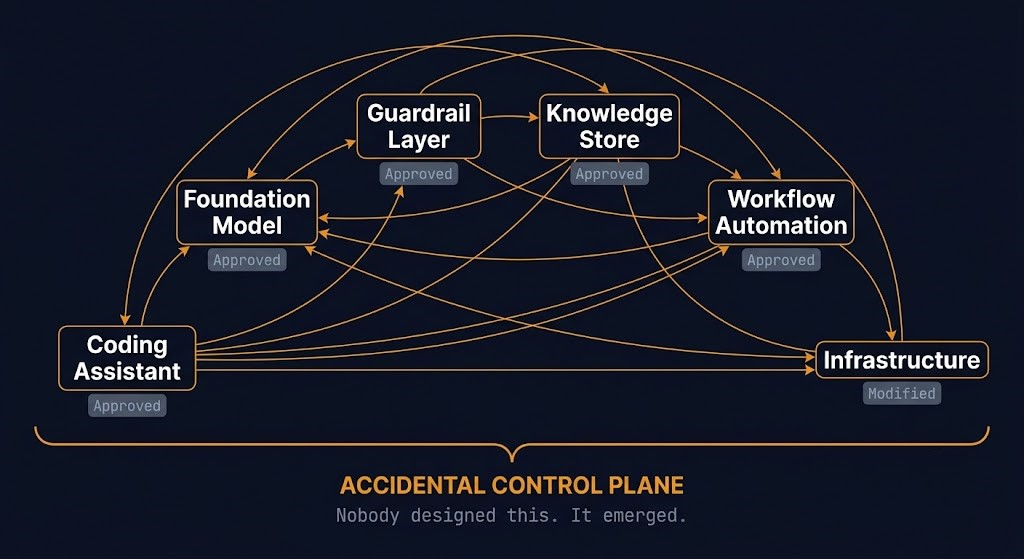
What they actually have is the early stages of an AI control plane. The tools arrived one purchase at a time. The platform emerged accidentally. Nobody designed it, nobody owns it, and in most organizations, nobody has noticed yet.
Every Tool Arrives as a Productivity Purchase
Nobody buys an AI tool and classifies it as infrastructure. That framing would trigger a different procurement process — architecture review, security assessment, integration standards, ownership assignment. None of that happens because none of it feels necessary.
They buy a coding assistant. A document copilot. A meeting summarizer. A research tool. A prompt gateway for the team that’s experimenting with automation. Each purchase is locally justified. An individual productivity improvement with a clear user and a clear use case. The infrastructure implications arrive later, and by then the tool is embedded.
This is not a failure of judgment. It is a predictable consequence of how AI tools are positioned and purchased. They enter organizations as software-as-a-service productivity tools because that is what they are — individually. The infrastructure character only becomes visible when you look at them collectively and ask a different question: not what does each tool do, but what does the set of them decide?
The Problem Is Dependency Order, Not Tool Count
The moment AI tool sprawl stops being a procurement problem and becomes a control plane problem is not when tool count gets high. It is when the tools form a decision chain.
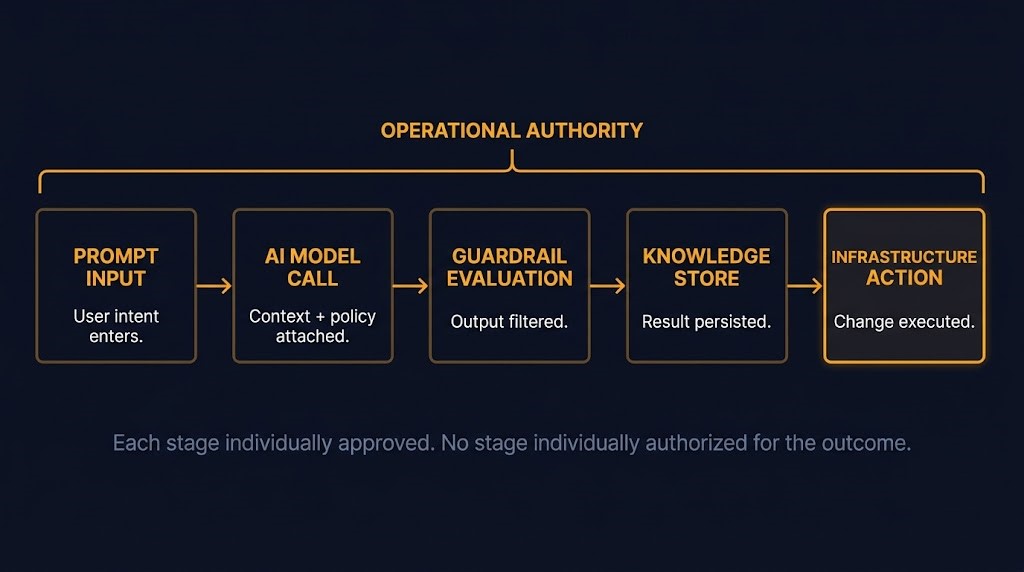
Consider what is actually happening across a typical technical organization right now. A prompt enters a coding assistant. The assistant calls a foundation model with organizational context attached. The output routes through an evaluation layer that checks it against policy guardrails. The result enters a shared knowledge store that other tools reference. Actions trigger downstream workflow automation that modifies infrastructure, updates documentation, or routes tickets.
At that point the organization no longer has five tools running in parallel. It has a runtime system. Inputs enter one end. Outputs exit the other. Operational decisions happen in between. And runtime systems — regardless of how they were assembled — require ownership, governance, and audit capability.
The individual tools are not the story. The dependency order between them is. A decision that begins in a coding assistant and ends in a deployed infrastructure change has passed through multiple AI systems, none of which was individually authorized to make that change, and all of which collectively did. That is the same authority migration pattern that runs through the entire Modern Infrastructure governance problem — the tools acquire operational authority before the organization decides who owns it.
This is the AI-specific instance of a broader pattern tool sprawl’s cost model names generally: cost and risk don’t scale with tool count, they scale with the relationships between tools once enough of them accumulate. The AI decision chain described here is what that compounding looks like when the relationships aren’t just cost and governance overhead but an actual runtime handing off operational authority tool to tool.
The Accidental Control Plane: the moment when individually approved AI tools begin collectively influencing how work is performed, what decisions are made, and which actions are executed — without anyone having designed them to do so.
The Org Chart Never Noticed
Governance tooling built over the last decade was designed to track a specific set of things: SaaS application inventory, infrastructure asset state, security control posture, access and identity. It was not designed to track AI decision chains. It has no concept of a chain that spans five tools, three vendors, and two infrastructure boundaries.
So the existing governance apparatus looks at the individual tools and sees what it was built to see — a set of approved applications with known users, known vendors, and known data classifications. It does not see the operational authority those tools have collectively acquired. It cannot see it. The visibility surface was never built.
The result is the same structural problem that has appeared repeatedly across infrastructure governance failures: authority moves before ownership does. The AI team thinks they are buying productivity tooling. The platform team does not know the workflow exists. Security sees individual tool approvals, each of which passed review. Nobody sees the emerging control plane because nobody is looking for a control plane — they are looking for tools, and the tools all check out. “Checks out” is doing a lot of work in that sentence, and GhostApproval is the sharpest illustration of how little it can mean: an individual tool’s approval step can render correctly, get answered by a human, and pass review completely, while describing an action that isn’t the one actually executing underneath it.
The visibility problem compounds when the tools themselves aren’t classified correctly. Many of the agents running inside these decision chains were never identified as agents — they arrived as workflow automation, passed procurement as SaaS tools, and were never inventoried as entities with execution authority. The classification failure that drives this is documented in The AI Agent Inventory Gap Nobody Is Measuring — when agents get classified as workflows, they don’t just evade the governance apparatus, they evade the inventory layer entirely.
By the time someone in the organization asks who owns the AI decision chain, the chain has been running for months. It has organizational dependencies. Teams have built workflows around it. The control plane is not being built — it has already been built. The question of ownership arrives after the fact.
This is not unique to AI. The Shadow Control Plane pattern appeared in CI/CD pipelines, in Kubernetes operators, in IaC automation. In each case, the infrastructure character of the system was invisible until something went wrong. AI tool chains follow the same trajectory with one additional dimension: the outputs are harder to trace, the decision logic is probabilistic rather than deterministic, and the audit trail is often incomplete or absent entirely.
Built by Accident, Governed by Choice
Shadow IT happened because software became easy to buy. Individual teams could acquire capabilities without going through central IT — and they did, because central IT was slow and the software was useful.
AI tool sprawl is happening because operational authority became easy to distribute. Individual teams can now assemble decision systems from approved tools without anyone recognizing that they are building decision systems. The tools pass procurement. The chain never gets reviewed.
The organizations that recognize the Accidental Control Plane forming early will govern it — establishing ownership, mapping dependency order, defining audit boundaries, and integrating AI decision chains into the same governance model that covers the rest of their operational infrastructure. The organizations that don’t will eventually discover they built one anyway. The difference is whether they find out by design or by incident.
The tools are not the story. The control plane they quietly become is. The structural pattern this describes — authority accumulating in undesigned layers before ownership is assigned — is the same migration documented in The Console Is the Shadow Control Plane at the CI/CD layer and in The AI Control Plane Is Becoming the New Shadow IT at the inference layer. Both posts map how authority vacuums form and what the governance response requires. The architectural model for governing execution authority once the control plane has formed — who holds final say over what runs, what enforces it, and what constitutes Runtime Authority Vacuum — is the domain of Governance & Runtime Control (A6) in the AI Infrastructure Architecture Path. Organizations that want that mapping done externally rather than reconstructed internally can get the same authority-fragmentation scoring from the AI Governance Assessment — the audit-service counterpart to doing this architecture review yourself.
Architect’s Verdict
AI tool sprawl is a productivity problem until the tools start sharing operational authority. At that point it is an infrastructure governance problem wearing a SaaS subscription invoice.
Most organizations will not recognize the transition until the control plane is already operational. The governance apparatus that should catch it is looking for tools, not chains. The procurement process that approved each tool was never asked to evaluate what the tools collectively decide.
The Accidental Control Plane does not require intent. It requires only that individually useful tools acquire enough organizational dependency to influence outcomes — and that nobody notices until the ownership question becomes urgent.
Additional Resources
View 1 more resource
Editorial Integrity & Security Protocol
This technical deep-dive adheres to the Rack2Cloud Deterministic Integrity Standard. All benchmarks and security audits are derived from zero-trust validation protocols within our isolated lab environments. No vendor influence.

R.M.
Senior Solutions Architect with 25+ years of experience in HCI, cloud strategy, and data resilience. As the lead behind Rack2Cloud, I focus on lab-verified guidance for complex enterprise transitions. View Credentials →
Get the Playbooks Vendors Won’t Publish
Choose the architecture problems you care about. Get field-tested playbooks and frameworks delivered to your inbox.
- > AI Infrastructure & Inference Economics
- > Cloud Strategy & Hidden Cost Models
- > Virtualization & Deterministic Migration
- > Kubernetes, IaC & Modern Infrastructure
- > Data Protection & Recovery Engineering
Zero spam. Includes The Dispatch weekly drop.
Need Architectural Guidance?
Independent review before major infrastructure decisions.
- > Validate assumptions
- > Identify hidden dependencies
- > Quantify migration risk
- > Challenge vendor narratives
Triage · Advisory · Fractional · Direct Hire