

The AI Observability Layer Is Becoming a Governance System
Most enterprises have observability. Almost none have built the governance architecture that observability is quietly becoming.
The AI observability layer started as a debugging tool — latency traces, token counts, error rates. It is becoming something structurally different: the enforcement layer for cost gates, routing decisions, authorization decisions, and execution approval. That is not an incremental capability upgrade. That is a category change. Most organizations still budget, staff, and operate the ai observability governance function as if that transition never happened.
The Observability Layer Was Never Designed for Governance
Traditional monitoring assumes deterministic systems. A process ran or it didn’t. A request succeeded or failed. The signal is binary and the tooling is built around binary interpretation.
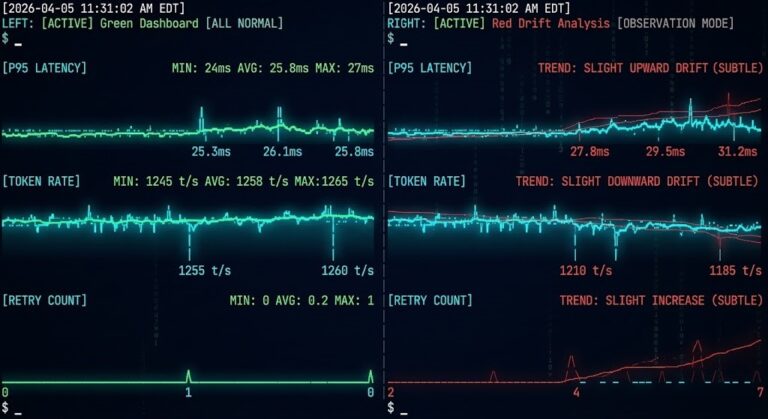
That model breaks for AI inference. Execution in AI systems produces behavioral variance inside “success.” A 200 OK response tells you nothing about whether the model stayed within policy, whether cost remained within the approved budget envelope, or whether the output fell within the confidence parameters the system was deployed under. Success codes are structurally inadequate as governance signals — and the monitoring infrastructure built around them inherits that inadequacy.
The semantic gap is not a tooling problem. It’s an architectural mismatch: what observability tools surface (latency, throughput, error rate) is disconnected from what governance requires (authorization boundary, cost attribution, behavioral compliance). The gap exists not because the tools are deficient but because they were designed to answer a different class of questions than governance asks.
Buying better dashboards doesn’t close the gap. Better dashboards produce better answers to the wrong questions.
See also: Your Monitoring Didn’t Miss the Incident. It Was Never Designed to See It.
AI Observability Governance Is Quietly Becoming an Enforcement Layer
This is where the transition is already happening in production AI environments — without most organizations recognizing it for what it is.
Observability data is now being used to drive enforcement decisions in real systems:
Cost gates — per-request cost signals that throttle or terminate execution before the request completes, not in the following billing cycle. The observability layer is producing the signal that stops the execution.
Routing decisions — model selection logic conditioned on observed cost, latency, and capacity state. The system routes differently because of what the observability layer sees. That is an enforcement action driven by observability data, not a configuration parameter set in advance.
Authorization decisions — execution permitted or denied based on observed policy state, not just request headers. Whether this call proceeds depends on what the observability layer currently knows about consumption, behavioral state, and policy compliance.
Execution approval in agentic chains — task sequences where observability of prior execution determines whether subsequent steps are permitted. An agent’s next action is gated on what was observed about its previous one.
Each of these is an enforcement action, not a reporting action. The moment observability data feeds a decision that affects execution, the observability layer has acquired authority. The architecture needs to be built to reflect that.
See also: Your AI System Doesn’t Have a Cost Problem. It Has No Runtime Limits. · The Model Answered. Nobody Asked Who Authorized That.
The Moment AI Observability Stops Being Passive
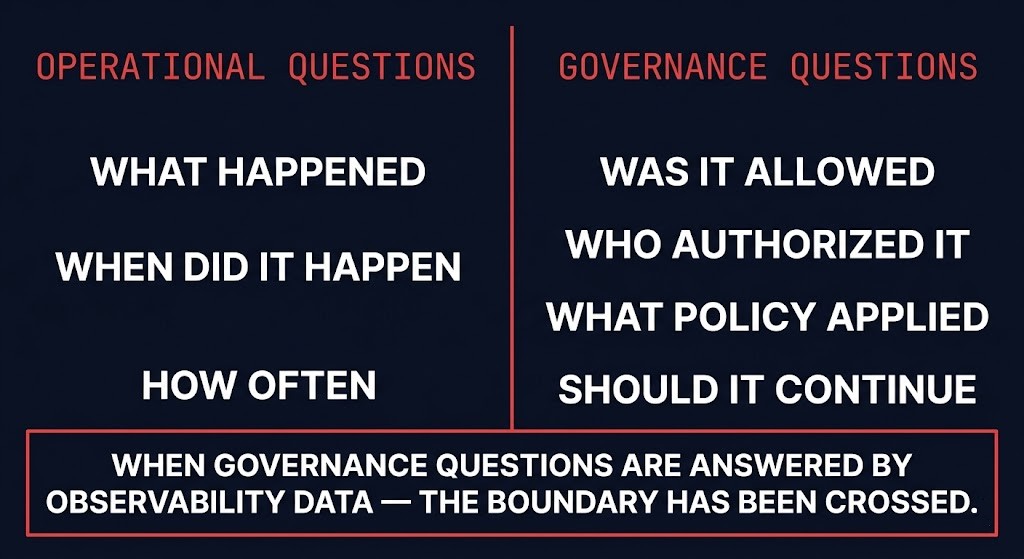
Traditional observability answers a specific class of questions:
- What happened?
- When did it happen?
- How often did it happen?
Those questions are oriented toward post-hoc analysis. The observability layer records what occurred; humans review what was recorded. The data is authoritative but passive — it describes what happened, it does not affect what happens.
Governance asks a categorically different class of questions:
- Was this execution allowed?
- Should it continue?
- Who authorized it, under what policy, with what constraints in effect at execution time?
- Who has the authority to stop it?
The architectural transition occurs when the answers to those governance questions are derived from observability data. Not reviewed in a dashboard later — derived in real time to determine what the system does next. At that point the observability layer is no longer passive infrastructure recording system state. It has become part of the decision system determining what the system is permitted to do.
This transition is not a future state. It is occurring now, in every organization deploying cost gates, routing policies, and inference authorization layers — whether or not they have recognized that the observability infrastructure is carrying governance responsibility.
Framework #121 — The Observability Authority Boundary
The Observability Authority Boundary marks the point at which observability infrastructure transitions from passive visibility to active governance enforcement — the point where what is seen determines what is permitted.
FRAMEWORK #121
Observability Authority Boundary
The point at which AI observability infrastructure transitions from passive visibility to active governance enforcement — where what is seen determines what is permitted.
BELOW THE BOUNDARY
Data collection, dashboards, alerting. Operationally valuable. Not governance. The observability layer reports what happened; no execution path depends on what it sees.
CROSSING THE BOUNDARY
The observability layer crosses this boundary the moment execution outcomes become contingent on observability signals: a request blocked because a cost threshold was exceeded; an agent halted because observed policy state changed; a model routing decision altered because behavioral drift was detected. Once execution behavior changes based on observability data, the observability layer is no longer passive.
ABOVE THE BOUNDARY
Policy enforcement, audit trail production, compliance attestation. The observability layer is now structural governance infrastructure. It owns authorization state, cost attribution, and behavioral compliance signals — not as reports, but as authoritative inputs to execution decisions.
NAMED FAILURE STATE
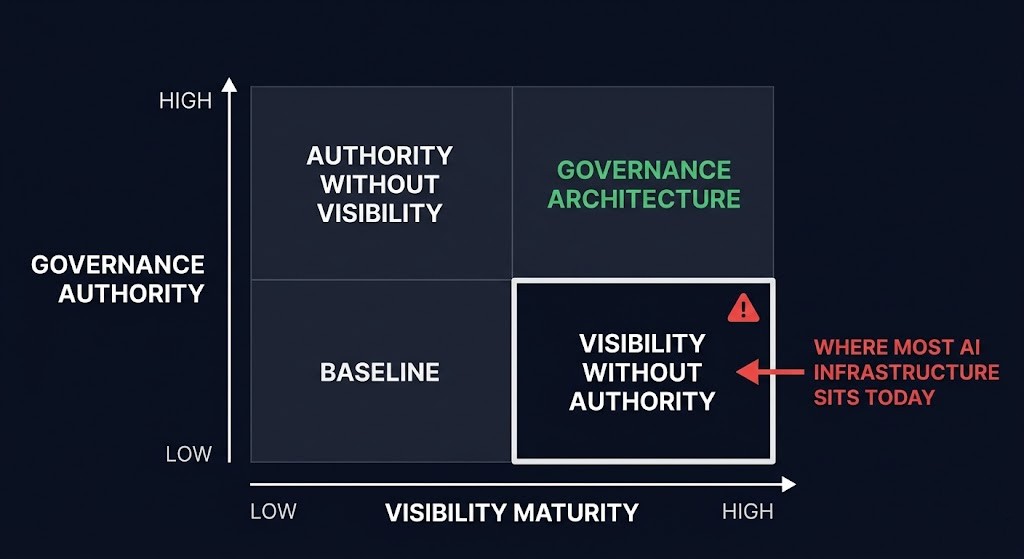
Visibility Without Authority — the organization has complete observability of AI execution behavior but no architectural mechanism to act on what it sees. Everything is visible. Everything is auditable. Nothing is controlled.
Maturity signal: Can your observability layer stop an execution, not just record it?
If the answer is no, the architecture is still below the boundary — regardless of how sophisticated the dashboards are.
That maturity signal is the same test Predictable Degradation and Continuity apply to infrastructure generally, asked at the observability layer specifically: not whether the system is visible, but whether it can be trusted to stay legible and stoppable under partial failure. A workload carrying real operational consequence needs an observability layer that’s crossed the Authority Boundary — one that can act, not just report — before it needs a better dashboard.
Vendor control planes are now shipping a version of that crossed boundary natively. Every AI Platform Is Becoming An Authority Platform examines VMware’s AgentMinder, Microsoft’s Entra Agent ID, and Salesforce’s Agentforce governance stack — each pairs a dynamic policy engine with an OpenTelemetry-based audit layer that produces chain-of-custody records at invocation time, not after the fact. That’s the Observability Authority Boundary (#121) crossed by design rather than by accumulated architecture decisions. It’s also a narrower claim than it looks: each vendor’s audit layer only sees what happens inside that vendor’s own platform, which means the cross-system visibility plane this post argues for still doesn’t exist the moment an agent’s authority spans more than one of these three platforms.
The Best Dashboard Can Still Be Architecturally Blind
This is the argument that most observability content gets backwards.
The standard framing is: more visibility equals more control. Invest in better tooling, get more data, improve dashboards, achieve better outcomes. The causal chain runs from visibility to control as though they were the same variable.
They are not.
An observability platform can deliver perfect traces, complete cost attribution, accurate latency distribution across percentiles, and precise error attribution down to the request level — and still be architecturally blind to the questions governance requires.
Because it cannot answer:
- Who authorized this execution?
- Which policy permitted this model to be selected for this request?
- What constraint was in effect at execution time when this cost was incurred?
- Who currently has the authority to stop this?
The system is not blind because it lacks data. It is blind because it lacks authority context. Visibility and authority are independent variables. An organization can have complete visibility with zero authority — and that is precisely the failure state most AI infrastructure is converging on.
Authority context does not appear in execution traces by default. It has to be deliberately propagated through the execution chain: the authorization chain, not just the request chain. The policy state at execution time, not just the outcome. Who permitted what under which constraints, captured at the moment of execution — not reconstructed afterward from logs.
That is architectural work. It requires decisions about what the observability layer is responsible for. Most teams haven’t made those decisions because they haven’t recognized that the observability layer has acquired that responsibility.
See also: Autonomous Systems Don’t Fail. They Drift Until They Break. · 200 OK is the New 500: The Death of Deterministic Observability
How Enterprises Are Misreading This Problem
The tactical misreads are predictable. Deploying better dashboards when the gap is authority architecture. Treating the problem as a logging and retention question rather than a real-time enforcement question. Per-team tooling that produces visibility silos — each team sees its own AI execution, no one sees cross-system behavioral state or cross-model authorization.
The structural misread is more consequential.
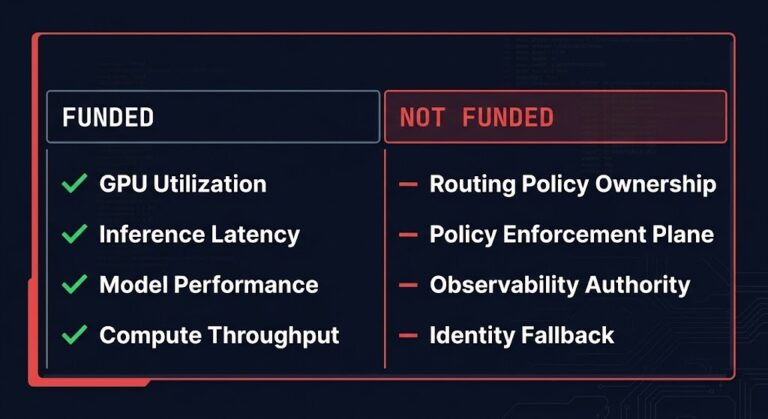
Most AI programs can justify observability spending because dashboards produce demonstrable deliverables. A CTO can see the dashboard. Utilization is measurable. Cost trend lines appear on slides. Observability spending passes a straightforward cost justification test.
Governance infrastructure is harder to justify. Authority ownership doesn’t appear on executive scorecards. The value of an enforcement layer is negative — it prevents outcomes that therefore never materialize, which means there is nothing visible to attribute the investment to. The governance plane is invisible when it’s working.
The result is predictable: visibility improves faster than control. Enterprises fund the layer they can demonstrate and defer the layer they can’t easily quantify — until an authorization failure, a cost overrun with no attribution, or a compliance audit makes the deferral visible.
This is Framework #107 (Governance Investment Inversion) expressed in the observability domain. The enterprise is not failing to invest. It is investing efficiently into the measurable layer while systematically underinvesting in the layer that would make that investment produce governance outcomes.
See also: Your AI Infrastructure Is Probably Solving the Wrong Problem · Agentic AI Has a Control Plane Problem
⚠ GOVERNANCE FAILURE PATTERN
Visibility Without Authority is the operational state where an enterprise has complete observability of AI execution behavior but no architectural mechanism to act on what it sees. Everything is auditable. Nothing is controlled. This is a governance architecture failure. The dashboard is not the problem. The absence of authority behind it is.
What the Governance-Layer Observability Stack Actually Requires
The architectural requirements are not product selections. They are design decisions about what the observability layer is responsible for.
Real-time cost attribution. Per-request cost signal attributed to requestor, model, and policy scope before the request terminates — not in the next billing cycle, not in a weekly report, not after the next cost review. By the time the aggregate appears in billing, the architectural decision that drove the overrun is invisible. Attribution has to happen at execution boundary to be actionable.
Authorization context propagation. The execution trace must carry the authorization chain, not just the request chain. Who authorized this execution, under what policy scope, with what constraints in effect at the time the request was processed. Standard traces capture the request; governance requires the authorization. These are different things and require different instrumentation.
Behavioral envelope monitoring. Statistical tracking of output characteristics against deployed model parameters — not error rate monitoring, behavioral drift monitoring. The ability to detect when a model’s output distribution has shifted outside the envelope it was evaluated and deployed for. This is a different signal class than latency or throughput, and it requires deliberate architecture to capture.
Cross-system visibility plane. A governance signal that spans team and tooling boundaries. Not a SIEM. Not a dashboard. An authoritative state layer that owns cross-system behavioral truth — so that when authorization, cost, and behavioral compliance questions are asked about the AI system as a whole, there is a single authoritative answer rather than a collection of team-scoped partial answers.
Enforcement hooks. Observability data must feed back into execution decisions, not only into reporting pipelines. The loop has to close. A cost gate that fires on observed data is an enforcement hook. An agent halt triggered by policy state change is an enforcement hook. Dashboards that generate alerts that humans review and then decide to act on are not enforcement hooks — they are delayed reporting with an optional human step. The authority side of that gap is diagnosable before an incident surfaces it. The AI Runtime Governance Analyzer maps authority fragmentation across seven governance domains — including who holds final authority to deny or halt inference execution — and surfaces the Runtime Authority Vacuum condition when that authority is undefined.
See also: Inference Observability: Why You Don’t See the Cost Spike Until It’s Too Late · Autonomous Operations Require Infrastructure Most Enterprises Don’t Have
The Infrastructure Implication
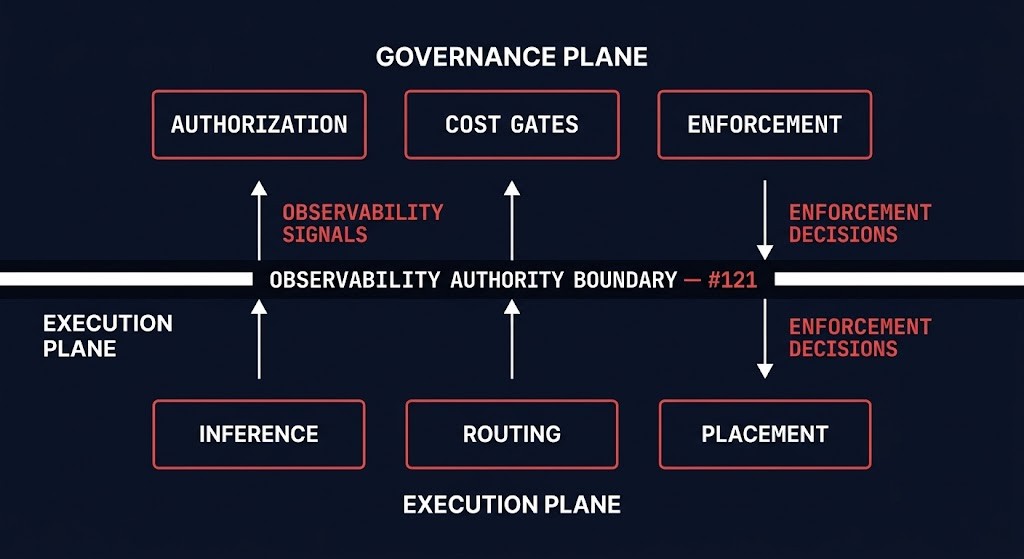
Organizations deploying AI at scale converge on a two-plane architecture: the execution plane (inference, routing, placement) and the governance plane (observability, authorization, enforcement). Most architectures today have the first plane built and instrumented. The second is absent, partial, or bolted on post-incident.
The question is not whether a governance plane exists. The question is whether it was intentionally designed or emerged accidentally through accumulated tooling decisions. An accidental governance plane has coverage gaps, authority ambiguities, and enforcement inconsistencies that are invisible until something fails — and the post-mortem requires answering questions the architecture was never built to answer.
The observability layer is where the governance plane gets built — or doesn’t. Infrastructure architects own that decision. Not security teams. Not AI product owners. The architects who design the observability layer are deciding, by default or by intent, whether it carries governance authority. That decision is being made right now in every organization building AI infrastructure, usually without being recognized as a governance decision at all.
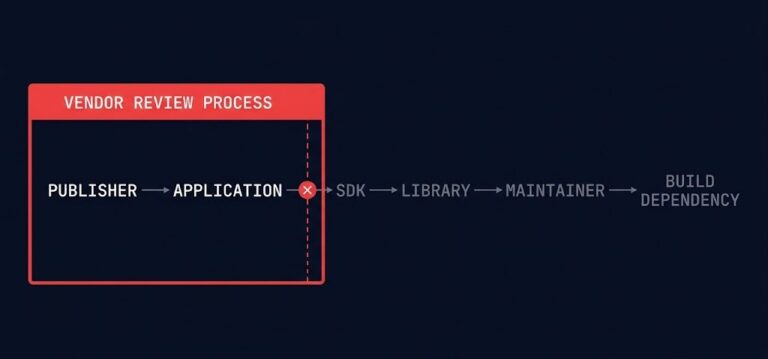
The governance gap compounds when the agents the observability layer is supposed to govern were never inventoried. An observability architecture designed to enforce authorization context and behavioral compliance presupposes knowing what agents exist to enforce against. When agents arrive through non-infrastructure paths and get classified as workflows, they operate below the observability governance plane entirely — not because observability is absent, but because the inventory layer that would surface them was never populated. That prior failure is documented in The AI Agent Inventory Gap Nobody Is Measuring.
See also: The Network Is Becoming the AI Control Plane · The Control Plane Shift: Every Infrastructure Decision Now Looks the Same
Architect’s Verdict
The AI observability layer began as a debugging tool. It is becoming the place where organizations decide what AI systems are allowed to do.
The moment observability data starts determining execution, authorization, cost limits, or policy enforcement, the observability layer is no longer operational tooling. It has become governance infrastructure. The architecture that was adequate for recording what happened is not adequate for governing what happens next.
Observability produces visibility. Evidence produces proof. The distinction matters when governance requires demonstrating not just what happened but what was authorized to happen — and why. The architectural gap between those two requirements is examined in AI Systems Need Evidence, Not Just Observability. The procurement failure underneath that architectural gap — why most organizations never assigned evidence generation as a purchase requirement in the first place — is the direct subject of You Bought an Observability Layer. You Needed an Evidence Layer. The EU AI Act’s Article 12 turns that gap from an architectural nicety into an enforceable obligation — the same telemetry-versus-proof distinction, now with an August 2026 compliance clock attached.
Visibility and authority are independent variables. An organization can have complete observability — perfect traces, accurate cost data, full behavioral telemetry — and still have zero governance authority over its AI systems. The dashboard is not the problem. The absence of enforcement architecture behind it is.
Organizations that continue treating the observability layer like a dashboard stack will eventually discover the difference the same way every authority failure is discovered: after the decision has already been made.
Additional Resources
AI INFRASTRUCTURE TRACK
Next → COMING SOON
Platform Engineering Created a New Shadow Operations LayerEditorial Integrity & Security Protocol
This technical deep-dive adheres to the Rack2Cloud Deterministic Integrity Standard. All benchmarks and security audits are derived from zero-trust validation protocols within our isolated lab environments. No vendor influence.

R.M.
Senior Solutions Architect with 25+ years of experience in HCI, cloud strategy, and data resilience. As the lead behind Rack2Cloud, I focus on lab-verified guidance for complex enterprise transitions. View Credentials →
Get the Playbooks Vendors Won’t Publish
Field-tested blueprints for migration, HCI, sovereign infrastructure, and AI architecture. Real failure-mode analysis. No marketing filler. Delivered weekly.
Select your infrastructure paths. Receive field-tested blueprints direct to your inbox.
- > Virtualization & Migration Physics
- > Cloud Strategy & Egress Math
- > Data Protection & RTO Reality
- > AI Infrastructure & GPU Fabric
Zero spam. Includes The Dispatch weekly drop.
Need Architectural Guidance?
Unbiased infrastructure audit for your migration, cloud strategy, or HCI transition.
>_ Request Triage Session