

Sovereignty Without Evidence Is Just Marketing
Sovereignty evidence is the difference between an architecture that can survive an audit and one that only survives a sales call. Ask ten organizations whether their data is sovereign and most will answer yes. Ask them to produce evidence — proof of where authority actually resides, who controls the encryption keys, what jurisdiction governs recovery operations, and how those controls get validated on an ongoing basis — and the conversation changes immediately. The yes turns into a pause, and the pause is the whole problem.
That gap between claim and proof used to be invisible because nobody was checking. It isn’t invisible anymore — and it’s a question that sits squarely inside cloud strategy architecture, not off to the side of it.
The Claim Era Is Over
For most of the last decade, “sovereign” was a marketing word attached to a map. A vendor would point at a data center pin somewhere inside national borders and call the problem solved. Residency became a proxy for sovereignty, and nobody pushed past the proxy, because there was no standard to push against — no scoring system, no assurance level, no way to fail. There was no concept of sovereignty evidence at all, because nobody had built the instrument that could demand it.
That made the claim unfalsifiable. An unfalsifiable claim isn’t an architecture decision. It’s copy.
The proxy breaks on a simple question: who can compel access to that data center, regardless of which country it physically sits in? A facility inside EU borders operated by a provider subject to extraterritorial legal reach doesn’t grant the protection the location pin implies. The EU’s own Cloud Sovereignty Framework makes this explicit — it scores a provider’s exposure to laws like the US CLOUD Act as a distinct, lower-scoring condition, independent of where the servers are racked. Jurisdiction over the operator beats geography of the hardware every time legal compulsion is the threat model. Residency answers “where.” It has never answered “who can reach in and take it.”
What the EU Actually Built
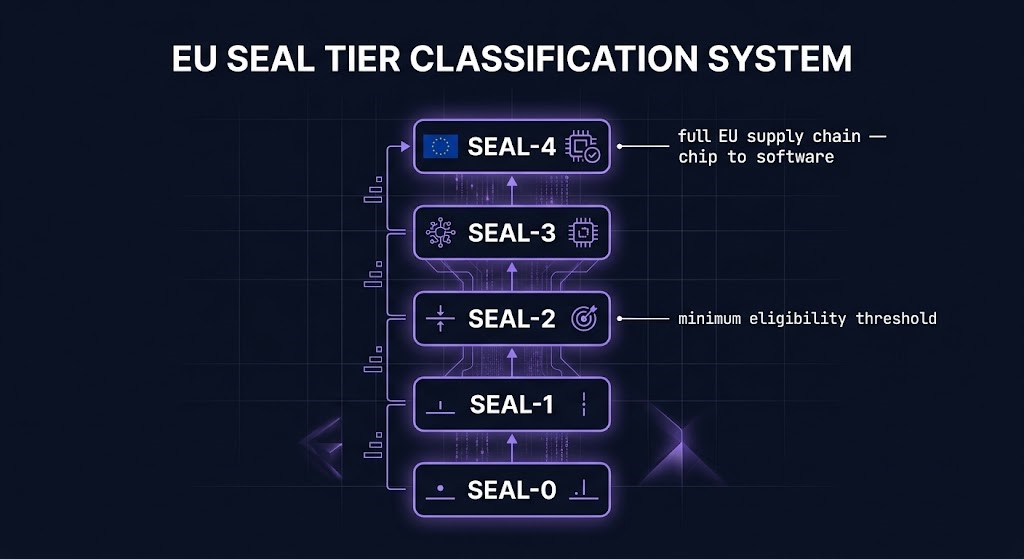
In April 2026, the European Commission did something no enterprise procurement team had managed at scale: it built the first real instrument for producing sovereignty evidence. The Commission’s Cloud Sovereignty Framework — developed for a €180 million sovereign cloud tender — defines eight objectives a provider has to score against, and a tiered Sovereignty Effectiveness Assurance Level (SEAL) running from SEAL-0 to SEAL-4. SEAL-2, Data Sovereignty, was the minimum eligibility bar for the tender — EU law applies and is enforceable, even though material non-EU dependencies can still exist underneath. SEAL-4 is the ceiling: a complete EU supply chain from chip to software, with no critical non-EU dependency anywhere in the stack. Almost nothing alive today clears SEAL-4. That’s the point — it defines the evidence standard the market is being pulled toward, not the standard most providers currently meet.
The Commission didn’t publish this as a position paper and walk away. It used the framework to award the tender, splitting the €180 million across four providers specifically to avoid re-creating the single-vendor lock-in that sovereignty work is supposed to prevent — a pattern with direct implications for how European sovereign cloud architecture gets designed in practice, not just procured on paper. And on June 3, 2026, the follow-up landed: the proposed Cloud and AI Development Act, layering a statutory four-level assurance framework on top of the same logic, with delegated-act authority to extend sovereignty risk assessment beyond public procurement into regulated private sectors.
01 — STRATEGIC & LEGAL SOVEREIGNTY
Who governs the provider, and which foreign legal regimes can compel disclosure or operational change regardless of contract terms.
02 — DATA & AI SOVEREIGNTY
Whether the customer, not the provider, controls the encryption keys — and whether the provider can technically access decrypted content at all.
03 — OPERATIONAL & SUPPLY CHAIN SOVEREIGNTY
Whether the service keeps running, under the same governance terms, if a foreign-controlled upstream vendor withdraws support or is compelled to stop serving the account.
04 — TECHNOLOGY, SECURITY & COMPLIANCE
Whether the underlying technology stack is auditable and open enough to verify the other three objectives, instead of taking the provider’s word for it.
This is cloud strategy’s version of a pattern that’s shown up across every pillar this year: the regulator builds the measurement instrument the market never built for itself. The EU AI Act’s Article 12 is the AI infrastructure instance of that same pattern — an evidence-generation mandate arriving before the market built one voluntarily, with an enforcement clock instead of a marketing conversation.
Where the Evidence Chain Breaks
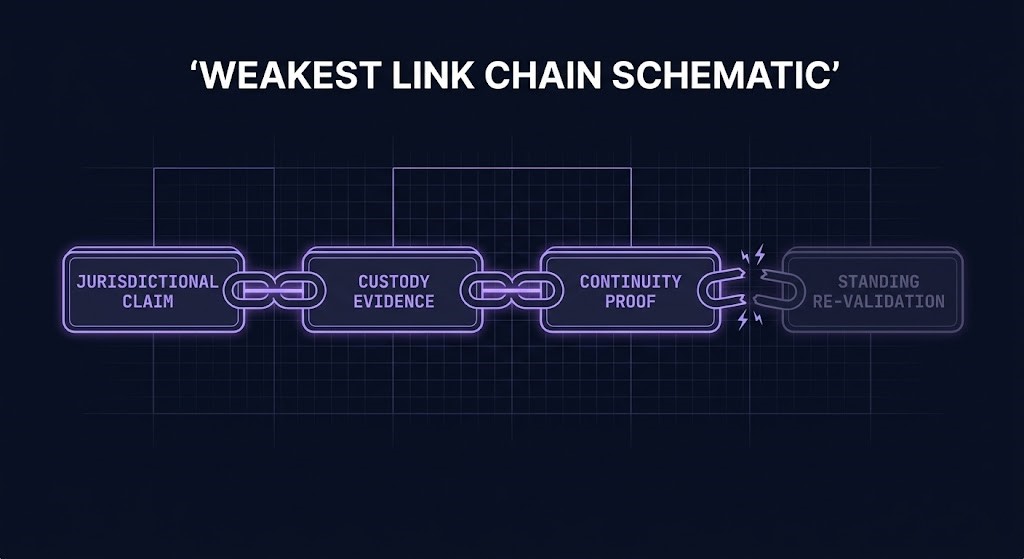
Run the SEAL objectives against a typical enterprise cloud footprint and the sovereignty evidence gaps surface fast — not because the architecture is bad, but because nobody was ever asked to produce proof of these specific things before. This is the same gap most sovereignty strategies hit before architecture even begins: the strategy assumes a property the architecture was never built to prove. And it’s the same residency-as-compliance fallacy examined in the compliance trap sovereign cloud creates — a location pin standing in for a control you never actually verified. Four links break more often than the rest:
FOUR LINKS THAT FAIL AN AUDIT REQUEST
- Jurisdictional exposure. Can you name every legal regime that can compel access to this workload, independent of where it’s hosted? Most architectures can name the host country. Almost none can name the operator’s full legal exposure chain — the same blind spot [vendor lock-in](/vendor-lock-in-networking-not-apis/) creates at the network layer, where the real dependency is never the one written into the contract.
- Key custody. If the provider were legally compelled to hand over data, could they technically comply without your participation? If yes, the encryption is a compliance checkbox, not a sovereignty control.
- Operational independence. If the upstream technology vendor inside your “sovereign” provider’s stack lost support overnight, would the service keep running under the same governance terms — or would continuity depend on a relationship you don’t control? This is the same question [cloud exit strategy](/cloud-exit-strategy/) asks about an entire platform, just scoped down to a single sub-vendor dependency.
- Validation cadence. Was sovereignty assessed once, at contract signing, or is there a control that re-verifies it as the provider’s ownership, subcontractors, and technology stack change? The same standing-control discipline an [egress audit framework](/egress-audit-framework/) applies to data movement has to apply here — a sovereignty assessment that only runs once is a snapshot, not a control.
Most organizations can answer one or two of these convincingly. Almost none can answer all four with evidence rather than assurance — and sovereignty evidence that’s only as strong as its weakest link isn’t a sovereignty posture. It’s a single point of failure wearing a compliance label.
The validation-cadence link has a mirror image at the other end of the relationship. Vendor Relationships End. Audit Rights Often Don’t. covers what happens when the assessment obligation runs the other direction — not re-verified periodically while the relationship is active, but still enforceable on the vendor’s own clock for years after the organization considers the relationship closed. Sovereignty evidence has to survive re-validation because the provider’s ownership and stack keep changing. Audit rights survive termination because the contract was written to outlive the relationship entirely. Same principle — evidence obligations don’t expire when convenient — running in opposite directions.
That’s the shape of the actual problem: sovereignty isn’t one property you either have or don’t. It’s a chain of separately provable claims, and the chain is exactly as strong as its weakest link.
The Sovereignty Evidence Chain
FRAMEWORK #134 — SOVEREIGNTY EVIDENCE CHAIN
A sovereignty claim is only as valid as the weakest link in the chain of evidence that supports it — and any link that cannot be evidenced is treated as absent by an auditor, regulator, or adversary, regardless of intent.
A claim that passes node 1 but can’t produce evidence at node 2 doesn’t get partial credit. It fails as a sovereignty claim entirely — the chain breaks at its first unevidenced link.
This is why the framework is named a chain and not a score. A weighted average lets a strong jurisdictional position paper over weak key custody. A chain doesn’t — the weakest link is the architecture’s actual sovereignty evidence position, full stop.
Data Protection’s Governance & Recovery Assurance stage draws the same conclusion from the recovery side of the business: an internal sign-off is not proof, and evidence that’s never been examined by a party structurally independent of whoever produced it doesn’t get partial credit either. The stage names that condition Evidence Theater — evidence that exists, looks complete, and satisfies every internal review, but has never actually been tested against outside challenge. A sovereignty claim with an unevidenced link and a recovery claim nobody outside the recovery team has reviewed fail for the identical structural reason.
The doctrinal lineage matters here. This is a direct descendant of Operational Memory Boundary (#129) — the same “how do you know, not how much do you coordinate” question, just applied to control-plane authority instead of operational history. Coordination Density (#132) makes the chain harder to defend — more actors, more control planes, more delegated authority means more links that can silently go unevidenced — but it doesn’t create the requirement. A disconnected, low-complexity sovereign enclave still needs every link in this chain. Complexity raises the cost of failure. It isn’t the reason the chain exists.
There’s a live version of this that shows up the moment the evidence chain feeds an automated system rather than an audit binder. The Cloud Arbitration Layer — Framework #166 — names Sovereignty as the vector most likely to be arbitrating on a claim nobody’s verified: a routing policy that redirects data based on an unevidenced sovereignty claim isn’t reducing risk, it’s automating a marketing assertion at the control-plane level — and it does so with veto power over cost, compliance, latency, and sustainability decisions made by the four other engines in the arbitration layer. An evidence chain that breaks at node 2 doesn’t just fail an audit. It fails silently, every time the routing policy fires.
A different version of that same break showed up this week, running in the opposite direction. Microsoft Said It Was Exploited. Then It Wasn’t. Your Tenant Still Can’t Tell You Which. isn’t an organization’s own sovereignty claim going unevidenced — it’s a vendor’s claim about its own infrastructure incident, made and retracted within a day, with no external chain of evidence for a customer to check either version against. Same structural failure as an unevidenced sovereignty link: the party making the claim and the only party positioned to verify it are the same entity.
Evidence Is an Architecture Decision, Not a Procurement Afterthought
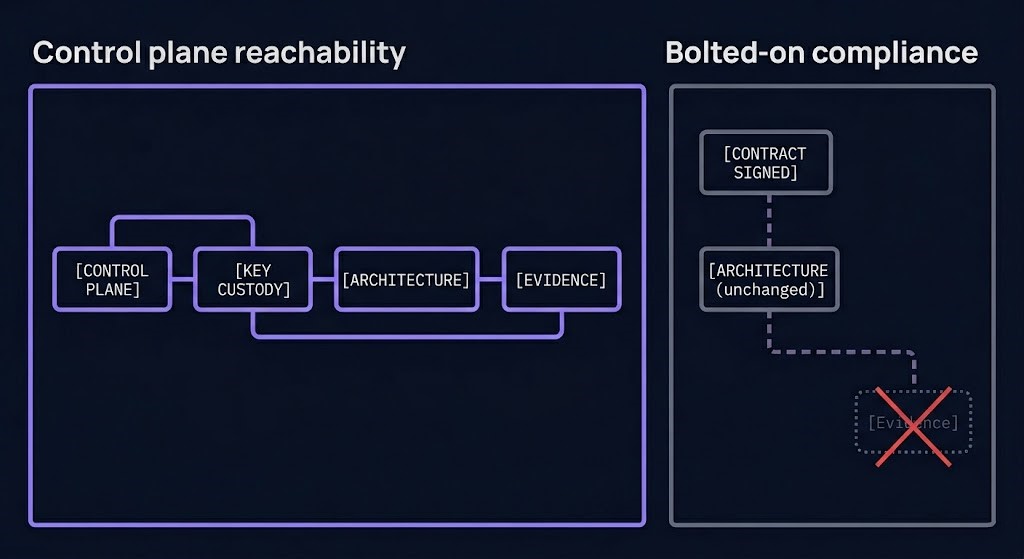
The instinct, once a framework like SEAL exists, is to treat sovereignty evidence as a compliance exercise — something legal and procurement handle after the architecture is already built. That instinct produces exactly the failure mode the framework is designed to catch. Evidence has to be designed in at the control-plane layer, because most of what SEAL actually scores — key custody, operational independence, jurisdictional exposure — are architecture decisions made at deployment time, not contract terms negotiated after the fact.
A provider can attest to data residency in a master service agreement. They cannot retroactively grant you customer-held key custody if the architecture was never built to support it. The evidence chain either exists in how the system was designed, or it doesn’t exist at all — and discovering that gap during an actual audit, incident, or geopolitical event is the most expensive possible time to find out.
This is also why sovereignty evidence is a control-plane ownership question before it’s anything else. It starts with the same question CS1 — Dependency Architecture asks at the foundation of the whole maturity path: what is this system actually dependent on? If you don’t have clear authority over who can change the control plane that governs encryption, access, and failover, you can’t produce evidence for any of the four links — there’s no single owner positioned to attest to them. Sovereignty architecture and control-plane architecture are not two different problems. The second is a prerequisite for being able to prove the first.
The same principle applies across AI infrastructure. Evidence of governance — authorization chains, policy state at execution time, behavioral compliance records — cannot be reconstructed from logs after the fact. It has to be produced at execution time as a first-class architectural output, not captured as an afterthought. The structural parallel between sovereignty evidence and AI governance evidence is examined in AI Systems Need Evidence, Not Just Observability.
Architect’s Verdict
Sovereignty was never actually about where data lives. It was always about who can prove control over it, under pressure, on demand. The data center pin on a map was a convenient stand-in for that proof, right up until someone built a scoring system that doesn’t accept the stand-in anymore.
What most organizations miss is that this isn’t a new compliance burden bolted onto existing architecture. It’s a forcing function that’s about to make an old, comfortable ambiguity impossible to maintain. “We’re sovereign” was a sentence anyone could say. “Here’s the evidence chain” is a sentence only a small number of architectures can currently complete — and that number is about to matter a great deal more than it did six months ago.
The organizations that treat this as an architecture problem now will be the ones with an answer when a customer, a regulator, or a procurement officer with a SEAL scorecard finally asks them to prove it.
Additional Resources
View 7 more resources
Editorial Integrity & Security Protocol
This technical deep-dive adheres to the Rack2Cloud Deterministic Integrity Standard. All benchmarks and security audits are derived from zero-trust validation protocols within our isolated lab environments. No vendor influence.

R.M.
Senior Solutions Architect with 25+ years of experience in HCI, cloud strategy, and data resilience. As the lead behind Rack2Cloud, I focus on lab-verified guidance for complex enterprise transitions. View Credentials →
Get the Playbooks Vendors Won’t Publish
Field-tested blueprints for migration, HCI, sovereign infrastructure, and AI architecture. Real failure-mode analysis. No marketing filler. Delivered weekly.
Select your infrastructure paths. Receive field-tested blueprints direct to your inbox.
- > Virtualization & Migration Physics
- > Cloud Strategy & Egress Math
- > Data Protection & RTO Reality
- > AI Infrastructure & GPU Fabric
Zero spam. Includes The Dispatch weekly drop.
Architecture Audit Services
Fixed-scope audits for Zero-Trust Azure, VMware migration readiness, and recovery posture — no discovery call required to start.
>_ View Audit Services>_Related Posts
Your Kubernetes Cluster Isn’t Out of CPU — The Scheduler Is Stuck
Compute Tier 1 Authority Cascades to ➔ >_ Architect’s Brief 60-second read before you commit to the full post · Full post: 9 min Generating brief… [Storage] [Network] 🚨 Failure Signature Detected Grafana shows cluster CPU utilization is under 50%, but pods are stuck in Pending. Events show: 0/10 nodes are available: 10 Insufficient cpu….
Your Identity System Is Your Biggest Single Point of Failure
Part 2 of the Rack2Cloud’s Cloud Fragility Series >_ Cloud Fragility Series 01 Multi-Cloud Cascading Failure Risks 02 Your Identity System Is Your Biggest Single Point of Failure [CURRENT] 03 Vendor Lock-In Happens Through Networking — Not APIs 04 Your Cloud Bill Quietly Increased in 2026 — Here’s Where the Money Is Actually Going >_…
Your Identity Provider Was Never Your Spend Boundary
Every enterprise cloud governance program assumes a spend boundary sits somewhere between identity and money — a checkpoint that catches compromised access before it becomes compromised spend. It doesn’t exist. Not as a distinct control. Not as a separate policy layer. Not anywhere in the architecture most organizations have actually built. >_ Architect’s Brief 60-second…
Your Identity Controls Passed. Your Authorization Chain Failed.
A credential chain functioned exactly as it was designed to. No firewall failed. No exploit executed. No malware bypassed a control. A red team walked past physical and social barriers using nothing more exotic than a plausible pretext, and came out the other side holding network admin credentials — issued correctly, authorized correctly, working exactly…
Your DR Test Passed. The Assumptions Didn’t.
DR plan failure rarely happens where you tested. It happens at the assumptions the exercise never reached — the dependencies that weren’t in scope, the runbook written for last year’s architecture, the authority chain nobody tested at 2am.
Your Cloud Provider Is Not Your HA Strategy
A Tactical Playbook for Architecting, Testing, and Automating Real Multi-Cloud & Multi-Region Resilience We’ve previously explored why cloud SLAs fail as guarantees in our deep dive, Cloud SLA Failure & Resilience Strategy. This article focuses on how to survive those failures in practice — architecturally, operationally, and financially. >_ Architect’s Brief 60-second read before you…