

The Browser Is Quietly Becoming Infrastructure

Enterprise browser infrastructure has been accumulating architectural responsibility for years without anyone formally assigning it. The cloud strategy question most organizations haven’t asked is not whether to deploy a managed browser — it’s whether anyone in the architecture function actually owns what the browser has become. The answer, in most enterprises, is no.
The browser didn’t get a promotion. It absorbed responsibilities that used to be distributed across the stack — and the governance model never followed.
How Enterprise Browser Infrastructure Absorbed the Stack
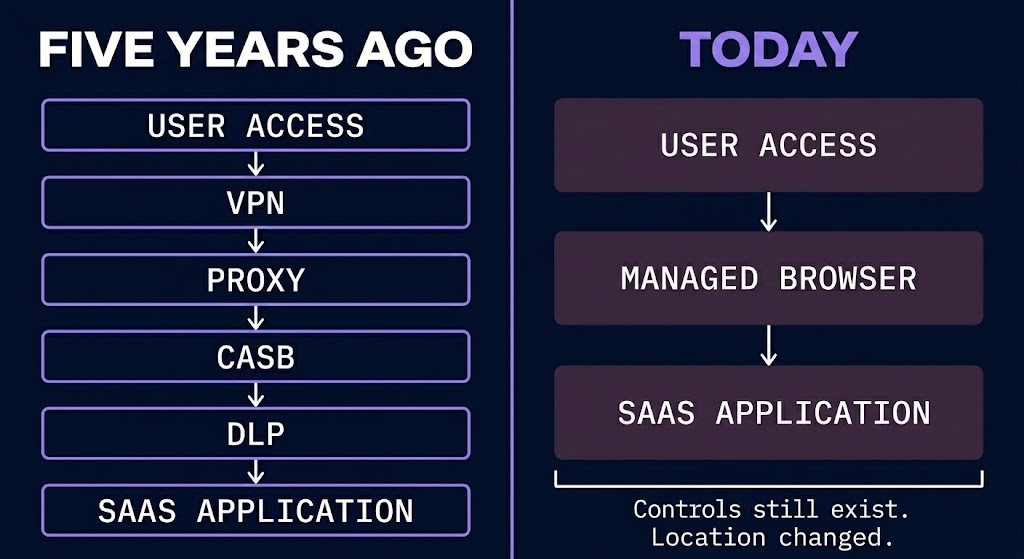
Start with where we were five years ago versus where we are now.
| Five Years Ago | Today |
|---|---|
| User Access → VPN → Proxy → CASB → DLP → SaaS Application | User Access → Managed Browser → SaaS Application |
We didn’t remove those controls. We collapsed them into a rendering surface that most architecture diagrams still treat as a client application.
What migrated into the browser isn’t a short list. Identity-bound session enforcement — previously handled by VPN concentrators and network access controls — now lives in the browser’s session layer. Content DLP that used to sit on a dedicated appliance or inline proxy now fires at the browser level, inspecting what the user sees and acts on rather than what traverses the network. SaaS policy enforcement, clipboard and download restrictions, screenshot controls, certificate inspection, and in some managed browser implementations, network path selection — each of these had a home. Each migrated not through deliberate architectural decision but through capability accumulation and the industry-wide shift to SaaS delivery.
Every one of those controls has now become a dependency. The problem is that almost nobody documents them as such.
The Dependency Nobody Mapped
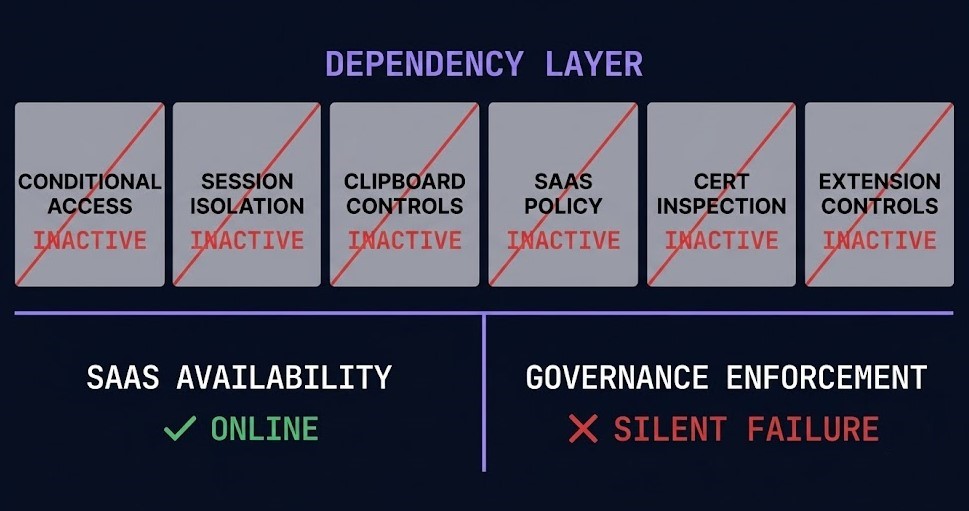
Entire SaaS control plane operating models now depend on browser-enforced controls that rarely appear in dependency architecture maps. The list of what organizations are silently depending on the browser to enforce is longer than most architecture reviews acknowledge:
BROWSER-ENFORCED CONTROLS — CURRENT ENTERPRISE DEPENDENCY
- Conditional access enforcement — session validity tied to browser identity state
- Session isolation — lateral movement prevention between SaaS tenants
- Clipboard and download restrictions — data exfiltration controls at the user interaction layer
- SaaS policy enforcement — application-level behavioral controls below the app’s own policy engine
- Browser certificate inspection — trust validation for SaaS connections
- Extension allow/deny controls — attack surface reduction at the tooling layer
If any of those fail: SaaS still works. Authentication still works. Users still log in. Governance disappears.
That’s not a security failure mode. That’s a dependency architecture failure mode — and it belongs in the same architectural conversation as infrastructure control plane consolidation and identity system resilience.
The controls migrated. The ownership model didn’t.
What Silent Failure Looks Like
The managed browser policy service stops synchronizing. The cause doesn’t matter — a configuration update, an identity provider timeout, a policy management platform incident. Users continue accessing Salesforce, Microsoft 365, GitHub, and ServiceNow normally. No alert fires. No incident is opened. Availability is unaffected, so no monitoring threshold trips.
Two weeks later, an audit surfaces that clipboard controls, download restrictions, and session protections haven’t been enforced since the sync failure. Every user session during that window operated without the governance layer the organization believed was active.
The browser failed. The business never noticed because availability wasn’t affected. Governance was.
DIAGNOSTIC QUESTION
“If your managed browser enforcement disappeared tonight, which controls would fail immediately — and would anyone know?”
What an Architectural Treatment Looks Like
Treating the browser as infrastructure changes three things — none of which require a new product procurement.
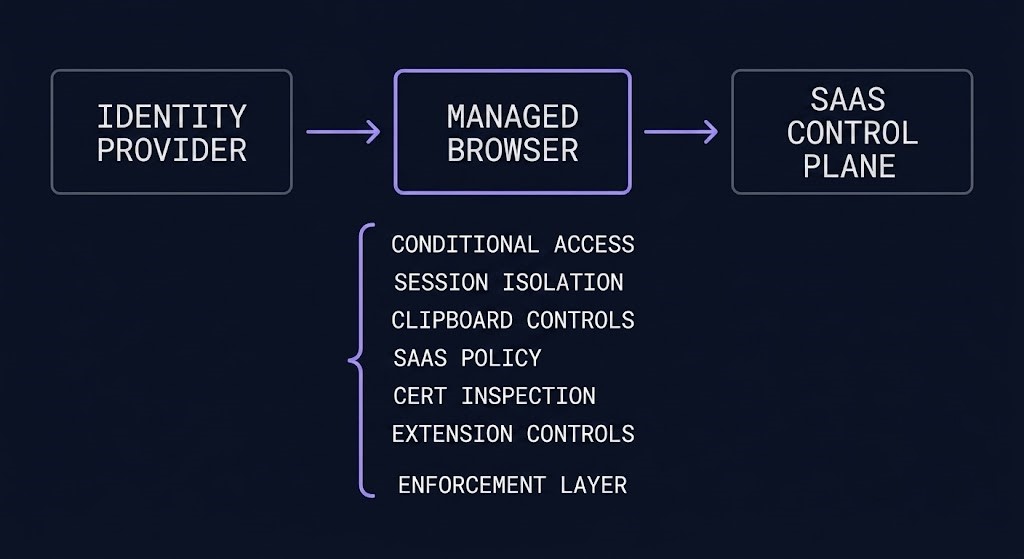
Browser-enforced controls appear in architecture diagrams the same way identity providers, DNS services, and SaaS control planes do. Not as an endpoint policy node attached to a device, but as a discrete layer with defined inputs (identity assertion, policy state), defined outputs (enforced session controls), and documented failure modes that include silent degradation, not just outage.
The browser gets an owner. Not an endpoint management team with a browser policy config — an architectural owner who can answer what the browser enforces, what depends on it, and what the recovery posture is when enforcement silently stops. That owner is responsible for the browser’s position in the operational architecture — the execution path between identity, policy, user action, and SaaS control plane.
Failure modes are modeled explicitly. The silent sync failure scenario above is a known failure mode for every managed browser implementation. If it isn’t in the architecture’s failure model, it will eventually show up in an audit instead.
The private cloud operating model analogy is useful here: organizations that repatriated workloads learned quickly that “we own the infrastructure” required owning the governance model for that infrastructure, not just the hardware. The browser requires the same discipline at the access layer.
Architect’s Verdict
The browser is load-bearing infrastructure in most enterprise stacks. It is not governed that way.
Security teams own a deployment they don’t fully model. Architects don’t own it at all. The result is an access layer that enforces governance controls most architecture programs have never formally documented as dependencies — and that fails in ways availability monitoring will never catch.
The browser didn’t become more important. It quietly inherited responsibilities that used to belong to the rest of the infrastructure stack. An unmanaged browser in a SaaS-first enterprise isn’t an endpoint problem — it’s infrastructure operating without architectural ownership.
Additional Resources
Editorial Integrity & Security Protocol
This technical deep-dive adheres to the Rack2Cloud Deterministic Integrity Standard. All benchmarks and security audits are derived from zero-trust validation protocols within our isolated lab environments. No vendor influence.

R.M.
Senior Solutions Architect with 25+ years of experience in HCI, cloud strategy, and data resilience. As the lead behind Rack2Cloud, I focus on lab-verified guidance for complex enterprise transitions. View Credentials →
Get the Playbooks Vendors Won’t Publish
Field-tested blueprints for migration, HCI, sovereign infrastructure, and AI architecture. Real failure-mode analysis. No marketing filler. Delivered weekly.
Select your infrastructure paths. Receive field-tested blueprints direct to your inbox.
- > Virtualization & Migration Physics
- > Cloud Strategy & Egress Math
- > Data Protection & RTO Reality
- > AI Infrastructure & GPU Fabric
Zero spam. Includes The Dispatch weekly drop.
Need Architectural Guidance?
Unbiased infrastructure audit for your migration, cloud strategy, or HCI transition.
>_ Request Triage Session