

IDPs Don’t Solve the Ownership Problem. They Defer It.
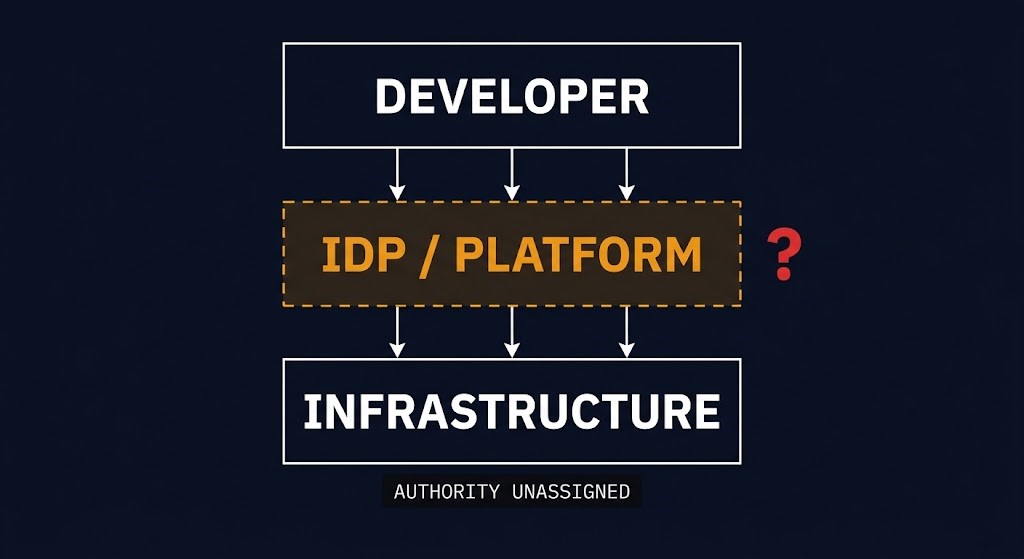
Internal developer platform ownership is the assumption that didn’t survive first contact with production. The pitch was straightforward: consolidate infrastructure consumption behind a single platform, give developers a self-service interface, and reduce the coordination overhead that was slowing everything down. Enterprise teams spent millions making that happen. The interface moved. The internal developer platform ownership model didn’t move with it — it stayed exactly where it was, contested and unresolved, now hidden behind a better abstraction layer.
The Promise Was a Clean Handoff
The IDP investment thesis rested on a hidden assumption that almost nobody stated explicitly: that ownership would naturally follow abstraction. If developers consumed infrastructure through a platform instead of directly, governance, accountability, and operational responsibility would migrate upward with the interface. The platform would become the natural locus of control because it was the natural locus of consumption.
This assumption was intuitive. It was also wrong.
Abstraction layers have never automatically transferred authority in modern infrastructure and IaC architecture. A firewall abstracts packet inspection but doesn’t own the security policy. A load balancer abstracts traffic routing but doesn’t own the availability SLA. An IDP abstracts infrastructure provisioning but doesn’t own the decision about what gets provisioned, who’s accountable for the consequences, or who resolves it when something goes wrong. The interface and the accountability are different things. The IDP made that gap structurally permanent by adding a layer between the developer and the infrastructure without chartering who owned the layer itself.
High Bypass Rates Are the Tell
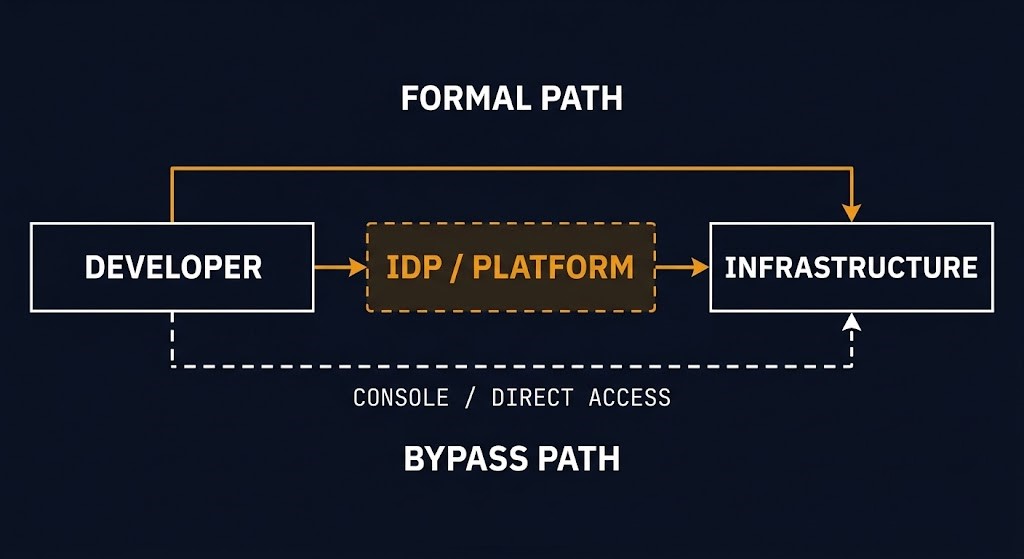
Enterprise architects running post-deployment reviews on IDP programs are consistently finding the same pattern: within months of a platform going live, a significant portion of developers are routing around it. Not because the platform has a bad UX. Not because the documentation is thin. Because the platform can’t express what those developers actually need to govern.
When someone needs an exception — a non-standard configuration, a resource type the platform doesn’t support, a deployment that falls outside the happy path — the IDP has no answer. There’s no escalation path, no override mechanism with proper authority attached, no named owner for the exception process. So developers go around it. They open the console. They call the platform team directly. They do what they’ve always done, which is find the person who can actually make the decision.
That bypass behavior isn’t a failure of platform adoption. It’s architects and developers correctly identifying that the abstraction doesn’t cover the full decision surface they’re responsible for. The platform solved the easy path and left the hard cases ungoverned.
Why the IDP Feels Like Progress
It’s important to be precise about what an IDP actually delivers, because the delivery is real.
Deployment frequency goes up. Ticket volume drops. Workflows that previously required manual coordination — environment provisioning, access requests, service catalog entries — become self-service. Developer experience measurably improves. These are not synthetic gains. Teams that have deployed well-designed internal platforms genuinely move faster.
The problem is that operational velocity and governance clarity are independent variables. A platform can improve both, or it can improve one while obscuring the other. The failure mode isn’t a platform that performs badly — it’s a platform that performs well on the dimensions it was measured against while leaving ownership questions in the same ambiguous state they were before it arrived.
Platform success metrics — deployment frequency, lead time, ticket deflection — don’t capture whether ownership was resolved. They capture whether the platform is being used. Those two things feel identical during a successful rollout. They stop feeling identical during an incident, a cost review, or the first time an auditor asks who owns the decision that created a specific resource. That’s the internal developer platform ownership question — and the platform didn’t answer it.
What the IDP Actually Does to Internal Developer Platform Ownership
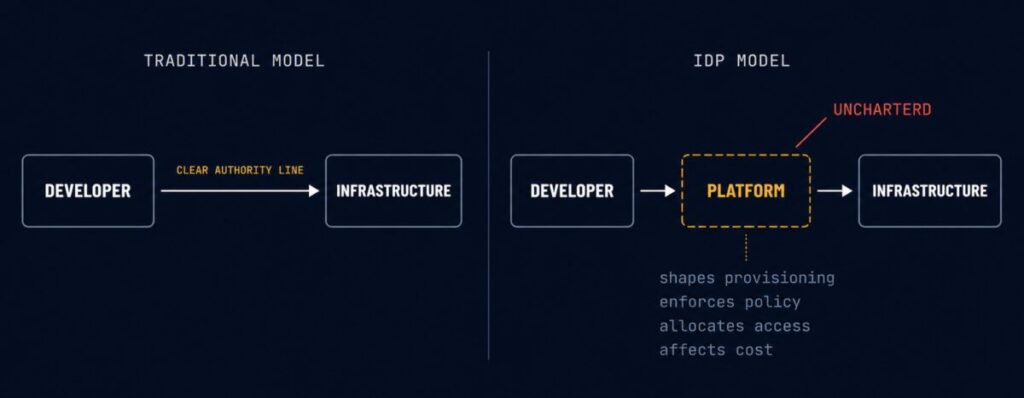
An IDP doesn’t reorganize authority. It adds a layer between the developer and the infrastructure, and that layer now influences every consequential decision in the system.
The traditional model had two actors with a clear line between them:
Developer → requests → Infrastructure → approves
The ownership structure was explicit, even when it was inefficient. Requests crossed a visible boundary. Approvals required a named team. Accountability had a location.
The IDP model introduces a third actor:
Developer → requests → Platform → mediates → Infrastructure → executes
The platform now shapes provisioning options. It enforces policy. It allocates access. It affects cost. It becomes an active participant in every infrastructure decision — not a passive conduit. And yet most organizations never formally assigned it authority to do any of that. The platform was chartered to improve developer experience. Nobody chartered it to govern infrastructure decisions. That’s the structural gap that Framework #135 — Control Plane Ownership Boundary names directly: when a control plane mediates decisions without assigned authority, it doesn’t simplify governance, it displaces it.
The inverse condition is just as real, and worth naming so the two don’t blur together: a platform that already holds the primitives — state, policy, an existing approval gate — doesn’t have this problem, because ownership was never in question. The IDP failure mode above is what happens when a mediating layer accumulates influence with no chartered authority behind it. HCP Terraform extending its already-owned state and policy into workflow and approvals is the same Framework #135 boundary, crossed in the opposite direction — deliberately, by a platform that earned the authority rather than merely inherited proximity to the decision.
GOVERNANCE DISPLACEMENT
An IDP that doesn’t carry ownership structure doesn’t simplify governance. It adds a layer governance has to penetrate.
How Deferred Ownership Becomes Operational Debt
The gap between platform capability and assigned authority doesn’t stay abstract. It surfaces in three specific failure modes that compound over time.
Drift Ownership Failure. The platform detects configuration drift. The infrastructure team owns remediation tooling. The application team owns the workload. Neither team owns the decision about whether to remediate, when, or at what priority. The alert persists indefinitely. Configuration drift without a named owner is exactly this failure pattern — the detection layer works, the accountability layer is absent. Platforms that surface drift without resolving the ownership question don’t reduce drift. They create a permanent backlog of ungoverned alerts.
Cost Attribution Failure. Infrastructure consumption belongs to the application teams. The billing lands in the platform team’s budget because the platform is the provisioning mechanism. Optimization authority and financial accountability have split apart. The platform team becomes a finance team by default — accountable for costs they don’t control, measured against budgets they can’t influence through the governance mechanisms available to them.
Policy Enforcement Failure. The platform can identify policy violations at provisioning time. No team has been assigned authority to block a deployment based on a policy flag. Detection exists. Enforcement doesn’t. The violation gets logged. The deployment proceeds. This is the shadow control plane problem expressed through a legitimate platform: the system knows something is wrong, and nobody is authorized to act on that knowledge.
A fourth failure mode runs the identical shape outside any platform at all. Patch Ownership Failure. Central IT owns the network. The department owns the mail server. Neither owns the decision to apply a patch that’s been sitting available for months. UNK_MassTraction’s campaign against university mail servers ran for the better part of a year inside exactly that gap — distributed infrastructure ownership with no distributed patch accountability to match it.
The same deferred-ownership pattern scales up to the infrastructure boundary itself: when a platform spans multiple cloud providers, an unresolved ownership question at the IDP layer compounds with an unresolved ownership question at the provider layer. Multi-Cloud Coherence Is an Ownership Problem, Not a Technology Problem covers the provider-level version of the same structural gap.
GitOps reconciliation loops run the same compounding pattern from the opposite direction. GitOps Has Escaped The Platform Team covers what happens once platform engineering, security, data platform, and AI/ML teams each stand up their own GitOps loop against the same cluster — every loop correctly owned, every loop passing its own validation, with no arbitration mechanism where their scopes intersect. Where an IDP defers the ownership question by never assigning it, GitOps governance answers it four separate times and never resolves which answer wins at the seam. Framework #165 — Authority Arbitration Gap — is the plurality-of-ownership version of the same structural failure this section describes.
There’s a third variant of the same failure, this time automated rather than organizational. The Cloud Arbitration Layer — Framework #166 — describes what happens when cost, compliance, latency, sustainability, and sovereignty engines each make a correct placement decision independently, with no layer above them reconciling the composite result. Where an IDP defers ownership and GitOps answers it four times without resolving the seam, the Cloud Arbitration Layer is a third shape entirely: nobody deferred anything and nobody’s contesting anything — five automated systems are simply deciding, correctly, in parallel, and the composite outcome belongs to none of them.
Widen the frame past a single platform and the same deferral shows up as a portfolio-level problem rather than a control-plane one: tool sprawl’s cost model covers what happens once an organization isn’t running one unchartered IDP but a dozen individually-adopted tools, each with an owner, none of whose relationships — integration maintenance, duplicate capability, governance surface — was ever assigned to anyone. The IDP defers ownership at the scale of one platform. Tool sprawl is the same deferral running across everything the IDP was supposed to consolidate in the first place.
What Solving It Actually Requires
Internal developer platform ownership has to be established before the platform is deployed, not discovered after it goes live. The IDP doesn’t need to be replaced or redesigned. It needs to be chartered against an accountability model that predates it — not used as a substitute for one.
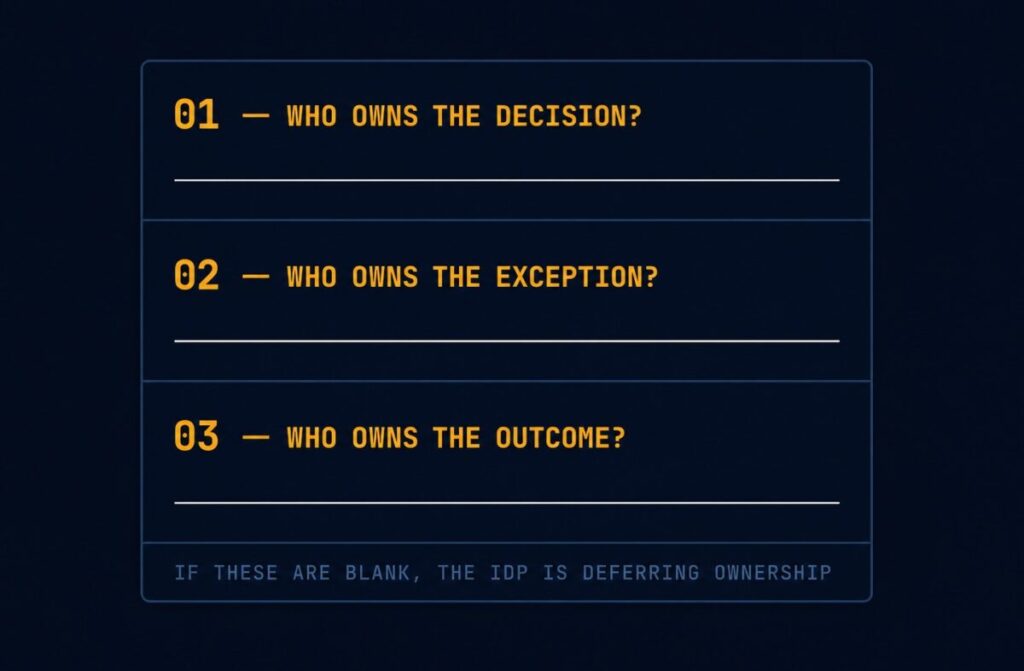
That means three questions have to be answered — with names attached — before the platform goes into production. Not organizational units. Not team labels. Names.
01 — WHO OWNS THE DECISION?
When the platform presents a provisioning option, who is accountable for the consequences of selecting it? Not the developer who clicked. Not the platform that surfaced it. The named individual or team whose accountability doesn’t disappear when the request is approved.
02 — WHO OWNS THE EXCEPTION?
When someone needs to bypass the platform — because the platform doesn’t cover their use case, or because the approved path is wrong for their context — who has authority to approve that exception? An exception process without a named owner is an implicit invitation to route around the platform entirely.
03 — WHO OWNS THE OUTCOME?
If the platform creates cost exposure, configuration drift, or a policy violation, who is responsible for correcting it? Not the platform team. Not the team that built the template. The team accountable for the infrastructure state the platform helped create.
If those questions don’t have names attached, the IDP is deferring ownership rather than organizing it. State & Dependency Architecture — the Learning Path stage that follows this thread past the platform layer — covers how the same deferred-ownership pattern determines whether infrastructure matures into a platform product or stalls as Platform Stagnation.
Architect’s Verdict
An internal developer platform can simplify infrastructure consumption. It cannot simplify accountability. The interface and the authority structure are different things, and no amount of platform sophistication transfers one from the other.
If internal developer platform ownership is unresolved before the platform arrives, the platform becomes another control plane competing for authority. Developers route around it not because it failed as a product but because it couldn’t answer the questions that matter when something goes wrong. The bypass rate isn’t a UX signal. It’s a governance signal.
The result isn’t self-service infrastructure. It’s deferred governance operating behind a better user interface.
Additional Resources
View 6 more resources
Editorial Integrity & Security Protocol
This technical deep-dive adheres to the Rack2Cloud Deterministic Integrity Standard. All benchmarks and security audits are derived from zero-trust validation protocols within our isolated lab environments. No vendor influence.

R.M.
Senior Solutions Architect with 25+ years of experience in HCI, cloud strategy, and data resilience. As the lead behind Rack2Cloud, I focus on lab-verified guidance for complex enterprise transitions. View Credentials →
Get the Playbooks Vendors Won’t Publish
Choose the architecture problems you care about. Get field-tested playbooks and frameworks delivered to your inbox.
- > AI Infrastructure & Inference Economics
- > Cloud Strategy & Hidden Cost Models
- > Virtualization & Deterministic Migration
- > Kubernetes, IaC & Modern Infrastructure
- > Data Protection & Recovery Engineering
Zero spam. Includes The Dispatch weekly drop.
Need Architectural Guidance?
Independent review before major infrastructure decisions.
- > Validate assumptions
- > Identify hidden dependencies
- > Quantify migration risk
- > Challenge vendor narratives
Triage · Advisory · Fractional · Direct Hire