

Multi-Cloud Coherence Is an Ownership Problem, Not a Technology Problem
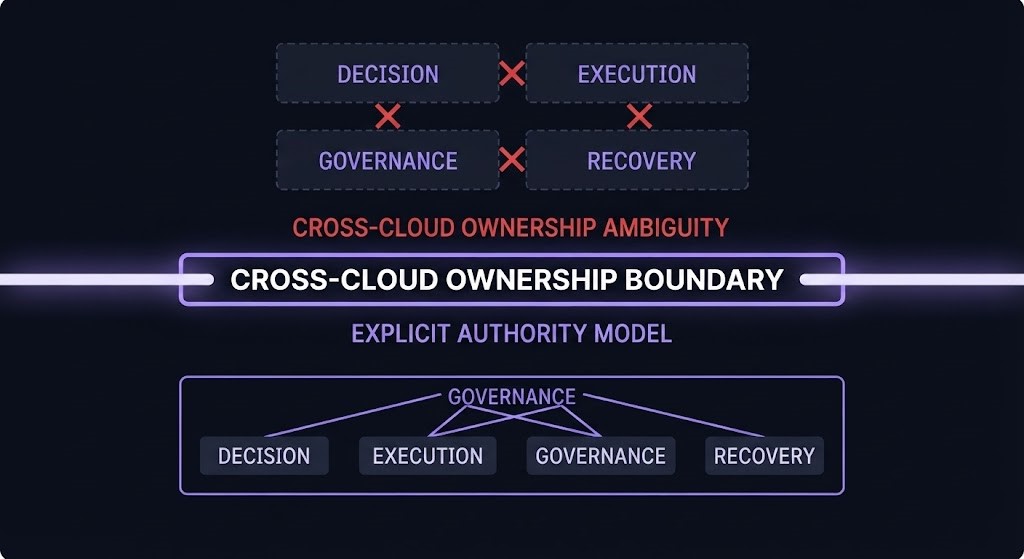
The multi-cloud ownership boundary is where most multi-cloud architectures actually break — not at the networking layer, not at the observability layer, but at the point where a decision crosses two cloud environments and no single authority can execute, govern, or recover it without coordinating across ownership domains. Architecture teams spend significant effort solving for tooling coherence: consistent observability platforms, federated policy engines, unified control planes, portable workloads. Those are real concerns. None of them is the coherence problem. The coherence problem is authority — and most architectures treat it as a residual concern that tooling will eventually absorb.
It doesn’t. And the gap shows up under pressure, not in design reviews.
For cloud strategy architecture teams managing multi-cloud environments, the consequence of misdiagnosing this at the tooling layer is an architecture that looks coherent in steady state and fragments the first time something goes wrong.
The Coherence Problem Most Architects Misdiagnose
Multi-cloud coherence is broadly understood as a tooling problem. Shared observability means both environments surface signals into the same platform. Federated policy means governance rules apply consistently across providers. Portable workloads mean a service can move between environments without a rewrite. Each of these is a genuine architectural goal. Achieving all three doesn’t make an architecture coherent in the way that matters.
What’s missing is the answer to an operational question that no tooling platform answers by default: when a decision affects both environments simultaneously — a production incident, a recovery sequence, a governance violation, a change requiring approval — who holds authority to execute that decision without escalating to a separate coordinating body?
If the answer requires negotiation, the architecture isn’t coherent. It’s coordinated, which is different. Coordination is a process. Authority is a model. Coordination can fail under load. Authority either exists or it doesn’t.
The misdiagnosis is architectural, not operational. Tooling frameworks answer the wrong question because the authority question was never formally asked. Multi-cloud failover architectures exhibit the same misdiagnosis at the availability layer — the failure mode shifts from HA theater to governance theater, but the root cause is the same: the seam between environments was closed at the technology layer, not at the authority layer.
Framework #157 — The Multi-Cloud Ownership Boundary
FRAMEWORK #157 — CROSS-CLOUD OWNERSHIP BOUNDARY
The point at which a decision affects multiple cloud environments and no single authority can execute, govern, or recover that decision without coordination across ownership domains.
When a decision crosses the boundary without a survivable authority model, all four domains fragment simultaneously. The failure state is Cross-Cloud Ownership Ambiguity — conflicting accountability, delayed decisions, and unresolved operational responsibility during failure conditions.
Framework #157 resides in Strategic Resilience, the final stage of the Cloud Architecture Learning Path, specifically in Cluster 04 — Cross-Cloud Survivability. It belongs there because cross-cloud coherence becomes impossible once authority can no longer cross cloud boundaries coherently. The question CS7 asks is: what survives when authority disappears? Framework #157 is the answer to a narrower version of that question — what survives when authority has to cross a cloud boundary and no one designed the crossing?
The four terms in the definition — decision, execution, governance, recovery — are not a process. They describe four parallel authority domains that must all function simultaneously at the boundary. When they’re unified below the boundary, the architecture is coherent. When they fragment above it, what you have is Cross-Cloud Ownership Ambiguity: four domains each waiting for someone else to claim the problem.
There’s a sharper version of this that shows up once automation, not just organizational structure, is doing the deciding. The Cloud Arbitration Layer — Framework #166 — assumes an ownership model like this one exists on paper and shows an automated layer overriding it in practice regardless of what the model says. #157 asks who owns the outcome across Decision, Execution, Governance, and Recovery. #166 asks who actually selected it when five competing engines — cost, compliance, latency, sustainability, sovereignty — each made a correct call in their own scope. Ownership versus selection: both can be correctly designed while this gap still exists between them.
Why Multi-Cloud Creates New Authority Structures
Single-cloud environments inherit authority from a single operating model. One provider relationship, one support escalation path, one change management workflow, one platform team, one governance domain. The authority model — however informal, however undocumented — is unified by default. The organizational structure and the cloud structure are the same shape. Gaps in authority exist, but they’re internal to one operating model and can be resolved inside that model.
Multi-cloud doesn’t merely add another cloud to that picture. It adds another authority structure. A second platform team with its own priorities. A second vendor relationship with its own SLA terms, support channels, and escalation paths. A second change management window that may not be synchronized with the first. A second governance domain with its own compliance scope, policy ownership, and audit trail. The architecture didn’t grow horizontally — it grew a second authority chain that now runs in parallel with the first, with no designed connection point between them.
The seam between those two authority chains is the Cross-Cloud Ownership Boundary. It exists whether it was designed or not. The question is whether it was assigned — whether there’s an explicit authority model at the crossing point — or whether it was left as a gap to be negotiated when the first incident requires a cross-boundary decision. This is the cost side of a decision concentration exposure pricing should have surfaced before multi-cloud was chosen as the mitigation: reducing concentration risk at the infrastructure layer creates a new, undesigned concentration point at the authority layer. Mitigating one exposure without pricing the other isn’t a fix — it’s a trade nobody evaluated.
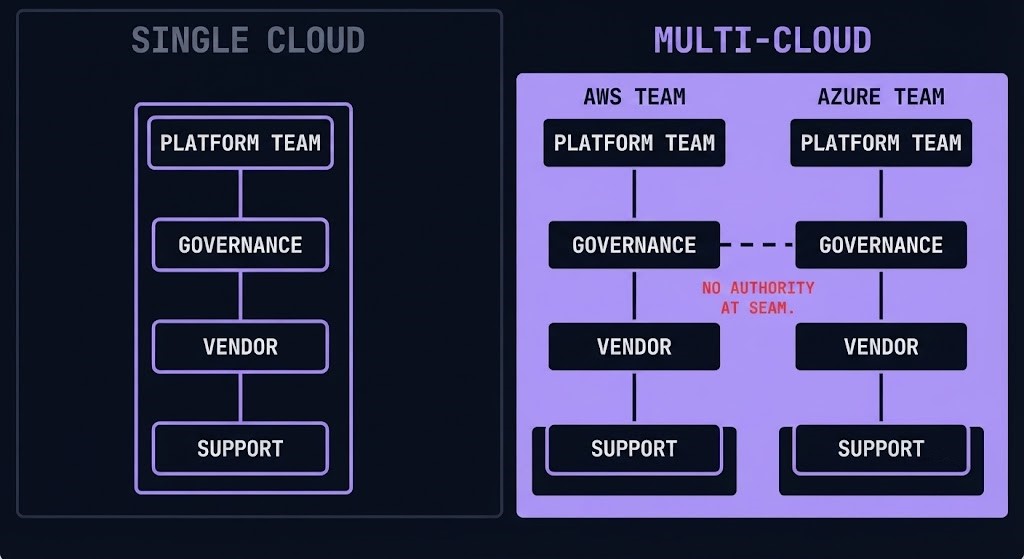
Most organizations discover the second authority structure the same way they discover the shadow control plane — not during architecture review, but during an incident that exposes the gap between what the diagram shows and what the teams actually own.
An announcement can show that a seam exists without showing whether the crossing was assigned. Airbus’s July 2026 placement of its first 70 applications with a European provider, while Skywise and Case Management Assistant stay on AWS and Salesforce, Coupa and Workday stay in the estate, creates a multi-provider seam by construction. The public record does not say who holds authority across it; what that record does and doesn’t show is worked through separately.
Why Technology Coherence Defers the Ownership Problem
The standard architectural response to multi-cloud ownership ambiguity is a coherence layer: a unified control plane, a shared policy engine, a federated identity framework, a cross-cloud observability platform. Each of these is a legitimate technology investment. Each of them defers the ownership problem rather than resolving it.
A shared policy engine still requires a human authority model underneath it. When the policy engine identifies a governance violation spanning both environments — a configuration drift, an unauthorized resource, a compliance gap — someone has to own the remediation. The policy engine surfaces the finding. It doesn’t assign authority over it. If the authority assignment doesn’t exist in the ownership model before the finding surfaces, it will be negotiated after. That negotiation happens under pressure, with incomplete information, while the violation continues.
A unified control plane has the same structure. The control plane provides visibility and, in some cases, execution capability across environments. It doesn’t resolve the question of who has authority to use that capability for decisions that cross ownership domains. A control plane operated by two teams with no defined cross-boundary authority model is two separate control planes that happen to share a dashboard.
The public internet interconnect architecture problem is the networking-layer parallel: deterministic connectivity doesn’t close the governance gap above it. You can have a private, low-latency, high-availability interconnect between AWS and Azure and still have no defined authority model for what crosses it under governance and recovery conditions. The technology layer and the authority layer are independent problems. Solving one doesn’t progress the other.
Multi-cloud architectures that treat cascading failures as a risk to be managed through redundancy discover that cascades don’t respect redundancy when the failure mode is ownership ambiguity — because adding redundant infrastructure doesn’t add redundant authority.
How Cross-Cloud Ownership Ambiguity Manifests
The four failure patterns below map directly to the four authority domains in Framework #157. Each one is an ownership gap, not a technology gap.
FOUR OWNERSHIP FAILURE PATTERNS — FRAMEWORK #157
01 — INCIDENT OWNERSHIP [DECISION]
Who declares, who scopes, who coordinates
When a failure spans both environments, both teams have partial visibility. Neither holds full authority. The incident lives in the gap between two partial views — and the first task, which should be scope declaration, becomes a negotiation about whose scope it is. Every minute of that negotiation is a minute the incident runs unmanaged.
02 — RECOVERY SEQUENCING [RECOVERY]
Whose RTO governs when the environments conflict
If the AWS environment has a defined RTO of four hours and the Azure environment has a defined RTO of two hours for the same workload dependency chain, those aren’t two RTOs — they’re a conflict. Resolving it requires an authority decision about which RTO governs and what sequencing follows. That decision has to exist before the recovery begins. If it doesn’t, recovery becomes arbitration under failure conditions, and the outcome depends on whoever has the most organizational leverage in that moment, not on what the architecture requires.
03 — CHANGE AUTHORITY [EXECUTION]
Whose approval chain covers changes that cross the boundary
A change affecting resources in both environments needs approval authority that spans both environments. Most change management frameworks are scoped to a single operating model. A change that crosses the ownership boundary either stalls — because neither approval chain claims full authority over it — or proceeds on one team’s approval alone, which is an incomplete approval regardless of the tooling used to execute the change. Both outcomes are worse than a defined cross-boundary change authority model.
04 — DRIFT ACCOUNTABILITY [GOVERNANCE]
Who owns remediation when drift originates at the seam
Configuration drift that originates at the ownership boundary belongs to neither team’s remediation scope by default. It accumulates — because the team that detects it doesn’t own it, and the team that should own it doesn’t have visibility into the detection. By the time the drift surfaces as a compliance finding or an incident trigger, the ownership dispute is the first conversation, not the remediation. The drift is the symptom. The missing governance authority at the boundary is the cause.
Configuration drift follows exactly this pattern at the config layer — the drift is detectable, the ownership of remediation is not. Cross-cloud drift compounds it because the detection surface spans two environments that have separate accountability models. The finding is visible. The owner is not.
The same fragmentation shows up a layer up, across an entire platform’s tool count rather than a single cloud boundary: tool sprawl’s cost model names the identical structure — a five-tool system where each tool has an owner, and the combination of behaviors those tools create together has none. Framework #157 asks who holds Decision, Execution, Governance, and Recovery authority at a two-cloud seam. The tool sprawl version asks the same question at a dozen-tool seam, and gets the same answer: nobody, because ownership was assigned per component, and the cost lives in the relationships between them.
The Organizational Seam Is the Boundary
The Cross-Cloud Ownership Boundary is usually described as a technology seam — the line between AWS infrastructure and Azure infrastructure, between one control plane and another. That framing is accurate as a topology description and misleading as an architectural diagnosis. The boundary isn’t primarily a technology seam. It’s an organizational one.
The boundary exists wherever two teams, two budgets, two change windows, or two vendor relationships meet without a defined authority model at the crossing point. It doesn’t require two different cloud providers. A single-provider environment with two distinct platform teams, two separate governance domains, or two conflicting operating models has the same ownership boundary geometry. The seam is defined by authority, not by technology. Two different cloud providers make the seam visible. They don’t create it.
GitOps Has Escaped The Platform Team is that geometry made concrete inside a single cluster. Platform engineering, security, data platform, and AI/ML teams each run their own GitOps reconciliation loop against the same shared resource — four boundaries, one technology, zero cloud providers involved. Framework #165 — Authority Arbitration Gap — names the identical condition Framework #157 names here: multiple legitimate authorities, each correct within its own scope, no arbitration mechanism where the scopes intersect. The seam doesn’t need a second cloud to exist. It needs a second correctly-owned authority touching the same object.
A related boundary-collapse shows up one register over, in Data Protection, when the two touching parties aren’t co-owners at all but a customer and a supplier sharing infrastructure neither built a boundary model for. The Breach Wasn’t Stadler’s. The Consequence Was. names five boundaries — infrastructure, data, access, consequence, accountability — that a shared-infrastructure incident can pull apart the same way Decision, Execution, Governance, and Recovery pull apart here. Framework #157 asks who holds authority across the seam before anything fails. That post asks who bears consequence after something already has, when nobody named the seam in advance either.
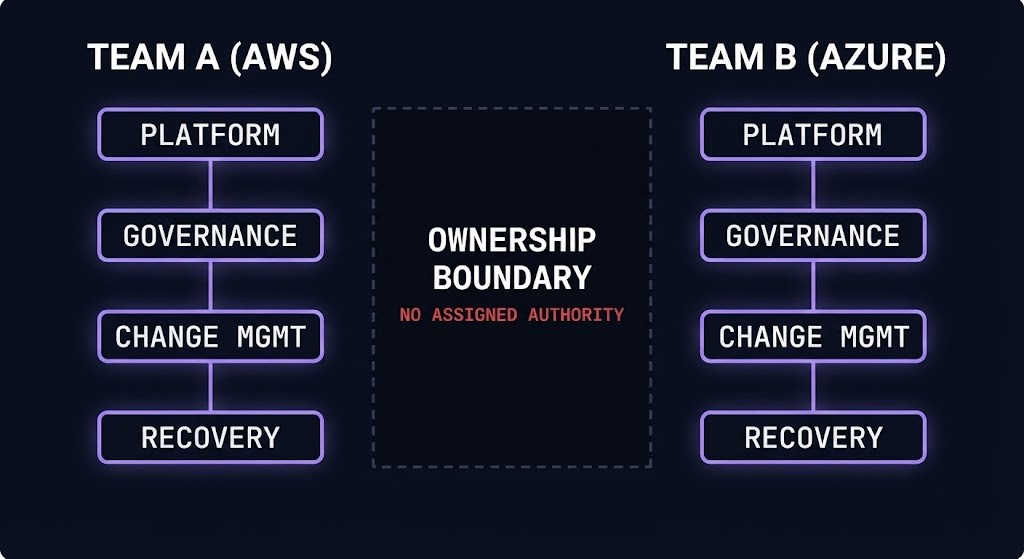
Platform ownership deferrals follow the same structure — the IDP provides a platform abstraction, but the ownership question underneath the platform is deferred, not resolved. Cross-cloud ownership ambiguity is the same deferral at a larger blast radius. The architecture abstracted the seam, but the seam didn’t go away. It moved.
The authority concentration risk applies directly here. An ownership model at the cross-cloud boundary that depends on a specific individual — the architect who designed the boundary, the director who has relationships with both vendor teams — fails the first time that individual is unavailable. Identity systems exhibit the same failure geometry: named personal authority is not the same as a survivable authority model. The model has to function without the person it depends on.
What an Explicit Ownership Model Requires
An ownership model at the cross-cloud boundary is an architectural artifact. Not an RACI table, not a service catalog entry, not a vendor-managed governance document. An architectural artifact that names three things explicitly: where the boundary is, who holds authority at the boundary, and whether the model survives the absence of the authority it names.
The boundary definition answers which decisions cross it. Not all decisions that touch both environments need cross-boundary authority — some are scoped entirely within one environment and happen to have a dependency on the other. The decisions that require cross-boundary authority are the ones in the four failure pattern categories above: incident declaration, recovery sequencing, cross-boundary change approval, and drift remediation.
The authority assignment names a role, not a person. An ownership model that names a person is not an ownership model — it’s a dependency on that person’s continued availability. The control plane architecture pattern applies: the authority structure has to be documentable, transferable, and executable by whoever holds the role, not just by the individual currently in it.
The survivability requirement is the gate the model must pass before it can be considered complete. If the named authority is unavailable — on leave, departed, reorganized out of scope — can the model still execute? If not, it doesn’t meet the standard. It’s a dependency, not a model.
Diagnostic Question
DIAGNOSTIC — FRAMEWORK #157
If a production outage simultaneously affects workloads running in two cloud environments, who has authority to:
- declare the incident
- set recovery priority
- approve remediation
- accept business risk
— without escalating to a separate coordinating authority?
If the answer requires negotiation during the incident, the Cross-Cloud Ownership Boundary already exists. The only question is whether it was designed.
Architect’s Verdict
Multi-cloud architectures fail at the same place most distributed systems fail: not where the technology changes, but where responsibility changes. That failure surfaces the same way a cloud exit does — the authority model looks sound until the first real test forces it to execute, which is exactly the validation gap examined in Why “Portable” Systems Still Fail During the First Real Exit Test.
The coherence problem in multi-cloud environments is not a tooling problem. Better observability platforms, federated policy engines, and unified control planes are legitimate investments — and none of them close the ownership gap at the boundary. They make the gap more visible. Visibility without authority is just a better view of an unresolved problem.
Every architecture that crosses a cloud boundary needs an explicit ownership model at that seam — one that names the authority, defines decision rights across all four domains (decide, execute, govern, recover), and survives the absence of the authority it names. An ownership model that depends on a specific person or a specific organizational relationship is not a model. It’s a single point of failure with a governance label on it.
Without an explicit model, coherence is a dashboards problem, not an architecture problem. The dashboard shows two environments. The ownership question remains unanswered.
Additional Resources
View 8 more resources
Editorial Integrity & Security Protocol
This technical deep-dive adheres to the Rack2Cloud Deterministic Integrity Standard. All benchmarks and security audits are derived from zero-trust validation protocols within our isolated lab environments. No vendor influence.

R.M.
Senior Solutions Architect with 25+ years of experience in HCI, cloud strategy, and data resilience. As the lead behind Rack2Cloud, I focus on lab-verified guidance for complex enterprise transitions. View Credentials →
Get the Playbooks Vendors Won’t Publish
Choose the architecture problems you care about. Get field-tested playbooks and frameworks delivered to your inbox.
- > AI Infrastructure & Inference Economics
- > Cloud Strategy & Hidden Cost Models
- > Virtualization & Deterministic Migration
- > Kubernetes, IaC & Modern Infrastructure
- > Data Protection & Recovery Engineering
Zero spam. Includes The Dispatch weekly drop.
Need Architectural Guidance?
Independent review before major infrastructure decisions.
- > Validate assumptions
- > Identify hidden dependencies
- > Quantify migration risk
- > Challenge vendor narratives
Triage · Advisory · Fractional · Direct Hire