

The Virtualization Market Is Splitting Into Three Camps
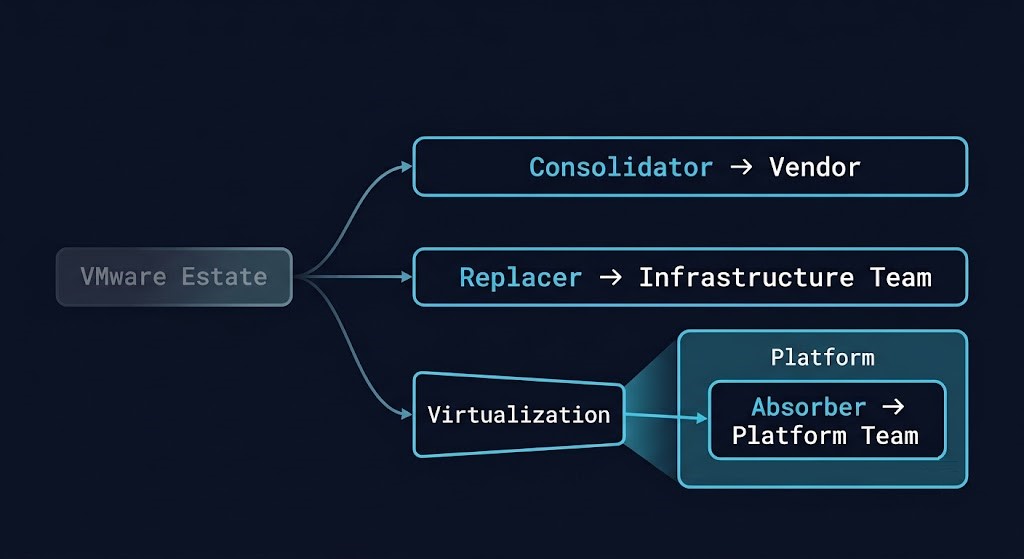
The virtualization market has stopped behaving like a two-sided argument about which hypervisor wins, and if you’re still evaluating it that way, you’re answering the wrong question. Two years past the Broadcom license shock, the noise has resolved into three distinct camps, and none of them are actually arguing about hypervisors anymore. They’re arguing about who owns the operational complexity that virtualization has always carried — the vendor, your infrastructure team, or your platform team. The hypervisor you end up running is just the visible artifact of that decision.
Three Camps, Not Two Sides
For the better part of two years, the virtualization architecture conversation around VMware’s exit got framed as binary: stay or leave. That framing was always too thin to be useful, and it’s now visibly wrong. Three coherent strategies have emerged, and every enterprise infrastructure conversation happening right now falls into one of them.
01 — THE CONSOLIDATORS
“We don’t want to own the platform problem.” These organizations are staying on VMware, absorbing the Broadcom subscription economics, and treating the higher bill as the price of never having to solve a platform problem themselves. The renewal decision itself was usually locked in long before the contract date — every dollar of licensing increase is a payment for someone else continuing to own it. This is the camp with the least visible drama and the most invisible risk: the assumption that the vendor will keep absorbing complexity indefinitely is itself a bet, and it’s rarely stated as one.
02 — THE REPLACERS
“We still want a virtualization platform, just not this vendor.” These organizations are moving off VMware and onto Nutanix, Proxmox, or another hypervisor platform — and stopping there. Nothing about the operating model changes. The infrastructure team still owns provisioning, lifecycle, storage design, network policy, and disaster recovery — they’ve just changed which console they do it in. This is a vendor swap wearing the costume of a migration.
03 — THE ABSORBERS
“Virtualization becomes a capability inside a larger platform.” These organizations are folding virtual machines into a Kubernetes-native control plane — KubeVirt, OpenShift Virtualization — where the VM stops being a first-class infrastructure decision and becomes one workload type among several the platform team’s control plane happens to schedule. This is the only camp where the operating model actually changes shape, because the team making infrastructure decisions is no longer a virtualization team — it’s a platform team that also happens to run VMs.
None of these three theses are about the technology being better or worse. They’re about where your organization wants operational risk to live: with the vendor, with your existing infrastructure team, or absorbed into a platform team that’s already managing something bigger than virtualization.
The Hypervisor Isn’t The Real Decision
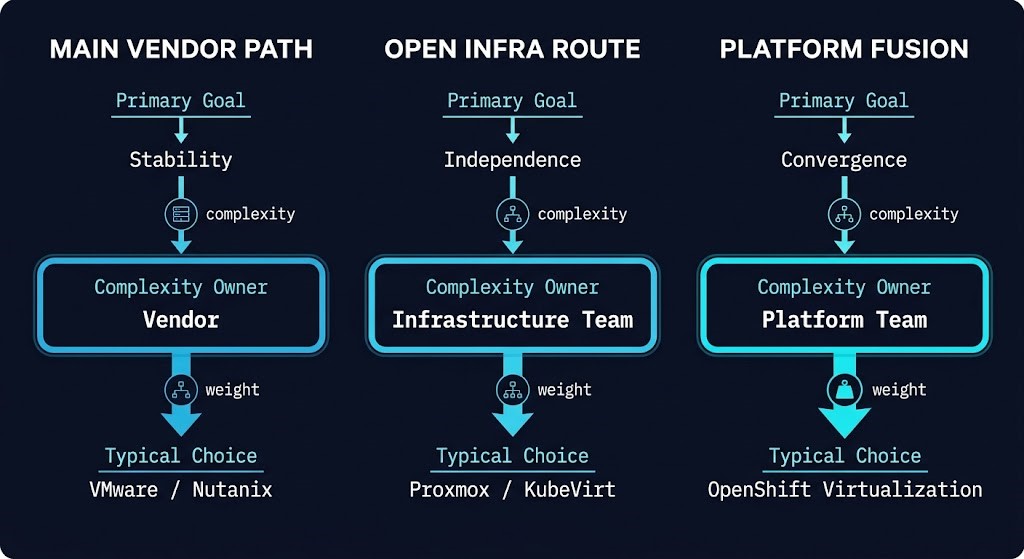
Compress the three camps into what they’re actually buying, and the pattern is cleaner than any product comparison:
| Camp | Primary Goal | Complexity Owner | Typical Choice |
|---|---|---|---|
| Consolidator | Stability | Vendor | VMware |
| Replacer | Cost / Independence | Infrastructure Team | Nutanix, Proxmox |
| Absorber | Platform Convergence | Platform Team | KubeVirt, OpenShift Virtualization |
Consolidators buy stability. Replacers buy independence. Absorbers buy convergence. All three are operating-model decisions first and technology decisions second — the hypervisor is just which invoice you get at the end of the decision, not the decision itself.
This is why the Replacer camp gets misread so often. Moving from VMware to Nutanix or Proxmox looks like the biggest technical change on paper — new APIs, new operational tooling, a genuine migration project — but it’s the smallest operating-model change of the three. The infrastructure team that owned governance, provisioning discipline, and lifecycle management under VMware owns exactly the same responsibilities under the new platform. What actually transfers, and what doesn’t, is a separate problem entirely — the Operating Model Transfer Gap — the operating model itself has to be explicitly rebuilt on the new platform, not assumed to come along for the ride.
Replacers and Absorbers share something Consolidators never have to face: once the second platform is running, operational maturity has to be proven at the estate level, not just within whichever platform a team happens to operate. Operational Parity Is Becoming The Real Virtualization Challenge picks up exactly there — the condition that exists once an organization maintains more than one independently governed platform and nobody’s been asked whether they behave the same way.
The Absorber camp is the one actually changing organizational shape, because the team making infrastructure decisions is a different team than the one that used to make them. That’s a governance conversation, not a hypervisor bake-off, and it’s the one most VMware-exit conversations skip entirely because they’re still arguing about which alternative platform is technically superior.
Why the Split Is Happening Now
None of this is new technology. Nutanix has been a viable alternative for a decade. KubeVirt has been production-viable for several years. What’s new is that organizations can no longer delay picking a camp.
For years, inertia was a valid strategy — renew VMware, defer the decision, wait for clarity. Renewal cycles, subscription transitions, VCSP program changes, and licensing-audit exposure have collectively closed off that option. An organization coming up on a renewal event this year isn’t choosing between “decide now” and “decide later.” Later isn’t on the table anymore — the contract structure, the audit exposure, or both, force an actual choice at the renewal date.
The market isn’t splitting because people discovered alternatives. It’s splitting because inertia stopped working.
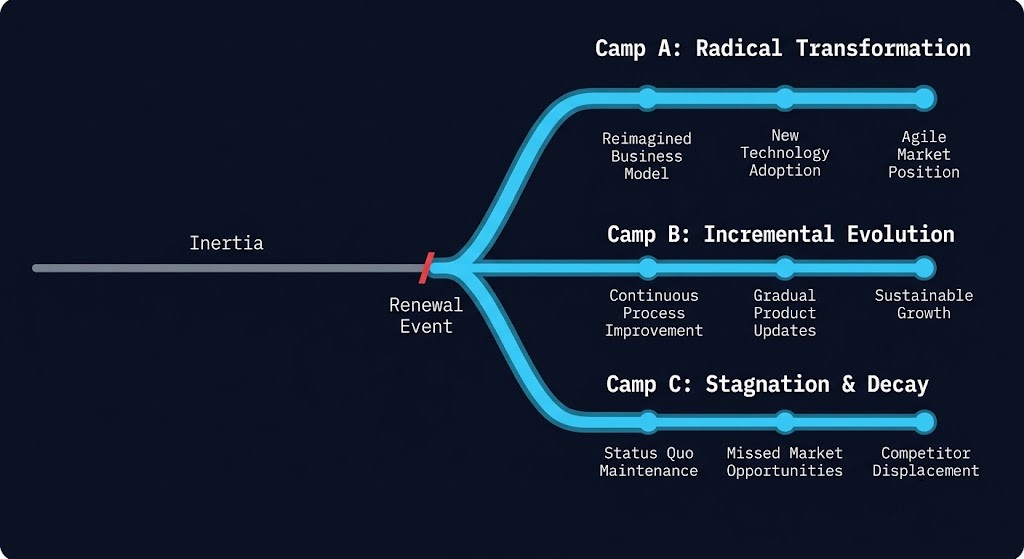
That forcing-function pattern isn’t unique to virtualization’s second act. AI infrastructure is running the identical five-stage sequence virtualization completed between 2005 and 2015 — right down to the same mechanism: inertia works until coordination costs exceed deployment costs, and then it stops working all at once. The three camps above are what that stage-five reckoning looks like when it’s happening to a market that already consolidated once. AI infrastructure is still in the earlier stages of the same curve.
Architect’s Verdict
The virtualization market didn’t fragment because Broadcom made a pricing mistake. It fragmented because a decision that used to have a default answer — renew, don’t think about it — no longer has one, and every organization forced to actually choose ended up sorting itself by a question nobody was asking out loud: who do we want owning this complexity for the next five years?
Most of the public conversation still argues the wrong layer — VMware versus Nutanix versus Kubernetes, as though the winning hypervisor is the outcome that matters. It isn’t. The camp you land in was decided by what your organization can operationally sustain, not by a feature comparison, and an infrastructure team that picks a camp without asking that question first will find out the hard way which complexity they actually inherited.
This is the first of several pieces mapping what comes after the split — the camp you’re in tells you what you signed up for. What it doesn’t tell you yet is what it costs to actually run.
Additional Resources
View 3 more resources
Editorial Integrity & Security Protocol
This technical deep-dive adheres to the Rack2Cloud Deterministic Integrity Standard. All benchmarks and security audits are derived from zero-trust validation protocols within our isolated lab environments. No vendor influence.

R.M.
Senior Solutions Architect with 25+ years of experience in HCI, cloud strategy, and data resilience. As the lead behind Rack2Cloud, I focus on lab-verified guidance for complex enterprise transitions. View Credentials →
Get the Playbooks Vendors Won’t Publish
Choose the architecture problems you care about. Get field-tested playbooks and frameworks delivered to your inbox.
- > AI Infrastructure & Inference Economics
- > Cloud Strategy & Hidden Cost Models
- > Virtualization & Deterministic Migration
- > Kubernetes, IaC & Modern Infrastructure
- > Data Protection & Recovery Engineering
Zero spam. Includes The Dispatch weekly drop.
Need Architectural Guidance?
Independent review before major infrastructure decisions.
- > Validate assumptions
- > Identify hidden dependencies
- > Quantify migration risk
- > Challenge vendor narratives
Triage · Advisory · Fractional · Direct Hire