

If Your Platform Must Exist To Verify The Evidence, The Evidence Doesn’t Exist
Evidence verification is the test most AI platforms have never been asked to pass: can what they produced be trusted by someone who doesn’t trust the platform that produced it. Two AI platforms can generate identical logs, identical dashboards, and identical audit exports. One of them produced evidence. The other produced a very convincing story about itself. The difference is invisible in a vendor demo. It only becomes visible the day someone tries to verify a specific decision without the platform’s cooperation — and discovers the record can’t stand on its own.
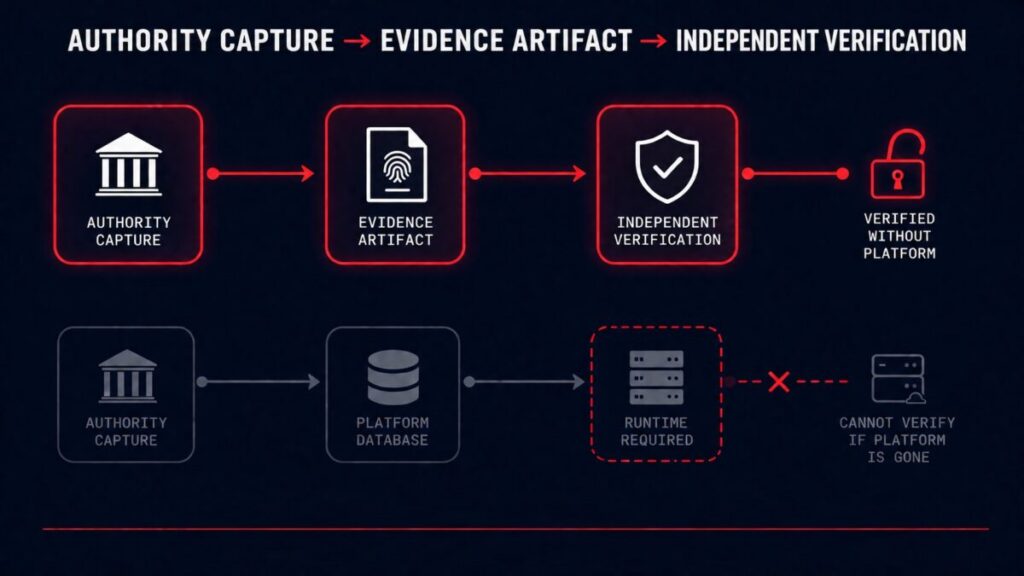
You Bought an Observability Layer. You Needed an Evidence Layer established the category mistake: organizations bought telemetry and assumed it was evidence. This piece is about something worse. Even organizations that believe they closed that gap — that bought an “evidence layer,” that can point to signed records and immutable logs — frequently never captured evidence that was authoritative in the first place. The category mistake is a procurement failure. This is an authenticity failure, and it’s harder to see because the artifacts exist. They just can’t be trusted without trusting the system that made them.
Integrity Is Not Authenticity
Most engineering teams stop at hashing. A record gets signed, the signature gets stored, and the assumption is that cryptographic integrity closes the evidence question. It closes half of it.
Integrity answers whether a record changed after it was written. A hash chain, a signature, an immutable log entry — all of these prove that the bytes you’re looking at now are the same bytes that were stored at some point in the past. That’s a real property and it matters. It is also a completely different question from whether the record was ever authoritative to begin with.
Authenticity answers whether the record was accurate, complete, and captured at the actual moment the decision occurred — not reconstructed afterward from adjacent systems that happened to be logging something. A hash-chained reconstruction and a hash-chained faithful record are indistinguishable to the integrity check alone. Both pass. Only one of them is evidence verification-grade.
| Question | Integrity Answers |
|---|---|
| Did the record change after it was written? | Yes |
| Was the record complete? | No |
| Was the record authoritative? | No |
| Was the record accurate? | No |
| Was the record captured at the decision boundary? | No |
An organization that treats a clean hash chain as proof of evidence quality has answered one question out of five and closed the file.
Authenticity Doesn’t Accumulate
The instinct across most AI infrastructure programs is that evidence quality improves as records move downstream — collect the logs, aggregate them, sign them, retain them, run them through a SIEM. Each step feels like it’s adding assurance.
Authenticity doesn’t work that way. It either exists at the moment the event is produced, or it never exists at all. #151 Infrastructure Evidence Gap already names this moment for infrastructure changes: the Authorization Event — the discrete, timestamped point at which identity, authority, and policy state are captured together with the action itself. #151’s six-step chain runs Approved Intent → Authorization Event → Signed Plan Artifact → Policy State Snapshot → Execution Record → Evidence Artifact. Every step after the Authorization Event is downstream processing. None of it can manufacture an Authorization Event that never happened.
This piece asks the same question #151 asks of infrastructure changes, applied to AI execution: if identity, authority, policy state, and action were not captured together at the moment the model or agent acted, no amount of retention, signing, or aggregation afterward can recreate that moment. The execution path is the only place where all four conditions co-exist. Every system downstream of it is already operating on a representation of the event, not the event itself.
The same requirement appears in AI execution paths as well. An authorization trail only exists if authority is captured at the moment a decision is exercised, not reconstructed afterward from adjacent telemetry.
Why Reconstruction Is Not Evidence
The distinction is easiest to see side by side.
An audit trail entry looks like this: “User X approved change, captured at write time, signed at the moment of approval.” That’s evidence — the Authorization Event exists as a discrete artifact, generated by the system that had the authority context at the moment it mattered.
A reconstruction looks like this: “We believe User X approved the change because a ticket existed, a role existed, an approval workflow completed, and the logs suggest approval occurred.” Every clause in that sentence is true. None of them is evidence. It’s an inference built from adjacent systems that were never designed to jointly attest to a single authorization event — which is precisely the shape of Authority Chain Opacity, Framework #141’s failure state for agentic tool chains: no evidence artifact exists that allows the authority movement to be reconstructed after execution, because it was never generated at execution time.
This is the same failure pattern that appears when authorization boundaries collapse and organizations discover they can explain a decision path but cannot prove who actually possessed authority at the moment it occurred.
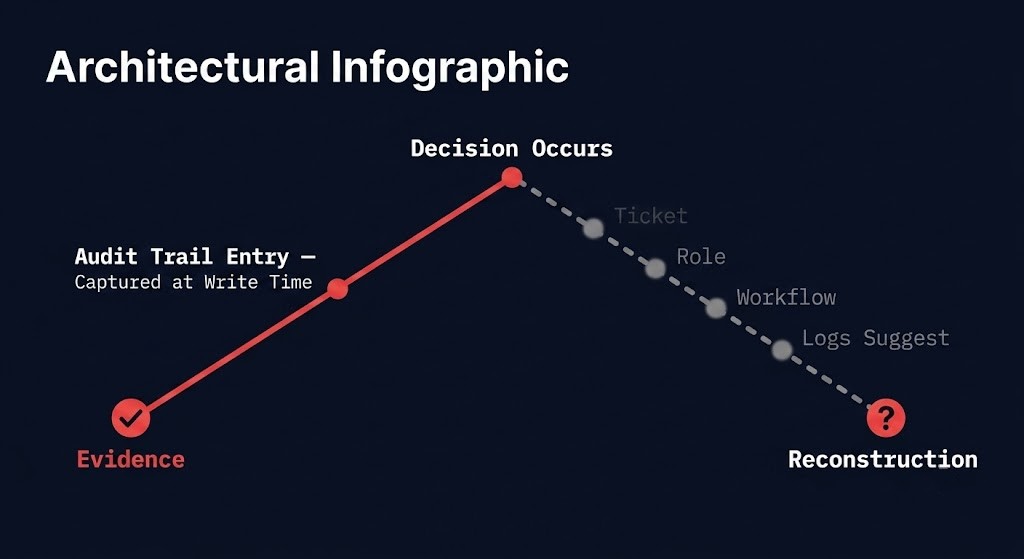
This is the trap most AI platforms fall into without noticing. The reconstruction reads as thorough. It cites four separate systems. It sounds like due diligence. It is not evidence, and the gap between “sounds like evidence” and “is evidence” is exactly where an audit, a regulatory inquiry, or an incident investigation stops accepting the answer. Evidence verification exists precisely to catch this gap before an outsider does.
The Two-Part Evidence Verification Test
Framework #149’s fourth component — Artifact Portability — is where this collapses into something an architect can actually test against. An artifact is not evidence if interpreting or verifying it requires the live system to remain available, or requires trusting the system that generated it to be believed. That standard breaks into two discrete, sequential tests.
THE TWO-PART EVIDENCE VERIFICATION TEST
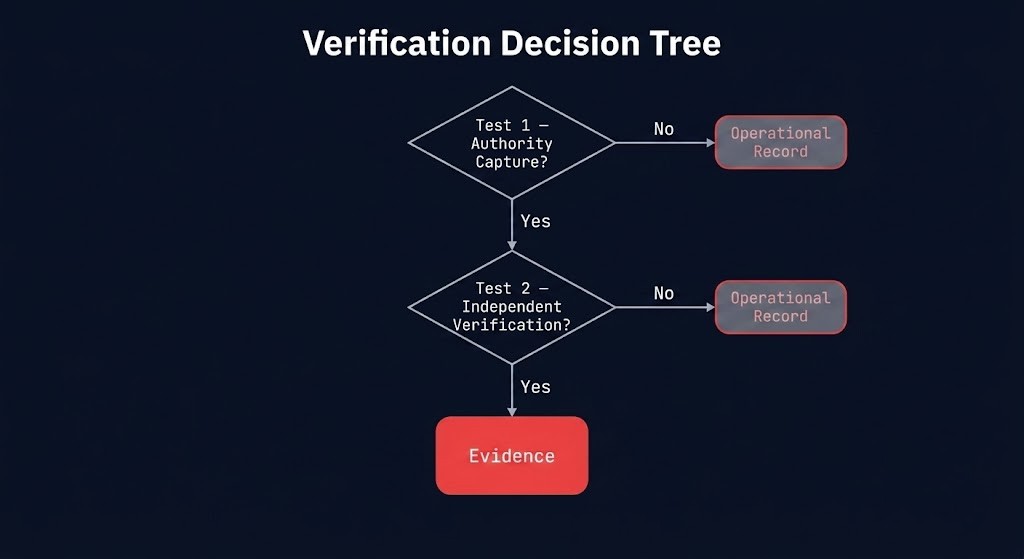
TEST 1 — AUTHORITY CAPTURE
Did the platform emit an authoritative artifact at the moment authority was exercised — identity, authority, and policy state captured together with the action, not assembled afterward from adjacent logs?
TEST 2 — INDEPENDENT VERIFICATION
Can another party verify that artifact without trusting the runtime that produced it — no live system access, no vendor-asserted integrity, no dependency on the platform staying operational or honest?
Fail either test and the artifact is an operational record, not evidence. Pass both and it qualifies. Most current AI platforms pass Test 1 in a soft form — some authority context gets captured somewhere near execution time — and fail Test 2 silently, because nobody asks the second question until an auditor does. The C2PA content provenance standard, built for an entirely different problem — proving media wasn’t manipulated after capture — makes the same architectural bet: provenance data gets bound at the moment of signature rather than fetched on demand during validation, precisely because on-demand validation depends on trusting whatever is doing the fetching. AI evidence architecture is running into the same constraint from a different direction.
An artifact that passes Test 1 but fails Test 2 is still runtime-dependent. The organization can prove authority was captured. It cannot prove that proof survives the platform going away — which is the entire point of evidence in the first place.
That’s the Automation Validation Tax (Framework #172) surfacing at the evidence layer specifically: an organization that passes Test 1 has automated the confidence-producing half of the process — the artifact exists, it looks authoritative — without automating, or even staffing, the verification half that would confirm Test 2 actually holds. The tax isn’t paid when the artifact is generated. It’s paid the first time someone outside the runtime tries to check it and finds nothing to check against.
The same Test 2 failure shows up outside AI systems entirely. Data Protection’s Recovery Evidence Boundary (#167) names the identical gap for recovery claims: an artifact chain can be timestamped, signed, and internally verifiable — passing something like Test 1 — while nobody structurally independent of the team that produced it has ever had standing to dispute the conclusion it draws. Independent verification isn’t an AI-specific requirement. It’s the same authority question wherever a system is asked to grade its own evidence.
The same Test 2 failure showed up a third time this week — not in a system an organization deploys internally, but in a security advisory from the vendor whose infrastructure the organization depends on entirely. Microsoft Said It Was Exploited. Then It Wasn’t. Your Tenant Still Can’t Tell You Which. is Test 2 failing at cloud-vendor scale: Microsoft’s own account of whether Entra ID had been exploited changed within a day, and no tenant held a way to verify either version without trusting the same party whose account had already proven unstable. Independent verification isn’t just an internal-systems requirement. It’s the same authority question wherever a party — a platform, or a vendor — is asked to grade its own evidence.
A fourth instance shows Test 1 itself being defeated, not just Test 2 going unbuilt. Your Logs Are Not Evidence If The Infrastructure That Produces Them Can Rewrite The Record documents Fire Ant, a China-nexus threat actor, injecting a shared library into a live TACACS daemon to falsify authentication records from inside the authority boundary that produced them — a filesystem integrity check can still show the binary as intact, because the manipulation happens in memory, at runtime, not on disk. The three cases above all describe an artifact that was authoritative but never independently checked. This one describes an artifact that was never authoritative to begin with, manufactured by infrastructure an attacker already controlled — the same authority-capture failure Test 1 exists to catch, just exercised by an adversary instead of exposed by an audit.
Why This Is a Procurement Failure, Not a Logging Gap
Most platform evaluations ask downstream questions: retention windows, export formats, search capability, RBAC scope on the audit log. A platform can answer yes to every one of those questions while emitting zero authoritative artifacts at execution time, because the RFP never asked the question that would have exposed it.
The questions almost nobody asks in procurement: what authoritative artifact is created the moment authority is exercised, and can that artifact be verified by someone who doesn’t have to trust our platform to do it? Those two questions are the entire Two-Part Evidence Verification Test, restated as buyer diligence instead of architecture review. The NIST AI Risk Management Framework frames organizational AI accountability in exactly this register — evidence that supports independent scrutiny, not evidence that supports the vendor’s own claims about itself.
The asymmetry that makes this dangerous: evidence-originating platforms and telemetry-only platforms look identical in a deployment that hasn’t yet had an audit event. The gap stays invisible at exactly the moment it would be cheapest to correct, and surfaces at exactly the moment it’s most expensive — mid-investigation, mid-regulatory-inquiry, with the runtime already answering to someone who doesn’t trust it by default. Procurement rubrics that never ask an evidence verification question will keep buying that gap by default.
Architect’s Verdict
Evidence that requires its originating platform to remain alive, available, and trusted in order to be verified was never evidence. It was a claim wearing evidence’s clothing, and the two are identical right up until the moment someone tries to check the claim without the platform’s help.
Most organizations that believe they’ve solved the evidence problem solved the integrity problem instead — records that provably haven’t changed since they were written, produced by a system nobody has separately confirmed was authoritative when it wrote them. That gap doesn’t show up in a demo, a retention policy, or a compliance checklist that only asks about storage. It shows up in the one conversation none of those artifacts were built to survive: an independent party, no access to the runtime, asking whether what they’re looking at is true.
The systems that hold up under that conversation aren’t the ones with the most complete logs. They’re the ones that never needed the runtime’s permission to be believed. That’s what evidence verification is actually testing for.
Additional Resources
View 7 more resources
Editorial Integrity & Security Protocol
This technical deep-dive adheres to the Rack2Cloud Deterministic Integrity Standard. All benchmarks and security audits are derived from zero-trust validation protocols within our isolated lab environments. No vendor influence.

R.M.
Senior Solutions Architect with 25+ years of experience in HCI, cloud strategy, and data resilience. As the lead behind Rack2Cloud, I focus on lab-verified guidance for complex enterprise transitions. View Credentials →
Get the Playbooks Vendors Won’t Publish
Choose the architecture problems you care about. Get field-tested playbooks and frameworks delivered to your inbox.
- > AI Infrastructure & Inference Economics
- > Cloud Strategy & Hidden Cost Models
- > Virtualization & Deterministic Migration
- > Kubernetes, IaC & Modern Infrastructure
- > Data Protection & Recovery Engineering
Zero spam. Includes The Dispatch weekly drop.
Need Architectural Guidance?
Independent review before major infrastructure decisions.
- > Validate assumptions
- > Identify hidden dependencies
- > Quantify migration risk
- > Challenge vendor narratives
Triage · Advisory · Fractional · Direct Hire