

Compatibility Is Not The Same Thing As Support
The lifecycle support boundary is the point past which a platform keeps running your architecture while the organization behind it has quietly stopped being accountable for it. Your build pipeline still compiles. Your container base image still pulls. Your CI runner still executes the job — and none of that tells you whether you’re inside or outside that boundary.
Debian 13 no longer supports i386 as a regular architecture. The i386 userland remains available for legacy 32-bit software on amd64, but there is no official i386 kernel or installer. The support boundary did not require an immediate runtime failure. Existing 32-bit software could continue running where the underlying environment still supported it; what changed was Debian’s support position — not whether the software could execute.
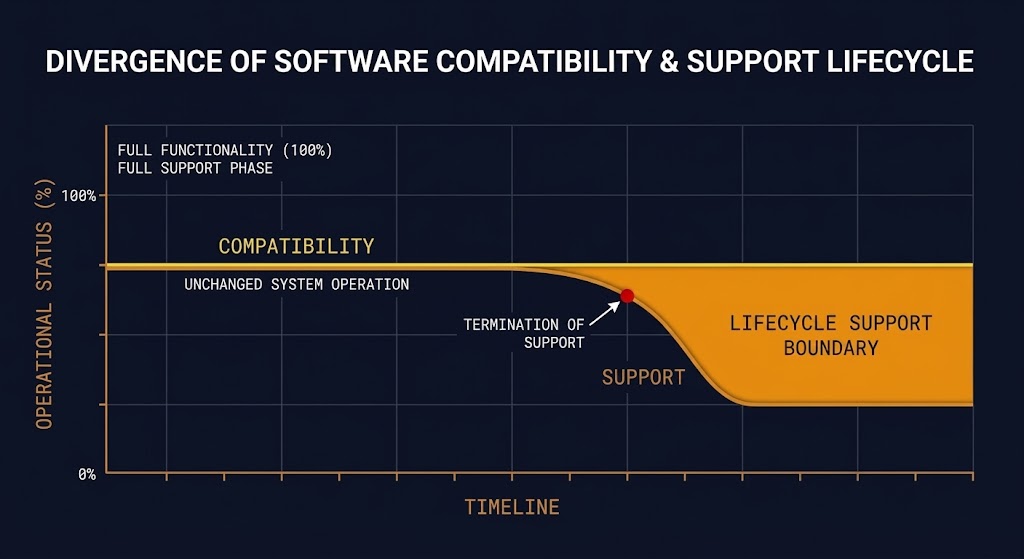
The Boundary Between Compatibility and Support
Compatibility is a technical fact: does the artifact run, does the syscall resolve, does the binary link. Support is an organizational commitment: does anyone patch it, does anyone answer for it, does anyone owe you a fix when it breaks.
Compatibility is a technical fact; support is an organizational commitment. They decay independently.
Most infrastructure discussions collapse these into one axis — “is it supported” as a single yes/no — because for most of a platform’s life, the two move together. The vendor ships the OS, the OS runs your workload, the vendor patches the OS. One curve, one decision.
They diverge at the edges of a platform’s life, and the edges are exactly where nobody’s watching. A vendor withdraws support for an architecture, a runtime version, an API surface, a hardware target — and the artifact that depended on it doesn’t stop working. It stops being anyone’s responsibility that it keeps working. Those are different failure conditions, and only one of them shows up in a monitoring dashboard.
A platform can continue executing your architecture long after the ecosystem has stopped accepting responsibility for it.
What “Still Works” Hides
The dangerous property of this gap is that it produces no local signal. A build that depends on a dropped architecture target doesn’t fail at the moment support is withdrawn — it fails at the moment something else changes: a downstream dependency bumps a minimum version, a security patch needs backporting and there’s no maintainer left to do it, a hardware refresh removes the last box that could still run the thing, an auditor asks who’s accountable for a component and the honest answer is nobody.
This is not a security-patching article, and it would be a weaker one if it became that. CVEs and patch cadence are one visible symptom of the boundary being crossed — they’re not the mechanism. The mechanism is broader than any one failure surface: responsibility disappeared before functionality disappeared, and that sentence is true whether you’re talking about an operating system’s architecture support, a cloud provider’s deprecated API version, a runtime’s end-of-life branch, a hardware platform’s driver lifecycle, or a toolchain that stopped tracking a language’s current spec.
The organizations that get hurt by this aren’t the ones running obviously ancient infrastructure — those get flagged in every audit. They’re the ones with a component that’s still fully functional, still passing every test, still invisible to any inventory process that only asks “does it work” instead of “who still owns making sure it keeps working.” The same gap shows up one layer up the stack, where a declared standard can sit unchanged on a wiki page looking exactly as authoritative as the day it was written, with no mechanism proving it still matches what’s actually deployed.
Three questions expose the gap, and none of them are “is this patched”:
QUESTIONS THAT EXPOSE THE GAP
- Who is the accountable party if this component needs a fix next quarter — a named vendor, a named team, or nobody?
- If the answer is “nobody,” was that an explicit architectural decision — or did the ecosystem simply move on without anyone noticing?
- Does your architecture inventory track support commitments as a first-class field, or only technical compatibility?
Lifecycle Support Boundary and the Governed Window
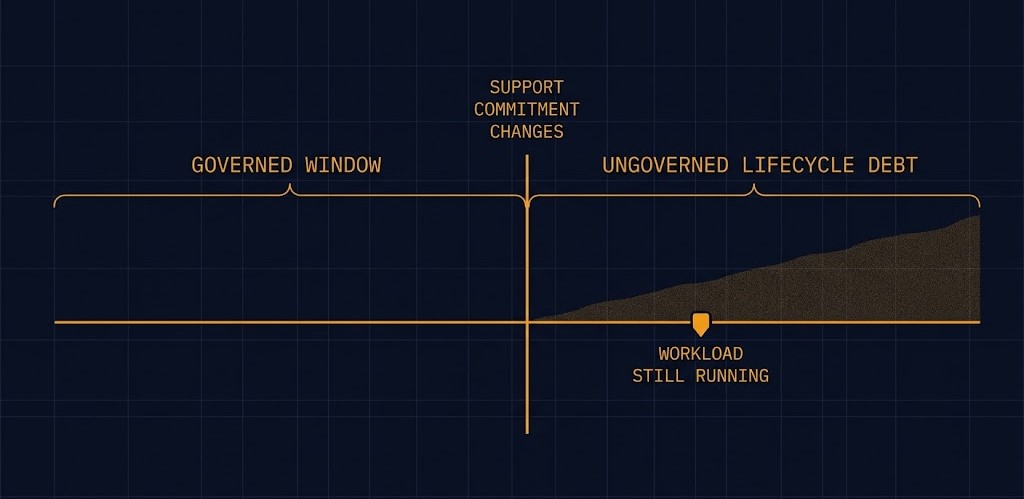
This is the same shape Framework #112, Lifecycle Governance Horizon describes for platform lifecycle decisions generally: a forward window within which upgrades, support, and licensing commitments remain governed — and past that window, lifecycle debt accumulates without anyone deciding to accumulate it. #112 was built against a hypervisor’s support matrix. The lifecycle support boundary is the same mechanism expressed at the architecture level rather than the hypervisor level — it applies as cleanly to an OS’s supported instruction sets as it does to a cloud API’s deprecation schedule or a language runtime’s LTS branch.
Windows 10 ESU is the boundary made explicit rather than discovered: Microsoft is still selling support, on a published schedule, for a fee that escalates specifically to prevent the governed window from becoming permanent by default. Compatibility never changes — Windows 10 keeps running identically before and after the boundary — but the support commitment is priced, dated, and cumulative. Most instances of this mechanism hide the boundary until something downstream forces the question. ESU is the rare case where the vendor drew the line in public and put a number on crossing it.
The identity tier shows that split on one date. DKM ACL hardening auto-remediates on Windows Server 2016 and later from October 2026. On Server 2012 and 2012 R2 the same control waits for a manual permission grant and an explicit registry opt-in, and Microsoft gives October 13, 2026 as the Server 2012 ESU end date. The monthly update still ships through that date. Whether the ACL changes depends on the manual step, which the update stream does not perform.
The governed window doesn’t close when your workload stops. It closes when the platform’s support commitment changes — often without producing a corresponding failure in the workload itself. The organizations that stay inside the window aren’t the ones with better patching — they’re the ones that track the window itself as a managed input, not an artifact they discover retroactively when something downstream forces the question.
A related but distinct failure shows up when multiple lifecycle support boundaries close at once rather than one at a time. Lifecycle Convergence covers what happens when several independently-governed windows land inside the same compressed span — the boundary itself doesn’t change, but the organization’s ability to sequence its response to it does.
A narrower failure sits even earlier in the chain: sometimes the boundary itself gets misreported before anyone has to sequence a response to it at all. The Kubernetes 1.37 Deadline That Doesn’t Exist covers a support-policy date circulated as a hard technical enforcement date — the same compatibility-versus-support confusion this post opens with, playing out in downstream secondary coverage rather than in the platform’s own documentation.
A related but distinct question sits inside each virtual machine, and it is about ownership rather than support. The Secure Boot trust anchors of a virtual machine are held as virtual-firmware state. On vSphere the host sets the certificates at first power-on and template VMs inherit the exact certificates of the source template, so a fleet built over several years can hold several initial states. A VM that is up tells you nothing about which of those states it holds or who is responsible for changing it. Secure Boot Trust: Who Owns the Virtual Firmware State takes that ownership question across vSphere, Proxmox VE and Azure, and stays off the question this post is about: what happens once a vendor support boundary passes.
Where This Actually Bites
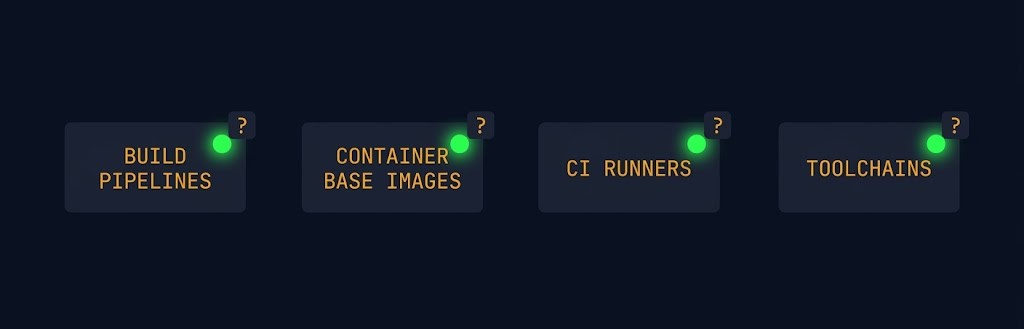
The pattern shows up wherever an architecture decision outlives the assumptions it was made under:
WHERE THE BOUNDARY HIDES IN THE ESTATE
- Build pipelines pinned to a specific target — a Makefile or CI config that hardcodes an architecture flag because that’s what the original hardware needed, years after the hardware changed and nobody revisited the flag.
- Container base images with inherited dependencies — a base image chosen for stability that quietly carries a dropped-support package three layers down, invisible unless someone actually diffs the image contents against current vendor support tables.
- CI runners nobody’s re-platformed — infrastructure that was provisioned once, works fine, and has never been on anyone’s replacement roadmap because “it still works” has been a sufficient answer for years.
- Cross-compilation toolchains built on assumptions that stopped being true — a build system targeting an architecture or API level that made sense at design time and has never been revisited against what’s currently supported upstream.
None of these produce an error. They produce a gap between what an inventory system reports (functional) and what an accountability system would report (unowned) — and most organizations only have the first system. Automation carries its own version of the same gap: the pipeline keeps executing while the operating discipline required to keep it trustworthy quietly erodes, with no single event marking the crossing.
The gap runs in both directions, and the direction matters. Secondary-platform support shows the same debt accumulating from the investment side — secondary platforms can remain functional while feature, fix, and lifecycle-tooling investment lags behind, creating the same separation between technical capability and architectural confidence. A vendor that closes that gap deliberately, matching support commitment to compatibility instead of letting the two drift apart, is the boundary held rather than crossed — worth naming as the exception, not the default.
DIAGNOSTIC QUESTION
“If a component in your estate lost its vendor’s support commitment tomorrow, would your architecture team find out from a changelog, or from an incident?”
Architect’s Verdict
Compatibility is a technical fact; support is an organizational commitment. They decay independently, and treating them as one axis is how the lifecycle support boundary gets crossed without anyone deciding to cross it.
The real failure most architecture teams are exposed to isn’t unsupported software running in production — that’s a known, auditable condition. It’s the belief that “still works” is evidence of “still owned.” A platform can continue executing your architecture long after the ecosystem has stopped accepting responsibility for it, and the gap between those two facts is exactly where accountability goes to disappear.
Functionality is not a proxy for ownership. If your inventory can’t answer who’s responsible when something breaks, it isn’t tracking risk — it’s tracking uptime.
Additional Resources
View 5 more resources
Editorial Integrity & Security Protocol
This technical deep-dive adheres to the Rack2Cloud Deterministic Integrity Standard. All benchmarks and security audits are derived from zero-trust validation protocols within our isolated lab environments. No vendor influence.

R.M.
Senior Solutions Architect with 25+ years of experience in HCI, cloud strategy, and data resilience. As the lead behind Rack2Cloud, I focus on lab-verified guidance for complex enterprise transitions. View Credentials →
Get the Playbooks Vendors Won’t Publish
Choose the architecture problems you care about. Get field-tested playbooks and frameworks delivered to your inbox.
- > AI Infrastructure & Inference Economics
- > Cloud Strategy & Hidden Cost Models
- > Virtualization & Deterministic Migration
- > Kubernetes, IaC & Modern Infrastructure
- > Data Protection & Recovery Engineering
Zero spam. Includes The Dispatch weekly drop.
Need Architectural Guidance?
Independent review before major infrastructure decisions.
- > Validate assumptions
- > Identify hidden dependencies
- > Quantify migration risk
- > Challenge vendor narratives
Triage · Advisory · Fractional · Direct Hire