

The Retirement Dates Converged. Your Teams Didn’t.
Lifecycle convergence is what happens on October 1, October 13, and November 10, 2026, when four unrelated Microsoft products — an identity policy, a productivity application, an office suite, and a server operating system — reach a support decision point inside the same six-week window. None of the four teams responsible for those products planned to compete for the same governance bandwidth this fall. Microsoft’s release calendar decided that for them.
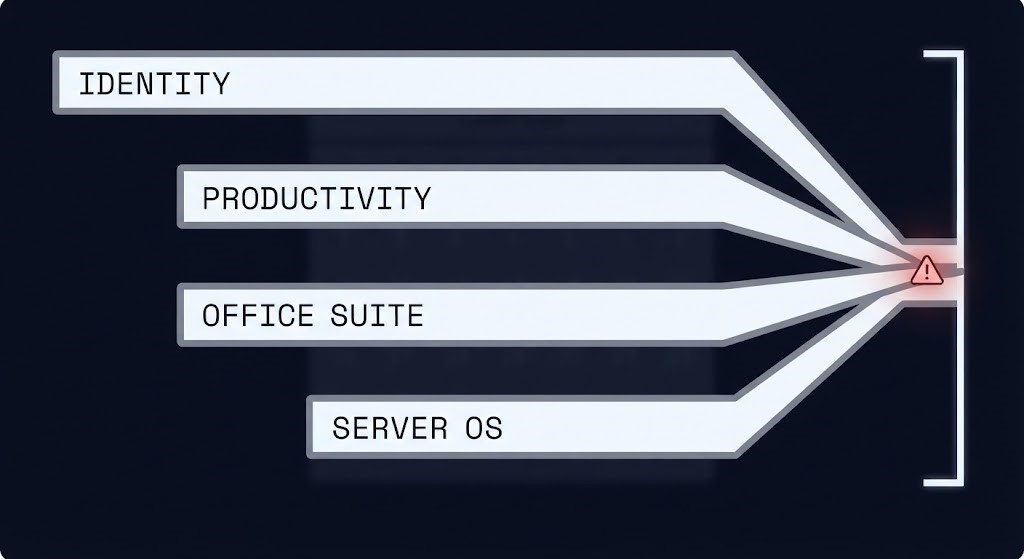
The Calendar, Stated Plainly
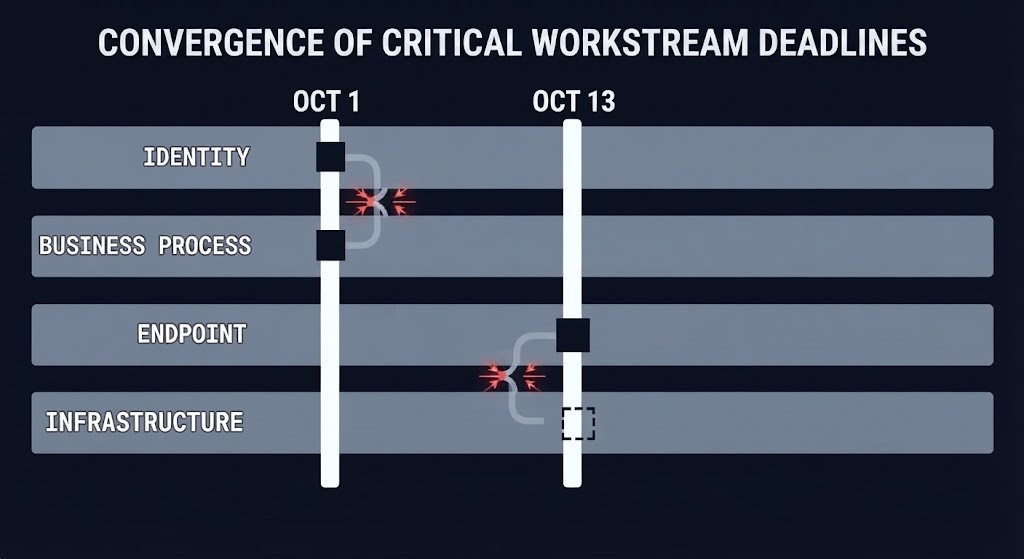
Three dates, four events, one governance bandwidth pool:
THE CONVERGENCE WINDOW
- October 1, 2026 — Entra ID’s legacy risk policies (user-risk and sign-in-risk, the Conditional Access predecessors) retire. Publisher retires from Microsoft 365 entirely.
- October 13, 2026 — Office, Visio, and Project LTSC 2021 reach full end of support, with no Extended Security Updates offered. Windows Server 2022 exits mainstream support the same day.
- November 10, 2026 — Windows 11 23H2 Enterprise editions get a four-week extension past the October cliff that hits every other edition.
None of these systems share a dependency chain. They only share a calendar.
Read as a news item, that’s a Microsoft compliance calendar. Read as an architecture problem, it’s something else: four independent teams — identity/security, business process owners, endpoint/application owners, and infrastructure — all discover their deadline is “now,” in the same quarter, for reasons that have nothing to do with each other.
This isn’t a single-domain problem. It’s an enterprise architecture problem that cuts across identity, endpoint management, infrastructure, and business operations at once — no single team owns the intersection.
Why This Isn’t “Everything Retires At Once”
The easy version of this article is a countdown clock. It’s also wrong, and the wrongness matters.
Windows Server 2022 does not become unsupported on October 13. It crosses from mainstream support into extended support — security updates continue at no additional charge through October 14, 2031. What actually ends on October 13 is non-security fixes, feature and design-change requests, and complimentary incident support tied to a license or Software Assurance. That’s a planning decision, not a cliff.
The other three are not the same shape at all:
| Event | Technical Severity | Governance Requirement |
|---|---|---|
| Entra ID legacy risk policies | Hard replacement — Conditional Access is the only forward path | Immediate |
| Publisher retirement | Product disappears from M365 entirely | Immediate |
| Office LTSC 2021 | Hard support cliff — no ESU offered | Immediate |
| Windows Server 2022 | Mainstream → extended support transition | Planning decision required |
Already, one lifecycle window closing is familiar territory — The Windows 10 ESU Price Doubles In Six Weeks covered exactly that: a single governed window, a known deadline, a procurement decision about the cost curve inside it. This signal is different. It isn’t one window. It’s four windows with four different severities, landing on the same calendar week, competing for the same finite governance attention.
THE PIVOT
The problem isn’t that four things become unsupported. They don’t. The problem is that four teams now have legitimate reasons to consume scarce governance bandwidth inside the same window.
Lifecycle Convergence: Naming the Mechanism
Lifecycle risk, on its own, is a solved problem. Every enterprise architecture practice already knows how to manage it: track the vendor’s published dates, budget the migration, sequence the work by business priority, done. Sequencing is the entire trick — it’s how an organization with finite engineering hours survives a world where every vendor eventually retires everything.
Lifecycle Convergence occurs when multiple independent lifecycle events become synchronized within a compressed governance window, forcing organizations to allocate migration bandwidth according to scheduling pressure rather than risk priority.
FRAMEWORK #173 — LIFECYCLE CONVERGENCE
Multiple independent lifecycle events synchronize inside one governance window, forcing unrelated programs to compete for the same migration bandwidth.
The failure point is node 3: once sequencing collapses, the organization has already lost the ability to choose who goes first.
The relationship deliberately isn’t “Part III.” Compatibility Is Not The Same Thing As Support named the Lifecycle Support Boundary — its own distinct concept, analogous to but separate from Framework #112, Lifecycle Governance Horizon — what happens when support and operability diverge on independent curves — the artifact still runs, but accountability for it quietly disappears. Lifecycle Convergence is a different failure entirely: it doesn’t require anything to be unsupported. It requires four separately-supported things to demand attention in the same week.
Where This Recurs Beyond Microsoft
The Microsoft calendar earns this mechanism its name, but it isn’t the reason the mechanism exists. Strip out the vendor and the product names, and the shape survives intact.
Broadcom’s post-acquisition VMware licensing changes bundled perpetual-license sunsets across vSphere, NSX, and vSAN into overlapping windows — different products, one procurement deadline, one budget cycle, one set of infrastructure architects who couldn’t sequence which platform to re-license first. AWS routinely retires multiple unrelated services in the same quarterly deprecation wave, and the teams affected — storage, networking, compute — rarely coordinate with each other before the notice lands. Oracle’s Java licensing changes and database support-tier consolidations have landed in the same fiscal year for enterprises running both, turning two separate vendor relationships into one budget collision. None of these are Microsoft. All of them are Lifecycle Convergence.
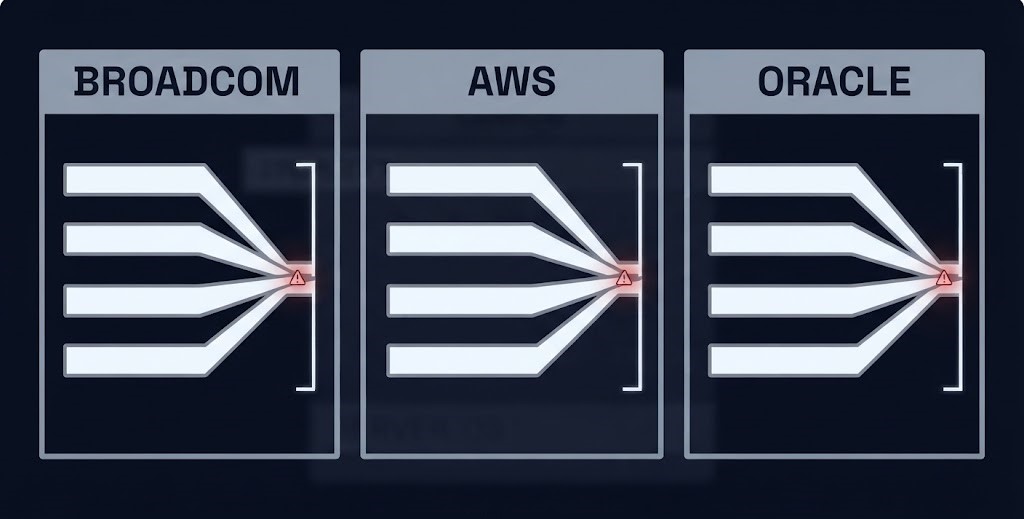
The same convergence shape shows up even where the shared resource isn’t governance bandwidth at all. The 2026 Licensing Trifecta covered three independent vendors — Broadcom, Microsoft, and Oracle — raising prices in the same budget cycle, with no coordination between them. Strip out the vendor names there too: independent events, external scheduling pressure, simultaneous arrival, and a shared constrained resource — in that case budget and procurement authority rather than migration bandwidth. Different resource, same convergence shape.
That’s the actual test for whether Lifecycle Convergence applies: if you remove the vendor names and the domain-specific language, does the mechanism still hold? If the answer is yes, the calendar in front of you isn’t the problem. It’s the current instance of a pattern that will recur with the next vendor, on the next stack.
What Changes in the Response Model
The instinct, faced with four “immediate” deadlines, is to migrate faster. That’s the wrong lever. Speed doesn’t fix a sequencing problem — it just means whichever team panics first wins the contested bandwidth, regardless of whether their deadline actually carried the most risk.
The real question an architect has to answer is: who has authority to sequence competing lifecycle deadlines when every affected team can legitimately claim urgency? In most organizations, nobody currently holds that authority, because lifecycle management has always been delegated per-platform — identity owns Entra, endpoint owns Office, infrastructure owns the server fleet — and nobody owns the intersection between them.
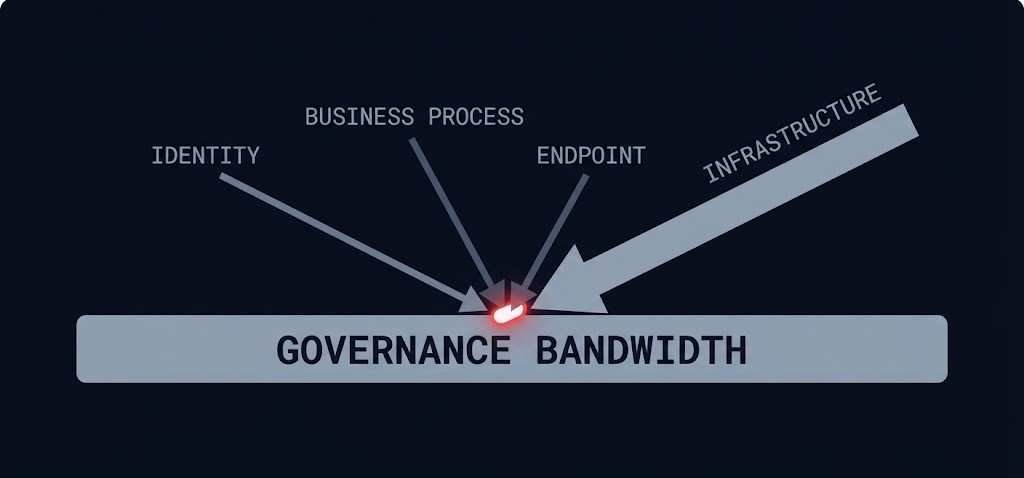
The composite response isn’t “migrate faster” project by project. It’s creating a composite sequencing decision before individual teams independently start consuming the same change windows, review cycles, and change-freeze slots — a single point of authority that ranks the four programs by actual risk (Entra and LTSC first, since both are hard cliffs with no fallback; Windows Server 2022 last, since extended support buys five years of room) rather than by whichever team escalated loudest first.
That authority has to exist before the next Lifecycle Convergence event, not be improvised during this one — because there will be a next one, on a different vendor’s calendar, and the organizations that survive it well are the ones that already know who makes the call.
Architect’s Verdict
Lifecycle risk is normally managed through sequencing: track the vendor dates, budget the migration, rank the work by business priority, and nothing collides. Lifecycle Convergence occurs when vendor scheduling removes the organization’s ability to sequence responses at all, forcing unrelated programs to compete for the same governance bandwidth whether they intended to or not.
The real failure this October isn’t Microsoft’s calendar. It’s that most organizations have no standing authority whose job is to rank four simultaneous “immediate” claims against each other — because nobody expected to need one until four vendor clocks landed in the same six weeks. That authority doesn’t currently exist in most IT organizations, and it needs to, because this is not the last time four unrelated deadlines will arrive together.
The retirement dates converged. Whether your teams do too is the only decision that was ever actually yours to make.
Additional Resources
Editorial Integrity & Security Protocol
This technical deep-dive adheres to the Rack2Cloud Deterministic Integrity Standard. All benchmarks and security audits are derived from zero-trust validation protocols within our isolated lab environments. No vendor influence.

R.M.
Senior Solutions Architect with 25+ years of experience in HCI, cloud strategy, and data resilience. As the lead behind Rack2Cloud, I focus on lab-verified guidance for complex enterprise transitions. View Credentials →
Get the Playbooks Vendors Won’t Publish
Choose the architecture problems you care about. Get field-tested playbooks and frameworks delivered to your inbox.
- > AI Infrastructure & Inference Economics
- > Cloud Strategy & Hidden Cost Models
- > Virtualization & Deterministic Migration
- > Kubernetes, IaC & Modern Infrastructure
- > Data Protection & Recovery Engineering
Zero spam. Includes The Dispatch weekly drop.
Need Architectural Guidance?
Independent review before major infrastructure decisions.
- > Validate assumptions
- > Identify hidden dependencies
- > Quantify migration risk
- > Challenge vendor narratives
Triage · Advisory · Fractional · Direct Hire