

The Retention Conflict Backup Architecture Wasn’t Built to Arbitrate
Retention conflict architecture is what happens when a backup platform designed to execute a single retention schedule becomes the enforcement point for legal obligations that disagree with each other about the same record. A GDPR erasure request lands on data under active litigation hold. A PCI-mandated retention window overlaps a customer’s Article 17 request. HIPAA’s six-year retention floor sits underneath a deletion order the platform has no way to evaluate. The backup system does not fail here in any conventional sense — it executes exactly what it was configured to do. The failure is that nothing in the architecture was ever built to decide which obligation wins.
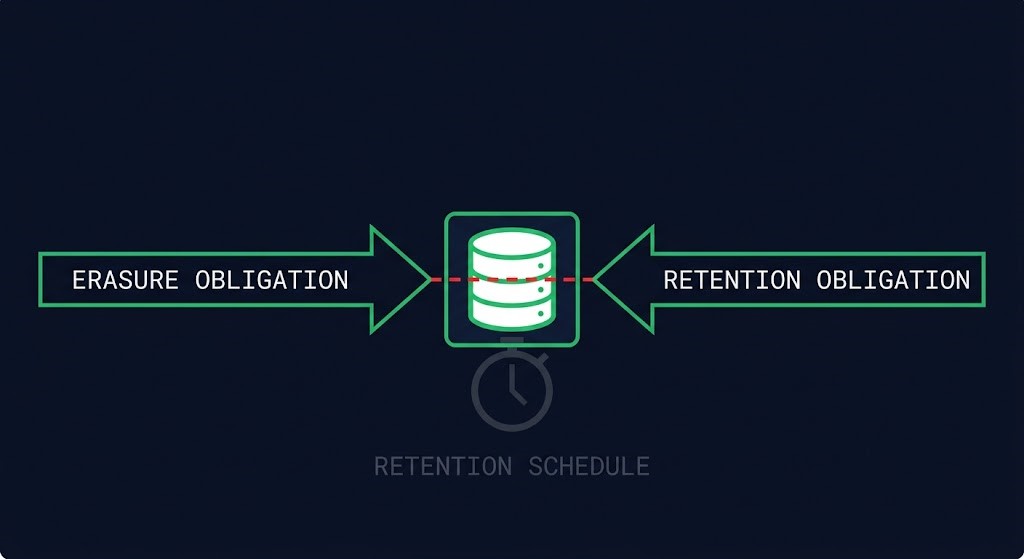
This is a different mechanism than the one rack2cloud’s existing ransomware and immutability coverage addresses. Immutable backup architecture defends a fixed record against an adversary trying to alter or delete it. Retention conflict architecture is not adversarial at all — it’s two or more legitimate, internally consistent legal obligations converging on the same object with opposite directives, and an infrastructure layer that was never given the authority, or the metadata, to resolve the disagreement.
This is a Data Protection architecture problem rather than a compliance-policy problem, because the conflict emerges inside the systems responsible for enforcing retention decisions — not in the legal department that writes the policy those systems are supposed to execute.
Retention Was Architected as a Schedule, Not a Decision
Every enterprise backup platform models retention the same way: a duration, an expiration trigger, sometimes an immutability lock. Retain for seven years. Retain until a litigation hold is lifted. Retain indefinitely under an object-lock policy. These are all timers — deterministic, auditable, and completely blind to why the timer exists.
That blindness was never a defect. For most of backup architecture’s history, a single retention clock was sufficient because a given dataset typically answered to one governing regime at a time. Financial records had a retention floor. Backups expired on a schedule. Legal holds were the rare exception, layered on top of an otherwise simple policy, and resolved manually when they arose.
What’s changed is density, not novelty. The same record — a customer’s transaction history, a patient’s treatment record, an employee’s HR file — now routinely sits inside overlapping jurisdictions and overlapping regulatory regimes simultaneously. GDPR’s Article 17 grants an enforceable right to erasure. HIPAA and PCI DSS impose multi-year retention floors on adjacent categories of the same data. Litigation holds suspend normal deletion the moment discoverability attaches. None of these regimes is aware of the others by default, and none of them was written with backup architecture in mind — they were written as legal obligations, and it’s the infrastructure layer that inherits the collision when they overlap.
The conflict isn’t created by any individual regulation. It emerges when multiple valid obligations are applied to the same object at the same time.
Where the Collision Actually Surfaces
The pattern isn’t hypothetical. The European Data Protection Board’s Coordinated Enforcement Framework report on the right to erasure — adopted in February 2026 after surveying 764 controllers across 32 supervisory authorities — found that a recurring share of controllers struggled specifically with determining retention periods and executing deletion in backup systems, alongside broader confusion over which legal exceptions could justify refusing an erasure request. That’s retention conflict architecture showing up as a regulatory finding: organizations aren’t failing to want to comply, they’re failing to have an architecture that can tell them which obligation governs a given record at the moment of conflict.
The UK’s Information Commissioner’s Office addresses the same territory from the other direction, describing what a controller can do when full backup erasure isn’t proportionate: put the data beyond use, exclude it from any future restoration, and delete it when the normal backup cycle expires. That guidance is a reasonable operational compromise — but it presumes the organization already knows the data is safe to put beyond use. It says nothing about what happens when the same record is simultaneously subject to a preservation obligation the organization is also legally required to honor. The ICO’s proportionality test and a litigation hold aren’t in conversation with each other; an architecture built around one has no native way to check the other before acting.
DIAGNOSTIC QUESTION
“If two legal obligations attached to the same record today — one requiring deletion, one requiring preservation — could your backup architecture identify which obligation takes precedence before acting?”
A Legal-Hold Feature Is Not an Arbitration Model
Enterprise backup vendors — Veeam, Commvault, Rubrik among them — already expose legal-hold and retention-lock constructs, and their existence is itself evidence that the underlying problem is real: customers keep running into conflicting governance requirements, and vendors have responded by giving administrators a way to flag a record as held. That’s a meaningful capability. It is not the same capability as determining which obligation should prevail when a record is simultaneously subject to more than one. That gap is retention conflict architecture in vendor-facing form: the industry has built tooling around the symptom, not the arbitration problem itself.
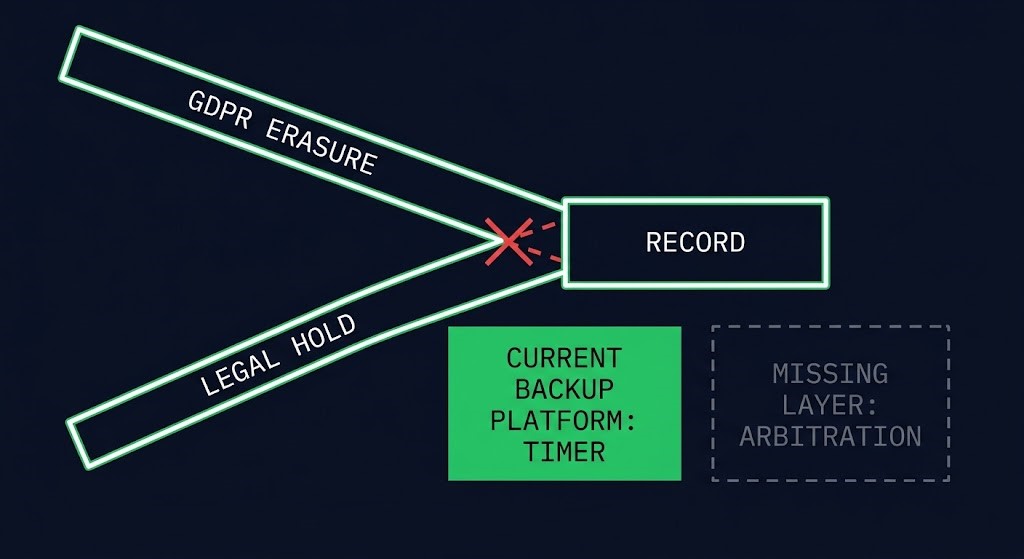
A legal-hold flag preserves data. It doesn’t interpret law. The platform can suspend a deletion job the moment a hold is applied — that’s a mechanical override, and it’s necessary. What it can’t do is evaluate whether the erasure request in front of it is superseded by the hold, whether the hold itself has expired, or whether a narrower deletion (redacting the personal fields while preserving the transaction record the hold actually protects) would satisfy both obligations at once. Those are judgment calls that require legal interpretation of precedence, and no backup platform on the market is positioned to make them, because none of them were designed to store obligation metadata in the first place — only retention metadata.
That’s the actual distinction this piece rests on: the platform knows how long to keep something. It doesn’t know why, and it doesn’t know what to do when the why conflicts with another why attached to the same object.
What an Arbitration Layer Actually Requires
If retention conflict architecture is the failure condition, the fix isn’t a better retention schedule — a schedule is precisely the tool that can’t resolve a conflict between obligations, only express the duration of one of them. What’s missing is a layer that can hold obligation-level metadata per record: which regime asserts a claim, what that claim requires (preserve vs. delete), and which claim has precedence when two are active at once.
Concretely, that means:
WHAT AN ARBITRATION LAYER REQUIRES
- Why retained — recording why a record is retained, not just until when, at the object or record level, distinct from the backup platform’s own retention-window configuration.
- Precedence model — evaluated before a deletion or erasure action executes, not discovered afterward when a hold notice arrives late.
- Escalation path — routing to legal or compliance review when precedence is genuinely ambiguous, rather than defaulting to either “delete” or “retain” as a fail-safe, since either default can itself violate an obligation.
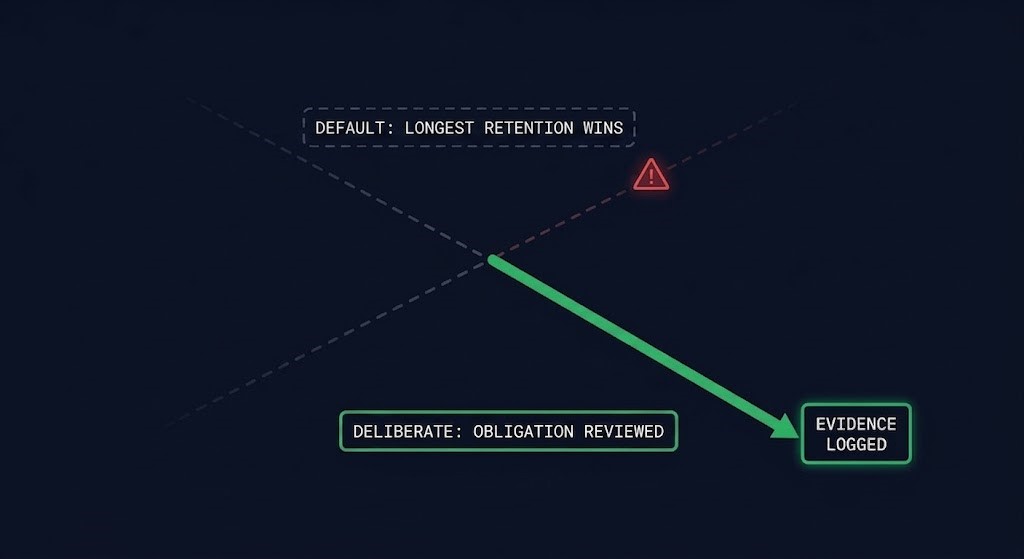
- Evidence trail — proof the precedence decision was made deliberately, and by whom, the same evidentiary standard rack2cloud’s own Recovery Evidence Boundary framework applies to recovery claims generally: a decision without an independent record of who made it and why isn’t a decision an auditor can trust, it’s an assertion. [Restore Evidence](/restore-evidence/) makes the same point from the recovery side — evidence that isn’t captured at decision time doesn’t exist later when someone asks for it.

None of this exists natively in backup platforms today, and it’s not obviously backup architecture’s job to build it alone — this is closer to a records-governance or data-classification layer that backup, archival, and primary storage systems would all need to consult. But until that layer exists somewhere in the stack, every backup platform executing a retention schedule against regulated data is making an arbitration decision by default, whether anyone intended it to or not. The default is usually “the longer retention wins” or “the most recent policy wins” — neither of which is a legal judgment, both of which are accidents of configuration order.
The same governance-and-assurance concerns appear throughout the Governance & Recovery Assurance learning-path stage, where authority over recovery decisions becomes as important as recovery execution itself — the same shift retention conflict architecture demands for retention decisions.
Retention Conflict Architecture Is Not a Compliance Checklist Item
The instinct when this surfaces is to treat it as a compliance gap — write a better retention policy, add a legal-hold procedure to the runbook, get sign-off from counsel. Those steps help, but they don’t touch the actual architectural gap, which is that the infrastructure layer executing retention has no structural place to record obligation precedence at all. A better policy document doesn’t give the platform anything new to check against before it acts. The policy lives in a wiki. The platform still only knows how to run a timer.
Architect’s Verdict
Retention conflict architecture appears when a platform designed to execute a single retention schedule becomes the enforcement point for multiple legal obligations with competing outcomes on the same record. The failure is not that retention rules are missing — most enterprises have more retention policy than they know what to do with. The failure is that the architecture has no mechanism to determine which obligation takes precedence when those rules collide, because it was never given the metadata to know a collision was happening in the first place.
What most people miss about retention conflict architecture is that it isn’t a legal problem wearing an infrastructure costume. It’s a genuine architecture gap: the platform stores duration, not authority. Fixing the policy doesn’t fix the platform. Until obligation precedence is something the infrastructure can evaluate — not just something counsel can explain after the fact — every backup system enforcing a retention schedule against regulated data is arbitrating law by accident.
A schedule can tell you when. It has never been able to tell you which.
Additional Resources
Editorial Integrity & Security Protocol
This technical deep-dive adheres to the Rack2Cloud Deterministic Integrity Standard. All benchmarks and security audits are derived from zero-trust validation protocols within our isolated lab environments. No vendor influence.

R.M.
Senior Solutions Architect with 25+ years of experience in HCI, cloud strategy, and data resilience. As the lead behind Rack2Cloud, I focus on lab-verified guidance for complex enterprise transitions. View Credentials →
Get the Playbooks Vendors Won’t Publish
Choose the architecture problems you care about. Get field-tested playbooks and frameworks delivered to your inbox.
- > AI Infrastructure & Inference Economics
- > Cloud Strategy & Hidden Cost Models
- > Virtualization & Deterministic Migration
- > Kubernetes, IaC & Modern Infrastructure
- > Data Protection & Recovery Engineering
Zero spam. Includes The Dispatch weekly drop.
Need Architectural Guidance?
Independent review before major infrastructure decisions.
- > Validate assumptions
- > Identify hidden dependencies
- > Quantify migration risk
- > Challenge vendor narratives
Triage · Advisory · Fractional · Direct Hire